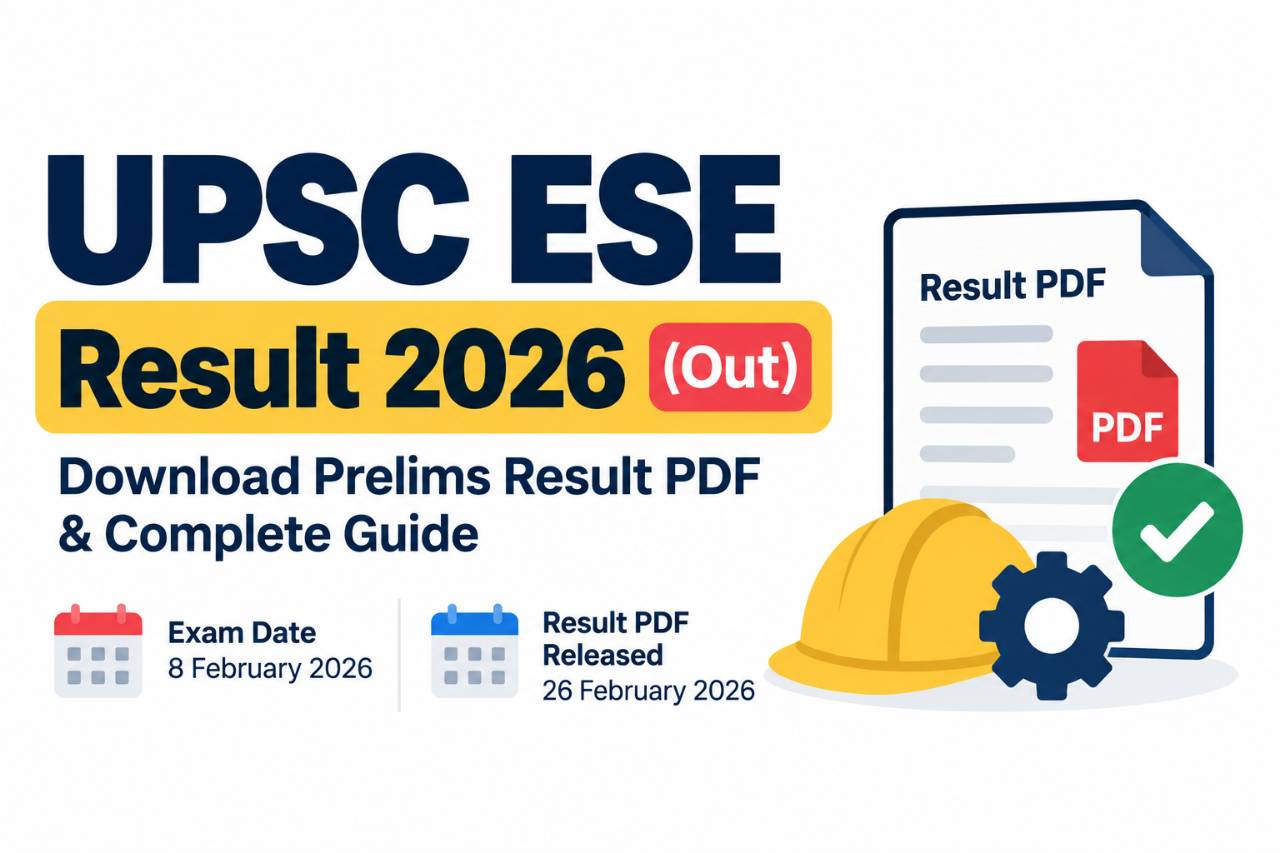
The UPSC ESE Result 2026 for the Engineering Services Examination (also known as IES Indian Engineering Services) is one of the most awaited announcements for B.Tech and B.E. graduates aiming for prestigious government Engineering posts across India. Conducted by the Union Public Service Commission (UPSC), this National-level exam recruits engineers into Central Government departments, Public Sector Undertakings (PSUs), and allied services in disciplines such as Civil, Mechanical, Electrical, and Electronics & Telecommunication Engineering.
Unlike many entrance exams that show individual scores immediately, UPSC typically publishes ESE results as PDF files containing roll numbers of qualified candidates. Whether you appeared for Prelims in the current cycle or are planning ahead, understanding how results are declared, where to download them, and what happens after qualification can save valuable time and reduce anxiety during the selection process.
In this comprehensive guide, we break down every stage of the UPSC ESE result process from Prelims to the Final merit list along with marking schemes, cut-off trends, interview preparation, and actionable next steps for successful candidates.
What Is UPSC ESE (Engineering Services Examination)?
The UPSC Engineering Services Examination is a three-stage competitive exam designed to select technically qualified engineers for Group A and Group B posts in organisations such as Indian Railways, CPWD, BRO, MES, Central Water Commission, and various ministries. It is often compared with the Civil Services Examination (CSE), but ESE is exclusively for engineering graduates and focuses heavily on technical knowledge alongside general aptitude.
Who Can Appear for UPSC ESE?
Eligibility is strict: candidates must hold a B.E./B.Tech degree in an eligible engineering discipline from a recognised university. Integrated engineering programmes and degrees from institutions established under Acts of Parliament or state legislatures generally qualify, while non-engineering degrees do not. Students pursuing B.Tech at institutions like Ims Engineering College or Ims Unison University should confirm that their specialisation matches one of the four ESE streams before registering.
Unlike creative or design-focused pathways such as the Nift Entrance Exam, which leads to fashion and design careers, UPSC ESE is purely for engineers seeking structured technical roles in government service. Both represent high-stakes National exams, but the preparation strategy, syllabus, and career outcomes differ significantly.
UPSC ESE Result 2026: Key Highlights at a Glance
- Conducting body: Union Public Service Commission (UPSC)
- Official websites: upsc.gov.in and upsconline.nic.in
- Result format: PDF listing roll numbers (Prelims/Mains); Final result includes names, subjects, and marks of recommended candidates
- Selection stages: Preliminary Exam → Main Exam → Personality Test (Interview)
- Total marks for final merit: Mains (600) + Personality Test (200) = 800 marks; Prelims is qualifying in nature
- Negative marking: Applicable only in the Preliminary stage
- Cut-off release: Category-wise cut-offs published after the complete recruitment cycle
Candidates who score equal to or above the minimum cut-off marks set by UPSC in each stage progress to the next round. Final appointment depends on vacancies notified for that year, category reservation, medical fitness, and document verification.
Stages of UPSC ESE Result Declaration
UPSC releases the ESE result in three distinct stages. Each stage serves a different purpose in the multi-tier selection framework. Understanding this sequence helps candidates track their progress and prepare for upcoming phases without missing critical deadlines.
Stage 1: UPSC ESE Prelims Result
The Preliminary examination acts as a screening test. UPSC publishes the Prelims result as a PDF containing roll numbers of candidates who have cleared the minimum qualifying standards. The Prelims result does not carry forward marks to the final merit; it only determines eligibility for the Main Examination.
Typically, UPSC releases the Prelims result in two sets over a few days: the first PDF lists roll numbers only, and a subsequent notification may include roll numbers along with candidate names. Always download and save both documents for your records.
Stage 2: UPSC ESE Mains Result
Candidates who qualify Prelims appear for the descriptive Main Examination, which tests in-depth engineering knowledge through conventional (written) papers. The Mains result PDF lists roll numbers of candidates shortlisted for the Personality Test. Performance in Mains carries significant weight because these marks form the core of the final merit calculation.
Stage 3: UPSC ESE Final Result
After the Personality Test (Interview), UPSC declares the Final Result. This document includes the names, roll numbers, engineering disciplines, and marks of recommended candidates. Marks of recommended candidates covering Mains and Interview components are released separately after the final result announcement. Successful candidates are allotted services and cadres based on merit, preferences, and available vacancies.
UPSC ESE Result 2026: Important Dates
Exact result dates are announced by UPSC after each examination. The table below reflects the typical examination calendar; always verify current dates on the official notification.
| Event | Expected Timeline |
|---|---|
| UPSC ESE Preliminary Examination | Usually January (Sunday) |
| Prelims Result Declaration | Approx. 6–10 weeks after Prelims |
| UPSC ESE Main Examination | Usually June |
| Mains Result Declaration | Approx. 2–3 months after Mains |
| Personality Test (Interview) | After Mains result; schedules sent individually |
| Final Result & Service Allocation | After completion of all interviews |
| Category-wise Cut-off Marks | After entire recruitment process concludes |
| Official Prelims Answer Key | After final result (objection window may apply) |
Actionable tip: Bookmark upsc.gov.in and enable notifications for the "What's New" section. UPSC rarely sends individual SMS alerts for result publication; proactive checking is essential.
How to Check and Download UPSC ESE Prelims Result 2026
Follow these steps immediately after UPSC announces the Prelims result. The process is straightforward but requires attention to detail when searching your roll number in a lengthy PDF.
- Visit the official UPSC website at upsc.gov.in or upsconline.nic.in.
- Navigate to the Examination tab and click on Active Examinations, or check the homepage under What's New.
- Look for the link titled Engineering Services (Preliminary) Examination, 2026 (or the relevant year).
- Click on the result notification link to open the PDF download page.
- Download the UPSC ESE Prelims Result PDF to your device.
- Press Ctrl + F (or Cmd + F on Mac) and type your roll number to search within the document.
- If your roll number appears, you have qualified for the Main Examination. Save and print the PDF for future reference.
- If not listed, review the official answer key (when released) and cut-off marks to evaluate your performance.
Common mistake to avoid: Do not rely on third-party websites that claim to show results by name alone. Always verify against the official UPSC PDF to prevent misinformation or phishing attempts.
Details Mentioned in the UPSC ESE Result PDF
The information available in result documents varies by stage:
- Prelims/Mains Result PDF: Roll numbers of qualified candidates; sometimes names in a supplementary list
- Final Result PDF: Name, roll number, engineering branch, and recommendation status
- Marks Sheet (post-final result): Mains marks, Interview marks, and total for recommended candidates
UPSC does not display individual Prelims scores in the initial result notification. Detailed marks for non-recommended candidates may be available through the marks disclosure process after the entire examination cycle ends.
UPSC ESE Prelims Marking Scheme
Understanding the marking scheme helps candidates estimate scores using answer keys and plan exam-day strategy. The Preliminary stage comprises two objective papers conducted in offline OMR mode.
| Paper | Subject | Questions | Duration | Maximum Marks |
|---|---|---|---|---|
| Paper 1 | General Studies & Engineering Aptitude | 100 | 2 Hours | 200 |
| Paper 2 | Engineering Discipline (Civil/Mechanical/Electrical/ECE) | 150 | 3 Hours | 300 |
| Total | 250 | 5 Hours | 500 | |
Negative marking: One-third (1/3) of the marks assigned to a question is deducted for each incorrect answer. Unattempted questions carry no penalty. This makes accuracy as important as speed during Prelims.
UPSC ESE Mains Marking Scheme
The Main Examination is descriptive and tests analytical depth, problem-solving ability, and subject mastery. Each paper presents eight questions; candidates must attempt any five.
| Paper | Format | Duration | Maximum Marks |
|---|---|---|---|
| Paper I | Engineering Discipline (5 out of 8 questions) | 3 Hours | 300 |
| Paper II | Engineering Discipline (5 out of 8 questions) | 3 Hours | 300 |
| Total Mains Marks | 6 Hours | 600 | |
The Personality Test carries 200 marks with no prescribed minimum qualifying score, though UPSC expects satisfactory performance. Final merit is prepared using Mains and Interview marks only; Prelims serves as a qualifying filter.
What to Do After the UPSC ESE Prelims Result Is Declared
Qualifying Prelims is a major milestone, but the most demanding phase Mains preparation begins immediately. Here is a structured action plan:
Immediate Steps (Within 48 Hours)
- Download and securely store your result PDF and UPSC admit card copies.
- Check the official website for Mains application or admission certificate instructions (DAF Detailed Application Form if required).
- Note the Main Examination date, centre city, and reporting time from the revised admit card.
- Begin transitioning from objective MCQ practice to descriptive answer writing.
Mains Preparation Strategy
Shift focus to conventional topics: derivations, design problems, numerical exercises, and diagram-based questions. Previous years' Mains papers are the single most valuable resource. Join a test series if possible, and get your answers evaluated by mentors or peers familiar with UPSC's expected depth.
Engineering graduates from universities such as Assam Down Town University and other regional institutions often balance final-semester projects with ESE preparation. Create a weekly timetable that allocates at least 6–8 hours daily to technical subjects, with dedicated slots for Paper 1 (General Studies & Engineering Aptitude) revision.
If You Did Not Qualify Prelims
Analyse unofficial answer keys released by coaching institutes on exam day. Identify weak topics, recalibrate your study plan, and consider attempting the next cycle. Many successful ESE officers required multiple attempts; consistent improvement matters more than a single setback.
UPSC ESE Personality Test (Interview)
Candidates clearing Mains receive call letters for the Personality Test at UPSC headquarters in New Delhi (or designated centres). The 200-mark interview assesses qualities beyond textbook knowledge:
- Leadership potential and initiative
- Intellectual curiosity and awareness of current affairs
- Tact, social skills, and communication clarity
- Mental and physical energy
- Powers of practical application in engineering contexts
- Integrity, honesty, and ethical judgment
Prepare a concise self-introduction covering your engineering background, final-year project, internships, and motivation for government service. Review your DAF thoroughly board members often ask questions based on information you submitted. Stay updated on national infrastructure projects, budget allocations for engineering departments, and recent policy developments.
UPSC ESE Final Result and Service Allocation
The Final Result consolidates performance across Mains and Interview stages. Recommended candidates are allotted services such as Indian Railway Service of Engineers (IRSE), Central Engineering Service (CES), Military Engineer Services (MES), Survey of India, and others depending on vacancy, merit rank, category, and candidate preferences submitted during counselling.
Document verification, medical examination, and training at academies like the Railway Staff College or equivalent follow service allocation. Treat the period between Final Result and joining as an opportunity to build domain knowledge relevant to your allotted cadre.
Understanding UPSC ESE Cut-Off Marks
UPSC releases category-wise cut-off marks after the entire recruitment process concludes. Cut-offs represent the minimum marks secured by the last recommended candidate in each category and are published separately for Prelims (qualifying), Mains, and Final stages.
Key points about ESE cut-offs:
- Cut-offs vary each year based on paper difficulty, number of vacancies, and candidate performance.
- Prelims cut-off is typically a fraction of 500 marks and differs for General, OBC, SC, ST, and EWS categories.
- Final cut-off reflects combined Mains and Interview performance (out of 800).
- Historical cut-off analysis helps set realistic targets but should not replace syllabus-focused preparation.
UPSC ESE Answer Key: Official vs Unofficial
Coaching institutes such as Made Easy, IES Master, and GATE Forum release unofficial Prelims answer keys within hours of the examination. These are useful for immediate score estimation but may contain errors.
UPSC publishes the official Prelims answer key after the complete recruitment cycle, often with an objection window allowing candidates to challenge specific questions with supporting evidence. Always rely on the official key for final score calculation and cut-off comparison.
Building the Right Foundation: Engineering Education and Career Choices
Success in UPSC ESE begins long before you fill the application form. A rigorous B.Tech programme with strong fundamentals in core subjects structural analysis, thermodynamics, network theory, or control systems depending on your branch creates the academic base ESE demands.
Students evaluating college options should prioritise AICTE-approved programmes, experienced faculty, and laboratory infrastructure. Institutions like Ims Engineering College and Ims Unison University represent pathways where engineering undergraduates can simultaneously build technical depth and explore competitive exam preparation.
Not every engineering graduate pursues government service. Some prefer private-sector roles, entrepreneurship, or postgraduate management studies. For those leaning toward business leadership rather than technical cadre posts, programmes at Ims Management College offer an alternative trajectory. Choosing between ESE, GATE, PSUs, or an MBA is a personal decision shaped by career goals, risk tolerance, and long-term lifestyle preferences.
North-eastern candidates benefit from growing access to quality technical education through universities like Assam Down Town University, reducing the need to relocate solely for undergraduate engineering. Wherever you study, start ESE-oriented preparation early final-year crunch time is rarely sufficient for a first-attempt success.
Expert Preparation Tips for UPSC ESE Aspirants
- Master the standard syllabus: UPSC ESE follows a defined syllabus for each branch. Map every topic to standard reference books used by GATE and ESE toppers.
- Solve previous years' papers: At least 10 years of Prelims and Mains papers reveal recurring concepts and question patterns.
- Balance Paper 1 and Paper 2: Engineering Aptitude and General Studies in Paper 1 are often underestimated; they can differentiate qualifiers from non-qualifiers.
- Practice OMR discipline: Simulate exam conditions with timed mock tests to manage negative marking effectively.
- Develop answer-writing speed for Mains: Quality diagrams, neat calculations, and structured introductions earn marks in descriptive papers.
- Stay medically and mentally fit: The selection process spans months; burnout is a real risk without scheduled breaks and physical activity.
- Read engineering current affairs: Follow developments in renewable energy, smart cities, railway modernisation, and national infrastructure missions.
- Join peer study groups: Collaborative problem-solving accelerates learning and keeps motivation high during long preparation cycles.
Conclusion
The UPSC ESE Result 2026 marks a pivotal moment for thousands of engineering graduates across India who aspire to serve the nation through technical leadership in government organisations. Results are published transparently on upsc.gov.in as PDF documents listing qualified roll numbers at each stage Prelims, Mains, and Final with comprehensive marks disclosed for recommended candidates after the complete cycle.
Whether you have just found your roll number in the Prelims PDF or are planning your first attempt, success rests on disciplined preparation, accurate understanding of the marking scheme, and strategic progression through each selection stage. Download official documents promptly, ignore unverified third-party result portals, and channel your energy into the next phase of preparation.
Engineering Services offer stable careers, meaningful public-impact projects, and the opportunity to contribute to India's infrastructure growth. With the right academic foundation, consistent effort, and clarity about the result process outlined in this guide, you can navigate the UPSC ESE journey with confidence and purpose.
For the latest updates on result dates, admit cards, and official notifications, continue monitoring upsc.gov.in and refer to trusted educational resources that summarise government exam timelines without replacing official announcements. Share this guide with fellow B.Tech aspirants preparing alongside campus placements or GATE so everyone stays informed about where and how ESE results are published each year.