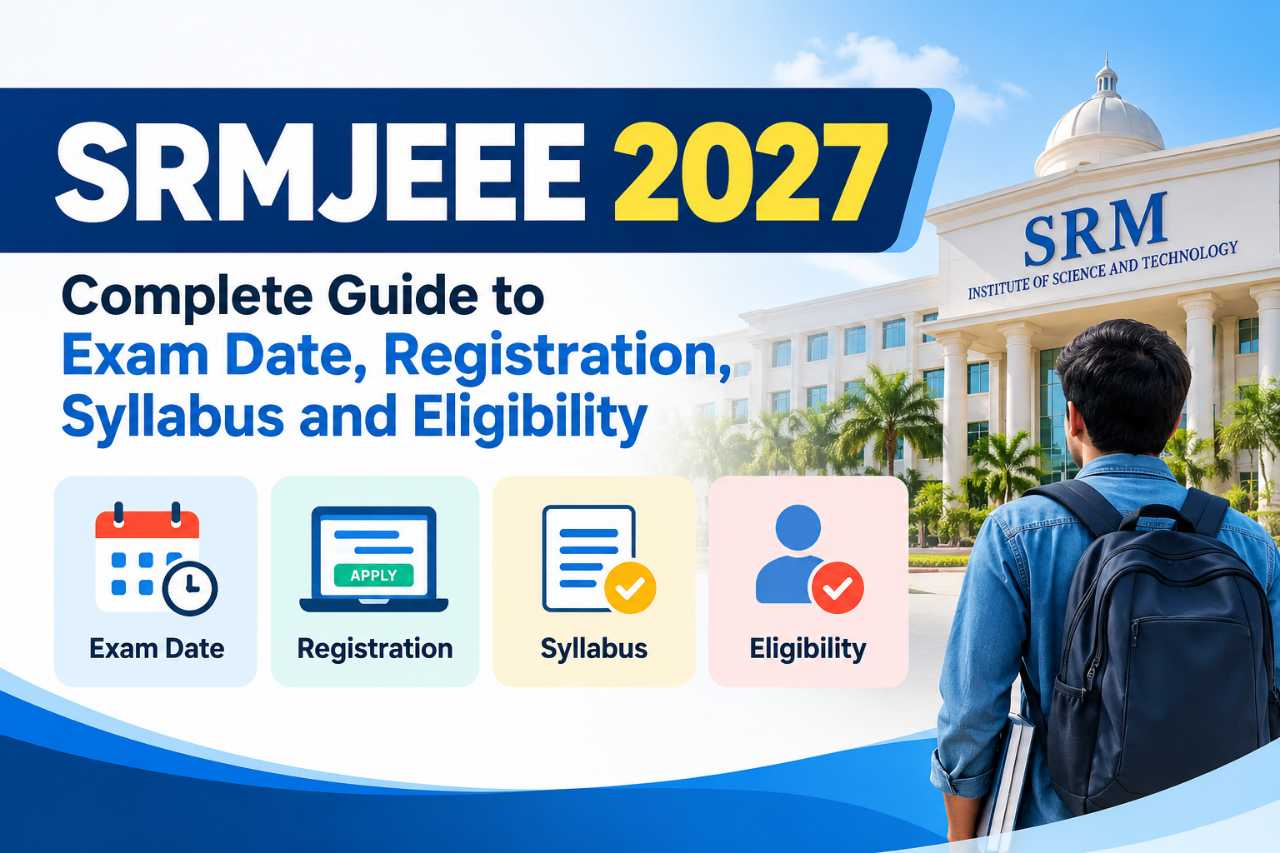
The SRM Joint Engineering Entrance Examination (SRMJEEE) 2027 is one of the most sought-after private engineering entrance exams in India. Conducted by SRM institute of Science and Technology (SRMIST), it opens doors to B.Tech and related programmes at multiple campuses in Tamil Nadu, Andhra Pradesh, Delhi-NCR, and other locations. If you are in Class 12 (or have recently completed it) and want a structured path into quality engineering education without relying only on JEE Main, understanding SRMJEEE end to end is essential.
Based on recent admission cycles, SRMIST typically opens Phase 1 registration around October 2026, with exam dates and counselling schedules announced on the official portal srmist.edu.in. The test is held in online mode, often as a remote proctored online test (RPOT), which means you can attempt it from a suitable location while meeting technical and identity checks. There is no negative marking, and each correct answer usually carries one mark a scoring pattern that rewards accuracy and steady preparation.
This CollegeDwar guide explains SRMJEEE 2027 dates, eligibility, registration, admit card, pattern, syllabus, preparation, results, counselling, and expected cutoffs. Information is aligned with official SRMIST practices and publicly reported trends; always confirm final dates on the official website before you pay fees or book slots.
What Is SRMJEEE and Who Conducts It?
SRMJEEE is the university-level entrance examination used for admission to undergraduate engineering programmes at SRMIST and affiliated SRM universities. Unlike a single national counselling body, SRM runs its own application, examination, result, and seat allotment process. Successful candidates may choose campus and branch preferences during counselling, subject to rank, category, and seat availability.
Popular destinations include the main Kattankulathur (Chennai) campus often explored via our profile of SRM Institute of Science and Technology Chennai along with Ramapuram, Vadapalani, Tiruchirappalli, NCR, SRM University AP Amaravati, and SRM University Sonepat. For a broader view of programmes and infrastructure, see SRM University Engineering.
Why Students Choose SRMJEEE
- Multiple exam phases: Phase 1 and later phases give you more than one attempt within the admission season if you register as per rules.
- No negative marking: You can attempt all questions without losing marks for wrong answers a useful edge if you manage time well.
- NCERT-aligned syllabus: Physics, Chemistry, and Mathematics (or Biology for Biotechnology) largely follow Class 11–12 boards, similar in spirit to JEE Main preparation.
- Pan-India campuses: One exam score can feed counselling for several campuses, helping you compare location, fees, and branch options.
SRMJEEE 2027 Important Dates (Expected Timeline)
SRMIST releases the final calendar on srmist.edu.in. Until the 2027 notification is live, use the table below as a planning checklist based on prior years. Mark “TBA” items and subscribe to official alerts.
| Event | Expected Window |
|---|---|
| Application form availability (Phase 1) | October 2026 |
| Last date to apply (Phase 1) | To be announced |
| Slot booking and hall ticket | To be announced |
| Official mock test | To be announced |
| SRMJEEE Phase 1 exam | To be announced |
| Result declaration | To be announced |
| Counselling registration and choice filling | To be announced |
| Seat allotment and fee payment | To be announced |
Action tip: Complete registration early in the window. Late applications may miss preferred slot booking windows, and popular exam dates fill quickly on the Online Test Booking System (OTBS).
SRMJEEE 2027 Eligibility Criteria
Before you pay the application fee, verify that you meet nationality, age, and academic requirements. SRMIST may refine criteria in the official brochure; the points below reflect the standard rules used in recent cycles.
Nationality and Candidate Category
- Indian citizens
- Non-Resident Indians (NRIs)
- Persons of Indian Origin (PIO) and Overseas Citizen of India (OCI) cardholders
- International students, as per university guidelines
Age Limit
Candidates should be at least 16 years and 6 months old as on 31 July 2027, in the same year they complete (or have completed) the Class 12 board examination. If your date of birth is close to the cut-off, calculate age precisely before applying.
Educational Qualification
You must have passed or appeared in Class 12 (or equivalent) from a recognised board. For most B.Tech streams, a minimum of 60% aggregate marks in relevant subjects (Physics, Chemistry, Mathematics/Biology as applicable) is required. Biotechnology applicants typically take Biology instead of Mathematics in the exam.
Example: A CBSE student targeting Computer Science Engineering should aim for strong PCM scores in boards and in SRMJEEE, because high-demand branches see tighter closing ranks at campuses like Kattankulathur.
SRMJEEE 2027 Registration and Application Fee
The SRMJEEE 2027 application is submitted online only. The process generally includes registration, form filling, document upload, phase selection, and fee payment.
Documents and Details You Will Need
- Valid mobile number and personal email ID (used for all login and result communication)
- Class 10 and 12 marks/details, board name, and year of passing
- Parent or guardian details
- Recent passport-size photograph and signature scan (as per size and format rules in the brochure)
- Campus and programme preferences, where the form asks for them
Application Fee
The application fee is typically ₹1,400 (confirm in the live notification). Payment is made through the gateway listed on the portal. Keep the payment receipt and confirmation page for counselling and future reference.
SRMJEEE 2027 Slot Booking and Admit Card
After successful registration, eligible candidates complete slot booking through the OTBS. Slot booking lets you pick an exam date, time, and shift from available options. Once confirmed, the system generates your admit card (hall ticket).
Admit Card Essentials
- Download only from the official SRMIST login avoid third-party “hall ticket” sites.
- Check name spelling, photograph, exam date, and reporting instructions.
- For centre-based exams, note address and reporting time; for RPOT, read laptop, webcam, and internet requirements carefully.
- Carry a printout (often colour) and valid photo ID as listed in the admit card.
SRMJEEE 2027 Exam Pattern
Knowing the pattern helps you build a mock-test routine. The exam is objective type with four options per question and a single correct answer.
| Particulars | Details |
|---|---|
| Mode | Online (including remote proctored options as notified) |
| Duration | 2 hours 30 minutes |
| Language | English |
| Total questions | 130 |
| Total marks | 130 |
| Question type | Multiple Choice Questions (MCQs) |
| Marking scheme | +1 for each correct answer |
| Negative marking | None |
Subject-Wise Question Distribution
| Section | Questions | Marks |
|---|---|---|
| Physics | 35 | 35 |
| Chemistry | 35 | 35 |
| Mathematics or Biology | 40 | 40 |
| English and Aptitude | 20 | 20 |
Time management tip: With 130 questions in 150 minutes, you have a little over one minute per question. English and Aptitude sections can be high-scoring if you practice comprehension, basic grammar, and logical reasoning regularly do not leave them for the last week.
SRMJEEE 2027 Syllabus Overview
The SRMJEEE syllabus is largely drawn from NCERT Class 11 and Class 12 Physics, Chemistry, Mathematics (or Biology), plus English and Aptitude. Download the official syllabus PDF when SRMIST publishes it and tick topics off as you revise.
Physics (Illustrative Topics)
- Units and Measurement, Motion, Laws of Motion, Work, Energy and Power
- Mechanical Properties of Solids and Fluids, Thermodynamics
- Oscillations and Waves, Electrostatics, Current Electricity
- Magnetism, Electromagnetic Induction, Optics, Modern Physics
Chemistry (Illustrative Topics)
- Atomic structure, chemical bonding, states of matter, thermodynamics
- Equilibrium, redox reactions, electrochemistry
- Organic chemistry fundamentals, hydrocarbons, functional groups
- Coordination compounds and biomolecules (as per NCERT scope)
Mathematics (Illustrative Topics)
- Sets, relations and functions, complex numbers, matrices and determinants
- Trigonometry, limits, continuity and differentiability, applications of derivatives
- Integrals, differential equations, coordinate geometry, probability
English and Aptitude
Expect reading comprehension, vocabulary, grammar, and aptitude items such as pattern recognition, data interpretation, and logical reasoning. These 20 marks are often the fastest to improve with daily practice.
Preparation Strategy for SRMJEEE 2027
A balanced plan works better than cramming one subject. Most toppers align SRM prep with board exams and optionally with JEE Main study material, then add SRM-specific mock tests.
Step-by-Step Study Plan
- Week 1–2: Read the official syllabus and exam pattern; collect NCERT textbooks and one good MCQ book per subject.
- Month 1–3: Complete concept revision for Class 11 topics, then Class 12, with chapter-wise tests.
- Month 4 onward: Take full-length mocks under timed conditions; analyse weak chapters after every mock.
- Final month: Revise formulas, reaction mechanisms, and standard results; attempt the official SRM mock test if released.
Recommended Books (Reference List)
- Physics: NCERT, Concepts of Physics by H.C. Verma, Understanding Physics by D.C. Pandey
- Chemistry: NCERT, Physical Chemistry by P. Bahadur, Organic Chemistry by O.P. Tandon / Himanshu Pandey
- Mathematics: NCERT, Objective Mathematics by R.D. Sharma, Cengage or Arihant practice sets
If you are also exploring design or other entrance paths, keep alternate exams on your radar such as NIFT Entrance Exam or NID DAT but stay focused on PCM depth for engineering.
Mock Tests and Sample Papers
SRMIST usually provides an official mock test link on srmist.edu.in before the exam. Treat it as mandatory: it mirrors timing, navigation, and question style. Supplement with previous-year-style sample papers from reputable coaching sources (unofficial but useful for practice). Because there is no negative marking, practice full-paper attempts where you attempt every question you can solve, then guess intelligently on remaining items only if time permits.
SRMJEEE 2027 Result and Rank
Results are published online on the official portal. Log in with the credentials created during registration (typically email and password). The scorecard reflects your performance across sections and your overall rank used for counselling. Download and save multiple copies; you will need rank details for choice filling and scholarship queries.
SRMIST generally does not release an official answer key. Coaching institutes may publish unofficial keys use them only for rough estimates, not final decisions.
Counselling, Seat Allotment, and Admission
Counselling is the gateway to a confirmed seat. Shortlisted candidates register for counselling, pay the counselling fee if applicable, enter branch-campus choices in order of preference, and participate in seat allotment rounds.
Typical Counselling Flow
- Online counselling registration and document verification as instructed
- Choice filling and locking (double-check order first preference matters most)
- Seat allotment based on rank, category, and availability
- Provisional acceptance and payment of tuition/hostel fees within deadlines
- Physical or online reporting to the allotted campus with original certificates
Branches like Computer Science Engineering historically require stronger ranks at the Chennai campus than many other programmes. Use past cutoffs as guidance, not guarantees.
SRMJEEE Cutoff Trends (Previous Years)
Cutoffs are expressed as closing ranks per campus, course, and category. They change every year with paper difficulty, seat intake, and applicant volume.
Indicative Closing Ranks – SRM Chennai (KTR) – Recent Trends
| Programme | Approximate Closing Rank Range |
|---|---|
| Computer Science Engineering | 8,000 – 10,500 (varies by year) |
| Electronics and Communication Engineering | 22,000 – 27,000 |
| Electrical and Electronics Engineering | 25,000 – 40,000 |
| Biotechnology Engineering | 43,000 – 48,000 |
| Civil / Chemical Engineering | 58,000 – 70,000 |
If your rank is near a branch cutoff, participate in all counselling rounds you are eligible for and keep realistic backup options across Amravati, NCR, and other campuses.
Participating Institutes and Campus Choice
SRMJEEE scores feed admission across multiple institutions under the SRM group, including:
- SRM Institute of Science and Technology, Kattankulathur (Chennai)
- SRM IST campuses: Ramapuram, Vadapalani, Tiruchirappalli, NCR
- SRM University AP, Amaravati
- SRM University, Sikkim
- SRM University, Delhi-NCR, Sonepat
Compare placement reports, campus facilities, and fee structures on CollegeDwar before locking choices. Students interested in other SRM verticals for example management or health sciences can explore related profiles such as SRM University Management, SRM Dental College Chennai, or SRM College of Nursing Chennai separately, as those may follow different admission routes.
SRMJEEE vs Other Engineering Entrances
Many students sit SRMJEEE alongside state exams or JEE Main. JEE Main feeds NITs, IIITs, and GFTIs; SRMJEEE feeds SRM campuses exclusively. JEE Advanced is only for IITs after qualifying Main. Keeping a calendar that lists each exam’s registration and test date prevents fee waste and burnout.
Remote Proctored Test (RPOT): What to Prepare
When SRMIST conducts SRMJEEE as a remote proctored online test, your exam room becomes part of the process. Read the instruction booklet before mock tests so you are not surprised on exam day.
Technical and Environment Checklist
- Use a laptop or desktop with a stable broadband connection; avoid mobile-only setups unless explicitly allowed.
- Install or update the test browser or application mentioned in the admit card, and disable unnecessary background apps.
- Ensure webcam and microphone work; proctors may ask you to show ID and scan the room.
- Choose a quiet, well-lit space with a clear desk no unauthorized books, notes, or second screens unless permitted.
- Keep a valid photo ID, admit card, and charged device power backup ready before login time.
Run the official mock test on the same device and network you plan to use for the real exam. If your connection drops, follow the helpline steps on the admit card immediately rather than restarting on your own.
Scholarships and Fee Planning
SRM campuses advertise merit and category-based scholarships that may consider SRMJEEE rank, board marks, or other criteria published each year. Scholarship rules change between admission cycles, so download the current prospectus from srmist.edu.in and note application deadlines separately from counselling dates. Even if you target a scholarship, block a seat in counselling within the stipulated time seat acceptance deadlines are strict, and missing them can forfeit an allotted branch regardless of rank.
Compare total cost of attendance (tuition, hostel, transport, and personal expenses) across campuses. A slightly lower rank at SRM Amaravati or Sonepat may still deliver strong outcomes for your branch if you engage early with internships and projects; treat campus choice as a fit problem, not only a prestige label.
Documents for Counselling and Reporting
Keep originals and photocopies organized in a single folder before allotment results appear. Typical documents include Class 10 certificate for date of birth, Class 12 mark sheet and pass certificate, SRMJEEE scorecard, admit card, category certificate (if applicable), transfer or migration certificate when requested, and passport-size photographs. NRI or international categories may need additional proof of status. Arriving at reporting without one critical certificate can delay enrollment, so verify the campus-specific checklist in your allotment letter.
Common Mistakes to Avoid
- Wrong subject selection: Biotechnology candidates must choose Biology instead of Mathematics; errors here can invalidate your attempt for the intended programme.
- Ignoring English and Aptitude: Twenty marks can shift your rank when PCM scores cluster together practice these sections weekly.
- Late slot booking: Desirable dates fill fast; register and book as soon as OTBS opens.
- Typos in the application form: Name and date of birth must match board records and ID proofs used at the exam.
- Skipping official mocks: Interface familiarity reduces stress and saves minutes during the real test.
Conclusion
SRMJEEE 2027 is a practical route into established engineering programmes at SRMIST and partner campuses, with a student-friendly marking scheme and multiple admission phases. Start by confirming eligibility (especially age and 60% aggregate norms), register early on srmist.edu.in, book your slot promptly, and prepare with NCERT-first revision plus timed mocks. Track results and enter counselling choices strategically, using past closing ranks as a benchmark. For campus-level details, continue your research on CollegeDwar profiles like SRM Institute of Science Technology Chennai and stay updated when SRMIST releases the official 2027 notification.