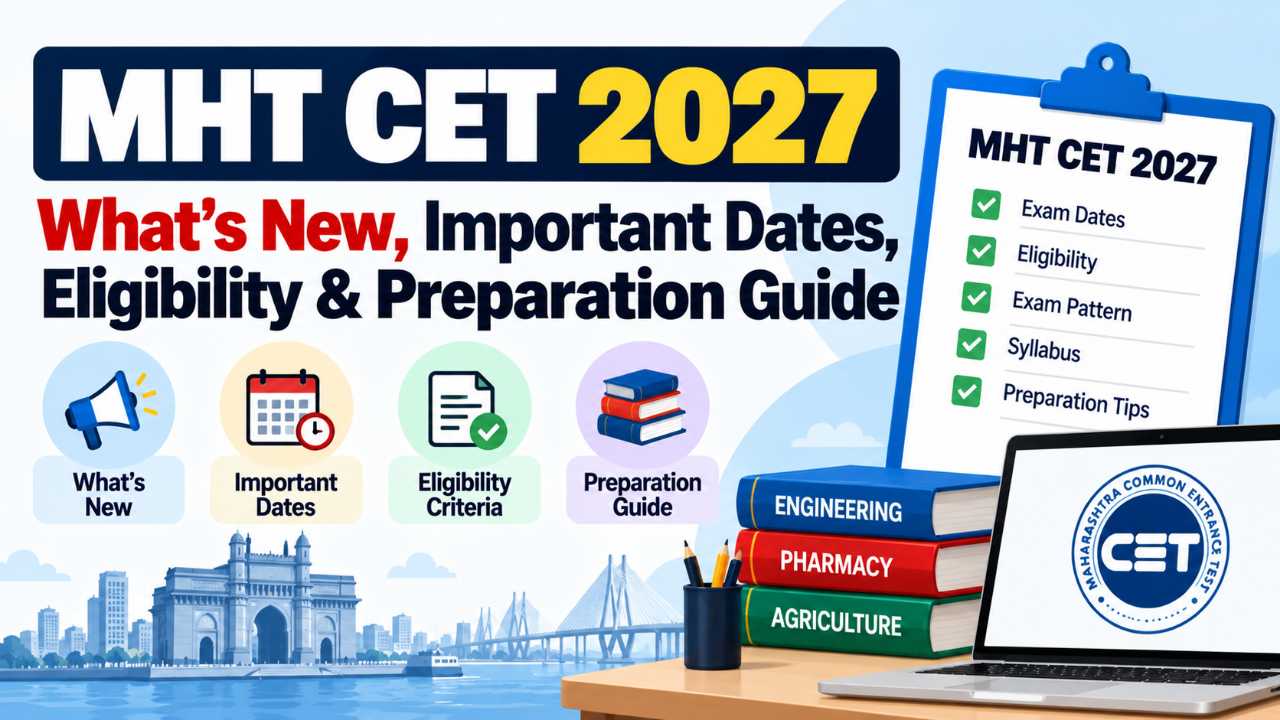

If you are a Class 12 student in Maharashtra—or planning to study engineering or pharmacy in the state—the Maharashtra Common Entrance Test (MHT CET) is one of the most important exams on your calendar. Conducted by the State Common Entrance Test Cell, Maharashtra, MHT CET opens doors to B.E./B.Tech, B.Pharm, Pharm.D, and other eligible undergraduate programmes through the Centralised Admission Process (CAP). For a structured overview of the exam, bookmark the MHT CET exam hub on CollegeDwar.
The MHT CET 2027 notification is expected on the official portal cetcell.mahacet.org, with registration likely beginning around October 2026. The exam is usually held in two sessions after board exams, tentatively in March and May 2027. Until the brochure is released, treat dates as indicative and verify every deadline on the CET Cell website.
This article explains what is new for 2027 aspirants, the full admission timeline, eligibility, exam pattern for PCM and PCB groups, syllabus strategy, counselling, and actionable preparation tips—written for students and parents in clear, exam-focused language aligned with Google’s helpful content and E-E-A-T expectations.
MHT CET 2027 at a Glance: Highlights Every Aspirant Should Know
Before you register, lock these facts in memory. They also answer many “People Also Ask” queries that search engines surface in AI Overviews.
| Particulars | Details |
|---|---|
| Full exam name | Maharashtra Common Entrance Test (MHT CET) |
| Conducting body | State Common Entrance Test Cell, Maharashtra |
| Application mode | Online only |
| Exam mode | Computer-Based Test (CBT) at allotted centres |
| Exam groups | PCM (Physics, Chemistry, Mathematics) and PCB (Physics, Chemistry, Biology) |
| Attempts | Two sessions per year (expected for 2027) |
| Official website | cetcell.mahacet.org |
| Typical use | Engineering, pharmacy, and related UG admissions via CAP in Maharashtra |
What’s “new” for 2027? As of now, the CET Cell has not published a separate overhaul announcement; the exam continues as a state-level MCQ test aligned largely with the Maharashtra State Board syllabus. What changes year to year are dates, fees, mock-test windows, and CAP rules—not necessarily the core subject mix. Always download the official information brochure when it appears; that document is the single source of truth for eligibility tweaks and admission policies.
MHT CET 2027 Important Dates (Expected Timeline)
The complete schedule for MHT CET 2027 will be confirmed only through the official notification. Based on recent cycles, you can use the table below as a planning calendar, not a guarantee.
| Event | Expected window (2026–2027) |
|---|---|
| Notification release | October 2026 |
| Online registration opens | To be announced (often soon after notification) |
| Registration last date | To be announced |
| Application form correction | To be announced |
| City intimation slip | To be announced |
| Admit card | To be announced |
| Exam dates – PCB group | To be announced (often post–Class 12 boards) |
| Exam dates – PCM group | To be announced |
| Provisional answer key | To be announced |
| Final answer key | To be announced |
| Result | To be announced |
| CAP counselling | To be announced |
Actionable tip: Build your personal deadline tracker
Create a simple spreadsheet with columns for “Event,” “Official date,” “My action,” and “Documents needed.” Set phone reminders 48 hours before each CET Cell deadline. Missing form correction or objection windows for the answer key can cost rank and seat options later.
Who Can Apply? MHT CET 2027 Eligibility Criteria
Eligibility is straightforward but unforgiving if you pick the wrong subject group or fall short on board marks. Read the official brochure; the points below reflect the usual rules.
- Nationality: Indian citizens (additional rules may apply for NRI/OCI categories when announced).
- Age limit: No specific upper age limit is generally prescribed for MHT CET.
- Qualifying exam: You should have passed or be appearing in Class 12 or equivalent.
- Subjects: Physics and Mathematics are compulsory for engineering-oriented programmes, along with Chemistry, Biology, or another approved subject as per rules. Pharmacy routes use the PCB group.
- Minimum marks: Typically 45% aggregate in the qualifying examination for open category candidates (relaxation for reserved categories as per state policy).
- Parallel national exams: For some engineering admissions, JEE Main scores may also be considered; for pharmacy, NEET may be relevant depending on the year’s policy. Medical aspirants nationwide often target institutes such as the All India Institute of Medical Sciences, New Delhi or Vardhman Mahavir Medical College (VMMC), New Delhi through NEET—not through MHT CET—so keep your exam strategy aligned with your degree goal.
PCM vs PCB: Choose the right group at registration
PCM is for candidates targeting B.E./B.Tech and related engineering streams. PCB suits B.Pharm and Pharm.D aspirants. Switching groups after submission is often difficult; match your group to your CAP preference list from day one.
MHT CET 2027 Exam Pattern: PCM and PCB Explained
MHT CET remains a multiple-choice question (MCQ) exam with no negative marking in the standard pattern—a major psychological advantage if you learn to attempt confidently without fear of penalty.
PCM group (Engineering – B.E./B.Tech)
| Paper section | Questions | Marks | Duration |
|---|---|---|---|
| Mathematics | 50 | 100 | 90 minutes |
| Physics & Chemistry (combined) | 50 | 100 | 90 minutes |
| Total PCM | 150 | 200 | 180 minutes (3 hours) |
PCB group (Pharmacy – B.Pharm / Pharm.D)
| Paper section | Questions | Marks | Duration |
|---|---|---|---|
| Biology | 100 | 100 | 90 minutes |
| Physics & Chemistry (combined) | 50 | 100 | 90 minutes |
| Total PCB | 200 | 200 | 180 minutes (3 hours) |
Featured-snippet tip: Mathematics carries double weight per question in PCM compared to individual P/C items in some sections—your preparation plan should reflect that Maths is the rank decider for most engineering aspirants.
MHT CET 2027 Syllabus and Weightage Strategy
The syllabus is anchored in the Maharashtra State Board curriculum. Historically, roughly 20% of questions draw from Class 11 topics and 80% from Class 12. Question type is MCQ; there is no negative marking in the usual scheme.
Class 11 topics you must not skip
- Physics: Vectors, error analysis, motion in a plane, laws of motion, gravitation, thermal properties of matter, sound.
- Chemistry: Basic concepts, atomic structure, chemical bonding, redox reactions, groups 1 and 2, adsorption and colloids, hydrocarbons, organic fundamentals.
- Mathematics: Trigonometry, straight line, circle, probability, complex numbers, permutations and combinations, functions, limits, continuity, conic sections.
- Biology (PCB): Biomolecules, respiration and energy, human nutrition, excretion and osmoregulation.
Study plan that matches the 80/20 split
- Months 1–2: Finish Class 12 board syllabus thoroughly (NCERT + state board textbooks).
- Month 3: Revise Class 11 high-yield chapters listed above.
- Months 4–5: Daily timed MCQ sets—30 questions per subject rotating Maths, Physics, and Chemistry.
- Final month: Full-length mock tests, error log revision, and formula sheets.
Students who also explore careers in design or other fields may parallel-track exams like NID DAT, but for Maharashtra engineering and pharmacy CAP, MHT CET should stay your primary focus unless you have a written alternate plan.
Application Process for MHT CET 2027
Registration is fully online. Keep scanned copies of your photo, signature, Class 10 and 12 marksheets, category certificate (if applicable), and a valid ID ready before you start.
- Register on cetcell.mahacet.org with email and mobile OTP verification.
- Complete identity verification as instructed in the brochure.
- Fill personal, academic, and category details accurately.
- Select PCM or PCB based on your target degree.
- Pay the application fee through the listed online modes.
- Review, submit, and save a printout or PDF of the confirmation page.
Double-check spelling of your name—it must match board records and later match your admit card and CAP documents.
Exam Centres, Admit Card, and Exam-Day Checklist
MHT CET is conducted only at allotted CBT centres, not from home. Centres are spread across Maharashtra and selected locations for outside-state candidates as notified. Your city intimation slip and admit card will show exam date, shift, reporting time, and centre address.
Admit card download (when live)
- Visit cetcell.mahacet.org and open the MHT CET 2027 admit card link.
- Log in with application number and password or date of birth.
- Verify all fields; report discrepancies immediately.
- Print multiple copies and carry acceptable photo ID on exam day.
Reach the centre at least 60–90 minutes before reporting time. CBT instructions, rough sheet rules, and biometric checks vary slightly by centre—follow staff directions calmly.
After the Exam: Answer Key, Response Sheet, and Result
The CET Cell releases a provisional answer key, accepts objections within a fixed window, then publishes the final answer key. Your response sheet shows what you marked; compare it with the key to estimate scores.
The MHT CET 2027 result will display percentile and merit details used in CAP. Download and archive your scorecard—counselling registration will ask for the same credentials.
MHT CET 2027 Counselling (CAP) and Cutoffs
Admission runs through the Centralised Admission Process (CAP): registration, document verification, merit lists, online option form, and seat allotment rounds. Cutoffs are not fixed before counselling; they depend on seats, branch demand, category, and choices filled by candidates each round.
Participating institutes include government, aided, university departments, and private colleges across Maharashtra. Research faculty, placements, and fees before locking preferences—do not chase a famous name without checking the branch you will actually study.
How MHT CET Fits in the Wider Indian Entrance Landscape
MHT CET is a state-level exam optimised for Maharashtra CAP seats. If you are comparing policies across regions, state CETs such as IPU CET for Delhi NCR institutions follow different rules, quotas, and timelines. National routes—JEE Main for many engineering colleges, NEET for medical—serve different admission pools.
Students interested in multidisciplinary campuses outside Maharashtra sometimes look at universities such as Jamia Millia Islamia, New Delhi, specialised institutes like the School of Planning and Architecture, New Delhi, or professional courses at the New Delhi Institute of Management through their respective entrance requirements—not via MHT CET. Clarity here prevents wasted application fees and misaligned preparation.
MHT CET 2027 Preparation Guide: Books, Mocks, and Daily Routine
Quality beats quantity. A small, trusted book set plus past papers usually outperforms a shelf of unread material.
Recommended resource mix
- Physics: NCERT Classes 11–12, H.C. Verma for concept depth, Maharashtra-focused MCQ practice books.
- Chemistry: NCERT, a standard reference such as Modern ABC, plus chapter-wise CET MCQs.
- Mathematics: NCERT, R.D. Sharma for objectives, timed CET-style tests.
- Biology (PCB): NCERT, Trueman’s or equivalent, plus state-board-aligned MCQs.
- Always: Previous-year MHT CET papers and official mock tests when released on cetcell.mahacet.org.
Sample weekly timetable (school-going student)
- Monday–Friday: 90 minutes board syllabus + 45 minutes CET MCQs.
- Saturday: Full chapter test (one subject).
- Sunday: Mock test or PYQ (half paper) + error notebook review.
Use official MHT CET mock tests to learn CBT navigation, on-screen timer pressure, and question sequencing. Note chapters where you lose time—those become your next week’s priority.
Scoring concepts to prioritise in PCM
In recent trends, calculus, coordinate geometry, electrostatics, modern physics, organic reaction mechanisms, and physical chemistry numericals appear frequently. For PCB, human physiology, genetics, and organic chemistry bridges often decide ranks. Maintain a running “weak list” and shrink it weekly.
Two Attempts in 2027: How to Use Both Sessions Wisely
When MHT CET is conducted twice, the better percentile typically counts for admission per CET Cell rules in the brochure. Treat Attempt 1 as a diagnostic live exam: note time traps and syllabus gaps. Use the gap before Attempt 2 for targeted revision—not new chapters you have never studied.
Common Mistakes Maharashtra Aspirants Should Avoid
- Ignoring Class 11 portion despite 20% weightage.
- Studying only for boards and starting CET MCQs one week before the exam.
- Choosing PCB while CAP preferences list only engineering branches (or vice versa).
- Skipping mock tests and struggling with CBT interface on exam day.
- Filling CAP options without researching branch-wise cutoffs and college accreditation.
Conclusion
MHT CET 2027 will remain the backbone of undergraduate engineering and pharmacy admissions for Maharashtra domicile and eligible candidates when CAP rules permit. Success comes from aligning board preparation with CET-style MCQs, respecting the Class 11–12 weightage split, using both exam attempts strategically, and staying alert to official updates on cetcell.mahacet.org. For ongoing exam news, eligibility reminders, and college pathways, keep the MHT CET resource page on CollegeDwar in your study folder alongside your timetable.
Start early, measure progress with mocks, and treat CAP counselling as a separate project with its own deadlines. Rank is important—but accurate forms, verified documents, and smart option filling turn a good score into a confirmed seat.