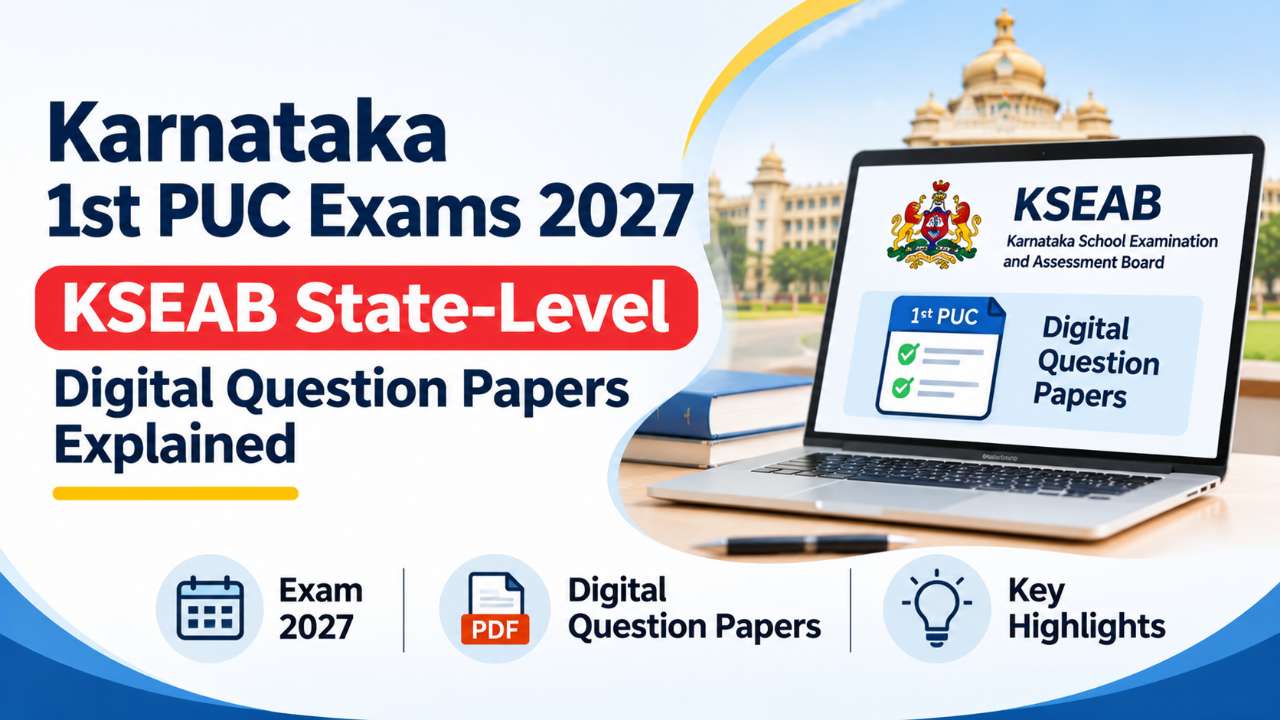
Karnataka’s Pre-University Course (PUC) is the bridge between school and college life for lakhs of students every year. In a significant shift, the state government has announced that First PUC (1st PUC) annual examinations from 2027 will no longer rely on question papers drafted separately by each college. Instead, the Karnataka School Examination and Assessment Board (KSEAB) will prepare centralised, state-level question papers and deliver them digitally to colleges on exam days.
This reform, backed by a government order dated 7 November 2026, aims to fix long-standing gaps in difficulty levels, syllabus coverage, and marking consistency. For students eyeing degrees at institutions such as Karnataka University Dharwad, Central University Of Karnataka Gulbarga, or professional paths that eventually lead to campuses like National Institute Of Technology Karnataka, a stronger and fairer 1st PUC foundation matters. This article explains what is changing, what stays the same, and how families can prepare with confidence.
What Is Changing in Karnataka 1st PUC Exams 2027?
Until the 2026 examination cycle, many pre-university colleges prepared, printed, and distributed their own question papers for 1st PUC annual exams. That decentralised model often meant two students in the same district could face noticeably different paper standards even when they followed the same state syllabus.
From 2027 onwards, the picture changes in three core ways:
- State-level paper setting: KSEAB will design question papers for 1st PUC annual examinations.
- Digital delivery on exam day: Papers will be sent confidentially in digital form to colleges when examinations are held.
- Common timetable: All government, aided, and private pre-university colleges will follow a unified examination schedule.
The Department of School Education (Pre-University) continues to conduct the examinations. KSEAB’s role is limited to paper preparationa split that keeps logistics with colleges while standardising academic content statewide.
Why Karnataka Introduced Centralised 1st PUC Papers
Education officials and college principals have repeatedly flagged variation in question difficulty when each institution sets its own paper. Some colleges leaned heavily on repeated internal patterns; others tested edge topics inconsistently. Students transferring between colleges mid-course sometimes found their preparation misaligned with local exam culture.
The government's stated goals include:
- Uniform standards across government, aided, and private PU colleges
- Better syllabus alignment with published blueprints
- Stronger readiness before students face 2nd PUC board examinations
- Reduced scope for paper leaks tied to local printing chains
For aspirants planning specialised degreeslaw at Karnataka State Law University Hubli, performing arts at Karnataka State Dr Gangubai Hangal Music And Performing Arts University, or design entrances such as the NIFT Entrance Exam and NATAa predictable 1st PUC standard helps you benchmark skills early.
KSEAB’s Role vs College-Level Responsibilities
Understanding who does what prevents confusion when results or evaluation queries arise.
KSEAB: Question Paper Preparation Only
KSEAB will prepare 1st PUC annual examination question papers at the state level, maintain confidentiality until delivery, and distribute papers digitally to colleges on the scheduled examination days. The board will not conduct the 1st PUC annual exams under this arrangement.
Department of School Education (Pre-University): Conduct
The department oversees examination conduct, invigilation protocols, and coordination with college principals. A common timetable means every affiliated college starts and ends papers on the same calendarsimilar in spirit to how board exams unify schedules, but scoped to 1st PUC annual tests.
Colleges: Evaluation and Result Processing
After students write the exam, answer scripts will continue to be evaluated at the college level, supervised by principals. Deputy Directors of Pre-University Education will verify and approve results before public announcement. Practical examinations follow district-level schedules, separate from theory paper logistics.
The government has also provisioned inter-college examination supervisors and vigilance squads to curb malpracticeimportant when digital papers reduce local printing risks but invigilation quality still varies by campus.
Digital Question Papers: How Delivery May Work on Exam Day
While operational manuals may evolve, the reform’s digital lens implies a controlled workflow:
- KSEAB finalises encrypted question paper sets for each subject and session.
- On the examination morning, authorised college officials receive papers through a secure digital channel.
- Colleges print or project papers according to board guidelines, under supervision.
- Invigilators follow the common timetable so no centre begins early.
Students should expect the question format and difficulty to reflect official blueprints rather than last year’s college-specific trends. Past internal “guess papers” circulated locally may lose relevance; state model papers become the primary reference.
Technology and Infrastructure Readiness
Rural and semi-urban colleges must ensure stable power, secure device access, and backup printing. Parents can ask principals about contingency plansuninterrupted exams matter as much as paper quality. If you study through flexible pathways later, institutions like Karnataka State Open University Mysore also emphasise reliable assessment systems; the 1st PUC reform nudges conventional PU colleges toward similar discipline.
Syllabus, Blueprints, and Official Study Resources
KSEAB has already published model question papers, question banks, and blueprints on its official website to help students transition. The 2027 annual examinations will follow these blueprints and the existing 1st PUC syllabusnot a surprise new curriculum.
How to Use Blueprints Effectively
Blueprints list unit-wise weightage, question types, and competencies tested. Treat them as your study map:
- Mark high-weightage units first in Physics, Chemistry, Mathematics, Biology, or Commerce combinations.
- Practise long-answer and application-based questions where blueprints show higher marks.
- Cross-check language subjects (Kannada, English, Sanskrit electives) with specimen papersstudents interested in classical pathways may later explore Karnataka Sanskrit University.
Question Banks vs Old College Papers
College-specific previous papers still help with basic revision, but prioritize KSEAB model papers for 2027. They mirror the state’s expected cognitive levelknowledge, understanding, application, and analysisacross streams (Science, Commerce, Arts).
Impact on Students in Science, Commerce, and Arts Streams
Science Stream
Science students often treat 1st PUC as a tune-up year before intense 2nd PUC board preparation and competitive exams. Uniform papers mean your class test scores better reflect statewide standing. Align lab records and practical notebooks with district practical schedules; internal assessment continues to influence holistic performance.
Commerce Stream
Accountancy and Business Studies questions should now test core concepts from the shared blueprint rather than idiosyncratic college preferences. Build speed in numerical problems and theory definitions; these skills carry into B.Com programmes and professional courses across Karnataka’s universities.
Arts and Humanities
Arts students benefit when evaluation rubrics stabilise. If you aim for women-centric campuses such as Karnataka State Women University Bijapur or cultural studies aligned with Karnataka Janapada Vishwavidyalaya Gotagodi, consistent language and social science testing in 1st PUC builds writing fluency early.
Evaluation, Results, and Grievance Redressal
Because theory answer scripts are evaluated locally, students should:
- Write clearly, label diagrams, and show steps in numericalslocal evaluators follow state key expectations.
- Confirm college-displayed moderation rules before result submission.
- Approach principals first for recheck requests within notified windows.
Deputy Directors of Pre-University Education approve results cluster-wide, adding a second layer of quality control. Keep hall tickets, registration numbers, and internal marks sheets organised; they matter for 2nd PUC registration continuity.
Practical Examinations and Vigilance Measures
Theory reforms do not abolish practicals. District authorities frame practical exam schedules; colleges conduct sessions per discipline norms. Record observations, viva answers, and journal submissions on time.
Inter-college supervisors and vigilance squads indicate the government’s parallel focus on exam integritywhether papers are local or digital. Students should follow dress code, item restrictions, and seating plans without exception.
How This Reform Connects to Your Higher Education Plans
1st PUC is not a terminal qualification; it seeds habits for 2nd PUC, which in turn unlocks undergraduate admissions. Stronger state papers can:
- Improve comparability when you apply for scholarships or inter-state programmes.
- Reduce anxiety caused by “easy college” vs “tough college” reputations.
- Encourage syllabus-complete teaching, benefiting even specialised entrants to veterinary sciences via routes linked to Karnataka Vetrinary Animal Fisheries Science University Nandinagar or policy studies through universities such as Karnataka State Rural Development And Panchayat Raj University.
After 2nd PUC, students compare options nationwidefrom engineering institutes to liberal arts. A disciplined 1st PUC year under KSEAB standards is an early signal of academic maturity admissions teams indirectly infer from subsequent board marks.
Actionable Tips for Students and Parents in 2026–27
- Download official KSEAB resources weekly and track updates on timetables.
- Replace local guesswork with blueprint-based revision timetables.
- Discuss digital exam readiness with your college administration before March 2027.
- Balance 1st PUC with foundation goals for 2nd PUC and entrance examsavoid treating year one as unimportant.
- Use college evaluations as feedback; clarify marking schemes with subject teachers early.
Timeline at a Glance
Although exact 2027 dates will appear in the official notification, planning assumes:
- November 2026: Policy notification and government order on state-level papers.
- Academic year 2026–27: Transition yearstudents should practise model papers alongside regular classes.
- Annual examinations 2027: First cycle under KSEAB digital state papers and unified timetable.
- Post-exam: College-level evaluation, Deputy Director verification, results.
Understanding Pre-University Education in Karnataka
The Pre-University Course is a two-year programme after SSLC (Class 10). Most students enrol in 1st PUC (Class 11) and 2nd PUC (Class 12) before undergraduate admissions. Karnataka hosts thousands of PU colleges in Bengaluru, Mysuru, Hubballi-Dharwad, Mangaluru, Kalaburagi, and smaller townseach affiliated to the Department of Pre-University Education.
Historically, 2nd PUC board examinations already follow centralised state papers and evaluation norms. The 1st PUC year, however, operated largely under college autonomy for annual theory exams. That dual system created perception gaps: families assumed 1st PUC marks would automatically predict 2nd PUC outcomes, yet inconsistent local papers distorted the signal.
By aligning 1st PUC annual exams with state-level standards, Karnataka moves closer to a coherent two-year assessment arc. Students transferring from one district to another mid-coursecommon in families relocating for workshould face fewer surprises when joining a new college before 2nd PUC registration.
Before vs After: Decentralised vs KSEAB State Papers
Clarifying differences helps teachers explain reforms in PTA meetings and helps students reset study expectations.
- Paper setting: Earlier, college exam committees; from 2027, KSEAB at state level.
- Printing and distribution: Earlier, local printing before exam week; from 2027, digital receipt on exam day under confidentiality protocols.
- Timetable: Earlier, colleges could stagger slightly within broad guidelines; from 2027, mandatory common timetable statewide.
- Difficulty benchmark: Earlier, varied by institution prestige; from 2027, anchored to published blueprints and model papers.
- Exam conduct: Department of School Education (Pre-University) before and after reform.
- Evaluation: College-level, principal-supervised before and after; Deputy Director approval continues.
This comparison shows the reform targets content and timing uniformity, not a wholesale shift of who runs exam halls or who corrects notebooks.
What Stays Unchanged for 1st PUC Students
Some elements remain stable so students in the 2026–27 academic year can transition smoothly:
- Subject choices within Science (PCMB, PCMC, etc.), Commerce (EBACS, etc.), and Arts combinations.
- Existing syllabus until a formal revision is notified separately.
- College attendance, internal tests, and co-curricular requirements set by institutional rules.
- Pathway to 2nd PUC registration through your current PU college after promotion criteria are met.
- Practical exams organised on district schedules with local viva panels.
Role of Teachers, Principals, and Parents
For Subject Teachers
Teachers should map each chapter to blueprint competencies and share weekly targets with students. When setting class tests, use KSEAB model questions rather than recycling only previous college annual papers. Collaborative staff meetings help departments align internal rubrics with expected state answer keys.
For Principals and Exam Committees
Principals oversee secure handling of digitally delivered papers, invigilator training, and evaluation quality. Early dry runs of download, print, and seal procedures can prevent last-minute chaos during the 2027 season. Inter-college supervisors require hospitality and clear reporting linescolleges should document standard operating procedures.
For Parents and Guardians
Parents play a stabilising role during policy transitions. Ask schools how often teachers review official blueprints in class. Monitor stress levels: uniform papers may feel harder initially if a college previously set very lenient tests. Encourage consistent study over short cramming, and verify exam-day instructions on the common timetable rather than rumour circles on messaging apps.
Digital Delivery: Benefits, Risks, and Safeguards
Digital distribution reduces advance printing pools that, in some regions, historically raised leak concerns. Encrypted transmission on examination morning narrows the exposure window. Yet new risks appearconnectivity failures, unauthorised device access, or delayed printing.
Benefits include statewide synchronisation, easier versioning if typographical errors must be fixed centrally, and a single authoritative difficulty calibration. Risks include infrastructure inequality between metro and remote colleges. The government's vigilance squads complement technology with on-ground checks, signalling that malpractice remains unacceptable regardless of format.
Students need not master technical logistics; focus on academic preparation. Still, knowing that papers arrive digitally explains why colleges may tighten mobile phone bans and restrict staff movement near server rooms on exam days.
Internal Assessment and Holistic Performance
Annual theory exams under KSEAB papers are one layer of assessment. Colleges typically maintain internal marks from unit tests, assignments, and attendance-driven components where policies apply. Do not neglect internals because state papers feel “more official”promotion and confidence both depend on year-round performance.
Maintain notebooks, record practical observations diligently, and participate in remedial classes if colleges offer them after pre-final tests. A strong internal record supports students who narrowly miss distinction levels in annual papers and seek revaluation or grade improvement routes allowed under college rules.
Planning Undergraduate Goals While in 1st PUC
Although undergraduate admissions hinge primarily on 2nd PUC or entrance tests, 1st PUC is when habits form. Science aspirants targeting engineering at institutes such as National Institute Of Technology Karnataka should strengthen problem-solving speed. Commerce students eyeing professional certifications can build accounting accuracy early. Arts students exploring gender studies or development programmes may later choose pathways connected to Karnataka State Women University Bijapur or governance-focused degrees aligned with Karnataka State Rural Development And Panchayat Raj University.
Creative careers often require portfolio or entrance exams beyond board marks. If architecture or design interests you, explore structured coaching for NATA; fashion aspirants review the NIFT Entrance Exam pattern alongside regular PUC subjects.
Open-degree seekers should note that flexibility offered by Karnataka State Open University Mysore does not replace the need for disciplined 1st PUC performance if you plan regular on-campus programmes immediately after 2nd PUC.
Common Mistakes to Avoid in the 2027 Examination Cycle
- Relying solely on photocopied “college paper sets” from seniors without checking blueprint updates.
- Ignoring language subjects that carry equal weight in aggregate calculations.
- Skipping practical journals until the last week before district practicals.
- Assuming digital papers mean open-book or relaxed invigilationthey do not.
- Missing registration or hall ticket corrections during tight common-timetable schedules.
- Comparing marks with friends from other states without adjusting for Karnataka’s marking rubric.
Regional Equity and Small-town Colleges
Karnataka’s PU ecosystem spans IT corridors in Bengaluru and colleges in North Karnataka, Malnad, and coastal districts. State-level papers aim to give every student the same academic challenge, which supports merit recognition regardless of pin code. Small-town colleges that invest in teacher training around blueprints may see faster quality gains than institutions waiting passively for exam week.
District Deputy Directors remain pivotal in approving results and supporting weaker centres. Community participationPTAs funding backup inverters, local NGOs sponsoring model-paper printoutscan narrow infrastructure gaps without waiting for large capital upgrades.
Conclusion
Karnataka’s move to KSEAB-prepared, state-level digital question papers for 1st PUC annual exams from 2027 is a structural upgrade aimed at fairness, syllabus fidelity, and smoother progression into 2nd PUC. Colleges retain conduct and evaluation duties; students gain a clearer, shared academic bar. Start early with official blueprints and model papers, support your college’s digital readiness, and treat 1st PUC as the first serious milestone on your path to Karnataka’s universities and beyond.