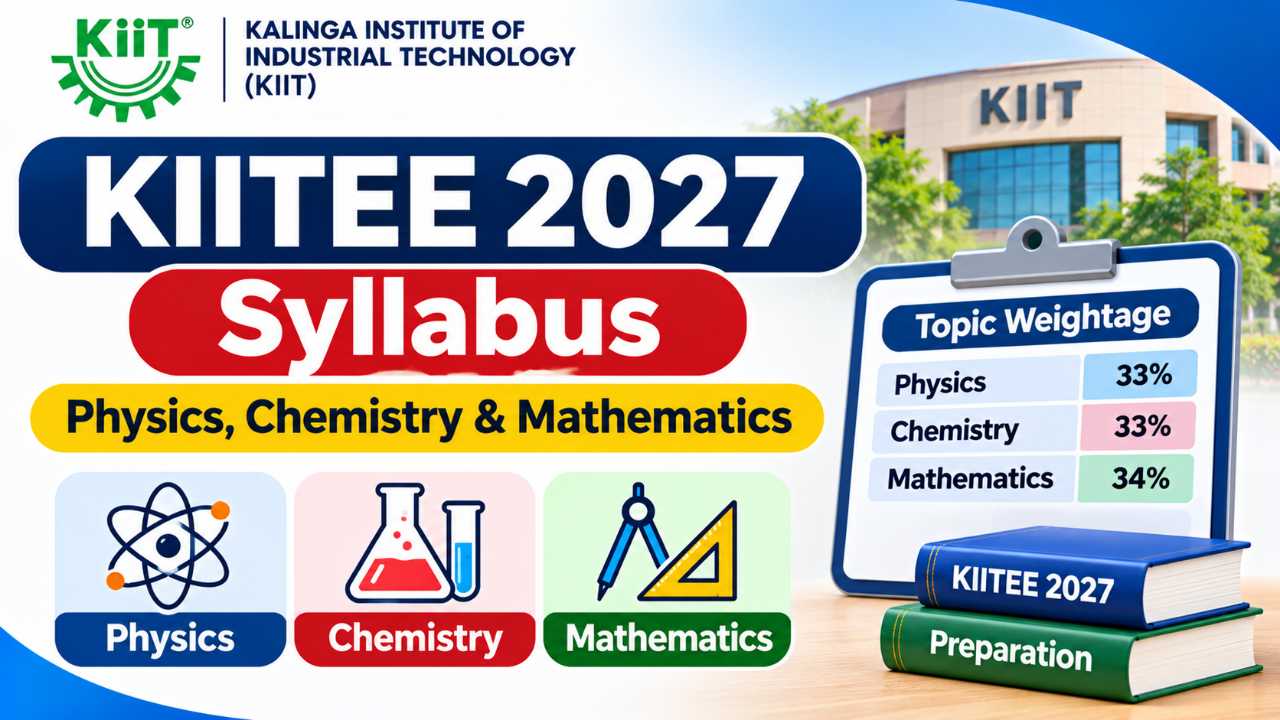
The KIITEE 2027 syllabus for B.Tech (PCM stream) is built on Class 11 and Class 12 Physics, Chemistry, and Mathematics the same academic ladder that feeds national exams like JEE Main and state engineering entrances. Kalinga Institute of Industrial Technology (KIIT), Bhubaneswar, uses the Kalinga Institute of Industrial Technology Entrance Examination (KIITEE) as a computer-based test to shortlist candidates for its engineering programmes. Until KIIT publishes the official KIITEE 2027 notification, the safest reference is the stable pattern seen in 2024–2026: 120 multiple-choice questions, equal split across PCM, negative marking, and a syllabus aligned with CBSE and equivalent boards.
This guide explains the KIITEE 2027 exam pattern, chapter-wise expected weightage in Physics, Chemistry, and Mathematics, and a practical study order without replacing the official PDF on kiitee.kiit.ac.in. If you also explore elite national options, institutions such as Indian Institute of Technology Bombay (IIT Bombay), IIT Delhi, and IIT Madras Chennai use JEE Advanced not KIITEE but the PCM fundamentals overlap heavily, which helps if you are preparing for both private university entrances and IIT-track exams.
Before you lock a study plan, note that KIITEE registration typically opens in the winter preceding the April–May exam window. Eligibility generally requires passing Class 12 with Physics, Chemistry, and Mathematics for PCM programmes (Physics, Chemistry, and Biology for Biotechnology), but minimum aggregate percentages and age limits are defined in the official brochure each year. Keep scanned mark sheets, category certificates, and identity proofs ready so application week does not eat into revision hours. Students from eastern and central India often pair KIITEE with state counselling; knowing exact chapter weightage early prevents last-minute panic revision.
What Is KIITEE and Who Should Focus on This Syllabus?
KIITEE is KIIT’s own entrance for admission to B.Tech and related programmes. For most engineering branches, the paper tests Physics, Chemistry, and Mathematics. Biotechnology is an exception: that stream uses Biology instead of Mathematics while keeping Physics and Chemistry. Candidates targeting core B.Tech at KIIT should treat this PCM syllabus as their primary blueprint.
The exam rewards speed, accuracy, and board-level clarity rather than olympiad-style trick questions. That makes it approachable for students from Odisha state boards, CBSE, ICSE, and other equivalents as long as their Class 11–12 textbooks cover the standard NCERT-style progression.
KIITEE 2027 Exam Pattern at a Glance
Understanding the pattern helps you convert syllabus coverage into marks. The structure has remained consistent across recent cycles.
- Mode: Online computer-based test (CBT)
- Duration: 3 hours (180 minutes), no sectional timer
- Questions: 120 total 40 Physics, 40 Chemistry, 40 Mathematics
- Question type: Single-correct MCQ with four options
- Marking: +3 correct, −1 wrong, 0 for unattempted
- Maximum score: 360 marks
- Medium: English
- Sessions: Multiple days; scores are normalised before merit lists
Subject-wise marks and realistic targets
Each subject caps at 120 marks. Aiming for roughly 28–30 correct answers per subject (with minimal negatives) often places you in a strong percentile band for popular branches, though cut-offs change every year. Because −1 hurts more than leaving a question blank, selective attempts beat blind guessing.
Time budgeting in mocks matters: many toppers spend about 55–60 minutes on Physics, 45–50 on Chemistry, and 70–75 on Mathematics, adjusting for personal strength.
KIITEE 2027 Physics Syllabus and Weightage
Physics pulls evenly from Class 11 mechanics and waves and Class 12 electricity, optics, and modern physics. Trend analysis from recent KIITEE papers suggests Electrostatics and Current Electricity together drive a large share of marks often cited around 18% of the Physics section while Modern Physics (dual nature, atoms, nuclei) delivers predictable, formula-friendly questions.
Class 11 Physics topics
- Units, dimensions, errors, and measurement
- Kinematics and laws of motion (including friction and circular motion)
- Work, energy, power, and rotational motion
- Gravitation and properties of bulk matter (fluids, elasticity, viscosity)
- Thermodynamics and kinetic theory
- Oscillations and waves (including Doppler effect)
Mechanics as a block kinematics through rotation typically accounts for roughly 22–25% of Physics questions. Graph-based kinematics and free-body diagrams appear regularly; practising NCERT intext and exemplar problems builds exam temperament.
Class 12 Physics topics
- Electrostatics and capacitors
- Current electricity (Kirchhoff, bridges, cells)
- Magnetic effects and magnetism
- Electromagnetic induction and alternating current
- Electromagnetic waves
- Ray and wave optics
- Dual nature, atoms, nuclei
- Semiconductor devices and basics of communication systems
Electricity and magnetism as a unit often contributes about 22–27% of Physics items. Optics (ray + wave) adds another 10–12%. Electronic devices and communication are lower weight but easy scoring if you memorise device characteristics and standard diagrams.
Physics preparation tips tied to weightage
Prioritise numerical fluency in electrostatics and current electricity, then consolidate modern physics definitions (photoelectric effect, Bohr model, half-life). Use concept-first books for mechanics, then shift to timed MCQ drills. Students comparing difficulty with JEE Main will find KIITEE Physics more direct fewer multi-concept traps, more single-formula applications.
KIITEE 2027 Chemistry Syllabus and Weightage
Chemistry is often the highest-scoring PCM subject for disciplined board readers. The section blends Physical Chemistry, Organic Chemistry, and Inorganic Chemistry, each roughly one-third of the paper, with organic reaction mechanisms appearing every year.
Physical Chemistry highlights
- Mole concept, stoichiometry, and redox basics
- Atomic structure and quantum numbers
- States of matter and gas laws
- Thermodynamics, equilibrium (including ionic equilibrium and pH)
- Solutions and colligative properties
- Electrochemistry and chemical kinetics
- Surface chemistry
Physical Chemistry collectively targets about 32–37% of Chemistry questions. Electrochemistry (Nernst equation, cell EMF) and kinetics (Arrhenius, order of reaction) are high-return chapters for numerical practice.
Inorganic Chemistry highlights
- Chemical bonding (VSEPR, hybridisation, MOT)
- s-Block and p-Block elements (Class 11 and 12 portions)
- d- and f-block elements
- Coordination compounds (nomenclature, isomerism, VBT/CFT basics)
Chemical bonding is frequently the top inorganic chapter often 6–8% of the Chemistry paper because question templates repeat (shape, hybridisation, bond order).
Organic Chemistry highlights
- IUPAC nomenclature, isomerism, and reaction mechanisms
- Hydrocarbons and aromatic chemistry
- Haloalkanes and haloarenes (SN1/SN2)
- Alcohols, phenols, ethers
- Aldehydes, ketones, carboxylic acids (aldol, Cannizzaro)
- Amines and diazonium salts
- Biomolecules, polymers, chemistry in everyday life
Organic Chemistry contributes about 32–37% of questions. Named reactions and acidity/basicity comparisons are staple MCQ formats flashcards work well here.
Chemistry study sequence
Start with NCERT for inorganic and organic theory, add a numerical book for physical chapters, and maintain a separate “named reactions” sheet. Unlike management entrances such as MAT, KIITEE Chemistry is pure science no aptitude section so board fidelity wins.
KIITEE 2027 Mathematics Syllabus and Weightage
Mathematics frequently decides rank because Calculus and Coordinate Geometry carry the largest shares. Together, differentiation, integration, and coordinate geometry can approach nearly half of the Mathematics section in recent papers.
Algebra and trigonometry (Class 11 foundation)
- Sets, relations, functions
- Trigonometric identities and equations
- Complex numbers and quadratic equations
- Sequences and series (AP, GP, special sums)
- Permutations, combinations, binomial theorem
- Limits, continuity, differentiability
- Straight lines, circles, conic sections
Class 12 Mathematics core
- Matrices and determinants
- Inverse trigonometric functions
- Applications of derivatives (maxima-minima, tangents, monotonicity)
- Indefinite and definite integration, area under curves
- Differential equations
- Vectors and three-dimensional geometry
- Probability, statistics, and mathematical reasoning/induction
Unit-wise weightage summary for Mathematics
Based on 2024–2026 trends:
- Calculus (limits through differential equations): about 25–30% of Maths questions
- Coordinate geometry (lines, circles, conics): about 17–22%
- Algebra (complex numbers, matrices, P&C, binomial, sequences): about 20–25%
- Trigonometry: about 10–12%
- Vectors and 3D: about 10–12%
- Probability and statistics: about 5–7%
Definite integration and area problems are the single highest-yield chapter often four to five questions per paper. Application of derivatives adds another three to four. Master these before chasing lower-frequency topics like mathematical induction.
How KIITEE Syllabus Compares with JEE Main and Board Exams
KIITEE and JEE Main share the same NCERT-style Class 11–12 footprint. JEE Main adds numerical-answer-type questions and a harder ceiling in Mathematics and Physics; KIITEE stays MCQ-only with generally shorter chains of reasoning. If you prepare for JEE Main, you automatically cover KIITEE just add KIITEE-specific mocks to learn time distribution and question framing.
There is no Class 10 syllabus block in KIITEE; foundational skills appear only inside senior-secondary problems (for example stoichiometry arithmetic or quadratic roots). Class 12 topics dominate Mathematics slightly (roughly 55–60%), while Physics and Chemistry split more evenly between classes.
Private universities in the NCR region such as The Northcap University Engineering and The Northcap University Gurgaon may use different exams (JEE scores, university tests, or state quotas). Always verify each Institute's admission bulletin; syllabus overlap with KIITEE does not imply interchangeable scores.
High-Priority Chapters for KIITEE 2027 Preparation
Use weightage to order revision, not to skip low-yield topics entirely easy marks hide in semiconductors, statistics, and surface chemistry too.
Physics priority list
- Electrostatics and current electricity
- Atoms, nuclei, and dual nature of radiation
- Kinematics and laws of motion
- Electromagnetic induction and AC circuits
- Ray optics
Chemistry priority list
- Chemical bonding and molecular structure
- Organic basics, hydrocarbons, and mechanism questions
- Electrochemistry and equilibrium
- Aldehydes, ketones, and carboxylic acids
- Coordination compounds (for quick theory marks)
Mathematics priority list
- Integration and applications (especially definite integrals and areas)
- Application of derivatives
- Straight lines, circles, and conics
- Matrices and determinants
- Limits, continuity, and differentiability
Recommended Books and Practice Resources
NCERT remains the credibility anchor for Chemistry and for theory in Physics. Supplement as follows:
- Physics: Concept-building volume sets (e.g., H.C. Verma style) plus timed MCQ sets for electricity and modern physics
- Chemistry: NCERT plus a dedicated organic reactions compendium and a numerical physical chemistry practice book
- Mathematics: Board-level comprehensive practice (R.D. Sharma style) and previous KIITEE papers from 2020 onward for pattern familiarity
Solving official-style mocks under a 180-minute cap trains you for negative marking discipline. After each mock, tag errors by chapter weightage-guided revision only works when analytics feed the next week’s plan.
Sample Preparation Timeline (2026–2027 Batch)
Adjust dates when KIIT releases the official calendar. A weightage-first timeline often looks like this:
- November 2026 – January 2027: Finish high-priority chapters in all three subjects; build formula sheets for Physics and reaction maps for Organic Chemistry.
- February 2027: Cover medium-yield units (wave optics, coordination compounds, vectors, probability) with at least 80–100 MCQs each.
- March 2027: One full-length mock every 2–3 days; analyse normalised score trends if your coaching provides them.
- April 2027 (typical exam window): Light revision only no new chapters in the final week.
Scoring, Normalisation, and Rank Strategy
KIITEE runs multiple sessions; raw scores are normalised to compare candidates fairly across shifts. Focus on maximising accurate attempts rather than gaming the session. A raw score near 240 with few negatives has historically aligned with strong percentiles for many branches, but treat this as guidance, not a guarantee.
For premium branches, aspirants often target 270–300 net marks meaning high accuracy plus roughly 90–100 correct attempts with controlled negatives. Skip uncertain items unless you can eliminate two options.
B.Tech Biotechnology: Different Syllabus Reminder
Candidates applying to B.Tech Biotechnology sit a Physics–Chemistry–Biology paper, not PCM. Biology follows Class 11–12 NCERT themes: cell biology, human and plant physiology, genetics, ecology, and biotechnology applications. Do not prepare Mathematics weightage if your application is strictly Biotechnology verify programme codes on the application form.
Class 11 vs Class 12: How Topics Split in KIITEE PCM
KIIT does not publish a fixed Class 11 versus Class 12 ratio, but paper reviews from 2024–2026 offer a practical planning split. Across all three subjects combined, expect roughly 45–50% Class 11 and 50–55% Class 12 content. Mathematics leans senior-secondary: Calculus, matrices, vectors, inverse trigonometry, and probability often push Class 12 share to about 55–60%. Chemistry tends toward a balanced mix Physical chapters span both years, while p-Block and organic functional groups peak in Class 12. Physics gives Class 12 electricity, optics, and modern physics a slight edge, yet Class 11 mechanics still supplies nearly a quarter of the section.
Actionable tip: if your Class 11 foundation is weak, repair it before deep-diving Class 12 integration or electrostatics. Many KIITEE mistakes trace back to shaky kinematics or mole concept not because those chapters dominate marks alone, but because later topics assume fluency in them.
Exam Pattern Summary Table for Quick Reference
Use this snapshot while designing mock tests:
| Feature | KIITEE 2027 (expected) |
|---|---|
| Mode | Computer-based test (online) |
| Total questions | 120 (40 per subject) |
| Duration | 3 hours; free navigation across sections |
| Marking | +3 / −1 / 0 |
| Maximum marks | 360 |
| Language | English |
| Syllabus base | Class 11 & 12 CBSE / equivalent boards |
Common Mistakes KIITEE Aspirants Make
Over-guessing under negative marking
With four options, random guessing loses marks over time. Build a rule: attempt only when you eliminate two distractors or you have solved a similar past-year question. Your mock analytics should track “net gain from guesses” if it is negative, tighten discipline.
Ignoring low-weight chapters completely
Communication systems or mathematical reasoning may carry only a few marks, but they are often quick reads. A single evening revision can secure three marks that matter in tie-breakers near branch cut-offs.
Studying only board-level theory without MCQ speed
Board exams reward structured steps; KIITEE rewards rapid recognition. After theory, always transition to timed sets. Even students aiming for IIT Delhi-level JEE prep benefit from KIITEE mocks as a confidence checkpoint on fundamentals.
Using the wrong paper for Biotechnology
Registering for Biotechnology but drilling Mathematics wastes weeks. Double-check programme-specific bulletins on the KIITEE portal during application.
Geo and Career Context: Why Syllabus Clarity Matters in Odisha and Beyond
KIIT Bhubaneswar attracts students from Odisha, West Bengal, Jharkhand, Chhattisgarh, and other eastern states, alongside national applicants. Local state-board students should map their textbooks to NCERT chapter titles terminology differs, but concepts align. Out-of-state candidates comparing KIIT with NCR private universities should note admission pathways: some Gurgaon campuses accept JEE Main percentiles while KIIT insists on KIITEE rank for most B.Tech seats.
Understanding weightage also helps counselling season: if your mock scores show Chemistry strength but Mathematics lag, you can justify branch choices where historical cut-offs align with your subject profile, or intensify calculus revision before the final attempt.
Featured Snippet Quick Answers (AEO-Friendly)
Total questions in KIITEE: 120 MCQs (40 Physics + 40 Chemistry + 40 Mathematics).
Total marks: 360 with +3 for correct and −1 for incorrect answers.
Highest-weight Mathematics topics: Integration (especially definite integrals and areas) and applications of derivatives.
Highest-weight Physics topics: Electrostatics, current electricity, and modern physics (atoms, nuclei, dual nature).
Highest-weight Chemistry topics: Organic reaction mechanisms, chemical bonding, and electrochemistry.
Always cross-check these points against the latest official notification before registration closes.
For day-of-exam readiness, carry your admit card, photo ID, and arrive early at the CBT centre. KIITEE interfaces allow marking questions for review use that flag instead of rushing a guess when time runs low. A calm last pass through flagged items often recovers marks you would lose to careless clicks.
Conclusion
The KIITEE 2027 syllabus for Physics, Chemistry, and Mathematics mirrors senior secondary PCM used across India’s engineering admissions landscape. Weightage trends from 2024–2026 point to electricity and modern physics in Physics, bonding and organic mechanisms in Chemistry, and calculus-plus-coordinate geometry in Mathematics as the highest return chapters. Pair NCERT clarity with timed MCQ practice, respect negative marking, and confirm any updates on the official KIITEE portal before your final revision cycle. Whether your goal is KIIT Bhubaneswar or you are parallel-tracking national exams toward campuses like IIT Bombay, a weightage-aware syllabus map turns study hours into rank-ready marks.