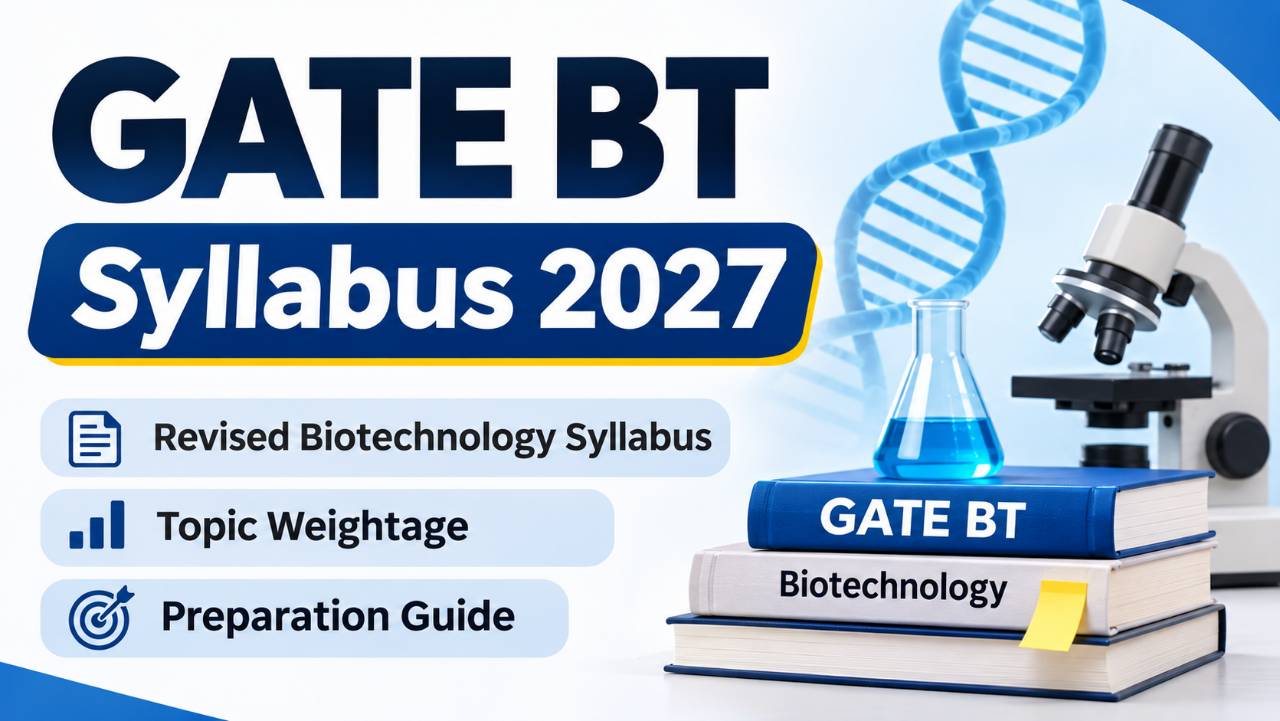
The GATE Biotechnology (BT) paper is one of the most competitive routes for Indian students who want M.Tech admissions, research fellowships, and public-sector engineering roles after graduation. For GATE 2027, the organising Institute is IIT Madras, which has published the revised syllabus on the official portal gate2027.iitm.ac.in. If you are in final year B.Tech Biotechnology, integrated programmes, or M.Sc life sciences, aligning your study plan with the latest PDF is non-negotiable small syllabus shifts often show up first in numerical and concept-linked questions.
This CollegeDwar guide unpacks the GATE BT syllabus 2027 in plain language: section-wise topics, what changed compared with earlier cycles, a practical view of topic-wise weightage from recent papers, exam pattern and marking, and actionable preparation tips. We also point you to biotechnology-focused campuses and top engineering institutes where a strong GATE score opens doors such as the Regional Centre for Biotechnology, Gujarat Biotechnology University, and premier IITs including IIT Bombay and IIT Delhi.
What Is GATE Biotechnology (BT) and Who Should Appear?
GATE is a national-level examination conducted jointly by the IISc and seven IITs on a rotating basis. The BT paper tests engineering mathematics, general aptitude, and deep biotechnology knowledge spanning biochemistry, genetics, bioprocess engineering, and modern omics tools. Eligible candidates typically hold or are pursuing a recognised degree in biotechnology, biochemical engineering, life sciences, or related branches approved by GATE authorities.
A high percentile in GATE BT helps you in multiple ways:
- M.Tech and M.E. admissions at IITs, NITs, IIITs, and state universities through centralized counselling (for example CCMT for NITs and participating institutes).
- Ph.D. and project positions at CSIR labs, DBT-supported centres, and university research groups.
- PSU recruitment where biotechnology or life-science specialisations accept BT scores (always verify the current PSU notification).
- Teaching and industry R&D roles that treat GATE as a quality filter.
Students from institutes like Shoolini University of Bio Technology and Management Sciences or Vel Tech Rangarajan Dr Sagunthala R D Institute of Science and Technology, Chennai often use GATE BT to pivot into national-level postgraduate programmes beyond their home state.
GATE 2027 BT: Key Dates and Official Syllabus PDF
According to the GATE 2027 schedule announced by IIT Madras, the examination will be held on February 6, 7, 13, 14, 20, and 21, 2027. Biotechnology is usually conducted in one of the afternoon or forenoon slots on a designated date; confirm your session only from the admit card.
To download the authoritative document:
- Visit gate2027.iitm.ac.in.
- Open the Syllabus section and select paper code BT.
- Save the PDF and cross-check section headings with your coaching notes or standard textbooks.
Third-party blogs (including career portals) summarise the syllabus for convenience, but your preparation boundary should always match the PDF hosted by the organising IIT. Treat any unofficial “short syllabus” as revision notes only.
GATE Biotechnology Exam Pattern 2027
Understanding the pattern alongside the syllabus prevents surprises on exam day. For GATE BT 2027, the structure remains aligned with the standard GATE format:
- Duration: 3 hours (180 minutes).
- Total marks: 100.
- Number of questions: 65 (including General Aptitude).
- Question types: Multiple Choice Questions (MCQs), Multiple Select Questions (MSQs), and Numerical Answer Type (NAT) questions as applicable in your session.
- Marking: Questions carry 1 or 2 marks; negative marking applies to MCQs (typically one-third of the question mark for 1-mark MCQs and two-thirds for 2-mark MCQs confirm in the official brochure).
Paper composition at a glance
The BT paper has two logical parts:
- General Aptitude (GA): 10 questions worth 15 marks (5 questions of 1 mark and 5 questions of 2 marks is the usual split).
- Subject paper (Biotechnology): 55 questions worth 85 marks, which includes Engineering Mathematics and all core biotechnology sections listed in the syllabus.
Because GA is common across papers, biotechnology students sometimes under-prepare it yet those 15 marks are often the easiest to improve with consistent practice.
Indicative Topic-Wise Weightage for GATE BT
IIT GATE does not publish fixed chapter-wise marks for BT. However, analysis of recent GATE Biotechnology papers shows a stable pattern that you can use for prioritisation. Treat the table below as planning guidance, not a guarantee for 2027.
- General Aptitude: ~15 marks (15%)
- Engineering Mathematics: ~11–13 marks (11–13%)
- General Biology (Biochemistry, Microbiology, Immunology): ~18–22 marks
- Genetics, Cellular and Molecular Biology: ~16–20 marks
- Fundamentals of Biological Engineering (Bioreaction + Upstream/Downstream): ~14–18 marks
- Plant, Animal, and Microbial Biotechnology: ~10–14 marks
- Recombinant DNA Technology and Other Tools (molecular, analytical, computational): ~14–18 marks
Actionable tip: Build a 70–20–10 study split 70% time on core BT sections with highest combined weight, 20% on Engineering Mathematics, and 10% on GA until your mock scores stabilise.
Section 1: General Aptitude (GA) Syllabus
General Aptitude is shared across GATE papers. For BT candidates in Delhi-NCR engineering colleges whether at Netaji Subhas University of Technology (NSUT Delhi) or NIT Delhi GA practice is the fastest way to lift your normalized score.
Verbal Aptitude
Topics include basic English grammar (tenses, articles, subject–verb agreement), vocabulary in context, reading comprehension, and narrative sequencing. Focus on accuracy rather than speed in the first month of prep.
Quantitative Aptitude
Expect data interpretation from bar charts, pie charts, tables, and 2D/3D plots; numerical computation (ratios, percentages, powers, permutations and combinations); mensuration; and elementary statistics and probability.
Analytical and Spatial Aptitude
Logic (deduction, induction, analogy), numerical relations, and spatial transformations (rotation, scaling, paper folding, pattern completion) appear regularly. Solve two GA sets per week under timed conditions.
Section 2: Engineering Mathematics Syllabus
Engineering Mathematics is common to many GATE engineering papers and rewards systematic problem-solving. The GATE BT 2027 mathematics syllabus includes:
Linear Algebra
Matrices and determinants, systems of linear equations, eigenvalues and eigenvectors. Link eigen concepts to stability ideas in bioreactor models where possible.
Calculus
Multivariable limits, continuity, partial derivatives, maxima and minima, sequences and series, convergence tests. Newer emphasis areas in the revised syllabus include gradient, divergence, and curl with applications in fluid mechanics and transport processes revise vector calculus with physical meaning, not just formulas.
Differential Equations
First-order linear and nonlinear ODEs, higher-order ODEs with constant coefficients, Cauchy and Euler equations, and Laplace transforms. These connect directly to batch and fed-batch bioreactor models.
Probability and Statistics
Mean, median, mode, standard deviation, random variables, Poisson, normal and binomial distributions, correlation, regression, and Bayesian statistics (recently highlighted in syllabus updates). Practice simple Bayes theorem problems tied to diagnostic test interpretation.
Numerical Methods
Solutions of linear and nonlinear algebraic equations, trapezoidal and Simpson’s rule for integration, and single-step methods for differential equations. GATE often asks one short numerical or concept question from this block.
Section 3: General Biology
This block separates BT from pure chemistry or biology GATE papers. It is high-yield for both MCQs and MSQs.
Biochemistry
Biomolecule structure and function, biological membranes (channels, pumps, transport), metabolism of carbohydrates, lipids, amino acids, and nucleic acids, regulation of metabolic pathways, glycolysis, citric acid cycle, fatty acid oxidation, photosynthesis, respiration, and electron transport chain. Enzyme classification, Michaelis–Menten kinetics, and competitive, non-competitive, and uncompetitive inhibition are exam favourites.
Microbiology
History of microbiology, bacterial classification, Gram-positive and Gram-negative cell walls, Archaea, culture methods, growth and nutrition, operons (lac, trp, ara), nitrogen fixation, host–pathogen interactions, antibiotics and antimicrobial resistance, two-component systems, bacterial communication, and virus structure and classification.
Immunology
Lymphoid organs, innate immunity and inflammation, cytokines and chemokines, complement, cellular and humoral immunity, antibody diversity, monoclonal antibodies, T- and B-cell development, memory responses, MHC, antigen processing, immune regulation, tolerance, hypersensitivity, autoimmunity, immunodeficiency, graft-versus-host disease, and vaccines.
Section 4: Genetics, Cellular and Molecular Biology
This section bridges classical genetics with modern molecular biology and frequently carries multi-concept questions.
Genetics and Evolutionary Biology
Mendelian inheritance, gene interaction, complementation, linkage and mapping, extrachromosomal inheritance, microbial genetics (transformation, transduction, conjugation), bacterial gene mapping, horizontal gene transfer, transposons, chromosomal variation, sex determination, genetic disorders, population genetics, epigenetics, selection, genetic drift, and speciation.
Cell Biology
Eukaryotic cell structure, cell cycle control, cell–cell communication, signal transduction, non-cell-autonomous signalling, post-translational modifications, protein trafficking, autophagy and cell death, and extracellular matrix.
Molecular Biology
Gene and chromosome structure, mutations, regulation of gene expression, replication, transcription, splicing, translation, non-coding and microRNA, RNA interference, DNA damage and repair.
Section 5: Fundamentals of Biological Engineering
Biotechnology engineers must translate biology into measurable rates and scalable processes this section tests that integration.
Bioreaction Engineering
Rate laws, zero- and first-order kinetics, Michaelis–Menten enzyme kinetics with inhibition types, ideal reactors (batch, CSTR, plug flow), enzyme immobilisation, Thiele modulus, effectiveness factor, Damköhler number, unstructured and structured growth models, substrate and product kinetics, batch, fed-batch, and continuous cultures, microbial and enzyme reactors, optimisation, and scale-up case studies (antibiotics, biofuels).
Upstream and Downstream Processing
Media formulation, sterilisation, filtration and ultrafiltration, centrifugation, cell disruption, chromatography (ion exchange, gel filtration, hydrophobic interaction, affinity, GC, HPLC, FPLC), extraction, adsorption, drying, measurement devices, valves, first- and second-order systems, feedback and feedforward control, PID controllers, and controller tuning.
If you study bioprocess engineering at an NIT such as MNIT Jaipur, map your lab experiments (fermentation, chromatography) directly to these syllabus lines for faster recall.
Section 6: Plant, Animal, and Microbial Biotechnology
Plant Biotechnology
Totipotency, organogenesis, plant growth regulators, tissue culture kinetics, secondary metabolites, hairy root culture, artificial seeds, somaclonal variation, protoplast fusion, transgenic plants, selectable markers, reporter genes, and plastid transformation.
Animal Biotechnology
Culture media, cell preservation, anchorage-dependent and suspension culture, growth kinetics, microcarrier culture, hybridoma technology, stem cells, cloning, transgenic animals, knock-out and knock-in models.
Microbial Biotechnology
Biofuels, bioplastics, industrial enzymes, antibiotics, large-scale protein production, and screening for novel metabolites in food, clinical, and industrial microbiology.
Section 7: Recombinant DNA Technology and Other Tools
Modern tools dominate contemporary biotechnology research and industry pipelines, and GATE reflects that breadth.
Recombinant DNA Technology
Restriction enzymes, cloning vectors (plasmids, phage, cosmids, Ti plasmid, BAC/YAC), expression vectors, genomic and cDNA libraries, gene cloning strategies, recombinant protein production, transposons, gene targeting, and recombination-based cloning.
Molecular Tools
PCR, DNA/RNA labelling, Sanger and next-generation sequencing, Southern and Northern blotting, in situ hybridisation, DNA fingerprinting, RAPD, RFLP, site-directed mutagenesis, CRISPR-Cas, biosensors, interaction tools, genomics and proteomics workflows.
Analytical Tools
Light, electron, fluorescence, and confocal microscopy; UV, visible, fluorescence, CD, IR, FT-IR, MS, and NMR spectroscopy; electrophoresis; microarrays; enzymatic and immunoassays (ELISA, RIA); immunoblotting; flow cytometry; ChIP and whole-genome sequencing applications.
Computational Tools
Bioinformatics databases, sequence alignment, scoring matrices, phylogeny, genomics, proteomics, metabolomics, gene prediction, functional annotation, structure prediction, metabolic engineering, systems biology, and metagenomics.
Candidates aiming for interdisciplinary programmes at institutes like IIIT Delhi should still master this computational block data-heavy GATE questions are increasingly common.
What Is New in the Revised GATE BT Syllabus 2027?
IIT Madras periodically revises GATE syllabi to mirror industry and research trends. Highlights frequently cited for the BT paper include:
- Engineering Mathematics: Gradient, divergence, curl with transport-process applications; Bayesian statistics.
- Biochemistry & Microbiology: Detailed metabolic pathways; expanded operon and bacterial communication content; Archaea and cell-wall biochemistry.
- Immunology: Inflammation, cytokines, chemokines, memory responses, immunodeficiency.
- Genetics & Cell Biology: Bacterial gene mapping, sex determination, non-cell-autonomous signalling.
- Biological Engineering: Integrated bioreaction and upstream/downstream processing outcomes.
- Plant Biotechnology: Cell fate transition and direct organogenesis.
- Molecular & Analytical blocks: Recombination-based cloning, advanced sequencing and interaction proteomics, expanded spectroscopy and assay tools.
When you compare older question papers with the 2027 PDF, mark each new bullet as a “high-alert” revision card.
How to Use the Syllabus for M.Tech and PSU Planning
Your syllabus checklist should align with where you want to study next:
- IITs and top NITs: Target 650+ normalized marks equivalent depending on year and category; emphasise accuracy in 2-mark MSQs.
- State counselling and private universities: Many accept GATE scores for waivers or direct admission verify department-specific cut-offs.
- Delhi ecosystem: Beyond IIT Delhi, institutes such as Guru Tegh Bahadur Institute of Technology and peers feed graduates into GATE BT pipelines for postgraduate upgrades nationally.
- North India engineering hubs: Students from Galgotias College of Engineering and Technology or GL Bajaj Institute of Technology often combine campus placements with GATE as a parallel M.Tech strategy.
Preparation Strategy: Books, Revision, and Mock Tests
Successful GATE BT rankers combine one standard textbook per section with previous-year papers and full-length mocks.
- Engineering Mathematics: Engineering mathematics texts used for GATE CE/CH plus targeted vector calculus notes.
- Biochemistry & Microbiology: Lehninger, Prescott/Hogg, or equivalent university-prescribed books.
- Bioprocess Engineering: Doran or Shuler & Kargi for reactor and downstream logic.
- Molecular Biology & Genetics: Watson-style molecular biology texts plus problem sets on mapping and operons.
- Immunology: Kuby or Abbas for concise diagrams you can redraw in exams.
- Bioinformatics: Practice FASTA formatting, alignment interpretation, and simple phylogeny questions.
Join a weekly revision rhythm: Monday–Wednesday theory, Thursday numericals, Friday GA, weekend mock analysis. Track errors in a spreadsheet tagged by syllabus section to see real weightage in your personal weak areas.
Common Mistakes Biotechnology Aspirants Should Avoid
- Ignoring GA until the last month.
- Memorising pathways without practising calculation-based bioreactor questions.
- Skipping analytical instrumentation (spectroscopy matching questions are common).
- Using outdated syllabus printouts from coaching institutes.
- Not attempting MSQs carefully partial wrong selections cost full marks.
GATE BT Eligibility and Application Basics (2027 Cycle)
Before you deep-dive into biotechnology chapters, confirm that you meet GATE eligibility for the year you apply. Generally, final-year students and recent graduates of approved programmes in engineering, technology, architecture, science, commerce, or arts (as listed in the information brochure) may register. Biotechnology, biochemical engineering, and many life-science degrees map to paper BT, but if your department allows multiple codes, compare syllabi and your mock scores before locking the paper.
Registration happens only on the official GATE portal. Keep your college ID, degree certificate, category certificate (if applicable), and a valid photo ID ready. Pay the application fee within the deadline; late fees apply in extension windows announced by IIT Madras. After submission, download the application PDF and verify your paper code BT a wrong paper code cannot be fixed casually after the correction window closes.
Sample One-Month Revision Planner for GATE BT
Use this calendar in the final month before February 2027 if your first-pass syllabus coverage is complete:
- Week 1: Engineering Mathematics plus Biochemistry pathways (glycolysis, TCA, ETC) with 200 MCQs.
- Week 2: Genetics, molecular biology, and immunology diagrams; redraw MHC and V(D)J pathways from memory.
- Week 3: Bioreaction engineering numericals (CSTR, batch, Michaelis–Menten) and chromatography principles.
- Week 4: Full-length mocks on alternate days; GA-only drills on off days; revisit every wrong answer against the official syllabus PDF.
Students in Jaipur or other regional hubs whether at Jaipur Institute of Technology (JIT Jaipur) or Global Institute of Technology Jaipur can form small peer groups for weekly mock discussions to stay accountable during this sprint.
After GATE BT: Counselling Pathways You Should Know
A strong BT score feeds multiple admission channels. CCMT centralizes M.Tech seat allocation for many NITs and participating institutes. IITs run separate admission processes with cut-offs tied to GATE performance and sometimes interviews or written tests for certain programmes. State universities may publish their own merit lists using GATE scores for biotechnology, food technology, or biomedical specialisations.
Document verification typically requires your GATE scorecard, degree marksheets, category certificates, and photo ID. Keep digital and physical copies organised before results release counselling rounds move quickly, and seat forfeiture rules are strict once you accept a seat in a round.
Conclusion
The GATE BT syllabus 2027 released by IIT Madras is comprehensive, application-oriented, and slightly expanded in mathematics, immunology, bioprocess engineering, and omics tools. Download the official PDF, map each heading to your weekly planner, and use indicative weightage from past papers to prioritise not to narrow your preparation excessively. Whether your next step is an M.Tech at an IIT, a research stint at a specialised centre like Regional Centre for Biotechnology, or a PSU shortlist, disciplined syllabus coverage plus mock-test analysis remains the most reliable formula. Start early, revise the newly added topics explicitly, and treat General Aptitude as scoring insurance for February 2027.