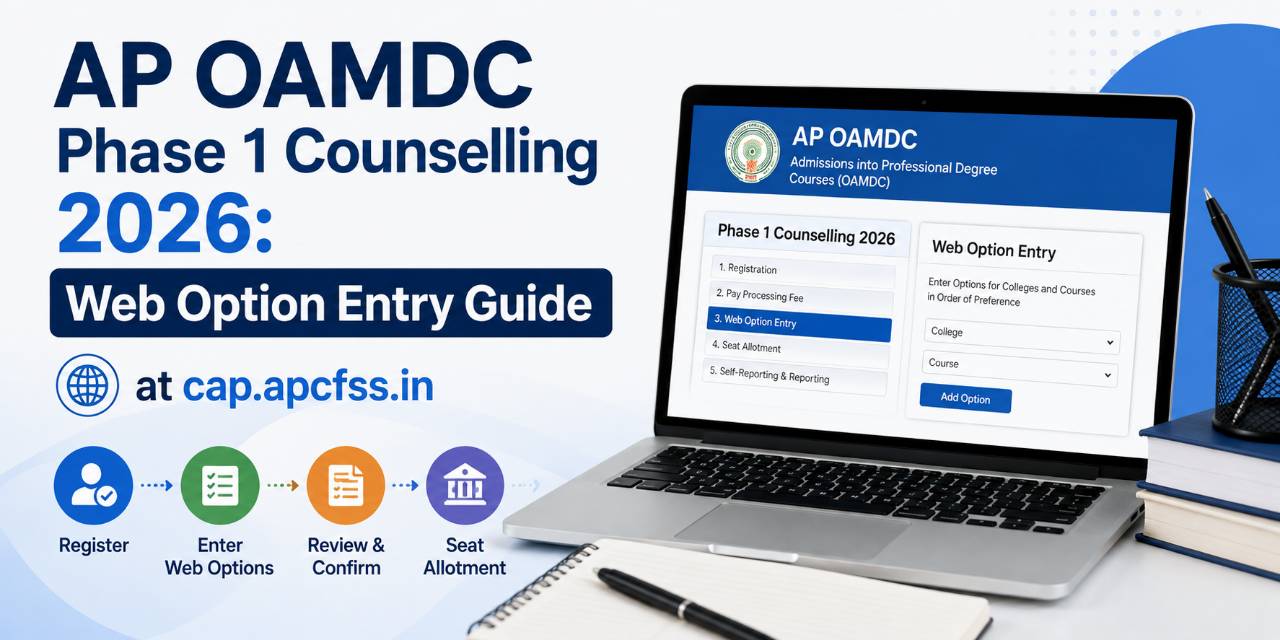

The Andhra Pradesh State Council of Higher Education (APSCHE) has opened the AP OAMDC Phase 1 Counselling 2026 web option entry window on the official Common Admissions Portal at cap.apcfss.in. If you cleared Intermediate or an equivalent exam and completed registration plus certificate verification, this is the stage where you choose colleges and courses that will decide your undergraduate seat. A revised counselling schedule is live on the portal, so every candidate should confirm the latest dates before logging in.
OAMDC (Online Admission Module for Degree Colleges) is Andhra Pradesh's centralised platform for non-professional degree admissions across government, aided, and private affiliated colleges. Phase 1 is the first major allotment round. Missing the option entry deadline means you cannot be considered for seat allocation in this phase, even if your merit rank is strong. This guide explains the revised timeline, eligibility, step-by-step option entry, smart preference strategy, documents to keep ready, and what happens after you lock your choices—written in simple language for students and parents across Andhra Pradesh.
What Is AP OAMDC and Why Does Phase 1 Matter?
AP OAMDC is the digital admission system APSCHE uses to manage undergraduate admissions fairly and transparently. Instead of visiting multiple colleges separately, candidates register once, verify documents, enter web options online, and receive seat allotment based on merit, category, reservation, and local area rules.
Phase 1 counselling typically covers the largest share of seats in popular programmes such as BA, B.Sc, B.Com, BBA, BCA, B.Voc, BMS, BHM, BFA, BPA, and select 5-year integrated postgraduate programmes. Because most students aim for their preferred college in the first round, Phase 1 option entry is the most competitive stage of the admission cycle.
Programmes Covered Under OAMDC 2026
OAMDC handles general degree admissions. Professional courses such as MBBS, BDS, and other health-science professional entries usually follow separate counselling channels. Students interested in medical and allied health pathways in Andhra Pradesh often look at institutions like the Dr NTR University of Health Sciences Vijayawada, which operates outside the standard OAMDC degree allotment framework. For OAMDC, focus on arts, science, commerce, management, vocational, and integrated degree routes offered by affiliated colleges statewide.
- Arts and Humanities: BA in History, Political Science, Economics, Psychology, and related combinations
- Science: B.Sc in Mathematics, Physics, Chemistry, Computer Science, Statistics, and life sciences
- Commerce: B.Com (General, Computers, Honours where available)
- Management and Professional Degrees: BBA, BMS, BHM, BCA
- Creative and Vocational: BFA, BPA, B.Voc streams
- Integrated Programmes: 5-year MA, MSc, or other integrated options listed on the portal
Always check the official college–course matrix on cap.apcfss.in before filling options. Not every college offers every combination, and seat counts vary by category and district.
AP OAMDC Phase 1 Counselling 2026: Revised Schedule Explained
APSCHE released a revised Phase 1 schedule after adjusting earlier timelines for registration, verification, and web options. Dates can change with short notice, so treat the portal notice as the final authority—not screenshots from older news articles.
Based on the latest revised schedule circulated around the option entry window, candidates should note the following Phase 1 milestones:
| Event | Revised Phase 1 Timeline (2026) |
|---|---|
| Online Registration and Fee Payment | August 5 to 11, 2026 |
| Certificate Verification (Help Line Centres / Virtual) | August 5 to 20, 2026 |
| Special Category Verification (PH, NCC, Sports, CAP) | August 12 to 13, 2026 |
| Web Option Entry (Exercise of Choices) | August 20 to 23, 2026 (revised window) |
| Change / Modification of Web Options | August 24, 2026 |
| Phase 1 Seat Allotment Result | August 31, 2026 |
| Reporting to Allotted college | August 31 to September 2, 2026 |
| Commencement of Classes | From August 31, 2026 (as notified) |
Important: If you registered late or your certificates were verified after the original web option dates, the revised schedule may still allow participation—provided verification is marked complete in your OAMDC profile before option entry closes. Log in and confirm your status rather than assuming eligibility.
Why Was the Schedule Revised?
Schedule revisions in Andhra Pradesh admissions often happen when registration volumes are high, help line centres need extra verification days, or technical updates are required on the portal. APSCHE publishes the updated notice on cap.apcfss.in and through official press communications. During revised windows, candidates who missed earlier deadlines get a fair chance to complete pending steps before allotment.
Who Is Eligible to Fill Web Options in Phase 1?
Not every Intermediate pass student can enter options immediately. APSCHE allows web option entry only for candidates who satisfy all of the following conditions:
- Successful OAMDC 2026 registration with application number and fee payment receipt
- Certificate verification completed for Phase 1 (online or at Help Line Centre)
- Eligible qualifying exam—typically AP Intermediate or equivalent board result
- Correct category and reservation claims verified in the profile (SC, ST, BC, EWS, PH, etc.)
- Local area status properly recorded where applicable (AU, SVU, OU regions)
Candidates who registered but have pending document objections must resolve them during verification. If your status shows incomplete verification, the web options module will not activate. In that case, contact the allotted Help Line Centre immediately or wait for the next counselling phase announced by APSCHE.
Special Category Candidates
Students claiming reservations under Physically Handicapped (PH), NCC, Sports, or CAP categories must complete special category verification on the designated dates. Without this step, benefit seats will not be allotted even if you enter those colleges as preferences. Double-check your category flags before locking options.
How to Fill AP OAMDC Phase 1 Web Options at cap.apcfss.in
Option entry is fully online. The process is simple if you prepare a college shortlist in advance. Follow these steps carefully on a laptop or desktop with stable internet—mobile browsers sometimes cause formatting issues on government portals.
- Visit the official portal: Open cap.apcfss.in and click the OAMDC candidate login link.
- Log in securely: Enter your application number, password, and date of birth. Use Forgot Password if needed.
- Open the web options module: From the dashboard, select the link for web options / choice filling for Phase 1.
- Review available colleges and courses: Download or browse the master list filtered by district, course, and college type.
- Add preferences in priority order: Enter your most preferred college–course combination first, then the next, and so on.
- Use Option A and Option B wisely: Where the portal offers both buckets, filling both increases allotment chances (explained below).
- Rearrange, add, or delete: Edit until the list reflects your true priorities—not parental pressure or peer suggestions alone.
- Save and freeze / lock: Options not locked before the deadline are not considered for allotment.
- Download confirmation: Print or save the locked option form and payment/registration summary for reporting day.
After the initial entry window closes, APSCHE opens a change-of-options day (August 24, 2026, in the revised schedule). Use this only if you genuinely need to reorder or replace choices—do not leave first-time entry for the modification day in case of server load or connectivity issues.
Understanding Web Options: Priority Order, Option A, and Option B
Many students lose good seats because they misunderstand how the allotment engine works. The system is merit-driven but strictly respects the order of your locked choices.
Why Option Order Is Critical
Suppose your rank qualifies you for both College X and College Y. If College Y is your dream institute but you listed it fifth, and your first four options have vacant seats matching your rank, you will be allotted to the highest available choice—not College Y. Always place the college you genuinely want to join at the top, followed by realistic backups.
Think of your list as a waterfall:
- The system checks Option 1 first.
- If a seat is available and you meet cut-off rules, you are allotted and lower options are ignored.
- If Option 1 is unavailable, the system moves to Option 2, and continues down the list.
Option A and Option B Explained
AP OAMDC often provides two parallel option buckets—Option A and Option B. You may fill only A, only B, or both. Career counsellors and APSCHE advisories generally recommend filling both A and B with carefully ranked choices to maximise the probability of receiving a seat in Phase 1.
Option A and Option B may correspond to different college groupings or programme clusters depending on the year’s notification. Read the on-screen instructions on the portal during entry. If you are eligible across multiple course groups, ensure your first preference in each group reflects the programme you are willing to join.
Merit, Category, and Local Area Rules
Seat allotment is not only about rank. Reserved category seats, local area quotas (Andhra University, Sri Venkateswara University, Osmania University regions), and special reservations interact with your preference list. A higher-ranked candidate in another category will not take your reserved seat, but you must still enter colleges where your category seats exist.
Documents to Keep Ready Before and After Option Entry
Option entry itself may not require uploads, but verification data must match originals you carry for reporting. Keep scanned copies and physical files ready:
- Intermediate or equivalent marks memo
- SSC certificate for date of birth proof
- Study certificates from Class 9 through Intermediate
- Transfer Certificate (TC) from the last institution
- Caste certificate (if applicable) and income certificate for fee reimbursement
- Aadhaar card
- OAMDC registration and fee payment receipt
- Special category certificates (PH, NCC, Sports, CAP) if claimed
- Printout of locked web options and future allotment letter
Mismatch between verified documents and reporting-day originals can lead to admission cancellation. Verify spellings of name, parent name, date of birth, and category codes in your OAMDC profile before the August 24 modification window closes.
Smart Strategy: Building Your College Shortlist
Successful candidates treat option entry like planning a backup ladder—not a single wish. Use this practical approach:
Step 1: Estimate Your Realistic Rank Band
Compare your Intermediate marks (or equivalent score used for OAMDC merit) with previous year cut-offs listed in unofficial trackers and college websites. Identify safe, moderate, and ambitious colleges within your district and neighbouring districts.
Step 2: Prioritise Course Over Brand Alone
A well-known college with the wrong specialisation can hurt long-term goals. If you want B.Sc Computer Science for software careers, do not list plain B.Sc General at a famous college above CS at a solid affiliated college unless you are comfortable with that trade-off.
Step 3: Include Enough Backups
Fill the maximum allowed options. Leaving the list short reduces allotment chances dramatically in Phase 1. Parents and students should agree on the lowest acceptable college before locking.
Step 4: Consider Location and Costs
Factor in hostel availability, travel time, and fee structure—including fee reimbursement eligibility. Government colleges differ sharply from private aided and unaided institutions in annual costs.
Step 5: Re-check Before Freeze
Read every preference line once more from bottom to top. Confirm course codes, campus names, and shift details (morning/evening where applicable). Typos in manual searches cause wrong selections.
Fee Reimbursement and Category Benefits During OAMDC
Many Andhra Pradesh students depend on fee reimbursement schemes linked to family income and social category. If you claimed reimbursement during registration, ensure your income certificate was verified correctly. Incorrect income slab data can delay fee processing after allotment even when your seat is confirmed.
Reserved category students should enter colleges where category seats are notified in the official matrix. Some popular colleges fill general seats quickly; your reserved quota may remain open longer at the same institution—another reason to research seat types, not just college names.
What Happens After You Lock Your Web Options?
Once the modification window ends, APSCHE processes allotments. On August 31, 2026, Phase 1 seat allotment results are published on cap.apcfss.in. Candidates must download the allotment memo and report to the allotted college between August 31 and September 2, 2026.
Reporting and Self-Reporting
Reporting typically involves physical presence at the college with originals and photocopies, payment of admission fee where required, and confirmation on the portal through self-reporting steps outlined in the allotment notification. Failure to report within the window may lead to seat cancellation and penalty rules for future rounds—read the fine print on the allotment letter.
If You Are Not Allotted a Seat
No allotment in Phase 1 is not the end. APSCHE conducts further phases with vacant seats. You may need to pay attention to Phase 2 and Phase 3 notifications, fresh web option windows, and spot admission guidelines. Keep your mobile number and email updated in your profile for SMS alerts.
If You Receive a Seat but Want a Better College
Understand whether Phase 1 allotment is freeze-type or allows participation in later rounds per that year’s rules. Some years require cancellation or non-reporting strategies to join subsequent phases—never skip reporting without reading official instructions, as you may lose both the current seat and future eligibility.
Common Mistakes to Avoid During AP OAMDC Option Entry
- Missing the lock deadline: Saved but unfrozen options are treated as no participation.
- Listing dream colleges first without backups: Leads to zero allotment if ranks fall short.
- Ignoring local area and category seats: Wastes reserved opportunities.
- Entering options on the last hour: Server slowdowns on final days are common.
- Using shared or public computers without logout: Protects your credentials and choices.
- Relying on unofficial WhatsApp forwards for dates: Always verify on cap.apcfss.in.
- Choosing courses under parental pressure: Dropping out later is costlier than careful planning now.
- Not filling Option B when eligible: Reduces allotment probability unnecessarily.
Phase 2 and Phase 3: What Comes Next?
AP OAMDC counselling continues in multiple phases through September 2026 (exact dates announced later on the portal). Phase 2 and Phase 3 capture vacant seats after reporting, college withdrawals, and non-reporting cases. Candidates who miss Phase 1 verification or want to upgrade after allotment should monitor APSCHE announcements.
Each phase follows a similar pattern—web options, modification day, allotment, and reporting—but with a narrower seat pool. Students who secured a seat in Phase 1 must decide carefully before joining later rounds.
Conclusion: Act Now, Choose Wisely, Verify Everything
The AP OAMDC Phase 1 Counselling 2026 option entry at cap.apcfss.in is the decisive step between qualifying Intermediate and securing an undergraduate seat in Andhra Pradesh. With the revised schedule placing initial web options through August 23, 2026, and modifications on August 24, 2026, eligible candidates have a narrow but manageable window to translate merit into admission.
Log in today, confirm your verification status, research courses using the official college list, rank choices honestly with strong backups, and freeze your options before the deadline. Download every confirmation page, prepare documents for reporting, and track August 31 allotment results. Whether you aim for a government degree college in your hometown or a specialised programme elsewhere in the state, disciplined option entry gives you the best chance—while separate professional pathways remain available through dedicated systems for fields like health sciences under universities such as Dr NTR University of Health Sciences Vijayawada.
Stay updated only through official APSCHE communications, avoid last-minute panic, and treat your preference list as a personal roadmap—not a guess. Phase 1 rewards preparation, clarity, and timely action.