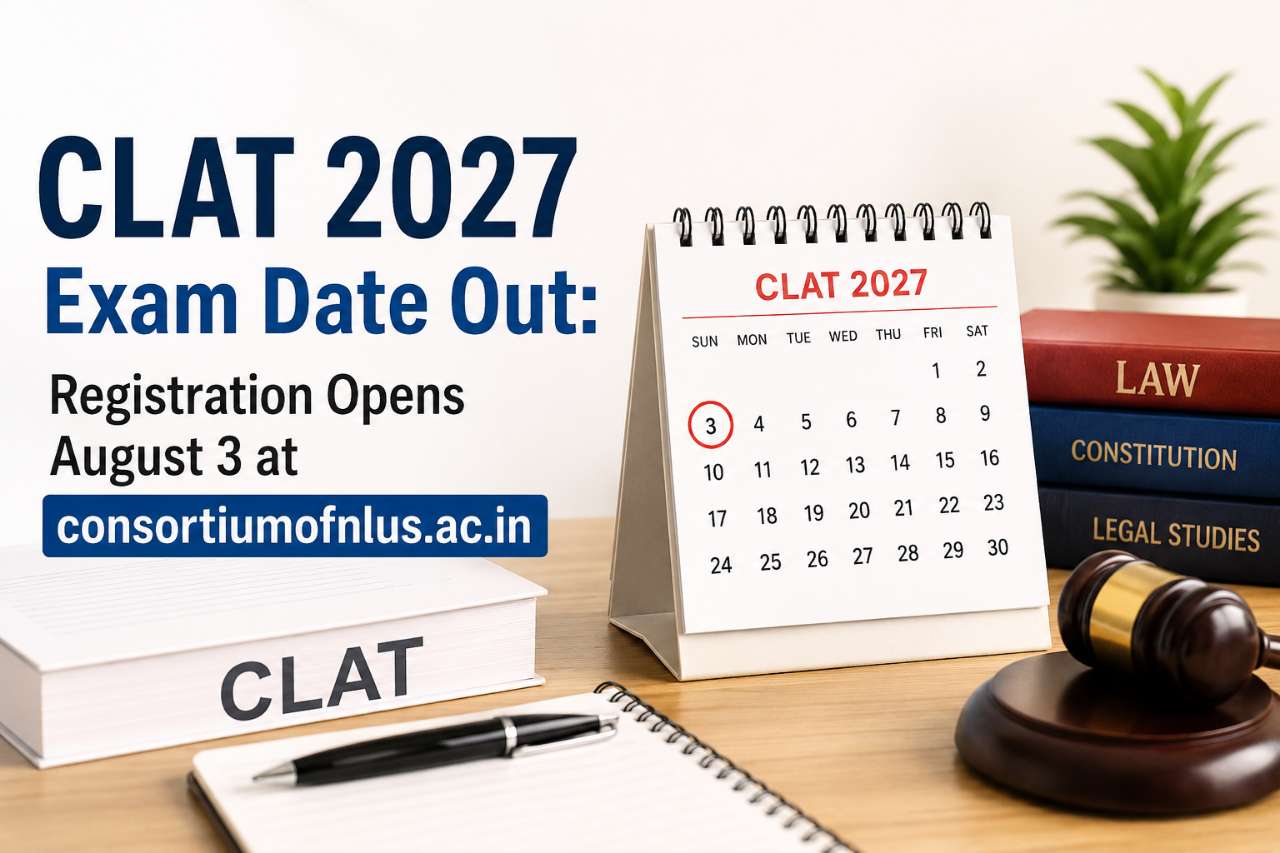

The Consortium of National Law Universities (Consortium of NLUs) has officially announced the schedule for the Common Law Admission Test (CLAT) 2027. According to the notification released on the official portal at consortiumofnlus.ac.in, the exam will be held on Sunday, December 6, 2026, from 2:00 pm to 4:00 pm. Online registration opens on August 3, 2026 and closes on October 31, 2026.
For lakhs of students who dream of studying law at India's top National Law Universities (NLUs), this announcement marks the beginning of a long and focused preparation journey. CLAT remains the single gateway for five-year integrated LL.B. programmes at premier institutions such as NLSIU Bangalore, NALSAR Hyderabad, and WBNUJS Kolkata. Whether you are a Class 12 student planning your first law entrance or an LL.B. graduate targeting an LL.M. seat through PG CLAT, the 2027 calendar gives you a clear timeline to plan applications, mock tests, and college preferences without last-minute confusion.
This guide covers every confirmed detail about CLAT 2027 dates, eligibility, exam pattern, fees, and the step-by-step registration process written in simple language for students and parents across India.
CLAT 2027 Important Dates at a Glance
The Consortium issued a press release on July 21–22, 2026, following meetings of its Executive Committee and Governing Body held on July 18, 2026. The schedule below reflects all officially confirmed dates. Keep checking the official website for updates on admit cards, answer keys, results, and counselling.
| Event | Date |
|---|---|
| Press release issued | July 21–22, 2026 |
| Registration opens | August 3, 2026 |
| Public feedback window closes | August 31, 2026 |
| Registration deadline | October 31, 2026 |
| CLAT 2027 exam date | December 6, 2026 (Sunday) |
| Exam timing | 2:00 pm to 4:00 pm |
| Admit card (expected) | November 2026 |
| Result (expected) | Late December 2026 |
Quick answer for featured snippets: CLAT 2027 will be conducted on December 6, 2026, from 2 pm to 4 pm. Registration begins August 3, 2026, and ends October 31, 2026, at consortiumofnlus.ac.in.
Why December 6 Matters for Your Preparation Plan
With roughly four months between the registration deadline and the exam, most serious aspirants begin structured preparation at least eight to ten months before the test day. If you are in Class 12 in 2026–27, December 6 falls early in your board exam year. Balance board syllabus revision with daily CLAT reading practice especially English passages, logical reasoning, and current legal affairs. Treat the confirmed date as a fixed anchor rather than waiting for further notifications.
What Is CLAT and Who Conducts It?
The Common Law Admission Test, widely known as CLAT, is a national-level entrance examination conducted by the Consortium of NLUs. It is the primary route for admission to undergraduate (UG) and postgraduate (PG) law programmes at participating National Law Universities across India.
CLAT UG leads to five-year integrated programmes such as BA LL.B. (Hons.), BBA LL.B. (Hons.), and B.Com LL.B. (Hons.). CLAT PG is used for one-year LL.M. admissions and is also accepted by several public sector undertakings (PSUs) for legal officer recruitment. Unlike design entrances such as the NID DAT or the NIFT Entrance Exam, CLAT tests reading comprehension, reasoning, and legal aptitude rather than sketching or portfolio skills but the same principle applies: start early, understand the pattern, and apply before the deadline.
Participating NLUs and Programme Options
Over 20 National Law Universities accept CLAT scores. Top choices include NLSIU Bangalore, NALSAR Hyderabad, NLIU Bhopal, NLU Delhi, and NUJS Kolkata. Each NLU offers different combinations some focus on BA LL.B., others on BBA LL.B. or specialised honours tracks. Before registration closes, research campus culture, placement records, fee structures, and hostel facilities. Your NLU preference order during counselling can significantly affect where you eventually study.
Many students also explore parallel career paths in design or fashion while keeping law as a primary goal. If you are weighing multiple creative or professional entrances alongside CLAT, compare timelines carefully so application deadlines and exam dates do not clash.
CLAT 2027 Exam Pattern No Changes Confirmed
The Consortium has confirmed that the CLAT 2027 syllabus and exam pattern remain unchanged for both UG and PG papers. This decision follows a review of the CLAT Expert Committee Report 2026. Convenors may refine question quality where feasible, but the overall structure stays the same a relief for students who have already been preparing using CLAT 2026 materials.
CLAT UG 2027 Pattern
- Mode: Offline, pen-and-paper (OMR-based)
- Duration: 2 hours (120 minutes)
- Total questions: 120 multiple-choice questions (MCQs)
- Total marks: 120
- Marking scheme: +1 for each correct answer; −0.25 (one-fourth mark deducted) for each wrong answer
- Unattempted questions: No negative marking
CLAT UG 2027 Syllabus Sections
The UG paper is divided into five sections. Each section tests skills that law schools consider essential for the first year of study:
- English Language Reading comprehension, inference, vocabulary in context, and grammar usage through passage-based questions.
- Current Affairs Including General Knowledge National and international events, awards, appointments, and static GK linked to recent developments.
- Legal Reasoning Principles and fact situations; no prior legal knowledge required, but logical application of given rules is essential.
- Logical Reasoning Arguments, assumptions, conclusions, puzzles, and analytical patterns.
- Quantitative Techniques Class 10 level mathematics percentages, ratios, averages, and basic data interpretation.
Passage-based questions dominate the paper. Unlike traditional entrance exams that rely on isolated fact recall, CLAT rewards sustained reading focus. Build the habit of reading 800–1,000 word passages daily and answering inference-based questions without re-reading excessively.
CLAT PG 2027 Pattern
The postgraduate paper also contains 120 objective-type questions in the same two-hour offline format, with identical marking (+1/−0.25). Questions cover constitutional law, jurisprudence, administrative law, contract law, torts, criminal law, and other core LL.B. subjects. Final-year LL.B. students and graduates should revise standard textbooks and recent landmark judgments alongside solving previous-year papers.
Eligibility Criteria for CLAT 2027
CLAT UG 2027 Eligibility
- Candidates must have passed Class 12 (or equivalent) from a recognised board, or must be appearing in the Class 12 examination in 2027.
- There is no upper age limit for CLAT UG a change welcomed by repeat aspirants and mature students.
- Individual NLUs may prescribe minimum marks in Class 12 during counselling; check each university's criteria when shortlisting preferences.
CLAT PG 2027 Eligibility
- Open to candidates holding an LL.B. degree (three-year or five-year) from a recognised university.
- Final-year LL.B. students may also apply, subject to producing proof of graduation at the time of admission.
- Some NLUs specify minimum percentage requirements in LL.B.; verify these during preference filling.
CLAT 2027 Application Fee Structure
The application fee must be paid online during registration. It is non-refundable once submitted.
| Category | Application Fee |
|---|---|
| General, OBC, PIO, OCI, NRI | ₹4,000 |
| SC, ST, BPL, PwD | ₹3,500 |
Accepted payment modes typically include UPI, debit/credit cards, and net banking through the CLAT portal gateway. Keep a screenshot or payment receipt after a successful transaction. If payment fails but money is deducted, note the transaction ID and contact CLAT helpdesk support promptly do not wait until October 31.
How to Register for CLAT 2027 Online
Registration for CLAT 2027 opens on August 3, 2026. The entire process is online at consortiumofnlus.ac.in. Below is a detailed walkthrough you can follow on the opening day or anytime before the October 31 deadline.
Documents and Details to Keep Ready
- Valid mobile number and email ID (active throughout the admission cycle)
- Class 10 marksheet (for date of birth verification)
- Class 12 details or appearing certificate
- Recent passport-size photograph (specifications as per portal)
- Scanned signature on white paper
- Category certificate (SC/ST/OBC/PwD/BPL) if applicable
- LL.B. marks and degree details (for PG applicants)
Step-by-Step Registration Process
- Visit the official website consortiumofnlus.ac.in and click the CLAT 2027 registration link.
- Register with your mobile number and email. Verify through OTP.
- Log in and complete personal details name (as per Class 10 certificate), date of birth, gender, nationality, and address.
- Fill academic qualifications board, year of passing, percentage or CGPA, and appearing status if applicable.
- Upload photograph, signature, and supporting category documents in the prescribed format and file size.
- Select your exam centre preference from the available cities listed on the portal.
- Pay the application fee online and download the confirmation page.
- Save and print the application form for future reference and counselling.
Pro tip: Register in the first week of August rather than the last week of October. Server load spikes near deadlines, and document upload errors are easier to fix when time is on your side.
Expert Committee Report and Public Feedback Window
Before finalising the unchanged pattern, the Consortium reviewed the CLAT Expert Committee Report 2026 at its July 18 meetings. A public feedback window remained open until August 31, 2026, allowing students, teachers, and institutions to share views on question quality and exam design. While the structure stays the same, convenors may implement feasible improvements in how questions are framed so practising recent CLAT papers remains the best preparation strategy.
CLAT 2027 Exam Day: What to Expect
Understanding exam-day logistics reduces anxiety and helps you perform at your best. CLAT 2027 will be conducted in offline mode across multiple cities in India. You will receive an OMR sheet and a question booklet at your allotted centre.
Items to Carry on December 6, 2026
- CLAT 2027 admit card (printout mandatory)
- Valid photo identity proof Aadhaar, passport, or school/college ID as specified in the admit card instructions
- Black or blue ballpoint pen for marking the OMR sheet
- Transparent water bottle, if permitted by centre rules
Exam-Day Guidelines
Report to the centre at least 60–90 minutes before the 2:00 pm start time. Electronic devices, calculators, watches with smart features, and study material are strictly prohibited inside the hall. Listen carefully to invigilator instructions regarding OMR filling a wrongly marked bubble can cost you marks even when your answer is correct. Manage your two hours by allocating roughly 24 minutes per section and leaving the last 10 minutes for reviewing flagged questions.
Preparation Strategy: From August 2026 to Exam Day
Month-by-Month Action Plan
August 2026: Complete registration, finalise NLU preferences, and begin daily reading of editorials and legal news. Take one full-length diagnostic mock to identify weak sections.
September–October 2026: Deep-dive into legal reasoning and logical reasoning. Solve sectional tests twice a week. Revise quantitative techniques using Class 10 NCERT examples. Continue current affairs notes weekly.
November 2026: Shift to full-length timed mocks every three to four days. Download your admit card as soon as it is released. Visit your exam centre location in advanvce if possible.
December 2026 (before December 6): Light revision only formula sheets, legal maxims, and current affairs from the last 90 days. Maintain sleep hygiene; avoid starting new topics in the final week.
Section-Wise Tips That Actually Work
- English: Read one editorial daily from a quality newspaper. Summarise the main argument in three sentences this builds speed for comprehension passages.
- Current Affairs: Maintain a monthly notebook covering national schemes, international summits, and major court rulings.
- Legal Reasoning: Never apply outside knowledge; stick strictly to the principle stated in the question.
- Logical Reasoning: Learn to identify premise-conclusion structures quickly; practice under a 90-second-per-question timer.
- Quantitative Techniques: Focus on accuracy over speed initially; CLAT maths is manageable with Class 10 revision.
Recommended Study Resources
Use the previous five years of CLAT papers as your primary practice material. Supplement with standard guides for legal reasoning and logical reasoning. For current affairs, combine a monthly magazine with daily newspaper reading. Join a structured mock test series from August onwards so you can track rank improvement before December 6.
After the Exam: Answer Key, Results, and Counselling
Although the Consortium has not yet released exact dates for post-exam events, historical trends suggest the following timeline. Treat these as expected milestones, not confirmed dates:
- Provisional answer key: Within a week after the exam
- Objection window: Short window after answer key release
- Final answer key and result: Late December 2026
- Counselling registration: Last week of December 2026 onwards
CLAT counselling is conducted centrally by the Consortium. Candidates are allotted seats based on rank, category, and NLU preference order. Multiple rounds including mop-up rounds may be held to fill vacant seats. Keep original documents ready: Class 10 and 12 certificates, category proof, CLAT scorecard, and identity proof.
How CLAT Counselling Works
After results are declared, eligible candidates register for counselling on the official portal, pay the counselling fee, and lock their NLU preferences. Seat allotment happens in rounds if you are allotted a seat, you can either accept and pay the admission deposit or choose to float for a higher preference in the next round. Understanding this process before the exam helps you set realistic NLU targets based on previous-year cutoffs.
Common Mistakes to Avoid During CLAT 2027 Registration
- Entering a name that does not match your Class 10 certificate this causes verification issues during counselling.
- Using a temporary email or inactive phone number all CLAT communication goes through these channels.
- Uploading blurred photographs or oversized files follow portal specifications exactly.
- Waiting until October 31 evening to pay the fee payment gateway failures on deadline day can cost you an entire year.
- Ignoring NLU-specific eligibility during preference selection a high rank cannot compensate for not meeting a university's minimum marks rule.
CLAT 2027 vs Other Law Entrances: Know the Difference
Many Class 12 students confuse CLAT with other law admissions routes. CLAT is the central exam for NLUs, while some universities including SLAT, AILET for NLU Delhi, and LSAT India conduct separate tests. If NLUs are your priority, CLAT should anchor your preparation calendar. AILET is a separate one-university exam with its own pattern; SLAT covers Symbiosis law schools. Applying to multiple exams is smart, but do not let secondary forms distract you from the December 6 CLAT date.
For postgraduate candidates, PG CLAT remains the most widely accepted route for LL.M. seats at NLUs. Some universities also accept CUET PG scores for law programmes, but NLU LL.M. admissions still revolve around CLAT PG performance and rank.
Why Starting Early Gives You an Edge
Law entrance preparation is a marathon, not a sprint. Students who begin reading comprehension and legal reasoning practice in early 2026 enter August registration with confidence rather than panic. Set weekly targets: three passages daily, two legal principle drills, one full mock every fortnight until November, then increase mock frequency. Track your accuracy percentage rather than raw scores alone CLAT rewards precision because of negative marking. Parents can support by creating a quiet study routine and helping students stay updated on official notifications from consortiumofnlus.ac.in.
Conclusion
CLAT 2027 brings clarity at the right time for law aspirants across India. With the exam fixed on December 6, 2026, registration running from August 3 to October 31, 2026, and the familiar offline pattern unchanged, students can channel their energy into consistent preparation rather than speculating about format changes. Register early on consortiumofnlus.ac.in, build a realistic study plan, and use the months ahead to strengthen reading speed, reasoning accuracy, and current affairs awareness.
Whether your goal is a top NLU seat through CLAT or an LL.M. programme via PG CLAT, the path starts with one disciplined step: completing your application correctly and on time. Stay updated through the official portal, practise with purpose, and approach December 6 with confidence.