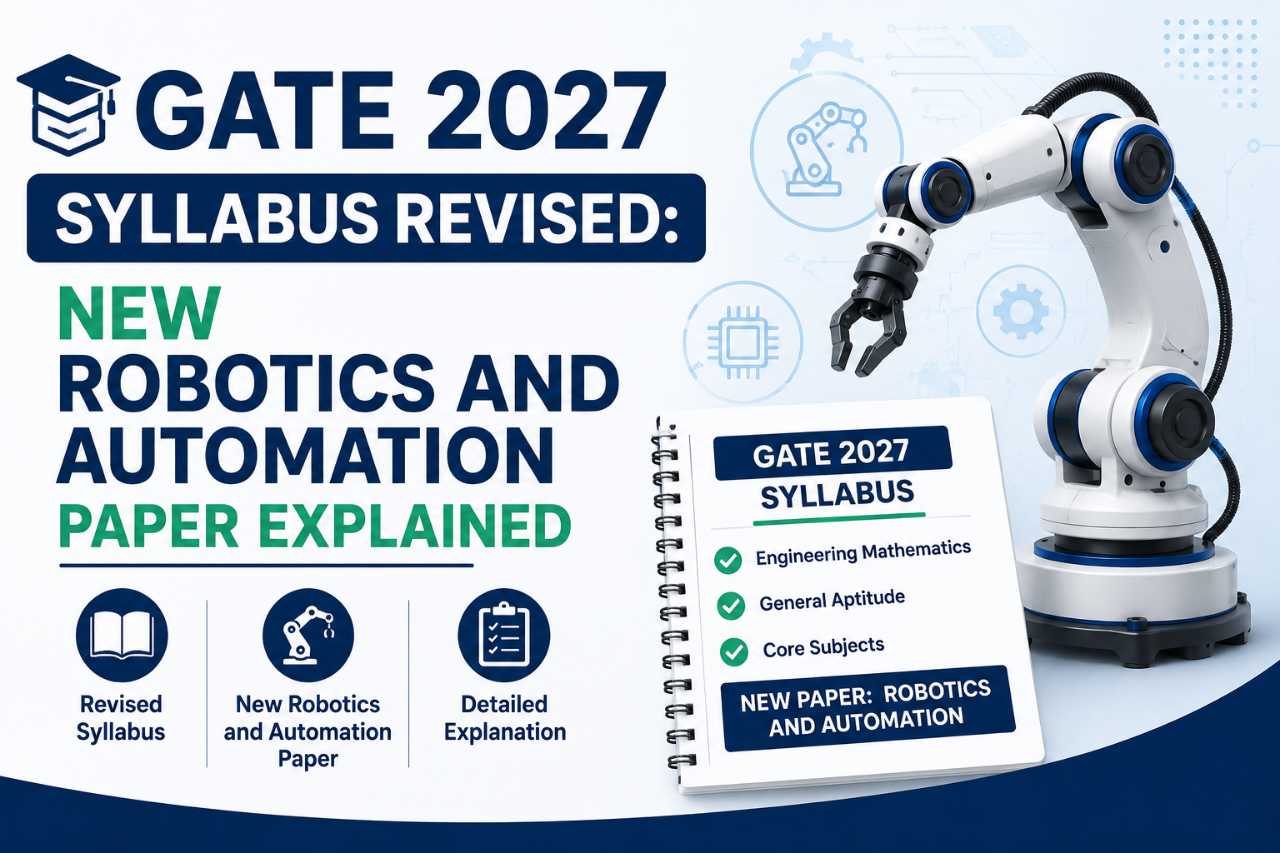
The Graduate Aptitude Test in Engineering (GATE) is one of india's most important national-level exams for postgraduate admissions, research fellowships, and Public Sector Undertaking (PSU) recruitment. For the 2027 cycle, IIT Madras Chennai has released a revised syllabus on the official portal gate2027.iitm.ac.in. The update includes a brand-new Robotics and Automation (RA) paper, structural changes to Textile Engineering and Fibre Science (TF), and section-level revisions across Engineering Sciences (XE), Humanities and Social Sciences (XH), and Life Sciences (XL).
If you are planning to appear in GATE 2027, reviewing the updated syllabus before registration opens on 14 August 2026 is essential. Old notes, coaching modules, or previous-year plans may no longer match the official topic list. This guide explains what changed, who the new RA paper is for, how to download the correct syllabus PDF, and how to adjust your preparation without losing momentum.
What Is GATE 2027 and Why Does the Syllabus Matter?
GATE evaluates undergraduate-level understanding across engineering, technology, science, architecture, commerce, arts, and humanities. The exam is conducted jointly by IISc Bangalore and the IITs under the National Coordination Board (NCB), Department of Higher Education, Ministry of Education, Government of India. A valid GATE score remains useful for three years and can unlock M.Tech, M.E., integrated Ph.D., and direct Ph.D. admissions at centrally funded institutions, along with recruitment at organisations such as BHEL, ONGC, IOCL, and NTPC.
The syllabus is not a formality. It defines the boundary of what examiners can ask, helps you prioritise high-weightage units, and prevents wasted effort on retired topics. When IIT Madras revises syllabi after several years—as reported for the 2027 cycle—the changes usually reflect industry trends, updated UG curricula, and emerging interdisciplinary fields such as robotics, automation, and data-driven manufacturing.
Who Should Pay Close Attention to the 2027 Revision?
- Final-year B.Tech/B.E. students targeting M.Tech admissions in 2027–28.
- Working professionals seeking PSU jobs or part-time postgraduate programmes.
- Robotics, mechatronics, and automation aspirants who previously had to choose ME, EE, EC, or CS papers that only partially matched their specialisation.
- TF and multi-disciplinary paper candidates appearing under XE, XH, or XL, where sectional codes and topic lists have shifted.
- Repeat test-takers using older syllabus PDFs from GATE 2022–2026 without cross-checking updates.
GATE 2027 Syllabus Revision: Key Highlights at a Glance
IIT Madras has notified candidates that syllabi for all GATE 2027 test papers have been revised. The organising institute has also highlighted four headline changes on the official website: introduction of Robotics and Automation (RA), updates to Textile Engineering and Fibre Science (TF), and modifications to sectional paper codes under XE, XH, and XL.
| Aspect | GATE 2027 Details |
|---|---|
| Organising institute | IIT Madras |
| Total test papers | 30 (including new RA paper) |
| New paper introduced | Robotics and Automation (RA) |
| Papers with notable syllabus changes | RA (new), TF, XE, XH, XL, and others |
| Total marks per paper | 100 (15 General Aptitude + 85 subject-specific) |
| Exam medium | English |
| Maximum papers per candidate | Two (in approved combinations only) |
| Score validity | 3 years from result declaration |
| Official syllabus portal | gate2027.iitm.ac.in |
The overall exam framework—computer-based test format, negative marking in MCQs, and the 15-mark General Aptitude section common to all papers—remains consistent. What has changed is the subject catalogue and the depth or grouping of certain topics, which directly affects paper selection and study planning.
New Robotics and Automation (RA) Paper: What Candidates Must Know
The most significant addition in GATE 2027 is Robotics and Automation (RA), a dedicated interdisciplinary paper designed for engineers working at the intersection of mechanical systems, electronics, control theory, embedded computing, and intelligent automation. This aligns with India's push toward smart manufacturing, industrial IoT, warehouse automation, medical robotics, and AI-enabled production lines.
Unlike choosing a traditional branch paper and hoping robotics questions appear incidentally, RA allows candidates to demonstrate focused competence in mechatronics, robot kinematics, sensors, actuators, real-time control, and related engineering fundamentals. Institutes such as Indian Institute of Technology Bombay, Indian Institute of Technology Delhi, and IIT Madras itself offer advanced programmes and research labs in automation; a specialised GATE paper helps admissions committees identify relevant applicants more accurately.
Expected Structure of the RA Paper
Based on the official syllabus framework released for GATE 2027, the RA paper is divided into a mandatory common section (Part A) and optional specialised sections (Part B). Candidates typically choose one Part B track aligned with their undergraduate strength.
- Part A – Common section: Engineering Mathematics, Basics of Mechatronics, and Principles of Robotics and Automation. Topics may include coordinate systems, degrees of freedom, robot classification, sensors and actuators, end-effectors, trajectory planning, and industrial robot applications.
- Part B1 – Electrical Engineering orientation: Analog circuits and embedded systems, signals and systems, and control systems—critical for motor drives, feedback loops, and electronic interfacing in robotic platforms.
- Part B2 – Mechanical Engineering orientation: Mechanics of materials, kinematics and dynamics, machine design, and computer-integrated manufacturing (CIM)—essential for manipulator design, linkage analysis, and production automation.
Who Should Consider RA Instead of ME, EE, EC, or CS?
RA is worth evaluating if your B.Tech projects, internships, or career goals sit squarely in automation rather than a single core branch. Students from mechanical, electrical, electronics, instrumentation, mechatronics, and sometimes computer science backgrounds may find RA more aligned than forcing a mismatch into legacy papers.
However, do not choose RA simply because it sounds modern. Compare the official RA syllabus against your UG transcript, lab exposure, and comfort with control systems and embedded hardware. If your fundamentals in mathematics and your chosen Part B track are weak, a conventional paper where you already own 70% of the content may still yield a better score.
Changes to TF, XE, XH, and XL Papers
Not every GATE aspirant will opt for RA. Many will notice quieter but equally important revisions in multi-disciplinary and niche papers.
Textile Engineering and Fibre Science (TF)
Reports around the GATE 2027 notification indicate that TF has undergone structural change, with Textile Engineering and Fibre Science being repositioned within the Engineering Sciences (XE) framework as a sectional paper rather than standing entirely apart in the previous format. For textile technology graduates, this means you must verify whether you should register for XE with a specific section code instead of assuming the old TF-only pathway.
Practical tip: open both the revised TF/XE documents on gate2027.iitm.ac.in and mark which sections are compulsory, which are optional, and whether your undergraduate university syllabus still maps cleanly to the updated topic list covering fibre science, yarn manufacturing, fabric structure, textile chemical processing, and quality control.
Engineering Sciences (XE), Humanities and Social Sciences (XH), Life Sciences (XL)
XE, XH, and XL have always functioned as umbrella papers with sectional codes. For 2027, IIT Madras has modified section-level codes and syllabi—meaning the section you picked in 2025 or 2026 may not exist under the same name or weightage.
- XE: Relevant for candidates from engineering science, chemistry, polymer science, and now potentially textile-related sections. Cross-check section codes before selecting two papers.
- XH: Used by arts, economics, linguistics, philosophy, and social science graduates pursuing interdisciplinary postgraduate routes. Review each humanities section for renamed or merged units.
- XL: Covers life sciences sections such as chemistry, biochemistry, botany, microbiology, and zoology. Medical and biotechnology aspirants should confirm whether microbiology or biochemistry sections include new molecular biology or instrumentation topics.
GATE 2027 Exam Pattern and Marking Scheme
Understanding the stable parts of the pattern helps you build a preparation template even when subject content changes.
- General Aptitude (GA): 15 marks for all papers—verbal ability and numerical ability. This section is often the fastest score booster and should not be neglected while chasing heavy technical syllabi.
- Subject paper: 85 marks covering core and optional sections as defined in the paper-specific syllabus PDF.
- Question types: Multiple Choice Questions (MCQs), Multiple Select Questions (MSQs), and Numerical Answer Type (NAT) questions, depending on the paper.
- Negative marking: Applies to MCQs; MSQs and NAT questions typically carry no negative marking—check the official brochure when released.
Candidates may appear in up to two papers in approved combinations listed in the information brochure. Choosing a second paper is a strategic decision: it should complement your profile, not dilute preparation. For example, an automation-focused student might pair RA with EE or ME only if the combination is officially permitted and realistically manageable within six months of focused study.
Important GATE 2027 Dates Indian Students Should Track
Missing registration or document deadlines can disqualify even the best-prepared candidate. Based on the official GATE 2027 schedule published by IIT Madras, mark these dates on your calendar:
| Event | Date |
|---|---|
| GOAPS registration opens | 14 August 2026 |
| Regular registration closes (without late fee) | 21 September 2026 |
| Extended registration closes (with late fee) | 30 September 2026 |
| Admit card download | From 4 January 2027 |
| Examination dates | 6, 7, 13, 14, 20 and 21 February 2027 |
| Result announcement | 19 March 2027 |
Registration is expected to integrate DigiLocker and facial authentication for smoother identity verification at test centres—a useful detail when keeping ID proofs and photograph specifications ready. Also note that GATE 2027 will be conducted only at domestic centres; international exam centres have been dropped, so NRI and overseas candidates must plan travel to an Indian city accordingly.
How the Revised Syllabus Affects M.Tech Admissions and PSU Recruitment
GATE is not just an exam score; it is a gateway credential. A strong percentile can secure seats in M.Tech programmes at IITs, NITs, IIITs, and reputed state universities, often with Ministry of Education financial assistance through TA/RA ships. PSUs publish recruitment notifications specifying eligible GATE papers and minimum cut-offs—sometimes year to year.
The introduction of RA may initially create uncertainty: not every institute will immediately advertise RA-specific specialisations. Over time, departments covering robotics, control and automation, mechatronics, and advanced manufacturing are likely to accept RA scores as they update their admission brochures. If you are targeting a specific college or lab, email the department or watch M.Tech admission pages on institute websites after GATE results.
Engineering graduates from colleges such as Krishna Institute of Engineering and Technology, Galgotias College of Engineering and Technology, SRM Institute of Science and Technology Chennai, Sathyabama Institute of Science and Technology Chennai, and RMK College of Engineering and Technology Chennai compete nationally on GATE percentiles; syllabus clarity levels the playing field regardless of your home institution's brand value.
Step-by-Step Preparation Plan After the Syllabus Update
When syllabi change, panic is common—but a structured reset works better than restarting from zero.
Phase 1: Audit and Map (Week 1–2)
- Download the official revised PDF for your primary paper from gate2027.iitm.ac.in.
- Highlight topics that are new, merged, renamed, or removed compared with your old notes.
- Build a topic matrix with columns for theory status, PYQ coverage, and priority (high/medium/low).
Phase 2: Resource Alignment (Week 3–4)
- Replace outdated modules in coaching notes with standard textbooks aligned to new units.
- For RA aspirants, combine mechatronics and robotics resources with core EE or ME revision based on Part B choice.
- Continue GA practice weekly—15 marks can shift your normalized score significantly.
Phase 3: Practice and Testing (Month 2 onward)
- Solve previous-year papers for overlapping topics; treat newly added units with open-book learning first, then closed-book tests.
- Join full-length mock tests under CBT timing to build stamina for the three-hour exam window.
- Revise weak sections using short concept sheets rather than re-reading entire textbooks before the exam.
Robotics and Automation Career Outlook in India
India's manufacturing, logistics, healthcare, defence, and agriculture sectors are adopting automated systems at a rapid pace. Job roles such as robotics engineer, automation specialist, PLC programmer, machine vision engineer, and controls engineer increasingly require postgraduate training or specialisation. GATE remains one of the most credible filters for such pathways because it is nationally standardised and recognised by top academic and public-sector employers.
Students comparing postgraduate entry routes should remember that GATE is engineering-centric. If you are from a pure management or arts background exploring postgraduate options, exams like MAT or university-specific tests may be more relevant, while science and humanities candidates should review XH or XL sections carefully rather than defaulting to branch engineering papers. Graduates from institutions such as University of Petroleum and Energy Studies and Gurukul Institute of Engineering and Technology Kota should verify which GATE paper codes their target M.Tech programmes accept before finalising registration.
Common Mistakes to Avoid After the GATE 2027 Syllabus Revision
- Using outdated syllabus PDFs from coaching institutes instead of the official gate2027.iitm.ac.in documents.
- Choosing RA without reading Part B options, then discovering the electrical track requires stronger circuit analysis than expected.
- Ignoring TF/XE restructuring and registering under the wrong paper code.
- Submitting multiple application forms—IIT Madras warns this can lead to rejection without refund.
- Neglecting General Aptitude while over-investing in niche technical topics with lower return per hour.
- Assuming international test centres remain available for 2027 planning.
Conclusion
The GATE 2027 syllabus revision marks an important shift for Indian postgraduate and PSU aspirants. IIT Madras has modernised multiple papers, introduced the dedicated Robotics and Automation (RA) test paper, and updated sectional frameworks under XE, XH, and XL—including structural changes linked to Textile Engineering and Fibre Science. The exam still awards 100 marks per paper with 15 marks of General Aptitude, accepts up to two papers in permitted combinations, and delivers results that remain valid for three years.
Your next step is simple but non-negotiable: visit gate2027.iitm.ac.in, download the official syllabus for your intended paper, and rebuild your study plan around the 2027 topic list before registration opens on 14 August 2026. Early alignment with the revised syllabus is the most reliable way to protect months of effort and maximise your GATE 2027 score when the exam is held across February 6–21, 2027.