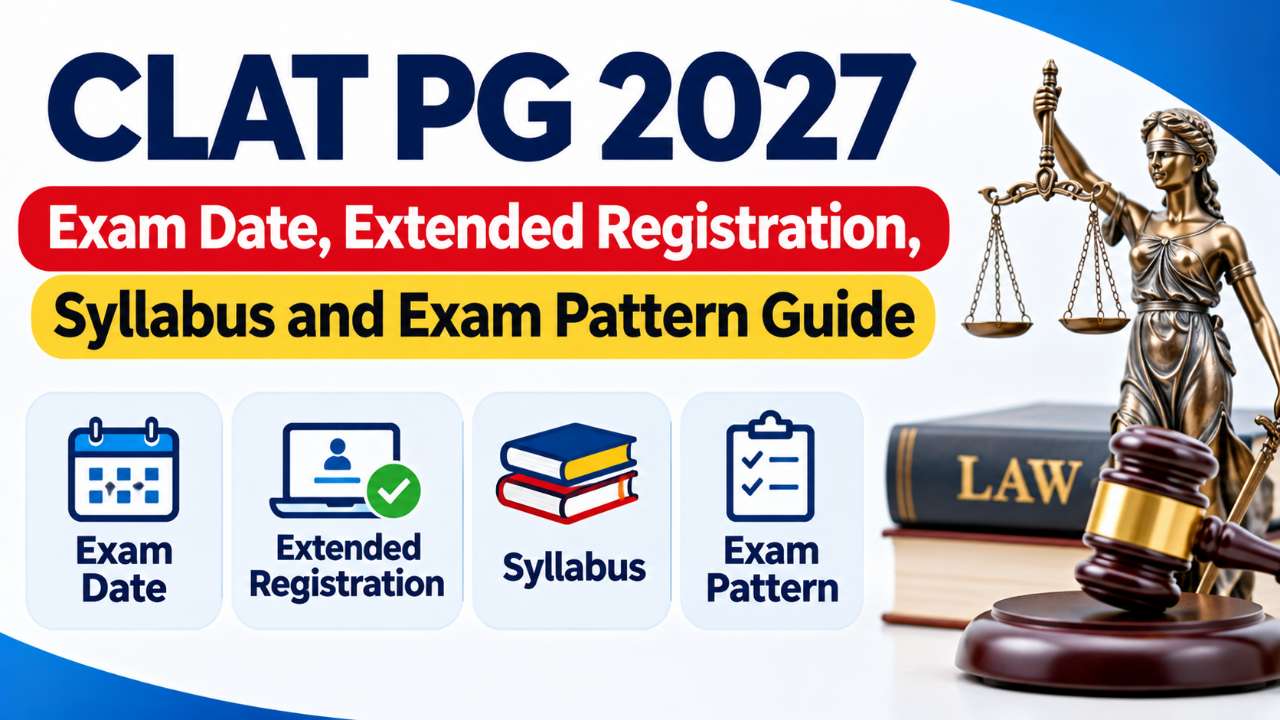
If you are targeting a five-year LLB or an LLM at a National Law University (NLU), CLAT 2027 is the gateway exam that shapes your next academic chapter. In a late update that gives last-minute applicants extra breathing room, the Consortium of National Law Universities has extended the CLAT 2027 registration deadline to November 7, 2026. The earlier cut-off was October 31, 2026. Importantly, the consortium has confirmed that the CLAT 2027 exam will still be held on December 6, 2026 as scheduled, with admit cards expected roughly ten days before the test.
This extension arrives at a moment when interest in law as a career has never been higher . Data from recent CLAT cycles shows registrations climbing sharply about 70.5% growth between 2023 and 2026 with undergraduate (UG) aspirants forming the bulk of the crowd and postgraduate (PG) numbers rising even faster in percentage terms. For Indian students in Class 12, final-year LLB, or working professionals considering an LLM, the message is clear: the calendar has shifted slightly for applications, but preparation timelines have not. Use the extra days to register correctly, not to delay study.
On CollegeDwar, we track CLAT and PG CLAT closely because these exams feed into some of India’s most competitive law programmes. This guide explains what the extension means, who can apply, how fees work, why competition is tightening, and how to finish registration without errors.
CLAT 2027 Registration Extension: Key Dates at a Glance
When a deadline moves but the exam date stays fixed, aspirants must re-read the timeline carefully. Missing a step after November 7 can still lock you out of the December 6 slot.
- Extended registration deadline: November 7, 2026 (previously October 31, 2026)
- CLAT 2027 exam date: December 6, 2026 (unchanged)
- Admit card: Expected around ten days before the exam (approximately late November 2026)
- Participating institutes: Admission to programmes at 26 NLUs across India through CLAT
Actionable tip: Treat November 7 as a hard stop. Consortium portals often see heavy traffic in the final 48 hours. Register at least two to three days early, upload documents in the correct format, and pay the fee in one sitting so your application status shows as complete.
Why CLAT Registrations Are Rising So Fast
Law has moved from a niche profession to a mainstream higher-education choice for students who want careers in litigation, corporate law, judiciary, policy, academia, and emerging fields such as technology regulation and arbitration. That shift shows up directly in CLAT numbers.
Registration and appearance trends (2019–2026)
Historical CLAT data illustrates both disruption and recovery. The COVID years affected appearance rates, but recent cycles show strong rebound and growth.
| Year | Total registrations | Appeared (all) | Appeared UG | Appeared PG |
|---|---|---|---|---|
| 2023 | 54,163 | 51,469 | 42,766 | 8,703 |
| 2024 | 67,590 | 65,185 | 53,180 | 12,005 |
| 2025 | 78,914 | 75,361 | 60,544 | 14,817 |
| 2026 | 92,344 | 88,657 | 72,631 | 16,026 |
Between 2023 and 2026, total CLAT registrations increased by approximately 70.5%. Analysts tracking the exam note that roughly 11,000 to 13,500 new candidates join the CLAT pool each year in recent cycles. For CLAT 2027, experts expect registrations to cross one lakh for the first time, which would mark a psychological and competitive milestone for aspirants.
UG vs PG: Different scales, both getting tougher
The undergraduate CLAT (five-year integrated LLB) dominates volume. In CLAT 2026, 72,631 candidates appeared in the UG paper, compared with 16,026 in the PG (LLM) paper. Yet PG CLAT has grown faster in relative terms about 84.1% growth in PG appearances over the same broad period reflecting more LLB graduates pursuing specialisation, academia, and higher-paying legal roles that favour postgraduate credentials.
If you are unsure which paper applies to you, use CollegeDwar’s dedicated pages: the UG journey is covered under CLAT, while LLM aspirants should follow PG CLAT for pattern, syllabus, and college-specific nuances.
CLAT Eligibility Criteria for 2027
Eligibility is programme-specific. Applying under the wrong category or with incomplete academic proof is one of the most common reasons applications fail scrutiny later in counselling.
Five-year integrated LLB (CLAT UG)
- Candidates must have passed Class 12 or equivalent with at least 45% marks (aggregate as per consortium rules).
- SC, ST, and PwD candidates need at least 40% in Class 12 or equivalent.
- Students who will appear in the Class 12 board examination in April–May 2027 are eligible to sit for CLAT 2027, subject to later proof of passing at admission.
Example: A student in Class 12 (Science stream) planning boards in 2027 can register now, attempt CLAT on December 6, and if selected submit final marksheets during NLU admission as per consortium guidelines.
LLM (CLAT PG)
- Candidates must hold an LLB degree (three-year or five-year) with at least 50% marks.
- SC, ST, and PwD candidates qualify with 45% in LLB.
- Final-year LLB students may apply; admission remains contingent on completing the degree with required marks.
- There is no upper age limit for CLAT UG or PG as per standard consortium policy communicated for recent cycles.
Actionable tip: Keep scanned copies of category certificates, PwD certificates, and mark sheets ready before you open the registration portal. File names and size limits matter compress images only if the portal allows, and never upload unreadable scans.
CLAT 2027 Application Fee Structure
Registration is completed online, including fee payment. The fee is non-refundable and non-adjustable, so double-check programme choice (UG vs PG) and personal details before paying.
- General and OBC candidates: ₹4,000
- SC, ST, BPL, and PwD candidates: ₹3,500
Use a stable internet connection and a payment method that you know works (UPI, net banking, or card). Save the payment receipt and application confirmation PDF immediately after submission.
Seat Matrix vs Applicants: Understanding Real Competition
Rising registrations do not automatically mean more seats. Through CLAT, NLUs collectively offer roughly 4,000 undergraduate seats and about 1,700 postgraduate seats. When you compare CLAT 2026 UG appearances (72,631) to UG seats (~4,000), the rough ratio is about 18 candidates per UG seat and that ratio may tighten if 2027 registrations exceed one lakh as projected.
This does not mean admission is impossible; it means rank optimisation matters. Many NLUs beyond the top five still offer excellent faculty, moot court culture, and placements. Smart counselling choices balancing preference list order with realistic cut-offs often matter as much as the exam score itself.
What “70% more applicants in three years” means for you
Competition is not uniform across sections. English and current-affairs-heavy sections reward daily habit. Legal reasoning rewards structured learning from principles, not rote statutes. Logical reasoning improves with timed sets. Quantitative techniques, though fewer in weight, can differentiate ranks when many students cluster in the middle.
Actionable tips for the unchanged December 6 exam:
- Run at least one full-length mock per week from now until the exam, analysing every wrong answer.
- Pair newspaper reading or monthly current affairs revision with static legal knowledge for CLAT-style passages.
- For PG aspirants, revise constitutional law, jurisprudence, and subject areas emphasised in recent PG CLAT papers via PG CLAT resources.
- Block the last ten days for admit card download, ID proof checks, and travel planning to your exam centre city.
CLAT 2027 Exam Pattern Overview (UG and PG)
While the consortium publishes the official notification and any pattern updates, CLAT has consistently tested comprehension-heavy, multiple-choice questions with negative marking. UG papers typically cover English language, current affairs including general knowledge, legal reasoning, logical reasoning, and quantitative techniques. PG papers focus on legal disciplines drawn from the LLB curriculum, with emphasis on understanding and application rather than isolated trivia.
Because the exam date did not move, your preparation plan should assume the standard CLAT timing and sectional balance unless an official revision bulletin says otherwise. Always cross-check the latest information bulletin on the consortium website after you register.
After Registration: Admit Card, Exam Day, and Next Steps
Once registration closes on November 7, the consortium shifts focus to centre allocation and admit card generation. Expect admit cards about ten days before December 6. On exam day, carry permitted ID and follow centre instructions on reporting time and materials allowed.
Post-exam, the cycle includes answer keys, objections (if opened), results, and centralized counselling for NLU seats. Cut-offs fluctuate yearly with paper difficulty and registration volume; a higher applicant pool in 2027 could push cut-offs upward for premier NLUs even if the paper difficulty stays similar.
Who Should Use the Extended Registration Window?
- Late deciders who only recently chose law over pure science, commerce, or humanities streams.
- Students awaiting documents such as category certificates or corrected spellings on mark sheets.
- PG applicants finishing LLB paperwork or degree completion proofs.
- Repeaters improving scores after CLAT 2026, who need a fresh application for 2027.
The extension is not an invitation to postpone preparation. With roughly four weeks between the new registration deadline and the exam, new registrants must enter an intensive, structured plan immediately after payment.
Common Registration Mistakes to Avoid
- Mismatch between name on Class 10 certificate and application form.
- Choosing UG when you intend PG (or vice versa) fee cannot be adjusted.
- Uploading photographs or signatures that fail specification checks.
- Ignoring email and mobile OTP steps; incomplete applications do not count as registered.
- Assuming extension of registration implies extension of admit card or exam date it does not.
Conclusion
CLAT 2027 registration now runs through November 7, 2026, giving thousands of additional aspirants time to join a pool that has already grown about 70% since 2023 and may exceed one lakh registrations for the first time. The exam itself remains on December 6, 2026, with admit cards expected near the end of November. Whether you are a Class 12 student eyeing a five-year LLB or an LLB graduate targeting an LLM through PG CLAT, act now: complete an error-free application, pay the correct fee, and redirect any time saved on paperwork into mocks and revision.
Stay updated on eligibility, syllabus, and college-wise cut-off trends on CollegeDwar’s CLAT hub as the consortium releases official bulletins after registration closes. In a year of record interest, preparation discipline and smart counselling strategy will separate aspirants who merely appear from those who secure NLU seats.