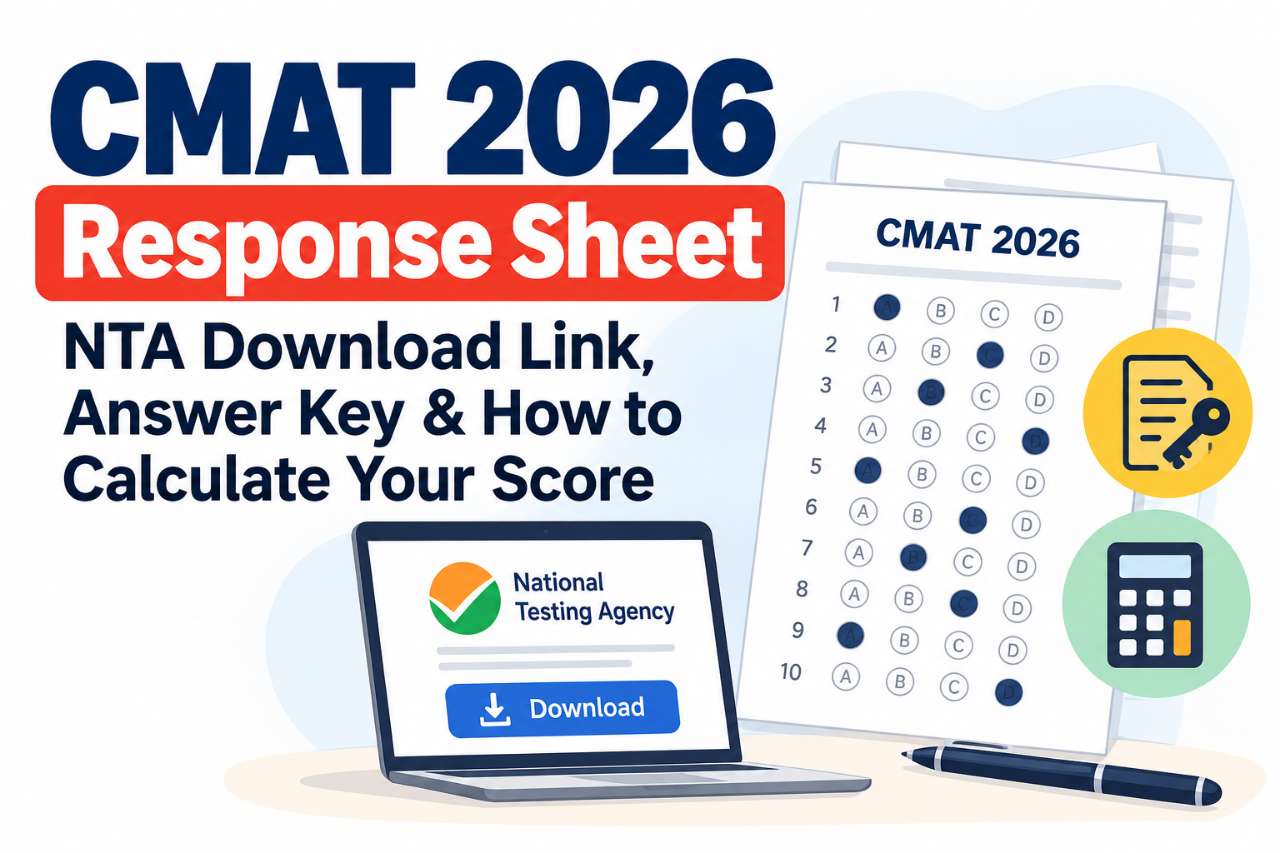

If you appeared for the Common Management Admission Test (CMAT) in 2026, the response sheet is one of the most important documents you will receive before the final result. Released by the national Testing Agency (NTA), it shows every question you attempted, the option you selected, and once the answer key is published the officially marked correct responses. Together, these tools let you calculate an expected raw score, compare your performance section-wise, and plan MBA applications to colleges that accept CMAT scores.
This article is written for Indian management aspirants who want clear, step-by-step guidance without jargon. Whether you are targeting Delhi NCR institutes, private universities in the Northeast, or comparing CMAT with exams like MAT, understanding the response sheet helps you make smarter admission decisions early. For a broader overview of the exam pattern, dates, and accepting colleges, also explore the dedicated CMAT page on CollegeDwar.
CMAT 2026 Response Sheet: What Has Been Released?
The CMAT response sheet is not your final scorecard. It is a transparent record of your exam attempt. NTA typically publishes it on the same day or within a few days after the CMAT exam, often together with the provisional answer key. Candidates log in with their application number and password or date of birth to access a downloadable PDF.
For CMAT 2026, keep your login credentials ready and use only the official NTA CMAT website (commonly listed as cmat.nta.nic.in or cmat.ntaonline.in always confirm the current URL on your admit card or NTA notification). Avoid third-party “mirror” links; phishing sites often appear around answer-key season.
Response Sheet vs Answer Key vs Result
- Response sheet: Your chosen answers and question identifiers as recorded by the system.
- Provisional answer key: NTA’s official correct options (subject to challenges within the objection window).
- Final answer key: Published after objections are reviewed; used for score calculation.
- Result and scorecard: Declared later with scaled scores, percentiles, and all-India rank details as applicable.
Think of the response sheet as your personal audit trail. If you forgot whether you changed an answer in Innovation & Entrepreneurship or marked a question for review in Logical Reasoning, the sheet settles the doubt instantly.
Expected Timeline After CMAT 2026 Exam
Exact dates change every year, but the sequence remains predictable. Use the table below as a planning reference and cross-check against the latest NTA PDF notice.
| Event | What to expect |
|---|---|
| CMAT 2026 exam day | Computer-based test at allotted centre; responses stored centrally by NTA. |
| Response sheet + provisional key | Usually within days of the exam; login required on the official portal. |
| Objection/challenge window | Short fixed period; fee per question challenged (refunded if objection accepted). |
| Final answer key | Released after processing challenges. |
| CMAT 2026 result | Scorecard with percentile; basis for college shortlists. |
Action tip: Screenshot or save the PDF the day it is released. Portal traffic spikes near deadlines, and having an offline copy helps if you need to discuss discrepancies with mentors or coaching faculty.
How to Download the CMAT 2026 Response Sheet (Official Steps)
The download process is simple but unforgiving of typos in login details. Use the same credentials you used for registration and admit card download.
- Open the official NTA CMAT website in a secure browser.
- Click the link labelled for Response Sheet or Answer Key / Response Sheet (wording may vary by year).
- Enter your application number and password or date of birth as prompted.
- Complete any security step if shown, then submit.
- Review the on-screen response sheet, then download the PDF and store it safely.
If login fails, reset the password through the “Forgot Password” flow before panicking about missing data. In most cases, the issue is a mismatched DOB format (DD/MM/YYYY) rather than a lost response record.
Details Mentioned on Your CMAT Response Sheet
When you open the PDF, verify identity fields first, then move question-by-question. Typical entries include:
- Candidate name, application number, and roll number
- Test date, shift, and subject/paper code if applicable
- Question ID and the option ID you selected
- Status of each item (attempted, not attempted, or marked for review exact labels depend on NTA format that year)
- After key release: indication of correct answer vs your response
Cross-check roll number and name against your admit card. Any mismatch should be flagged immediately through NTA’s helpdesk channels mentioned in the official information bulletin.
CMAT Marking Scheme Used for Score Calculation
To estimate raw marks from the response sheet and answer key, apply the standard CMAT marking pattern (confirm in the official brochure if NTA announces any change for 2026):
- Correct answer: +4 marks
- Wrong answer: −1 mark (negative marking)
- Unattempted question: 0 marks
CMAT is structured across sections such as Quantitative Techniques & Data Interpretation, Logical Reasoning, Language Comprehension, General Awareness, and Innovation & Entrepreneurship (weighting and section names should be verified against the latest syllabus). Your response sheet lets you tally correct and incorrect attempts per section, which is valuable because many colleges care about sectional balance, not only total raw score.
Sample Raw Score Calculation
Suppose you matched the final answer key and found:
- 62 questions correct → 62 × 4 = 248 marks
- 18 questions wrong → 18 × 1 = 18 marks deducted
- 20 unattempted → 0 impact
Estimated raw score = 248 − 18 = 230 (illustrative only; your actual count comes from your PDF).
Repeat the exercise section-wise. If General Awareness pulls your total down but Quant and LR are strong, you may still qualify for programmes that emphasise analytical skills provided you meet each Institute's sectional cutoff policy.
Challenging the CMAT Answer Key
NTA allows candidates to submit objections against the provisional answer key within a limited window. This is not a complaint about difficulty; it must be a supported claim that a particular official key is incorrect under standard reference material or exam logic.
When challenging makes sense
- You can cite authoritative sources (textbook standard, established formula, or unambiguous language comprehension).
- Multiple coaching institutes and subject experts independently flag the same question ID.
- Your response sheet shows you attempted the question but the key marks a different option than the clearly correct one.
Practical tips for objections
- Keep proof concise: one paragraph argument plus reference link or book page scan if allowed.
- Pay attention to per-question fees and refund rules in the official notice.
- Do not wait until the last hour of the window payment gateway delays happen.
Accepted challenges update the final key, which changes raw scores for all candidates affected by that question not only yours.
From Raw Score to Percentile: What Past Data Suggests
Percentile is computed relative to all test takers; it is not a fixed conversion from raw marks. Still, historical CMAT score bands help you set realistic expectations while waiting for the official result.
| Approximate percentile band | Indicative raw score range (past years) |
|---|---|
| 99+ percentile | Often near 290–320+ raw marks depending on paper difficulty and cohort size |
| 95 percentile | Often near 255–265+ |
| 90 percentile | Often near 235–245+ |
| 80 percentile | Often near 200–215+ |
Treat these as directional guides, not guarantees. A slightly easier paper can push cutoffs upward for everyone. NTA’s official formula for percentile ranking uses the relative position of your score among candidates who appeared; coaching centres replicate estimates using response-sheet crowdsourcing until the result is live.
Formula concept (simplified): Your percentile reflects the percentage of candidates who scored at or below your raw score. Exact tie-breaking and normalization rules are defined by NTA in the result documentation read that PDF carefully when published.
Using Your Response Sheet for MBA Admission Planning
Once you have a reliable raw score estimate, shift from speculation to strategy:
- Shortlist by exam acceptance: Filter MBA/PGDM programmes that accept CMAT and match your category (General, EWS, OBC, SC, ST).
- Compare alternate exams: If your score sits below target, consider whether retaking CMAT or applying through MAT or other national tests fits your timeline.
- Geography and fees: Metro cities may demand higher percentiles; regional universities can offer strong ROI with moderate scores.
- Specialisation fit: Finance, marketing, HR, and business analytics tracks differ in cutoffs align choices with strengths shown in your section-wise tally.
- Prepare documents early: Graduation marksheets, category certificates, and work experience proofs should be ready before interview calls.
Institutes across India including private universities in Assam and the Northeast participate in CMAT-based admission cycles. For example, aspirants exploring options in Guwahati and nearby regions sometimes review campuses such as Assam Down Town University alongside national brands, weighing fee structure, specialisations, and placement support.
Remember that postgraduate management study is different from academic arts pathways. If you are also researching non-MBA master's routes, resources like the MA course hub on CollegeDwar help you compare programme types but for management admissions, your CMAT percentile and interview performance remain the primary levers.
Common Mistakes to Avoid After the Response Sheet Is Out
- Ignoring unattempted questions: They cost nothing in negative marks but represent lost +4 opportunities use them to diagnose time management issues for a retake.
- Trusting unofficial keys blindly: Base serious decisions on the NTA provisional/final key, not social media screenshots.
- Missing the objection deadline: A single accepted correction can shift your percentile band.
- Applying randomly: Application fees add up; match college cutoffs to your estimated band plus a safe buffer.
- Neglecting sectional cutoffs: A high total with a weak section can still fail institute filters.
What Happens After the Final Answer Key?
NTA processes objections, releases the final key, computes results, and publishes scorecards. You will then see official percentiles suitable for filling admission forms. Many colleges run their own selection processes Group Discussion, Personal Interview, Written Ability Test, or micro-presentation rounds even after you clear the exam cutoff.
Start interview preparation while waiting: revise graduation basics, current affairs for General Awareness gaps, and prepare crisp answers on career goals. Your response sheet already highlights weak sections; use that as a revision checklist rather than as a reason to delay preparation.
Section-Wise Analysis: Turn Your Response Sheet into a Study Report
MBA selection is rarely about a single number at the top of a spreadsheet. Admissions teams want evidence that you can handle quantitative coursework, communicate clearly, and stay aware of business context. Your CMAT response sheet gives you a free diagnostic across all of these dimensions if you analyse it systematically.
Quantitative Techniques and Data Interpretation
Count how many questions you got wrong because of calculation slips versus concept gaps. If wrong answers cluster around arithmetic speed or interpretation of charts, your retake plan should prioritise timed sets rather than re-reading theory alone. If unattempted questions pile up here, you likely need a question-selection strategy: identify solvable sets in the first ninety seconds and skip traps early.
Logical Reasoning
Logical Reasoning rewards pattern recognition under pressure. On the response sheet, tag each incorrect item by type blood relations, coding-decoding, arrangement puzzles, or verbal logic. When one type repeats as a weakness, drill that subtype for two weeks before any mock test. Correct LR attempts often lift percentile quickly because many candidates avoid lengthy puzzles; accuracy here can differentiate your profile.
Language Comprehension
Reading comprehension mistakes usually come from rushing the passage or inferring beyond the text. Compare your wrong attempts: if they are mostly inference-based, practice eliminating extreme options and sticking to what the paragraph states explicitly. Vocabulary and grammar items should be nearly error-free for top-tier targets; use the response sheet to see whether you lost marks on familiarity questions you could have revised.
General Awareness
General Awareness is volatile but manageable with a structured last-mile plan. Wrong answers here rarely justify panic if your Quant and LR compensate, yet some institutes publish sectional thresholds. Note whether your incorrect options were static GK (appointments, awards, static facts) or business/economy current affairs. Split revision accordingly instead of reading random PDF compilations without tracking weak themes.
Innovation and Entrepreneurship
This section tests application of ideas startups, business models, government schemes, and entrepreneurial mindset. Use the response sheet to see whether errors came from unfamiliar scheme names or from misreading caselet-style prompts. A focused week on recent startup policy, incubation programmes, and classic innovation frameworks can recover several marks in a retake attempt.
Should You Retake CMAT Based on the Response Sheet?
The response sheet helps you decide if a retake is worth the calendar cost. Consider a retake when your estimated raw score sits more than fifteen to twenty marks below your target college’s historical safe line, and your wrong answers are concentrated in improvable areas rather than random guessing across the paper. Skip an immediate retake if you attempted fewer than eighty-five percent of questions because of time collapse that problem is fixable with mocks even without waiting for another exam cycle.
If you are balancing CMAT with MAT or state-level options, compare registration deadlines before committing. Sometimes a strong MAT session plus a moderate CMAT score opens more doors than repeating CMAT alone without adjusting preparation. Document your decision in writing: target percentile, backup colleges, and the date you will reassess after the official CMAT result.
Category, Reservation, and Cutoff Context for Indian Applicants
Published college cutoffs often list separate lines for General, EWS, OBC (Non-Creamy Layer), SC, ST, and sometimes PwD categories. Your response-sheet score is category-neutral until institutes apply their admission rules. If you belong to a reserved category, compare your estimated band with last year’s closing percentiles for that category at each institute not only the General column in marketing brochures.
State domicile and regional quotas at some universities add another layer. Northeast and eastern India campuses, including institutions you may discover while browsing Assam Down Town University, may offer viable PGDM routes when metro cutoffs feel out of reach. Always verify current year rules on the college’s official admission page because quotas and fee waivers change.
Staying Safe: Authentic Downloads and Data Privacy
During response-sheet season, fake SMS and WhatsApp messages claim “CMAT score leaked” or offer paid PDFs. NTA never asks for OTP sharing over phone calls. Use only HTTPS official domains, type URLs manually or bookmark them during registration, and log out on shared computers. Your application number is sensitive; treat downloaded PDFs like identity documents and store them in encrypted folders if you use cloud backup.
If a website asks for card details to “unlock” the response sheet, it is fraudulent the legitimate download is free aside from optional objection fees later. Report suspicious pages through NTA channels so other aspirants are protected.
Quick Reference Checklist After You Download the PDF
- Confirm candidate name, roll number, and exam date match your admit card.
- Save one copy locally and one backup on a secure drive.
- Tally correct, wrong, and unattempted counts overall and by section.
- Apply +4 / −1 / 0 marking and record your estimated raw score.
- Compare with past percentile bands and draft a tiered college list (dream, match, safe).
- File objections before the deadline if you have evidence-based key errors.
- Begin GD-PI preparation and gather academic and ID documents for application forms.
- Track the official CMAT updates for result date and scorecard download links.
Following this checklist keeps you ahead of peers who wait passively for the scorecard. Admissions windows move quickly once results are announced; institutes with rolling intake may close preferred specialisations early.
Conclusion
The CMAT 2026 response sheet turns exam-day uncertainty into measurable facts. Download it promptly from the official NTA portal, pair it with the answer key, calculate your raw score with the +4/−1/0 marking logic, and challenge genuine errors within the objection window. Use historical percentile bands to plan a realistic college list, explore CMAT-accepting institutes on CollegeDwar, and keep alternate exams in view if needed. The response sheet is a planning tool used well, it helps you secure a seat in the right MBA programme for your profile, budget, and career goals.