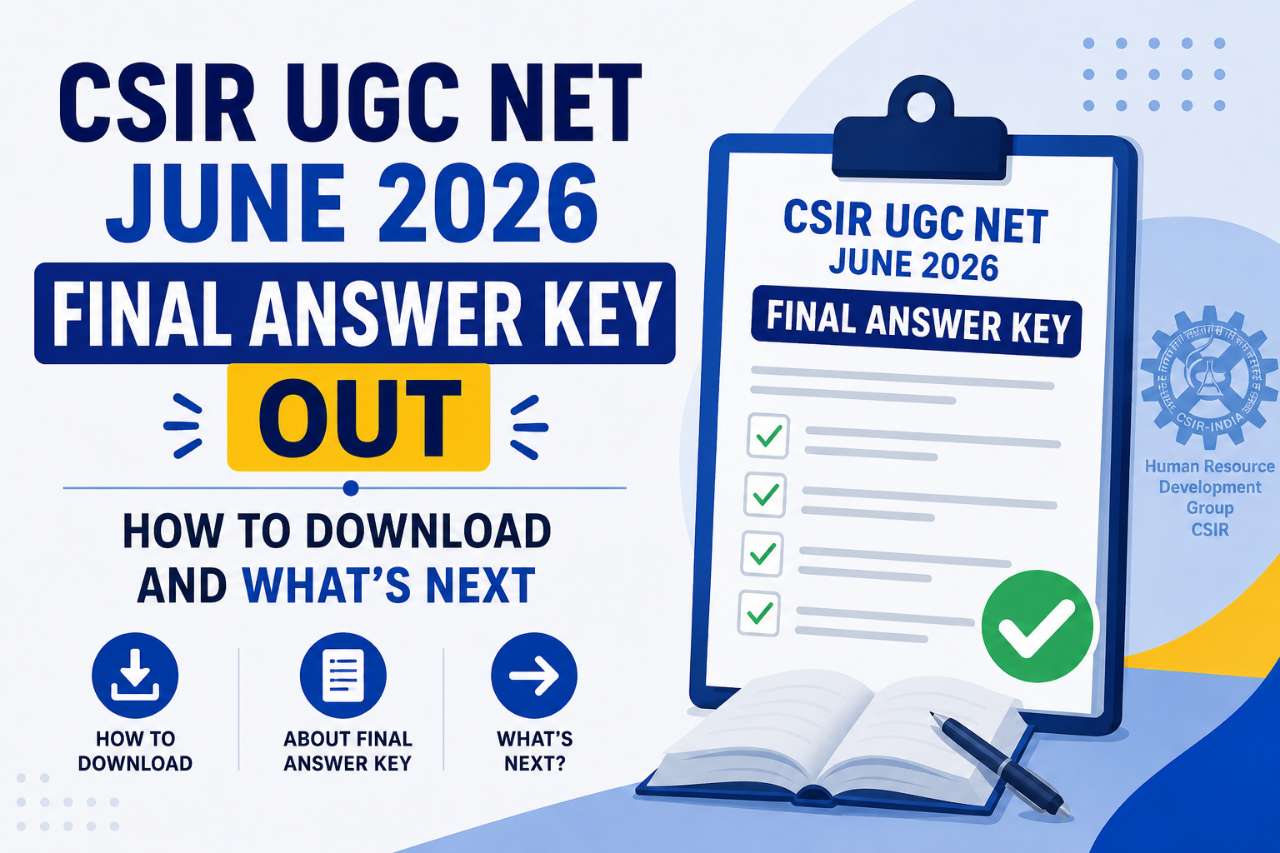

The National Testing Agency (NTA) has published the Joint CSIR UGC NET June 2026 final answer key on the official portal at csirnet.nta.nic.in. For lakhs of science graduates across India, this release marks a decisive stage in one of the country's most competitive research eligibility examinations. The final answer key reflects the official responses accepted by NTA after the objection window closed, and it will form the basis for result calculation and cut-off determination.
If you appeared for the June 2026 session, you should download and save your subject-wise final key immediately. Cross-checking it against your response sheet helps you estimate your score before the official result is declared. This guide explains what the final answer key means, how to download it step by step, what happens next in the CSIR NET timeline, and how qualifying through this exam opens doors to Junior Research Fellowship (JRF), Assistant Professor eligibility, and Ph.D. admission at universities and colleges nationwide. For a broader overview of the examination, visit our dedicated CSIR NET resource page on CollegeDwar.
What Is the CSIR UGC NET June 2026 Final Answer Key?
The final answer key is the authoritative set of correct answers published by NTA after reviewing challenges submitted by candidates during the provisional answer key phase. Unlike the provisional key, which allowed objections within a fixed window, the final key is generally not open for further challenge. NTA has confirmed that the Joint CSIR UGC NET June 2026 final answer key is available for all five CSIR NET subjects, making it essential reading for every test-taker regardless of specialisation.
The CSIR NET examination serves a distinct purpose within Indian higher education. It determines eligibility of Indian nationals for three separate outcomes: the award of Junior Research Fellowship and appointment as Assistant Professor, appointment as Assistant Professor and admission to Ph.D., and admission to Ph.D. only at recognised universities and colleges. Because the exam directly affects research funding, faculty eligibility, and doctoral admissions, the accuracy of the final answer key carries significant weight for candidates planning their academic careers.
Provisional vs Final Answer Key: Key Differences
Understanding the two-stage answer key process helps you interpret what NTA has now released:
- Provisional answer key: Published shortly after the exam; candidates could raise objections by paying a prescribed fee per question challenged.
- Final answer key: Released after NTA evaluates all objections; this version is used to compute results and cannot typically be contested again.
- Score impact: Any revision from provisional to final directly changes your estimated marks and potential category-wise cut-off standing.
- Transparency: Both keys are accessed through the same candidate login on the official CSIR NET website.
Candidates are advised to visit the official Joint CSIR-UGC NET June 2026 examination website regularly for the latest updates. For any clarification related to the examination, NTA directs applicants to contact the help desk through details available on the official portal.
CSIR NET June 2026: Exam Overview and Five Subjects
The Council of Scientific and Industrial Research (CSIR) jointly conducts this national eligibility test with the University Grants Commission (UGC). Unlike UGC NET, which covers more than 80 humanities and social science subjects, CSIR NET is limited to five science disciplines. Each paper follows a common structure with Part A (General Aptitude), Part B (subject concepts), and Part C (analytical and application-based questions).
| Subject Code | CSIR NET Subject | Typical Career Path After Qualifying |
|---|---|---|
| 701 | Chemical Sciences | Research in chemistry, pharmaceuticals, materials science |
| 702 | Earth, Atmospheric, Ocean and Planetary Sciences | Climate research, geology, oceanography roles |
| 703 | Life Sciences | Biotech, microbiology, biomedical research |
| 704 | Mathematical Sciences | Academia, data science, theoretical research |
| 705 | Physical Sciences | Physics research, instrumentation, teaching posts |
The June 2026 session forms part of the bi-annual CSIR NET cycle held in June and December. Qualifying candidates may pursue doctoral research at central universities, IITs, NITs, CSIR laboratories, and state universities. Private and deemed universities that accept UGC-NET or CSIR-NET scores for Ph.D. admission—such as Sir Padampat Singhania University Udaipur—also consider valid CSIR NET scores where their regulations permit. Always verify individual institutional Ph.D. admission policies before applying.
It is worth noting that CSIR NET covers science streams only. Candidates in design, architecture, and fine arts typically follow different national or university-level entrance routes. For instance, specialised institutions like Sir J J School Of Art Architecture And Design admit students through discipline-specific processes rather than CSIR NET, which remains focused on scientific research eligibility.
How to Download the CSIR UGC NET June 2026 Final Answer Key
NTA has made the final answer key available exclusively through the candidate login portal. You will need your application number and password—the same credentials used during registration and admit card download. If you have forgotten your password, use the "Forgot Password" option on the login page before attempting to access the key.
Step-by-Step Download Process
- Visit the official CSIR NET website at csirnet.nta.nic.in using a secure browser on a desktop or mobile device.
- On the homepage, locate the link titled "Final Answer Key for Joint CSIR UGC-NET June 2026" under the Candidate Activity section.
- Click the link and enter your login credentials: application number and password.
- After successful login, the Joint CSIR UGC NET June 2026 Final Answer Key for your subject will appear on the screen.
- Download the PDF and take a printout for score estimation and future reference during result and certificate stages.
Save a dated copy on cloud storage or email it to yourself. Many candidates find it useful to maintain a spreadsheet comparing question numbers, their marked answers, provisional key answers, and final key answers to track any revisions that may have worked in their favour.
Common Login Issues and Quick Fixes
- Forgotten application number: Check your registration confirmation email or SMS from NTA; the number usually begins with a session-specific prefix.
- Incorrect password: Reset via registered mobile number or email linked to your application.
- Page not loading: Try during off-peak hours (early morning or late night) as server traffic spikes immediately after key releases.
- Subject mismatch: Ensure you are viewing the answer key for the subject paper you actually attempted on exam day.
How to Calculate Your Estimated Score Using the Final Answer Key
Once you have the final answer key, you can approximate your raw score before NTA publishes the official result. CSIR NET follows negative marking, so careful counting matters.
CSIR NET Marking Scheme (General Pattern)
- Part A: +2 marks for each correct answer; −0.5 marks for each incorrect answer.
- Part B: +2 marks for correct; −0.5 for incorrect (may vary slightly by subject booklet).
- Part C: +4 marks for correct; −1 mark for incorrect in most subject papers.
- Unattempted questions: No marks added or deducted.
Add marks for all correct responses, subtract penalties for wrong answers, and total the three parts. Compare your estimated score against previous session cut-offs for your category (General, EWS, OBC-NCL, SC, ST, PwBD) to gauge JRF and Lectureship/Assistant Professor eligibility. Keep in mind that NTA normalises scores when multiple shifts or booklets are used, so your final displayed score may differ slightly from a manual calculation.
What Happens After the Final Answer Key Release?
The final answer key is typically followed by result declaration within a short window. Based on recent NTA practice for CSIR and UGC NET examinations, candidates can expect the following sequence of events:
- Result announcement: NTA publishes results on csirnet.nta.nic.in with category-wise qualification status.
- Scorecard download: Qualified candidates download scorecards showing marks obtained and eligibility type (JRF, Assistant Professor, Ph.D. only).
- Cut-off release: Subject-wise and category-wise minimum qualifying marks are published alongside or shortly after results.
- JRF fellowship process: JRF awardees complete fellowship formalities through CSIR/UGC channels as per current guidelines.
- Ph.D. and faculty applications: Qualified candidates apply to doctoral programmes and Assistant Professor posts at institutions across India.
NTA has also released the UGC NET June 2026 result for 84 subjects on ugcnet.nta.nic.in—a separate but related development for humanities and social sciences candidates. Out of 7,73,806 registered applicants, 6,07,151 appeared for UGC NET June 2026. Of those who appeared, 4,241 qualified for JRF and Assistant Professor, 45,904 qualified for Assistant Professor and Ph.D. admission, and 97,434 qualified for Ph.D. admission only. CSIR NET candidates should not confuse the two portals; always use csirnet.nta.nic.in for science NET updates.
CSIR NET Qualification Types Explained
One examination, three possible outcomes—understanding this structure is critical for planning your next move in Indian academia.
Junior Research Fellowship (JRF) + Assistant Professor Eligibility
This is the highest tier of qualification. JRF recipients receive a monthly fellowship stipend from CSIR or UGC to pursue doctoral research at recognised institutions. Simultaneously, they earn eligibility to apply for Assistant Professor positions in Indian universities and colleges, subject to additional recruitment rules of individual employers.
Assistant Professor Eligibility + Ph.D. Admission
Candidates who meet the lectureship cut-off but fall below the JRF threshold qualify for Assistant Professor eligibility and may also seek Ph.D. admission. This category suits aspirants aiming for teaching careers while pursuing research part-time or full-time.
Ph.D. Admission Only
Some candidates qualify exclusively for doctoral admission without Assistant Professor eligibility. Several universities accept this qualification for Ph.D. enrolment, though top central universities may prefer or require higher cut-off scores.
Category-Wise Cut-Off Trends: What to Expect After the Final Key
Although NTA publishes official cut-offs only after results, reviewing past session data gives science postgraduates a realistic benchmark. CSIR NET cut-offs vary sharply by subject because Life Sciences and Chemical Sciences typically attract the largest applicant pools, pushing JRF thresholds higher than Mathematical Sciences or Earth Sciences in many cycles.
Candidates belonging to reserved categories benefit from relaxed minimum qualifying marks as per government norms. General and EWS applicants generally face the steepest JRF cut-offs, while OBC-NCL, SC, ST, and PwBD categories receive proportionate relaxation. Persons with Benchmark Disabilities may also access scribe facilities and compensatory time during the examination, factors that NTA accounts for during normalisation and result processing.
Subject-Wise Competition Snapshot (Indicative)
- Chemical Sciences: High competition; JRF cut-offs historically among the toughest due to large M.Sc. Chemistry graduate volumes.
- Life Sciences: Similar intensity; biotechnology and microbiology graduates contribute to a crowded applicant base.
- Physical Sciences: Moderate to high competition depending on the session; strong conceptual clarity in quantum mechanics and electrodynamics is essential.
- Mathematical Sciences: Relatively smaller pool but demanding Part C problems requiring proof-based thinking.
- Earth Sciences: Niche field with fewer applicants; cut-offs can fluctuate based on paper difficulty and seat availability.
After downloading the final answer key, compare your estimated marks with previous June and December session cut-offs published on the official portal. Treat these as guidance only—the June 2026 cut-offs will depend on paper difficulty, normalisation, and the total number of candidates qualifying in each category.
Documents to Keep Ready Before CSIR NET Result Declaration
Organising paperwork in advance prevents last-minute delays when applying for JRF, Ph.D. programmes, or faculty positions. Keep the following documents scanned and stored in a single folder on your device:
- CSIR NET admit card and self-attested photocopy for identity verification during counselling or fellowship formalities.
- M.Sc. or integrated postgraduate degree mark sheets and provisional certificate confirming eligibility subject requirements.
- Category certificate (OBC-NCL, SC, ST, EWS) issued by competent authority in the prescribed format, valid for the examination year.
- PwBD certificate from a recognised medical authority if you claimed disability benefits during application.
- Photo ID proof such as Aadhaar, PAN, passport, or driving licence matching the name on your application.
- Passport-size photographs identical to those uploaded during CSIR NET registration.
- Final answer key PDF and score estimation sheet for quick reference when the scorecard is released.
Universities may request CSIR NET qualification proof during Ph.D. interview shortlisting. Having these documents ready allows you to respond promptly to admission notifications from central universities, IITs, NITs, and state institutions across India.
What JRF Qualification Means for Your Research Career
Securing Junior Research Fellowship through CSIR NET is one of the most sought-after outcomes for Indian science graduates. JRF awardees receive a monthly fellowship stipend disbursed through CSIR or UGC, along with a contingency grant for research expenses. The fellowship tenure is initially two years and extendable to five years upon satisfactory progress in registered Ph.D. programmes at recognised institutions.
Beyond financial support, JRF qualification signals research aptitude to doctoral supervisors and interview panels. CSIR laboratories, ICMR units, DBT-supported centres, and university departments actively recruit JRF-qualified candidates for project and doctoral positions. Even if you ultimately pursue a Ph.D. without availing the fellowship immediately, the qualification strengthens your curriculum vitae for national and international research opportunities.
Assistant Professor Eligibility: What It Does and Does Not Guarantee
Qualifying for Assistant Professor through CSIR NET satisfies the minimum eligibility criterion mandated by UGC for appointment to entry-level teaching posts in Indian universities and colleges. However, it does not guarantee a job. Individual institutions conduct their own recruitment through interviews, presentations, and sometimes additional written tests. State public service commissions and university-specific advertisements list vacancies separately, and NET qualification remains valid for a limited period as per current UGC regulations—verify the latest notification before relying on an older score.
Preparing for Result Day: Actionable Checklist
Use the gap between final answer key release and result declaration productively:
- Download and archive the final answer key PDF with a clear file name including subject and date.
- Calculate estimated scores for Part A, B, and C separately to identify weak sections for future attempts.
- Shortlist universities and CSIR labs where you intend to apply for Ph.D. or research positions.
- Keep scanned copies of category certificates, PwBD certificates (if applicable), and graduation/postgraduation mark sheets ready.
- Monitor csirnet.nta.nic.in daily and bookmark the NTA help desk contact page for technical queries.
- Review our CSIR NET exam guide on CollegeDwar for syllabus updates, previous cut-offs, and preparation resources for the December session if you plan a reattempt.
CSIR NET vs UGC NET: Quick Comparison for Science Aspirants
Science postgraduates often wonder which NET examination they should target. The table below clarifies the distinction:
| Parameter | CSIR UGC NET | UGC NET |
|---|---|---|
| Conducting body | NTA (on behalf of CSIR & UGC) | NTA (on behalf of UGC) |
| Subjects covered | 5 science subjects | 84+ subjects across disciplines |
| JRF funding | CSIR/UGC JRF fellowship | UGC JRF fellowship |
| Exam frequency | June and December | June and December |
| Official portal | csirnet.nta.nic.in | ugcnet.nta.nic.in |
| Typical candidates | M.Sc. and integrated MSc-PhD science graduates | Humanities, commerce, management, and select science PG students |
Qualifying either examination strengthens your academic profile, but CSIR NET remains the standard benchmark for research careers in chemical, physical, mathematical, life, and earth sciences.
Re-Examination and Future CSIR NET Sessions
Candidates who estimate a score below the expected cut-off should not lose hope. CSIR NET is conducted twice every year—in June and December—offering a relatively quick reattempt window compared with many other national examinations. Use the final answer key analysis to build a targeted revision plan focusing on Part A aptitude gaps and Part C analytical weaknesses.
Registration for the December 2026 session typically opens a few months before the examination date on csirnet.nta.nic.in. Monitor the official portal and trusted education platforms like CollegeDwar for notification alerts. Previous question papers, topic-wise weightage analysis, and subject expert guidance available on our CSIR NET page can help you convert a near-miss into a confident qualification in the next attempt.
Tips for Candidates Who Missed the Objection Window
If you did not challenge the provisional answer key and later discover discrepancies, remember that the final key is binding for result computation. NTA considers objections only during the designated window. For future cycles, mark your calendar as soon as the provisional key is released and review every question you found ambiguous. Even a single corrected answer can shift your score above the JRF cut-off in competitive subjects like Chemical Sciences and Life Sciences.
Important Reminders for CSIR NET June 2026 Candidates
As you navigate the post-answer-key phase, keep these practical reminders in mind to avoid common mistakes:
- Do not trust unofficial answer keys or result prediction posts on social media; rely exclusively on csirnet.nta.nic.in.
- Do not share your login password or OTP with third-party websites claiming to check results on your behalf.
- Save multiple backup copies of the downloaded final answer key in case the login portal becomes temporarily unavailable closer to result day.
- If you appeared for both CSIR NET and UGC NET, track each portal separately—results and answer keys are not interchangeable.
- Contact the NTA Help Desk promptly if your answer key shows a different subject or session than the paper you attempted.
- Begin exploring Ph.D. supervisor profiles and research areas now so you can apply quickly once your scorecard confirms qualification.
Conclusion
The release of the Joint CSIR UGC NET June 2026 final answer key at csirnet.nta.nic.in is a milestone for every science postgraduate who sat the examination. Download your subject-wise key without delay, verify your login credentials, estimate your score using the official marking scheme, and stay alert for the upcoming result and cut-off announcements. Whether your goal is a CSIR-funded JRF, Assistant Professor eligibility at a central or state university, or Ph.D. admission at institutions ranging from IITs to universities like Sir Padampat Singhania University Udaipur, this answer key is your first reliable indicator of performance.
NTA has urged all candidates to rely only on the official website for authentic updates and to use the help desk for examination-related clarifications. Keep your documents organised, avoid misinformation on unofficial social media channels, and continue monitoring CollegeDwar for timely guidance on CSIR NET results, cut-offs, and the next examination cycle.