
If you dream of teaching young learners in central government schools across India, the Central Teacher Eligibility Test (CTET) is one of the most important milestones on your journey. Conducted by the Central Board of Secondary Education (CBSE), CTET certifies that a candidate meets the minimum standards prescribed by the National Council for Teacher Education (NCTE) to teach Classes 1 to 8 in schools under the administrative control of the Central Government—such as Kendriya Vidyalayas, Navodaya Vidyalayas, and schools under the administrative control of UT administrations.
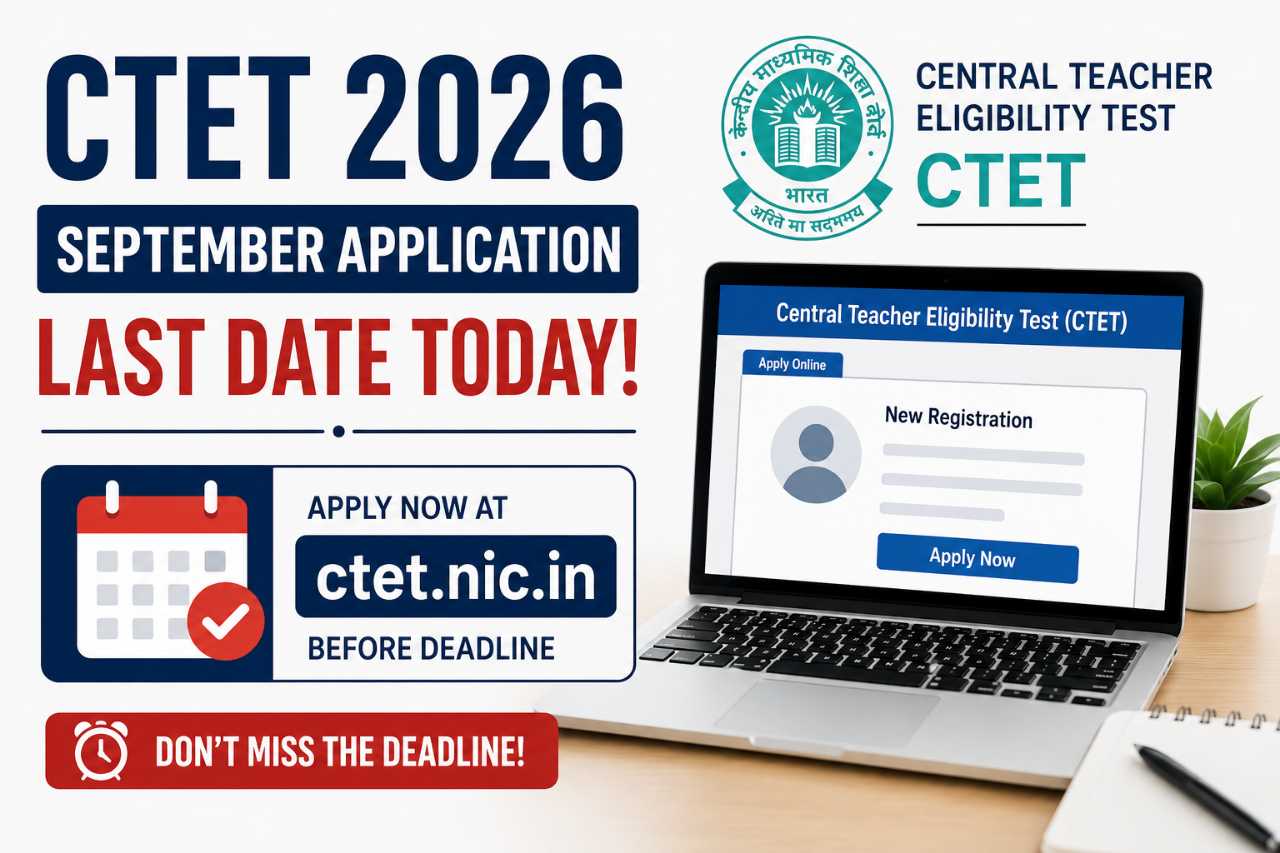
According to the latest update reported by Careers360, the CTET 2026 September application window closes today. Candidates who missed the original deadline of June 10, 2026, received a second chance after CBSE reopened registration following requests from aspirants. If you have not yet submitted your form, visit the official portal at ctet.nic.in immediately. Missing today's deadline could delay your teaching career by several months, as CTET is typically held twice a year.
This comprehensive guide explains everything you need to know about CTET 2026 September—from eligibility and fees to exam pattern, syllabus, and actionable preparation strategies—written in simple language for students, B.Ed graduates, and working professionals exploring a stable career in public-sector teaching.
What Is CTET and Why Does It Matter for Indian Teachers?
The Central Teacher Eligibility Test was introduced under Section 23 of the Right of Children to Free and Compulsory Education (RTE) Act, 2009. It serves as a National benchmark to ensure that teachers appointed in central government schools possess essential pedagogical knowledge and subject competence.
Clearing CTET does not guarantee a job by itself. However, it is a mandatory eligibility requirement for recruitment in most central government schools and is widely accepted by state governments, private schools, and educational NGOs as proof of teaching aptitude. A valid CTET certificate remains useful for seven years from the date of declaration of results, giving candidates ample time to apply for teaching posts through recruitment exams such as KVS, NVS, DSSSB, and state-level Teacher Eligibility Tests (TETs).
Who Should Appear for CTET 2026?
CTET is ideal for:
- D.El.Ed and B.El.Ed students aiming to teach at the primary level (Classes 1–5)
- B.Ed and integrated teacher education graduates targeting upper-primary teaching (Classes 6–8)
- Final-year teacher training candidates who meet NCTE-prescribed qualifications
- Existing teachers seeking central government school appointments or upgrading their credentials
Teaching is a rewarding long-term profession, but it is not the only path open to graduates. Many students simultaneously explore options in management, technology, or other competitive exams. For instance, graduates who prefer corporate careers often prepare for exams like the CAT, while those inclined toward IT may pursue degrees such as Bachelor of Computer Application (BCA) or broader programmes in Computer Applications. CTET, however, remains the gold standard for anyone committed to shaping India's school education system.
CTET 2026 September: Important Dates and Application Timeline
Understanding the timeline helps you plan registration, document preparation, and exam-day logistics without last-minute stress. Below is the schedule based on the official CBSE notification and recent news updates.
Key Dates at a Glance
- Notification release: May 11, 2026
- Original application window: May 11 to June 10, 2026 (11:59 PM)
- Application reopening: Extended window for candidates who could not apply earlier
- Final application deadline: September 1, 2026 (today, as per latest reports)
- Expected exam date: September 6, 2026 (Sunday)—subject to official confirmation on ctet.nic.in
- Exam cities: 132 cities across India
- Medium of exam: 27 languages
Actionable tip: Even though Careers360 reported that CBSE had not formally announced the September 2026 exam date at the time of publication, historical patterns and the official notification indicate the test is likely scheduled for early September. Keep checking ctet.nic.in and cbse.gov.in for admit card release, city intimation slips, and any corrigendum.
CTET 2026 Application Fee Structure
Fee payment is mandatory to complete registration. CBSE accepts online payment through debit card, credit card, net banking, or UPI. Always save the payment receipt and confirmation page.
| Category | One Paper (Paper I or II) | Both Papers (I and II) |
|---|---|---|
| General / OBC-NCL | ₹1,000 | ₹1,200 |
| SC / ST / PwD | ₹500 | ₹600 |
Which paper should you choose? Select Paper I if you want to teach Classes 1–5. Choose Paper II for Classes 6–8. If your goal is maximum flexibility—especially for recruitment exams that accept both levels—opt for both papers in a single session and pay the combined fee.
CTET 2026 Eligibility Criteria: Paper 1 vs Paper 2
Before applying, verify that you meet NCTE-mandated educational qualifications. Applying without eligibility leads to cancellation of candidature at any stage, including after results are declared.
CTET Paper I Eligibility (Classes 1 to 5 – Primary Stage)
Candidates must satisfy any one of the following conditions:
- Senior Secondary (or equivalent) with at least 50% marks and passed or appearing in final year of 2-year Diploma in Elementary Education (D.El.Ed)
- Senior Secondary with at least 45% marks and passed or appearing in final year of D.El.Ed, as per NCTE recognition norms
- Senior Secondary with at least 50% marks and passed or appearing in final year of 4-year Bachelor of Elementary Education (B.El.Ed)
- Senior Secondary with at least 50% marks and passed or appearing in final year of 2-year Diploma in Education (Special Education)
- Graduation and passed or appearing in final year of 2-year D.El.Ed programme
Example: Priya completed Class 12 with 52% marks and is in the second year of D.El.Ed at a recognised NCTE-affiliated institute. She is eligible to apply for Paper I even before her diploma results are declared, provided she submits required proof during document verification stages of recruitment.
CTET Paper II Eligibility (Classes 6 to 8 – Elementary Stage)
Candidates must satisfy any one of the following conditions:
- Graduation with at least 50% marks and passed or appearing in final year of 2-year B.Ed programme
- Graduation with at least 45% marks and passed or appearing in final year of B.Ed, as per NCTE norms
- Passed or appearing in final year of 4-year B.A./B.Sc. Ed or B.A. Ed/B.Sc. Ed integrated programme
- Graduation with at least 50% marks and passed or appearing in 1-year B.Ed (Special Education)
- Passed or appearing in final year of 4-year B.El.Ed programme
- Passed or appearing in final year of 2-year D.El.Ed (Elementary) with Graduation
Age Limit and Nationality
There is no upper age limit for appearing in CTET. Candidates must be citizens of India. Persons of Indian Origin (PIO), Overseas Citizens of India (OCI), and foreign nationals may check specific recruitment rules of the appointing authority, as CTET eligibility for them depends on the employer's policy.
CTET 2026 Exam Pattern and Marking Scheme
CTET is a pen-and-paper or computer-based test (mode is specified in the admit card) consisting entirely of objective multiple-choice questions. Understanding the pattern is essential for time management on exam day.
Paper I Structure (Primary – Classes 1 to 5)
- Duration: 2 hours 30 minutes
- Total questions: 150 MCQs
- Total marks: 150
- Sections: Child Development and Pedagogy (30), Language I (30), Language II (30), Mathematics (30), Environmental Studies (30)
Paper II Structure (Elementary – Classes 6 to 8)
- Duration: 2 hours 30 minutes
- Total questions: 150 MCQs
- Total marks: 150
- Sections: Child Development and Pedagogy (30), Language I (30), Language II (30), Mathematics and Science or Social Studies/Social Science (60)
Candidates choose Mathematics and Science if they intend to teach those subjects; others select Social Studies/Social Science. Language I is typically the medium of instruction or primary language, while Language II tests proficiency in another language.
Marking Scheme and Qualifying Criteria
- Marks per question: +1 for each correct answer
- Negative marking: None
- Qualifying marks: 60% (90 out of 150) for General/OBC; 55% (82 out of 150) for SC/ST/PwD
The absence of negative marking is a significant advantage. Attempt every question, but prioritise accuracy in Child Development and Pedagogy, as this section appears in both papers and often determines whether candidates cross the qualifying threshold.
CTET 2026 Syllabus Overview
The CTET syllabus aligns with the National Curriculum Framework (NCF) 2005 and RTE Act 2009 objectives. Rather than testing deep postgraduate specialisation, it evaluates whether you can teach age-appropriate content using sound pedagogical principles.
Child Development and Pedagogy (Both Papers)
Topics include principles of child development, cognition and learning theories, intelligence and individual differences, inclusive education, understanding children with special needs, and pedagogical approaches for diverse learners. Expect scenario-based questions such as: How would you address a shy learner in a multilingual classroom?
Language I and Language II
Both sections test reading comprehension, grammar, and pedagogy of language development. Choose languages you are comfortable teaching. Popular combinations include Hindi-English, regional language-English, or Sanskrit-English.
Mathematics and Environmental Studies (Paper I)
Paper I Mathematics covers numbers, geometry, measurements, and basic operations suitable for primary classes. Environmental Studies integrates themes from science and social science—family, food, water, travel, and the natural environment—reflecting the EVS curriculum in primary schools.
Mathematics, Science, and Social Studies (Paper II)
Paper II Mathematics includes number systems, algebra, geometry, and mensuration at the upper-primary level. Science covers food, materials, natural phenomena, and natural resources. Social Studies spans history, geography, civics, and pedagogical issues in social science teaching.
Preparation tip: Download the official Information Bulletin PDF from ctet.nic.in and tick off each topic weekly. Pair NCERT textbooks for Classes 1–8 with previous-year question papers for realistic practice.
How to Apply for CTET 2026 September at ctet.nic.in
Registration is entirely online. Incomplete applications or incorrect photographs and signatures are common reasons for rejection, so follow each step carefully before the deadline tonight.
- Visit the official website at ctet.nic.in.
- Click on the "Apply for CTET 2026" link on the homepage.
- Select New Registration and note your application number.
- Read the instructions, tick the acknowledgement checkbox, and proceed.
- Fill in personal details, category, educational qualifications, and exam city preferences.
- Upload a recent passport-size photograph and signature in the prescribed format and file size.
- Pay the application fee online and save the transaction ID.
- Submit the form and download the confirmation page for your records.
Double-check spellings of your name (as on Class 10 certificate), date of birth, category certificate details, and contact information. Errors discovered after the correction window closes can cause problems during document verification at the time of appointment.
Documents Required for CTET 2026 Registration
Keep scanned copies of the following ready before you begin:
- Recent passport-size photograph (colour, white background)
- Signature on white paper (black or blue ink)
- Class 10 mark sheet for name and date of birth proof
- Category certificate (SC/ST/OBC-NCL/PwD) if applicable
- Educational qualification certificates (Class 12, Graduation, D.El.Ed/B.Ed marksheets)
- Valid photo ID (Aadhaar, PAN, passport, or driving licence)
- Active email ID and mobile number for OTP verification
CTET 2026 Preparation Strategy: Practical Tips That Work
With the exam likely just days away if you apply today, a focused revision plan matters more than trying to cover every textbook chapter in depth.
Week-by-Week Focus Areas
- Week 1–2: Complete Child Development and Pedagogy from standard CTET preparation guides; solve 20 questions daily.
- Week 3–4: Revise Language I and II comprehension passages; practice grammar rules frequently tested in MCQs.
- Week 5–6: Cover Mathematics and EVS (Paper I) or Mathematics-Science/Social Studies (Paper II) using NCERT exemplar problems.
- Final week: Attempt two full-length mock tests per paper under timed conditions; analyse weak sections.
Recommended Resources
- Official CTET Information Bulletin and syllabus PDF
- NCERT textbooks for Classes 1–8
- Previous years' CTET question papers (2011 onwards)
- Subject-wise MCQ banks from recognised publishers
- Free mock tests on educational platforms for timed practice
Exam-day tip: Reach the centre at least 90 minutes early with admit card, photo ID, and a transparent water bottle. Electronic devices, study material, and bags are generally not permitted inside the examination hall.
CTET 2026 Exam Day Schedule and Reporting Guidelines
When both papers are held on the same day, CBSE typically schedules Paper II in the morning and Paper I in the afternoon. Based on the official Information Bulletin for the September 2026 session, the expected timings are:
- Paper II (Classes 6–8): 9:30 AM to 12:00 PM
- Paper I (Classes 1–5): 2:30 PM to 5:00 PM
Candidates appearing for both papers receive a lunch break between sessions. Carry your admit card, valid photo identity proof, and a black or blue ballpoint pen. CBSE may also issue city intimation slips before admit cards, showing your exact exam centre address—verify this in advance using public transport or GPS to avoid delays on exam day.
In recent editions, CBSE introduced a revised exam city allocation process. Your centre may differ from your first preference depending on seat availability. Check all correspondence from ctet.nic.in promptly and raise queries through the official helpdesk if discrepancies appear.
Understanding Your CTET Certificate and Validity
Once results are declared on ctet.nic.in, qualified candidates can download their CTET eligibility certificate from the DigiLocker platform linked through the official portal. The certificate confirms your roll number, paper qualified, category, and marks obtained.
The CTET certificate remains valid for seven years from the date of announcement of results. During this period, you can apply for any recruitment that accepts CTET without reappearing for the exam. If your certificate expires, you must take CTET again to regain eligibility. There is no limit on the number of attempts, so candidates who miss the qualifying marks by a small margin often reappear in the next session with targeted revision.
After CTET: Career Opportunities and Next Steps
Qualifying CTET opens doors to multiple recruitment channels:
- Kendriya Vidyalaya Sangathan (KVS) – PRT, TGT, and PGT posts through ntional-level recruitment
- Navodaya Vidyalaya Samiti (NVS) – Teaching and non-teaching vacancies in JNVs
- DSSSB and UT-level exams – Delhi and other union territory school appointments
- State government schools – Many states accept CTET scores for TET-exempt or weightage-based hiring
- Private and international schools – CTET certification strengthens your resume even where not legally mandatory
Remember that CTET is a qualifying exam, not a rank-based selection test. Recruitment exams that follow often include written tests, interviews, and document verification. Start tracking official notifications from KVS, NVS, and your state education department immediately after results are declared.
Common Mistakes to Avoid Before the Application Deadline
- Waiting until the last hour: Server overload on deadline day can cause payment failures—apply early today.
- Wrong paper selection: Choosing Paper II when you only qualify for Paper I wastes fees and exam effort.
- Blurry photograph upload: Non-compliant images lead to form rejection during scrutiny.
- Ignoring eligibility at appointment stage: Final-year candidates must complete degrees before joining as teachers.
- Skipping admit card download: Print multiple copies once available and verify exam city and reporting time.
Conclusion
The CTET 2026 September application closes today, and this reopened window is likely your final opportunity to register for the 22nd edition of India's premier teacher eligibility examination. Whether you aspire to nurture curious minds in a Kendriya Vidyalaya classroom or build a stable public-sector teaching career, clearing CTET is an essential first step backed by national recognition and a seven-year certificate validity.
Act now: visit ctet.nic.in, complete your registration, pay the fee, and download your confirmation page before midnight. Then shift focus to structured preparation using NCERT textbooks, previous-year papers, and consistent mock testing. Teaching remains one of India's most impactful professions—and with the right eligibility, preparation, and persistence, your CTET 2026 journey can begin today.