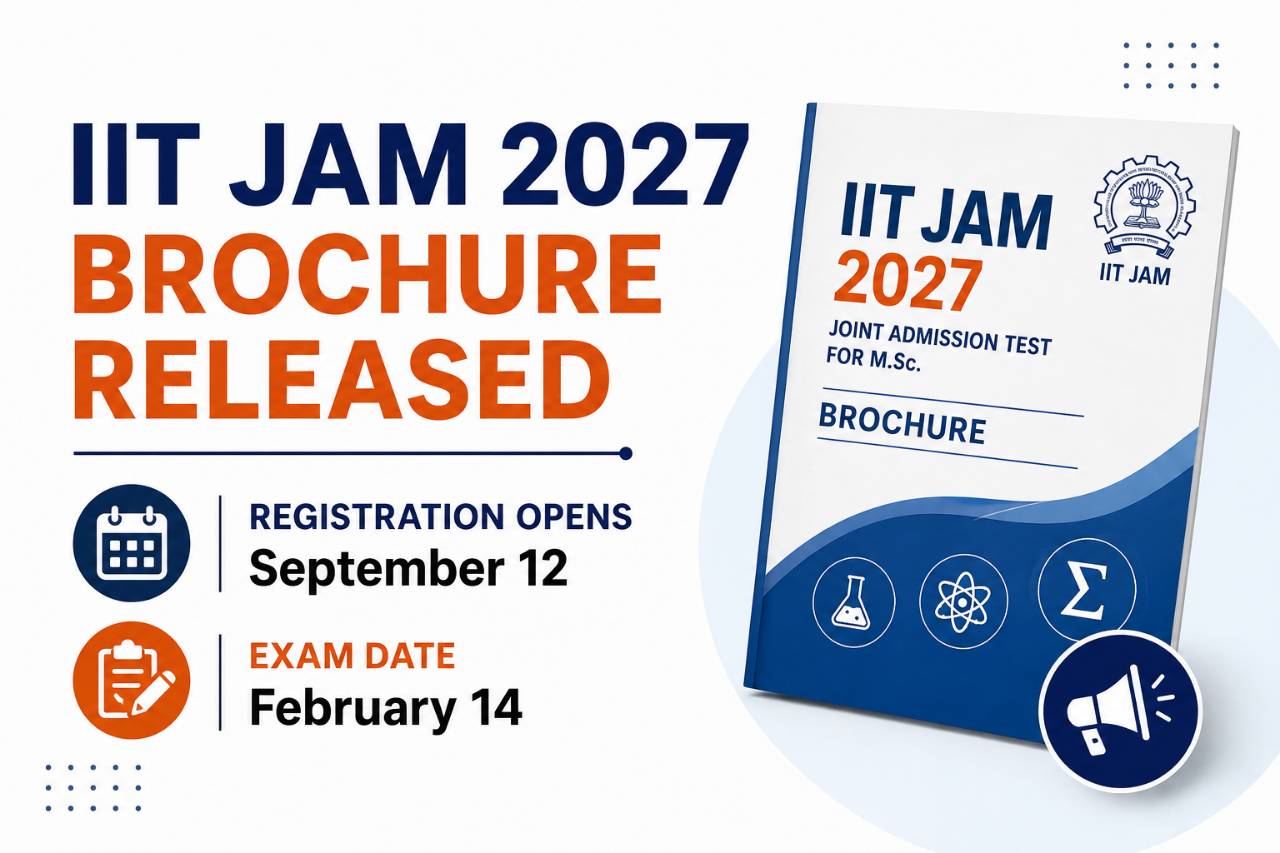
The Joint Admission Test for Masters (JAM) 2027 is one of the most important national-level entrance exams for science graduates who want to pursue postgraduate studies at India's premier technical institutes. In a key update announced in September 2026, Indian Institute of Technology Kharagpur, the organising institute for this cycle, has released the official brochure and revised the registration start date to September 12, 2026. The examination date remains unchanged: candidates will appear for JAM 2027 in computer-based test (CBT) mode on February 14, 2027.
For lakhs of BSc, BTech, and integrated science students across India, JAM opens the door to MSc, MSc-PhD dual degree, and other postgraduate programmes at all 23 IITs, along with seats at IISc Bangalore, NITs, IISERs, and other participating institutes. If you are planning your higher education after graduation, understanding the revised timeline, eligibility rules, exam pattern, and admission process is essential. This guide breaks down everything you need to know about JAM 2027 in clear, actionable language.
What Is IIT JAM and Why Does It Matter?
IIT JAM is a national entrance examination conducted jointly by the IITs on a rotational basis. Qualifying in JAM does not automatically guarantee admission, but your JAM score is the primary criterion used during centralized counselling for postgraduate seats. For the academic year 2027-28, JAM scores will be accepted for admission to approximately 3,000 postgraduate seats across 23 IITs, plus more than 2,000 additional seats at result-sharing institutes such as IISc, NITs, CFTIs, DIAT, IIEST Shibpur, IISER Pune, IISER Bhopal, IIPE, JNCASR, and SLIET.
Unlike undergraduate admissions through JEE, JAM is designed specifically for candidates who have completed or are completing their bachelor's degree in science or related disciplines. Programmes offered through JAM include MSc, Joint MSc-PhD, MSc-PhD Dual Degree, and other PG science courses depending on the admitting Institute. For many students from tier-2 and tier-3 cities, JAM represents one of the fairest routes to study at institutes like IIT Bombay, IIT Delhi, and IIT Madras Chennai without needing to relocate abroad or pay high private tuition fees.
Who Should Consider JAM 2027?
- Final-year BSc students in Physics, Chemistry, Mathematics, Statistics, Geology, Biotechnology, or Economics
- BTech and BE graduates seeking MSc or research-oriented programmes in core science areas
- Working professionals planning a career shift into academia, research, or data-heavy industry roles
- Students aiming for PhD pathways through Joint MSc-PhD programmes at IITs and IISc
IIT JAM 2027: Key Dates and Registration Update
The most important change in the latest notification is the revision of the application portal opening date. While candidates were earlier expecting registration to begin earlier, the official JAM 2027 website now confirms that applications will open on September 12, 2026. The exam date has not changed.
Important Dates at a Glance
| Event | Date / Timeline |
|---|---|
| Release of official brochure | September 2026 |
| Registration begins on JOAPS | September 12, 2026 |
| Last date to apply | To be announced in brochure (check jam.iitkgp.ac.in) |
| Admit card release | Expected January 2027 |
| JAM 2027 examination | February 14, 2027 (CBT mode) |
| Result declaration | Expected March 2027 |
| Admission counselling | Expected April–July 2027 (up to 4 rounds) |
Actionable tip: Do not wait until the last week of registration. Server load, payment gateway delays, and document verification issues are common during the final days. Create your JOAPS account on September 12 itself and complete your application within the first fortnight.
JAM 2027 Test Papers and Session Schedule
JAM 2027 will be conducted in seven test papers across two sessions on the same day. Each paper has a duration of three hours. Candidates may appear for one or two test papers, but if you choose two papers, they must be scheduled in different sessions.
Test Papers Offered
- Biotechnology (BT)
- Chemistry (CY)
- Economics (EN)
- Geology (GG)
- Mathematics (MA)
- Mathematical Statistics (MS)
- Physics (PH)
Session-Wise Paper Schedule (February 14, 2027)
| Session | Timing | Test Papers |
|---|---|---|
| Forenoon | 9:30 AM to 12:30 PM | Chemistry (CY), Geology (GG), Mathematics (MA) |
| Afternoon | 2:30 PM to 5:30 PM | Biotechnology (BT), Economics (EN), Mathematical Statistics (MS), Physics (PH) |
Choosing two papers can improve your admission options if you are eligible for both. For example, a Mathematics graduate might appear for both MA and MS papers since they are in different sessions. However, prepare only if you can score competitively in both; a weak second paper adds little value during counselling.
Eligibility Criteria for IIT JAM 2027
Understanding eligibility before you apply saves time and application fees. The basic requirement is straightforward: you must have completed your qualifying undergraduate degree, or you must be appearing in the final examination of your qualifying degree in 2027.
Key Eligibility Points
- Candidates who have passed or will pass their bachelor's degree in 2027 are eligible to sit for the exam
- There is no age limit specified for appearing in JAM 2027
- Qualifying JAM alone does not guarantee admission; each admitting institute may impose additional criteria
- Your undergraduate degree must be completed before the admission date set by the admitting institute
- You must submit proof of meeting the required qualification within the timeline prescribed during counselling
- Specific programmes may require certain subjects at the undergraduate level—always check the admitting institute's brochure
Example: A student in the final year of BSc Physics from a state university is eligible to apply and appear for JAM 2027. If they qualify and receive an MSc offer at an IIT, they must submit their degree certificate and mark sheets before the institute's deadline, typically during the first admission round.
Application Fee Structure
The JAM 2027 application fee varies based on category and the number of test papers you choose. All fees are non-refundable.
| Category | One Test Paper | Two Test Papers |
|---|---|---|
| Female / SC / ST / PwD | Rs 1,000 | Rs 1,350 |
| All other candidates | Rs 2,000 | Rs 2,700 |
Keep digital copies of your category certificate (if applicable) ready before filling the form. Incorrect category claims can lead to cancellation of candidature at later stages.
JAM 2027 Exam Pattern and Marking Scheme
The JAM 2027 question paper follows a standardized format across all seven subjects. Each paper contains 60 questions for a total of 100 marks, divided into three compulsory sections. Understanding the pattern is critical for time management and score optimization.
Section-Wise Breakdown
- Section A: 30 Multiple Choice Questions (MCQs)—10 one-mark and 20 two-mark questions
- Section B: 10 Multiple Select Questions (MSQs)—each carrying two marks
- Section C: 20 Numerical Answer Type (NAT) questions—10 one-mark and 10 two-mark questions
Marking Scheme
- MCQs (Section A): Negative marking applies. One-third of marks deducted for wrong one-mark answers; two-thirds deducted for wrong two-mark answers
- MSQs (Section B): No negative marking
- NAT (Section C): No negative marking
Preparation strategy: Because Section A carries negative marking, accuracy matters more than blind guessing. Sections B and C reward thorough problem-solving without penalty for incorrect attempts, so attempt every question where you can eliminate options or compute a reasonable estimate.
Exam Centres Across India
JAM 2027 will be conducted in approximately 114 cities across India. During registration on JOAPS, you must select your first, second, and third choice of examination cities. All three choices must belong to the same examination zone.
If your preferred city cannot accommodate all candidates due to operational constraints, you may be allotted an alternative city within the same zone. Select cities close to your location but also consider travel connectivity and accommodation options, especially if the exam falls on a weekend with heavy rush.
Admission Process After JAM 2027
After results are declared, the Joint Admission Committee conducts centralized counselling for IITs. Result-sharing institutes conduct their own admission processes using JAM scores. The JAM 2027 brochure mentions a maximum of four admission rounds, with a possible additional round depending on vacant seats.
Options When You Receive a Seat Offer
- Accept as final: Confirm your seat and exit further rounds
- Accept with upgrade: Keep your current seat but stay eligible for a higher preference if a vacancy opens
- Reject and exit: Decline the offer and leave the admission process
Fill your preference list carefully during counselling. Listing only top-tier IITs without realistic backups can leave you with no seat after all rounds. Research past cutoffs for your category and paper to build a balanced preference order.
How IIT Kharagpur Is Conducting JAM 2027
Each year, one IIT serves as the organising institute for JAM. For the 2027 cycle, IIT Kharagpur is responsible for releasing the brochure, managing JOAPS registrations, coordinating the examination, and declaring results. The official website for all updates is the JAM 2027 portal hosted by IIT Kharagpur. Always rely on this official source rather than unverified social media posts for date changes and instructions.
JAM vs Other Entrance Exams: Where It Fits in Your Plan
Science graduates often juggle multiple entrance exams during their final year. JAM is the gateway for MSc and research programmes at IITs. GATE, organized separately, is primarily for MTech and PSU recruitment. If you are a design-oriented student, exams like NID DAT serve a different academic path altogether. Build a calendar that accounts for preparation time for each exam without overlap burnout.
Preparation Tips for JAM 2027
Start With the Official Syllabus
Download the subject-wise syllabus from the official JAM 2027 website immediately after the brochure release. Map each topic to your undergraduate coursework and identify gaps early.
Solve Previous Year Papers
JAM papers from recent years reveal recurring concepts and difficulty trends. Simulate exam conditions with a three-hour timed attempt at least once a month in the final six months before the exam.
Strengthen Fundamentals Over Shortcuts
JAM tests conceptual depth. NCERT textbooks for Classes 11 and 12, standard undergraduate texts, and institute lecture notes form the foundation. Avoid relying solely on coaching formula sheets.
Plan for Two-Paper Candidates
If you are appearing for two papers, allocate separate weekly study blocks for each subject. Papers in the same session cannot be combined, so use the session split to your advantage.
Track Official Notifications
The September 12 registration revision shows that dates can change. Bookmark the official portal and check it weekly during the application season.
Documents Required for JAM 2027 Application
- Valid email ID and active mobile number
- Recent passport-size photograph (specifications as per JOAPS guidelines)
- Scanned signature
- Category certificate (if applicable)
- PwD certificate (if applicable)
- Valid photo ID proof (Aadhaar, passport, or other accepted ID)
- Academic details and qualifying degree information
Ensure your name matches across all documents. Discrepancies between your JAM application and degree certificates cause problems during IIT admission verification.
Postgraduate Programmes Available Through JAM
JAM is not limited to conventional MSc degrees. Depending on the admitting institute and your test paper, you may be eligible for several programme types. Understanding these options helps you set the right career expectations before you even fill the application form.
Common Programme Types
- MSc (2 years): Standard postgraduate degree in Physics, Chemistry, Mathematics, Statistics, Geology, Economics, or Biotechnology
- Joint MSc-PhD: Integrated research pathway where you can transition to PhD based on performance and supervisor availability
- MSc-PhD Dual Degree: Structured programme combining master's coursework with doctoral research
- MS (Research): Offered at select IITs for candidates with strong research orientation
- Interdisciplinary programmes: Some IITs offer specialized tracks combining science with computation, data science, or environmental studies
Each IIT publishes its own programme list and seat matrix in the admission brochure after results. A high JAM score in Chemistry might qualify you for MSc at IIT Bombay but a different set of options at IIT Guwahati or IIT Roorkee. Review institute-wise brochures during counselling to avoid missing niche programmes that match your interests.
Understanding JAM Score, Rank, and Cutoffs
Your JAM result includes an All India Rank (AIR) and a normalized score. Admissions are primarily rank-driven, but cutoffs vary by institute, programme, category, and year. There is no single universal cutoff for all IITs.
Factors That Influence Cutoffs
- Number of seats available in a programme for a given year
- Difficulty level of the question paper and overall candidate performance
- Category (General, OBC-NCL, SC, ST, EWS, PwD) and any institute-specific reservations
- Popularity of the institute and city—metros like Mumbai and Delhi often see higher demand
- Number of counselling rounds completed and remaining vacant seats
Practical advice: Refer to previous years' closing ranks for your paper and category at each IIT, but treat them as estimates rather than guarantees. A shift in seat matrix or paper difficulty can move cutoffs significantly. During counselling, always include mid-tier IITs and newer IITs in your preference list to secure a seat if top choices remain out of reach.
Subject-Wise Preparation Overview
While each test paper demands deep subject knowledge, some cross-cutting strategies apply across all seven papers in JAM.
Physics (PH)
Focus on Classical Mechanics, Electromagnetism, Quantum Mechanics, Thermodynamics, and Mathematical Methods. Prioritize conceptual clarity over memorization. Practice NAT questions involving multi-step calculations.
Chemistry (CY)
Physical, Organic, and Inorganic Chemistry carry roughly equal weight. Reaction mechanisms, spectroscopy, and thermodynamics appear frequently. Revise laboratory techniques and analytical chemistry topics often overlooked by students.
Mathematics (MA) and Mathematical Statistics (MS)
Real Analysis, Linear Algebra, Differential Equations, and Probability form the core. MS candidates should additionally master estimation, testing of hypotheses, and distribution theory. Since MA and MS are in different sessions, strong students can target both.
Biotechnology (BT), Geology (GG), and Economics (EN)
These papers attract smaller but dedicated candidate pools. BT covers molecular biology, biochemistry, and microbiology. GG requires strong field and lab knowledge alongside theoretical geology. EN, a relatively newer paper, tests microeconomics, macroeconomics, statistics, and econometrics at the undergraduate level.
Common Mistakes to Avoid During JAM 2027
- Ignoring the registration revision: Many candidates miss updated dates. Verify the official portal after September 12, 2026, before planning your application.
- Choosing two papers without preparation: Paying for a second paper without dedicated study wastes money and energy.
- Excessive guessing in Section A: Negative marking can pull down an otherwise strong score.
- Listing unrealistic counselling preferences: Over-optimistic preference lists lead to seat forfeiture in later rounds.
- Uploading incorrect photographs or signatures: Non-compliant uploads cause application rejection during scrutiny.
- Missing document deadlines after admission: Failing to submit degree proof on time can cancel your hard-earned seat.
Career Outcomes After MSc Through JAM
An MSc from an IIT or IISc opens diverse pathways. Graduates pursue PhD programmes in India and abroad, join research labs at DRDO, ISRO, and CSIR, enter analytics and finance roles, or move into teaching and academia. Joint MSc-PhD programmes at institutes like IIT Delhi and IIT Madras Chennai are particularly valued by students aiming for long-term research careers. Even a two-year MSc adds significant credibility when applying for scientific roles in pharma, energy, and environmental sectors.
Compared with private university postgraduate degrees, an IIT MSc carries strong employer recognition and alumni networks. Combined with the relatively modest programme fees at IITs, JAM offers excellent return on investment for motivated science graduates from across India.
Conclusion
The release of the IIT JAM 2027 brochure marks the beginning of a structured preparation and application season for postgraduate science aspirants across India. With IIT Kharagpur revising the registration start to September 12, 2026, and the exam confirmed for February 14, 2027, candidates now have a clear timeline to follow. Register early on JOAPS, choose your test paper(s) wisely, and align your study plan with the 60-question, 100-mark pattern covering MCQs, MSQs, and NAT sections.
Whether your goal is an MSc at a top IIT, a Joint MSc-PhD pathway, or a seat at a result-sharing institute, JAM 2027 remains one of the most accessible and merit-driven routes in Indian higher education. Stay updated through the official portal, prepare with discipline, and use counselling strategically to convert your score into a confirmed admission for the 2027-28 academic year.