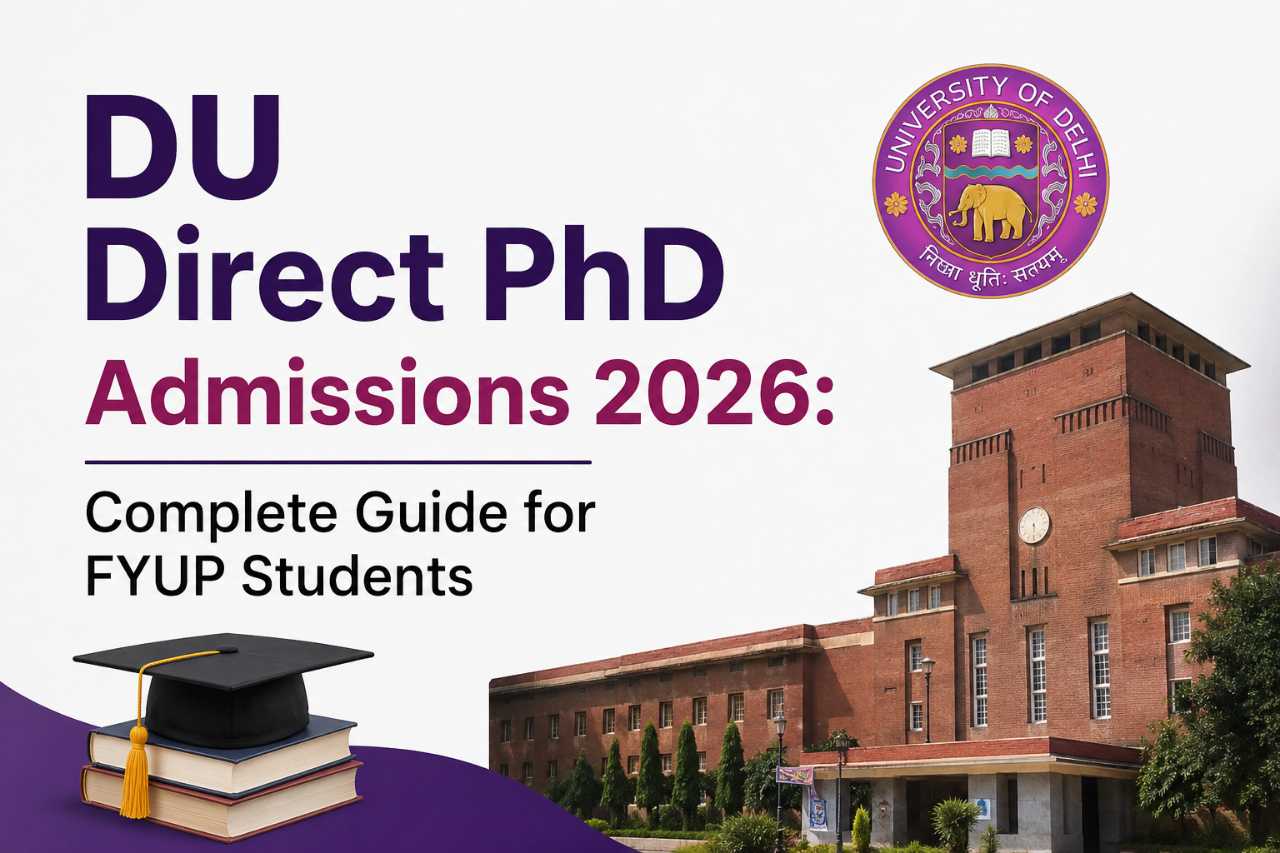
Delhi University (DU) has taken a major step toward research-focused undergraduate education by opening direct PhD admissions for the academic year 2026-27. Students who complete the four-year Undergraduate Programme (FYUP) at DU or its affiliated colleges can now apply for doctoral studies without first earning a postgraduate degree. Registration is live on the official portal, and the last date to apply is September 6, 2026.
This pathway reflects India's broader shift under the National Education Policy (NEP) 2020, which encourages multiple entry and exit options, research exposure at the undergraduate level, and smoother transitions from UG to advanced research. For FYUP graduates aiming at academic careers, R&D roles, or specialised industry positions, understanding this route early can save time and open doors that previously required a two-year master's programme first.
In this guide, CollegeDwar breaks down eligibility, fees, the selection process, revised FYUP credit norms, and a step-by-step application walkthrough—so you can apply confidently before the deadline.
What Is DU Direct PhD Admission?
Traditionally, admission to a PhD programme in India required a master's degree with a minimum percentage or NET/JRF qualification, followed by an entrance test and interview. Delhi University's direct PhD route is different: it allows students who have completed the four-year FYUP from DU or affiliated colleges to move straight into doctoral research.
The university introduced this as a one-time direct admission passage for students completing four-year undergraduate programmes in 2026. The move aligns with NEP goals of integrating research skills into undergraduate curricula and reducing unnecessary delays between UG completion and doctoral enrolment.
Who Benefits Most from This Route?
- FYUP graduates with strong academic records who already engaged in dissertation or project work during the fourth year.
- Students who want to avoid an extra one-year or two-year PG before starting research.
- Candidates targeting faculty positions, CSIR/DBT fellowships, or industry R&D labs where early research experience matters.
- Graduates from leading DU colleges such as Lady Shri Ram College for Women (LSR), Delhi, Indraprastha College for Women, Delhi, and Indira Gandhi Delhi Technical University for Women, where FYUP research components are already part of the curriculum.
It is important to note that this is not an automatic promotion. Meeting the CGPA threshold makes you eligible to apply; final selection still depends on department-level evaluation.
DU PhD Admissions 2026: Key Dates and Registration Portal
Registration for DU direct PhD admissions 2026 has been activated on the university's postgraduate admission portal. Keep these details handy:
- Registration portal: pgportal.uod.ac.in
- Academic session: 2026-27
- Application deadline: September 6, 2026
- Applicant pool: FYUP graduates from DU and affiliated colleges only
Do not wait until the final day. Portal traffic tends to spike near deadlines, and incomplete forms—missing documents, incorrect category certificates, or CGPA entry errors—are common reasons for rejection.
Context: FYUP and PG Applications at DU
Delhi University recently reported receiving over 12,000 applications from nearly 35,943 FYUP students for its one-year postgraduate programmes. That volume shows how many fourth-year graduates are actively planning their next academic step. Students who meet the higher CGPA bar for direct PhD may prefer research over a one-year PG, while others may combine PG applications as a backup plan.
Eligibility Criteria for Direct PhD at Delhi University
Only candidates who satisfy all conditions below can apply. Partial fulfilment does not qualify.
Basic Eligibility Requirements
- Completion of a four-year undergraduate programme (FYUP) from Delhi University or its affiliated colleges.
- Graduation in the relevant or allied discipline as specified by the concerned PhD department.
- Minimum CGPA as per category (see table below).
- Willingness to appear for the department/university-level selection test and subsequent interview, if shortlisted.
CGPA Requirements by Category
Delhi University has set clear grade-point thresholds. These are eligibility cut-offs, not guarantees of admission.
| Category | Minimum CGPA Required |
|---|---|
| UR (Unreserved) | 7.5 |
| OBC (Non-Creamy Layer) | 7.5 |
| EWS (Economically Weaker Section) | 7.5 |
| SC (Scheduled Caste) | 7.0 |
| ST (Scheduled Tribe) | 7.0 |
| PwBD (Persons with Benchmark Disabilities) | 7.0 |
Actionable tip: Calculate your CGPA using the official DU transcript format. If your college uses letter grades, confirm the conversion method before entering figures on the portal. A mismatch between self-reported and verified CGPA can lead to cancellation at any stage.
What Direct PhD Does Not Require
Unlike the conventional route, eligible FYUP graduates do not need a completed master's degree to apply under this pathway. However, departments may still assess research aptitude, subject knowledge, and alignment with available supervisors and funding.
Application Fee for DU FYUP PhD Registration
Category-wise registration charges apply at the time of online application:
- UR, OBC-NCL, and EWS candidates: ₹250
- SC, ST, and PwBD candidates: ₹100
Keep payment confirmation screenshots and transaction IDs. Fee payment alone does not confirm admission; it only completes your registration for the selection process.
Selection Process: What Happens After You Apply
Delhi University has stated that selection will include a test conducted by the concerned department or the university. The exact pattern may vary by faculty—Humanities, Sciences, Commerce, and Interdisciplinary Studies often use different evaluation formats.
Typical Stages in the Selection Cycle
- Online application and document verification on pgportal.uod.ac.in
- Department-level entrance test assessing subject fundamentals and research orientation
- Interview or viva voce with faculty members, often including discussion of your FYUP dissertation or project
- Final merit list based on combined performance and seat availability under supervisors
Students who completed substantial fourth-year research—especially under the revised credit framework—should prepare to present their project work clearly. Supervisors look for curiosity, methodological clarity, and feasibility of proposed research topics.
How to Prepare for the Department Test
- Revise core UG papers from the third and fourth years of your FYUP programme.
- Re-read your dissertation or major project report; be ready to defend methodology and findings.
- Read recent papers from DU faculty in your target department to understand active research areas.
- Practise explaining why you chose a specific research problem—clarity of purpose matters as much as factual knowledge.
If you are considering a science or engineering-oriented doctorate, reviewing pathways like PhD in Engineering and comparing research cultures at institutes such as the Jawaharlal Nehru Centre for Advanced Scientific Research, Bangalore, the Regional Centre for Biotechnology, or the Indian Association for the Cultivation of Science can help you articulate why DU fits your goals.
Revised FYUP Credit System Under UGCF 2022
In July 2026, Delhi University announced revised credits for four-year students under the Undergraduate Curriculum Framework (UGCF) 2022, effective from the academic year 2026-27. A key change affects research-oriented components:
- Credits for dissertation, academic project, and entrepreneurship track increased from 6 to 10 credits.
- Four additional credits were added specifically to strengthen research and applied learning in the final year.
This revision matters for direct PhD applicants because your fourth-year project now carries greater academic weight. A strong dissertation under the expanded credit structure can strengthen your interview profile and demonstrate readiness for doctoral work—similar to how dedicated research foundations such as Vinayaka Missions Research Foundation, Salem or Ramakrishna Mission Vivekananda Educational and Research Institute, Howrah integrate research training early in their programmes.
Documents You Should Keep Ready
Although the portal will list exact upload requirements, prepare these in advance:
- FYUP degree or provisional certificate from DU or affiliated college
- Official mark sheets showing semester-wise CGPA
- Category certificate (OBC-NCL, EWS, SC, ST, or PwBD) in the prescribed format, if applicable
- Government-issued photo ID (Aadhaar, passport, or voter ID)
- Recent passport-size photograph and signature scan
- Summary of FYUP dissertation or major project (abstract, objectives, methodology)
- Payment receipt for registration fee
Scan documents in PDF format within the size limits mentioned on the portal. Blurry uploads are a frequent cause of verification delays.
Direct PhD at DU vs Conventional PhD Routes in India
Understanding how this pathway compares with other options helps you make an informed decision.
| Aspect | DU Direct PhD (FYUP) | Conventional PhD Route |
|---|---|---|
| Prior degree required | Four-year UG from DU/affiliates | Master's degree (typically) |
| Minimum CGPA | 7.5 (UR/OBC/EWS) or 7.0 (SC/ST/PwBD) | Varies by university (often 55% in PG) |
| Entrance test | Department/university test | NET/JRF, GATE, or university entrance |
| Time to doctorate | Can start immediately after FYUP | Usually after 2-year MA/MSc/MCom |
| Geographic scope | DU departments only | All recognised universities |
Students who do not meet DU's CGPA cut-off or who completed UG elsewhere may explore PhD programmes at other institutions. Open universities such as Indira Gandhi National Open University, Dr B R Ambedkar Open University, Hyderabad, and Karnataka State Open University, Mysore offer doctoral options under different eligibility rules—though most still require a master's degree.
Actionable Tips for FYUP Students Applying in 2026
1. Identify Supervisors Early
Visit department websites and read faculty profiles. Shortlist two or three potential supervisors whose research aligns with your FYUP project. Mentioning specific alignment in your application or interview shows seriousness.
2. Treat Your Dissertation as a Portfolio
With 10 credits now assigned to dissertation and project work, invest time in producing publishable-quality output. Even a departmental journal or conference presentation adds weight.
3. Apply to Multiple Departments Carefully
If your interdisciplinary FYUP allows, you may be eligible for more than one PhD department. Read each department's eligibility note—applying blindly without matching prerequisites wastes effort and fees.
4. Keep a PG Backup Plan
Given that over 12,000 FYUP students already applied for one-year PG seats, competition for direct PhD will also be selective. Continue monitoring PG admission timelines as a parallel option.
5. Stay Updated via Official Channels
Rely on pgportal.uod.ac.in and official DU notifications. Third-party summaries can miss deadline changes or department-specific instructions.
Department-Wise PhD Opportunities at Delhi University
Delhi University hosts doctoral programmes across dozens of departments spread over the North and South Campuses and affiliated colleges. While the direct PhD route uses a common registration portal, each department sets its own research priorities, supervisor availability, and evaluation emphasis. Understanding these differences helps you target the right programme.
Faculty of Social Sciences and Humanities
Departments such as Economics, Political Science, History, Sociology, and English receive high application volumes every year. Candidates should demonstrate strong writing skills, familiarity with theoretical frameworks, and a clear research proposal connected to their FYUP dissertation. Humanities applicants often benefit from reading lists shared by faculty on department websites and from attending research seminars before the entrance test.
Faculty of Science and Interdisciplinary Research
Science departments—including Physics, Chemistry, Botany, Zoology, and Environmental Science—typically emphasise quantitative aptitude, laboratory exposure, and problem-solving under timed conditions. If your FYUP included hands-on project work or internships at labs such as the international institute for Population Sciences, Mumbai, highlight those experiences during the interview.
Faculty of Commerce and Management
Commerce and Business Economics departments look for analytical rigour, data interpretation skills, and awareness of current economic policy debates. FYUP graduates who completed entrepreneurship-track credits under the revised UGCF framework should explain how applied projects shaped their research interests.
Professional and Applied Departments
Departments in law, education, and applied sciences may have additional prerequisites. Always download the official notification for your chosen department and confirm that your FYUP subject combination satisfies listed requirements before paying the registration fee.
Fellowships, Funding, and Financial Planning
Admission to a PhD programme is only the first step; sustaining three to six years of doctoral research requires financial planning. Delhi University PhD scholars may become eligible for university fellowships, government scholarships, or project-based funding depending on department resources and National schemes.
- UGC-NET JRF: Although direct PhD applicants enter without a master's degree, pursuing NET in subsequent years can unlock Junior Research Fellowship support if you meet evolving eligibility norms.
- CSIR, DBT, and ICMR fellowships: Science departments often guide scholars toward external funding based on research area and supervisor collaborations.
- Institute-specific assistantships: Some departments offer teaching or research assistantships that cover stipends and reduce tuition burden.
- Self-funded research: Candidates without immediate fellowship support should budget for study materials, conference travel, and living costs in Delhi.
Discuss funding prospects openly with potential supervisors during the interview stage. Transparent conversations prevent misunderstandings later about stipend availability or project grants.
Career Outcomes After a DU PhD
A doctorate from Delhi University opens multiple career pathways in India and abroad. FYUP graduates who enter research early may gain a time advantage over peers who complete a master's first.
- Academic careers: Assistant professor roles at universities and colleges, subject to UGC norms and NET/SET requirements where applicable.
- Public-sector research: Positions in CSIR labs, DRDO, ICAR, ISRO, and national think tanks value DU's research training.
- Industry R&D: Pharmaceutical, biotechnology, data analytics, and policy consulting firms recruit PhD holders for specialised roles.
- International postdoctoral fellowships: Strong publication records during the PhD improve chances for postdoc positions at global universities.
Institutions such as the ICFAI Foundation for Higher Education, Hyderabad and Noorul Islam Centre for Higher Education, Kanyakumari represent the wider ecosystem of research-focused universities where DU PhD graduates compete for faculty and research positions.
Common Mistakes to Avoid During Application
Even strong students lose opportunities because of preventable errors. Watch out for these pitfalls:
- Incorrect CGPA calculation: Using informal online calculators instead of official DU grade conversion rules.
- Expired category certificates: OBC-NCL and EWS certificates must be valid for the admission year and issued in the prescribed format.
- Applying to incompatible departments: Submitting forms without verifying subject prerequisites leads to automatic disqualification.
- Ignoring test admit cards: Missing department test dates because of unchecked spam folders or outdated mobile numbers.
- Weak dissertation presentation: Failing to prepare a concise summary of fourth-year research work for the viva.
- Relying on unofficial websites: Fraudulent portals mimic university pages—always verify the URL is pgportal.uod.ac.in.
Pre-Application Checklist for September 6 Deadline
Use this checklist one week before submitting your application:
- Confirm final FYUP CGPA meets category-wise cut-off (7.5 or 7.0).
- Collect degree/provisional certificate and all semester mark sheets.
- Prepare valid category and PwBD certificates, if applicable.
- Shortlist PhD departments and read official eligibility PDFs.
- Draft a one-page research interest summary linked to your FYUP project.
- Ensure a working email ID and mobile number for all DU communications.
- Keep debit/credit card or UPI ready for ₹250 or ₹100 registration fee.
- Save screenshots of every portal step until admission is confirmed.
Students from colleges outside the main campus—whether at SRD Modi College for Women, Kota or open-learning backgrounds such as Vardhman Mahaveer Open University, Kota—should remember that only DU-affiliated FYUP graduates qualify for this specific route. Others may consider conventional PhD pathways after completing a recognised master's programme.
Why Direct PhD Matters for Indian Higher Education
Delhi University's experiment with direct doctoral entry from FYUP sends a signal across Indian higher education: undergraduate programmes are no longer just stepping stones to master's degrees—they can be launch pads for research careers. Similar conversations are happening at central universities, IITs, and research institutes nationwide.
For students in Delhi, this is a time-sensitive opportunity. The September 6 deadline leaves a narrow window to gather documents, pay fees, and prepare for department tests. For educators and policymakers, it offers a real-world test of whether four-year UG curricula under NEP can produce research-ready graduates without an intermediate PG year.
Conclusion
DU direct PhD admissions 2026 give FYUP graduates a rare chance to begin doctoral research immediately after completing a four-year undergraduate degree. Register at pgportal.uod.ac.in before September 6, 2026, ensure you meet the CGPA requirement for your category (7.5 for UR/OBC/EWS; 7.0 for SC/ST/PwBD), pay the applicable registration fee, and prepare thoroughly for the department selection test.
The expanded 10-credit research component under UGCF 2022 strengthens the case for students who invested seriously in fourth-year project work. Whether you aim for academia, government research labs, or industry innovation roles, starting your PhD journey early at India's largest central university can be a decisive career move—provided you plan carefully, document everything accurately, and treat the application as the first step in a long research commitment.
For broader options beyond Delhi, explore doctoral pathways on CollegeDwar and compare colleges, open universities, and specialised research institutes to find the route that best matches your academic profile and career goals.