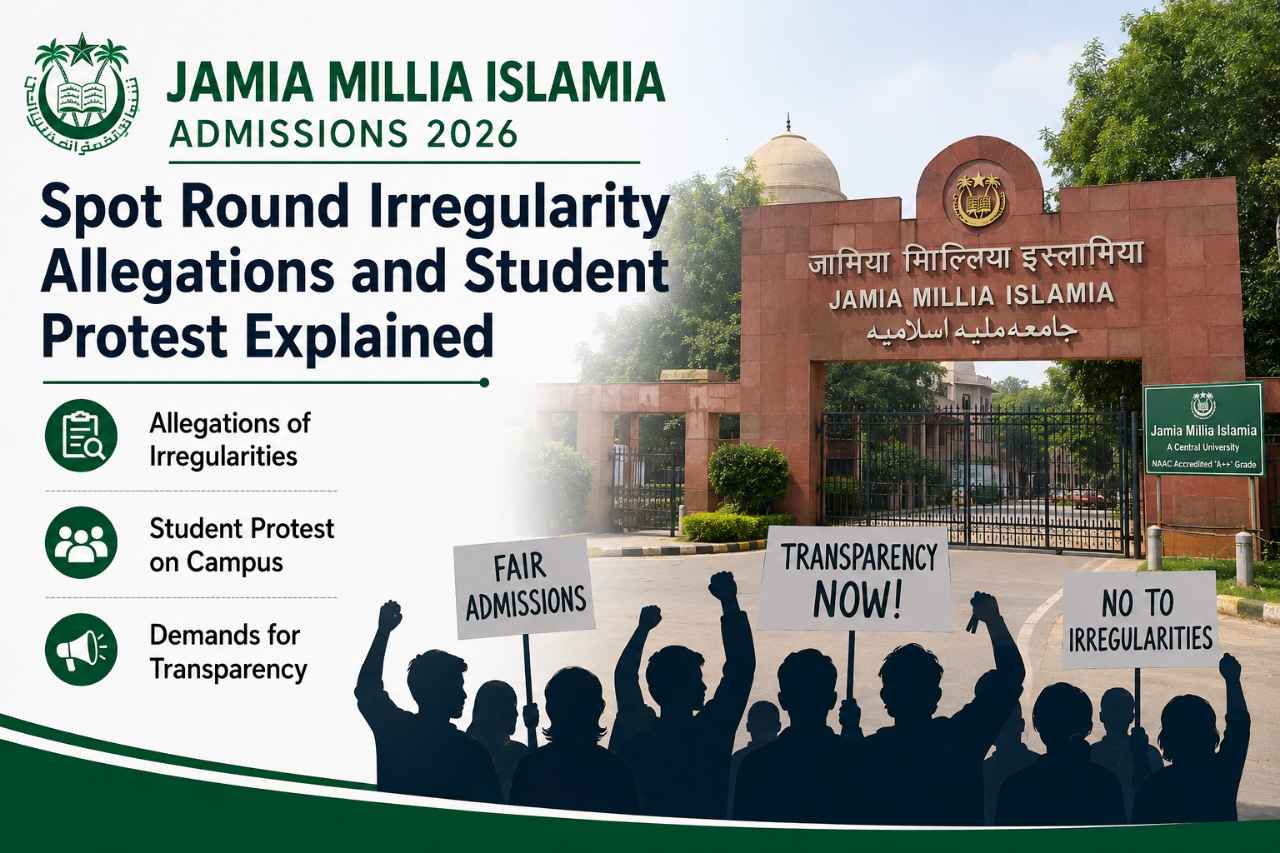
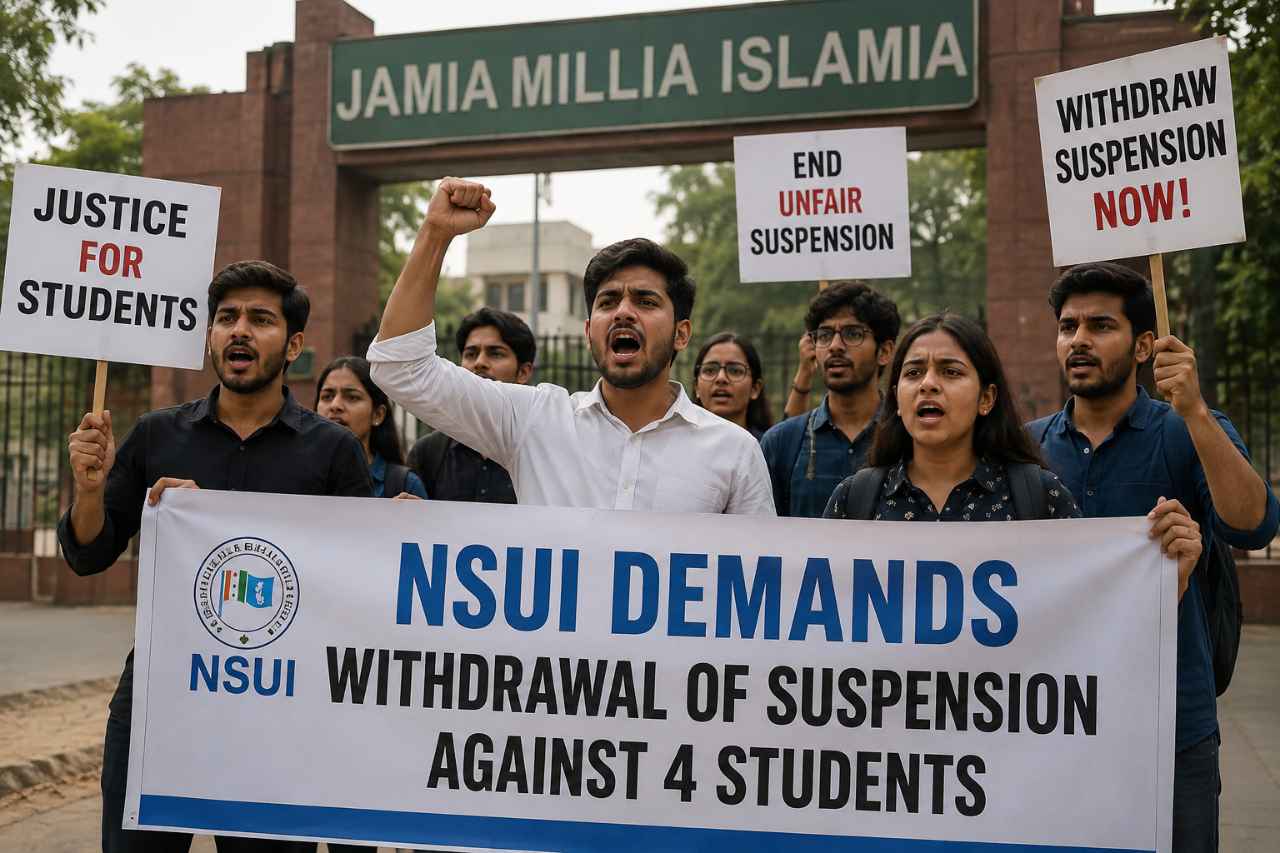

Spot admission rounds at central universities often decide the final fate of thousands of waitlisted candidates. In August 2026, Jamia Millia Islamia (JMI) in New Delhi became the centre of a fresh controversy when the National Students' Union of India (NSUI) JMI unit demanded that the university administration withdraw suspension and campus-ban orders against four students who protested alleged irregularities in the spot admission process. The dispute highlights a recurring tension in Indian higher education: transparent merit-based seat allotment versus student activism when candidates believe the rules were not followed fairly.
For students preparing for university admissions across India from Delhi's competitive central universities to state colleges in Jaipur, Kota, and Chennai understanding how spot rounds work, what rights you have if seats are allotted unfairly, and how campus protests intersect with disciplinary action is essential. This article explains the JMI spot admission row, the allegations raised by students, the administrative response, and practical guidance for aspirants navigating similar situations at institutions like Jesus and Mary College Delhi, Delhi Technical Campus, and other campuses nationwide.
What Happened at Jamia Millia Islamia: A Timeline of Events
Jamia Millia Islamia is a centrally funded university in New Delhi with a long history of student politics and academic activism. Each admission cycle, JMI conducts regular counselling followed by spot admission rounds for vacant seats in undergraduate and postgraduate programmes. In the 2026 cycle, student representatives from NSUI JMI raised serious concerns after the spot admission process concluded.
Student Allegations Over Spot Admission Irregularities
According to reports, protesting students claimed that candidates lower on the official waiting list were granted admission while applicants with higher ranks were denied entry. This allegation strikes at the core of merit-based admissions a principle that governs seat allotment at central universities, state universities, and most reputable private institutions offering regulated programmes.
Students submitted written complaints to the Controller of Examinations at JMI, questioning:
- The legal and procedural basis for conducting spot admissions
- The publication methodology of merit and waiting lists
- The criteria used to allot seats during the spot round
- Whether documented rank order was maintained throughout the process
Similar transparency concerns have surfaced at other campuses. Students comparing admission experiences at Fairfield Institute of Management and Technology or SRM Institute of Science and Technology Chennai often find that clear, published cut-offs and waiting-list movement reduce confusion. When those documents are missing or inconsistently applied, protests become more likely.
Administrative Action Against Four Students
In response to the protests, the JMI administration issued show cause-cum-suspension-cum-campus ban notices against four individuals:
- Dhruv Vice President, NSUI JMI
- Tabrez General Secretary, NSUI JMI
- Ebin Secretary, NSUI JMI
- Jasim Student at JMI
A campus ban typically restricts a student's physical access to university premises, while suspension may affect academic participation depending on institutional rules. Combined with a show-cause notice, the action signals that the administration viewed the protest as a disciplinary matter requiring formal inquiry.
NSUI JMI's Official Demands
NSUI JMI issued a public statement calling for immediate withdrawal of the suspension and campus ban. The organisation argued that disciplinary action affecting students' academic and campus rights must follow due process, transparency, fairness, and a meaningful opportunity to be heard.
Key demands included:
- Immediate revocation of suspension and campus ban against all four students
- Fulfilment of legitimate and democratic demands without delay
- Open and transparent dialogue between the university administration and student representatives
- No victimisation or retaliatory action against students raising concerns through peaceful, democratic means
NSUI JMI also stated it would continue pursuing these demands through lawful and peaceful channels while standing in solidarity with the affected students.
Understanding Spot Admissions in Indian Universities
Spot admission sometimes called spot counselling or mop-up round is a final opportunity for universities to fill vacant seats after regular admission rounds close. At central universities like JMI, spot rounds typically follow a published merit or waiting list. Understanding this process helps students nationwide, whether they are targeting JMI, Sawai Man Singh Government College Jaipur, or engineering institutes such as Krishna Institute of Engineering and Technology.
How Spot Admission Usually Works
Although procedures vary by institution, spot admission at most Indian universities follows a broadly similar framework:
- Publication of vacant seats: The university announces programme-wise vacancies after regular counselling.
- Merit or waiting list release: A rank-ordered list of eligible candidates is published on the official admission portal.
- Spot round registration: Waitlisted or eligible candidates register within a specified window.
- Seat allotment: Seats are offered strictly according to rank, category reservation rules, and programme-specific criteria.
- Fee payment and document verification: Selected candidates complete formalities within the deadline or forfeit the seat.
When this sequence is followed transparently, lower-ranked candidates cannot jump ahead of higher-ranked ones unless specific rules such as category-wise seat movement or programme transfer apply and are publicly documented.
Spot Admission vs Regular Counselling: Key Differences
The table below summarises how spot rounds differ from regular admission cycles at most Indian universities:
| Aspect | Regular Counselling | Spot Admission |
|---|---|---|
| Timing | Main admission window after entrance results | After regular rounds close; limited window |
| Seat pool | Full sanctioned intake | Only vacant/unfilled seats |
| Candidate pool | All qualified applicants | Typically waitlisted or registered eligible candidates |
| Documentation | Merit lists, category-wise cut-offs published | Updated waiting list; sometimes live allotment |
| Flexibility | Multiple rounds possible | Final chance; strict deadlines |
Why Spot Admission Disputes Arise
Spot admission disputes typically emerge when:
- Waiting lists are updated without clear public notification
- Seat allotment order does not match the published rank list
- Category or programme-wise seat movement rules are applied inconsistently
- Manual overrides occur without documented justification
- Communication gaps leave higher-ranked candidates unaware of their turn
Students at private universities such as Mewar University Jaipur Campus or Galgotias College of Engineering and Technology should note that UGC-notified institutions and AICTE-approved colleges are also expected to maintain admission transparency, though enforcement mechanisms differ from central universities.
Student Rights, Due Process, and Campus Protests
The JMI controversy raises broader questions about student rights during admission disputes. Indian universities operate under statutes, ordinances, and UGC guidelines that generally require fair inquiry before major disciplinary action. Students who believe spot admission rules were violated have both administrative and legal pathways protests being one form of democratic expression recognised on many university campuses.
What Due Process Means for Students
Due process in a university context typically includes:
- Written notice specifying the alleged violation
- Access to evidence or charges against the student
- Reasonable time to respond through a show-cause submission
- A hearing before an impartial committee where applicable
- Proportionality of punishment relative to the alleged misconduct
NSUI JMI's statement emphasised that suspension and campus bans should not be imposed without these safeguards, especially when students raise legitimate academic grievances rather than engage in violence or disruption.
Peaceful Protest vs Disciplinary Action
Indian campus culture has a long tradition of student union activism. Central universities including JMI, JNU, and Delhi University have historically seen protests over admissions, fee hikes, and administrative decisions. Universities may regulate protest time, place, and manner through conduct rules, but retaliatory punishment for raising documented grievances can attract public scrutiny and legal challenge.
The NSUI JMI demand that authorities must not victimise students for peaceful, democratic protest aligns with principles echoed in student movements at institutions ranging from University of Petroleum and Energy Studies to regional colleges like Rathinam Technical Campus Chennai, where student bodies routinely negotiate with administrations over policy changes.
What Aspirants Should Learn from the JMI Spot Admission Row
Whether you are a Class 12 graduate seeking BA admission at JMI or an engineering aspirant comparing Amity Entrance Test scores with other entrance routes, the JMI episode offers practical lessons for safeguarding your admission interests.
Document Everything During Admission Season
During spot rounds, save screenshots of:
- Published merit and waiting lists with timestamps
- Your registration confirmation and rank position
- Seat allotment notices and payment receipts
- Official emails or portal messages from the university
These records become critical if you need to file a grievance with the Controller of Examinations, the admission committee, or external bodies.
Know the Correct Grievance Channel
Before joining a protest, exhausted administrative remedies often strengthen your case. At most universities, the recommended order is:
- Admission helpline or programme coordinator
- Controller of Examinations or Registrar (Admissions)
- University Grievance Redressal Committee
- UGC grievance portal for affiliated/central universities where applicable
- RTI application for admission records if responses are inadequate
Students at colleges in Rajasthan such as Arch College of Design and Business Jaipur or Lords Institute of Engineering and Technology Jaipur should identify equivalent grievance officers listed on their institution's website at the start of each admission cycle.
Compare Backup Options Early
Spot admission uncertainty makes backup planning essential. Maintain active applications at multiple institutions including state universities like SKNAU Jaipur Campus, DSRRAU Jaipur Campus, and regional options such as Bhartiya Institute of Engineering and Technology Sikar or Gurukul Institute of Engineering and Technology Kota so that a disputed spot round at one university does not leave you without alternatives.
Jamia Millia Islamia Admissions: Context for 2026 Aspirants
JMI conducts its own entrance tests and merit-based admissions for numerous programmes. As a minority institution with central university status, it follows reservation policies applicable to central educational institutions while maintaining programme-specific eligibility criteria. Spot rounds at JMI typically attract high demand because Delhi remains one of India's most competitive education hubs alongside institutions near Jesus and Mary College Delhi and other premier colleges.
Programmes and Competition Levels
JMI offers programmes across humanities, sciences, engineering, law, and social sciences. High-demand courses often generate long waiting lists, making the final spot round decisive. Candidates who miss a seat by a few ranks may understandably react strongly if they observe lower-ranked applicants receiving offers a scenario that erodes trust in the entire admission ecosystem.
Role of Student Unions in Admission Oversight
Student unions like NSUI JMI often act as watchdogs during admission season, monitoring list publications and assisting fellow students with grievance drafting. Their involvement can accelerate administrative review but may also lead to disciplinary friction when administrations view protests as violations of conduct codes. Constructive dialogue as NSUI JMI has requested remains the most sustainable resolution path.
Broader Implications for Indian Higher Education Transparency
The JMI spot admission row is not an isolated incident. Across India, students have questioned admission irregularities at universities, coaching-driven professional courses, and professional colleges. Transparency initiatives such as public faculty data releases and RTI-driven disclosures at other institutions show that structured accountability can reduce suspicion.
UGC and Regulatory Expectations
The University Grants Commission expects institutions to publish admission policies, maintain fair practice codes, and operate grievance redressal mechanisms. Central universities receive additional oversight through visitorial powers and ministry review. When spot admission criteria are opaque, regulatory scrutiny becomes more likely especially when student organisations escalate complaints through media and formal channels.
Technology Solutions for Fair Seat Allotment
Many universities now use automated counselling software that logs every seat allotment decision with a timestamp and rank reference. JMI and peer institutions could reduce future disputes by:
- Publishing real-time waiting list movement on the admission portal
- Issuing allotment letters that cite rank, category, and rule applied
- Archiving spot round data for audit and RTI compliance
- Conducting spot rounds via live streaming or recorded sessions for high-demand programmes
Institutions ranging from Sathyabama Institute of Science and Technology Chennai to Mody University of Science and Technology Lakshmangarh that invest in transparent digital admission systems often face fewer post-allotment conflicts.
Actionable Tips for Students Facing Spot Admission Issues
If you believe your spot admission was handled unfairly at any Indian university, consider these steps before the admission window closes:
Immediate Steps (Within 24–48 Hours)
- Download and archive all portal data related to your application
- Compare your rank with candidates who received allotment announcements on social media or student groups
- Send a formal email to the admission office citing your rank and requesting written clarification
- Contact your programme's student representatives or union for guidance
Medium-Term Steps (If No Response)
- File a written complaint with the Controller of Examinations, as JMI students did
- Request a meeting with the Grievance Redressal Committee
- Consult a lawyer specialising in education law if your academic year is at risk
- Explore parallel admission at backup institutions without delaying fee deadlines elsewhere
Long-Term Prevention
- Join admission-season peer networks that track list updates collectively
- Follow official university social media and portal notifications only not unverified WhatsApp forwards
- Understand reservation and category movement rules before assuming foul play
- Participate in student council elections if you want systemic oversight of future admission cycles
What Happens Next at JMI?
As of August 27, 2026, the JMI administration had not publicly confirmed withdrawal of the suspension and campus ban against Dhruv, Tabrez, Ebin, and Jasim. NSUI JMI continues to press for dialogue and reversal of disciplinary action while pursuing spot admission transparency demands. Outcomes may depend on whether the Controller of Examinations investigates the written complaints, whether an impartial inquiry finds merit in the irregularity allegations, and whether both sides agree to a mediated resolution.
Students watching this case should monitor official JMI notifications rather than relying solely on social media updates. The resolution or lack thereof may set a precedent for how central universities balance student activism with admission integrity during future spot rounds.
Conclusion
The NSUI JMI demand to withdraw suspension and campus bans against four students has brought Jamia Millia Islamia's spot admission process under national scrutiny. At its heart, the controversy reflects a universal student concern: admission decisions must follow published merit, transparent criteria, and fair process. Whether you aspire to study in Delhi at JMI, at Ramakrishna Mission Vivekananda Educational And Research Institute Howrah, or at professional colleges across Jaipur, Kota, Sikar, and Chennai, the lesson is the same know your rights, document every step, use official grievance channels, and plan backup options before spot admission deadlines pass.
Indian higher education works best when universities publish clear rules, students raise concerns peacefully and lawfully, and administrations respond with inquiry rather than retaliation. The JMI spot admission row is a timely reminder that transparency in the final admission round protects not only individual candidates but the credibility of the entire institution.