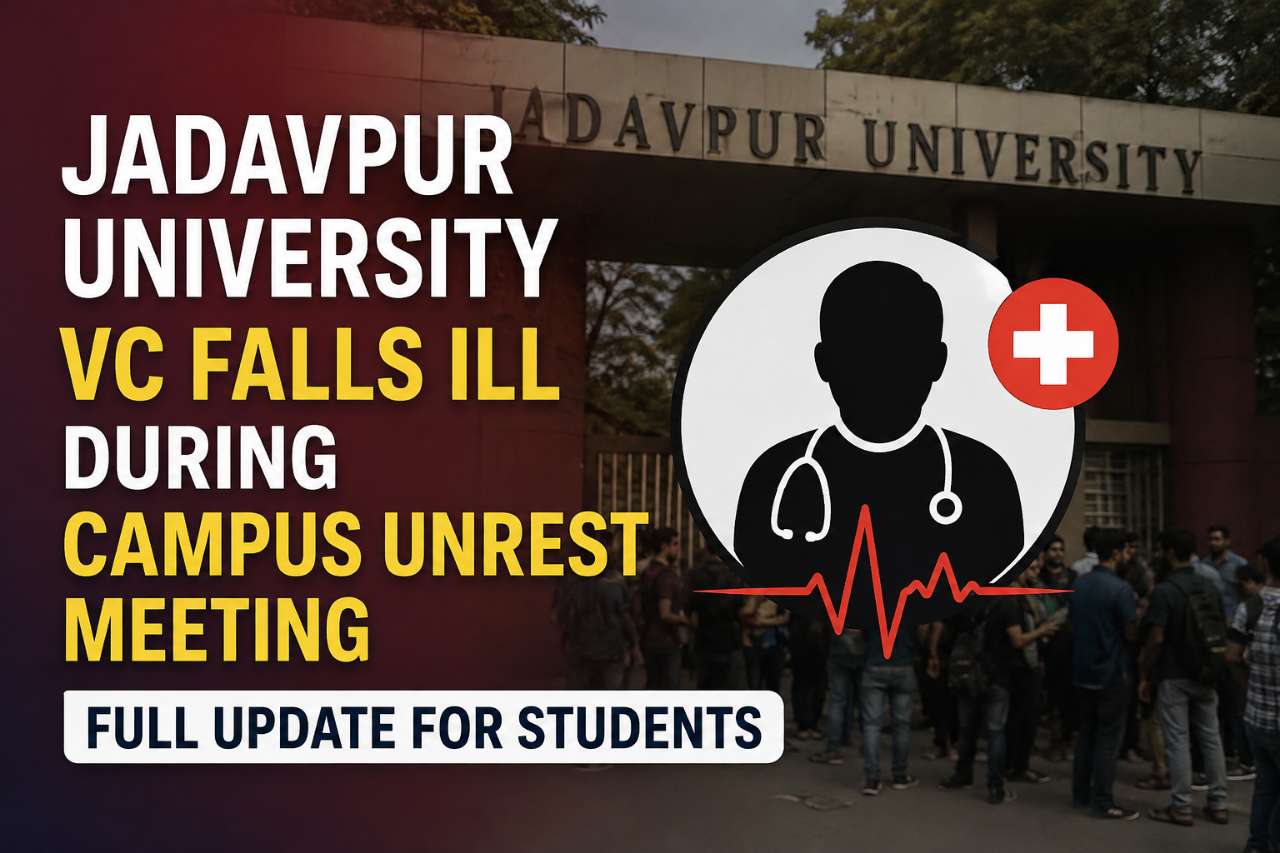
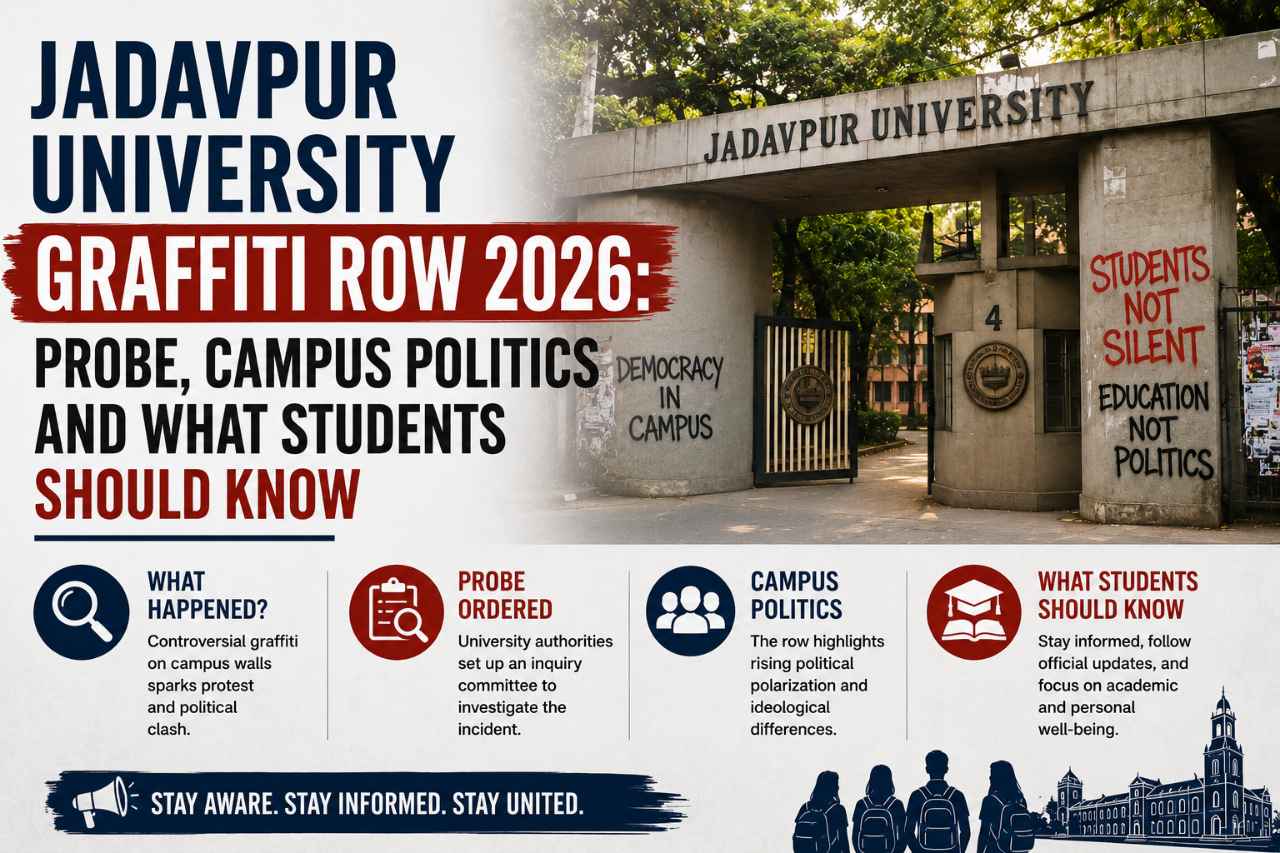

In August 2026, Jadavpur University Kolkata found itself at the centre of a fresh campus controversy after reports of objectionable wall graffiti at the Arts Boys Hostel triggered a state-level response. Videos and photographs allegedly showing provocative drawings reached the Chief Minister's Office Grievance Cell, after which senior political leader Suvendu Adhikari directed the vice-chancellor and West Bengal Higher Education Department officials to conduct an on-ground verification. The episode unfolded against a backdrop of recent clashes between ABVP and Left-leaning student groups, renewed debates on nationalism on campus, and questions about how Indian universities balance free expression with institutional discipline. For students preparing for college admissions, parents evaluating campus safety, and educators tracking higher-education policy, the Jadavpur graffiti row offers a timely case study in governance, student politics, and academic freedom in India.
What Triggered the Jadavpur University Graffiti Row?
According to reports from August 25, 2026, students submitted visual evidence—videos and photographs—through the state Grievance Cell claiming that the Arts Boys Hostel walls carried graffiti described by authorities as objectionable, violent, and anti-national in nature. The complaint focused not on routine campus art or political slogans common at universities, but on specific drawings that officials argued crossed into propaganda territory.
Suvendu Adhikari, responding through a social media statement, described educational institutions as sacred spaces dedicated to learning, academic excellence, and nation-building. He asserted that campus premises must not become platforms for spreading what he termed deranged propaganda or anti-India sentiment. On that basis, he asked Jadavpur University authorities to physically inspect the hostel area and, if allegations were confirmed, identify those responsible and initiate appropriate action.
Key Facts at a Glance
- Date of development: Monday, August 25, 2026
- Location: Arts Boys Hostel, Jadavpur University, Kolkata
- Trigger: Grievance Cell received student-submitted photos and videos
- Official response: Directed physical verification and possible disciplinary or legal action
- Broader context: Recent ABVP–Left student clashes and damaged university emblem at a campus gate
For aspirants researching Jadavpur University Kolkata, it is important to separate long-term academic reputation from short-term political flashpoints. JU remains one of India's most competitive public universities for engineering, arts, and science programmes, but its politically active campus culture regularly attracts media attention—something prospective students should understand before admission.
The Ordered Probe: What Happens Next?
When a state-level leader directs a university probe, the process typically involves several coordinated steps. First, university security and hostel wardens conduct a physical inspection of the reported site. Officials document wall markings through timestamped photographs, collect witness statements from hostel residents, and review CCTV footage if cameras are operational in the area—a point that has itself been disputed at Jadavpur in recent weeks.
If the inquiry confirms unauthorized graffiti, the administration usually issues show-cause notices to individuals or groups suspected of creating or permitting the content. Depending on severity and applicable rules, consequences can range from hostel transfer or suspension under university discipline codes to referral to law enforcement under provisions related to unlawful assembly, defacement of public property, or laws governing offensive content.
Expected Outcomes of the Verification
- Immediate removal and repainting of hostel walls if objectionable content is verified
- Identification of students or outsiders involved in creating the graffiti
- Administrative penalties under Jadavpur University conduct regulations
- Possible legal proceedings if content is deemed to violate Indian law
- Renewed discussion on hostel access control and visitor policies
Universities with strong legal studies departments often see these moments spill into broader constitutional debates. Institutions such as The West Bengal National University of Juridicial Sciences Kolkata and National Law University Delhi frequently train students who later argue cases involving speech, sedition, and campus autonomy—making law-school perspectives especially relevant when graffiti rows become national news.
Background: Campus Clashes and Rising Tensions at JU
The graffiti controversy did not emerge in isolation. Jadavpur University had already witnessed violent clashes between Akhil Bharatiya Vidyarthi Parishad (ABVP) members and Left-aligned student organizations. During one such confrontation, the university emblem at a campus gate was reportedly damaged—a symbolic incident that intensified emotions on all sides.
Student politics at JU has deep historical roots. The campus has long served as a space for ideological debate, protest art, and political mobilization. What changes in 2026 is the scale of state attention and the explicit framing of certain expressions as anti-national rather than merely political disagreement. That shift matters for how inquiries are conducted and how students perceive safety and freedom on campus.
Recent Issues Reported at Jadavpur University
- Clashes between ABVP and Left-leaning groups leading to injuries
- Damage to the university emblem at a campus entrance
- Allegations that Vande Mataram is not sung on campus
- Claims that the national flag is not hoisted and Education Department officials face entry restrictions
- Disputes over installation of CCTV cameras in hostel and campus areas
Students injured or traumatized during campus unrest may require counseling and clear communication from the administration. As seen at other premier institutions facing sudden crises, transparent inquiry committees and student representation can reduce mistrust. The resignation of an inquiry panel chief in a related JU matter, reported separately, underscores how sensitive governance becomes when political groups collide.
Kishenji Slogans and the Limits of Campus Expression
Parallel to the graffiti probe, Adhikari stated that slogans glorifying slain Maoist leader Mallojula Koteswara Rao, known as Kishenji, would not be permitted on the Jadavpur campus. He specifically referenced the phrase Kishenji red salute, warning that the government possessed documents and videos and would act against those promoting such messaging.
This declaration highlights a recurring tension in Indian higher education: where does political speech end and unlawful glorification of violence begin? Campus communities often argue that universities must remain venues for sharp political critique, especially in arts and social sciences programmes. Governments and opposing student groups counter that glorification of armed insurgency or terror figures creates an intimidating environment and violates the institutional duty to uphold constitutional values.
For students at universities with active debating cultures—whether at JU, Uniraj University of Rajasthan Jaipur, or Netaji Subhas University of Technology NSUT Delhi—the practical lesson is that expressive conduct on hostel walls carries higher scrutiny than spoken debate in a seminar room. Visual propaganda persists, spreads quickly on social media, and often triggers faster administrative response.
Zero-Tolerance Policy and Patriotism Day Announcements
Adhikari emphasized a zero-tolerance approach toward activities described as anti-national, particularly on educational campuses. He also criticized what he characterized as silence regarding the Pulwama terror attack and opposition to Operation Sindoor, stating such conduct would not be tolerated in a BJP-ruled state.
Further, he announced that August 28, 2026—coinciding with Raksha Bandhan—would be observed as Patriotism Day across West Bengal. Approximately 4,000 programmes were planned statewide, including a full rendition of Vande Mataram at Jadavpur University. These symbolic measures connect the graffiti dispute to a wider cultural and political project linking campus conduct with national loyalty narratives.
Patriotism Day: What Students Can Expect
- Flag ceremonies and patriotic song programmes at universities and colleges
- Increased media presence at high-profile campuses like Jadavpur
- Possible counter-protests or boycotts from opposing student groups
- Heightened security arrangements during large gatherings
- Disciplinary warnings against disrupting official ceremonies
Whether one supports or critiques such initiatives, applicants should recognize that campus life at politically visible universities includes national-event calendars that intersect with student protest cultures. Understanding this dynamic helps parents and students make informed choices about fit and comfort level.
Free Speech, Campus Discipline, and UGC Expectations
Indian universities operate under multiple overlapping frameworks: the Constitution's free speech protections, institution-specific discipline codes, hostel manuals, UGC regulations on campus safety, and state government oversight for public universities. None of these frameworks gives unlimited license for wall graffiti in residential hostels, yet they also caution against arbitrary punishment that bypasses due process.
The University Grants Commission has repeatedly stressed safe, inclusive campuses free from harassment and violence. After physical clashes, regulators and courts typically prioritize student safety and functional academic calendars. The JU graffiti row adds a layer: administrative action targeting expressive content labeled anti-national. Students facing inquiry should receive written notices, opportunity to respond, and access to student union or legal aid support where available.
Principles of Fair Campus Inquiry
- Evidence-based findings: Decisions should rely on documented proof, not rumor
- Proportional penalties: Punishments must match actual rule violations
- Non-discrimination: Action cannot target students solely for ideological affiliation
- Academic continuity: Classes and examinations should proceed wherever safe
- Transparency: Findings should be communicated to prevent speculation
Law programmes at institutions like National Law School of India University Bangalore, Gujarat National Law University Gandhinagar, and Chanakya National Law University Patna often examine precisely these due-process questions—evidence that campus politics and legal education intersect across India, not only in West Bengal.
Impact on Admissions, Rankings, and Student Decisions
Short-term controversies rarely alter cutoffs or accreditation status overnight, but they influence perception. Prospective students browsing Jadavpur University Kolkata profiles may worry about safety, hostel conditions, or political disruptions during festival seasons or election cycles.
Here is a balanced way to evaluate the situation:
- Academic strength endures: JU's faculty, laboratories, and alumni networks remain influential in engineering, comparative literature, international relations, and sciences.
- Campus culture is political: Students seeking a quiet, apolitical environment may prefer campuses with different traditions, such as certain technical institutes or private universities.
- Media cycles pass: Probes and political statements dominate headlines for weeks, but semesters continue; officials reported classes proceeding normally during the controversy.
- Hostel choice matters: Boys' and girls' hostels with active political activity may experience more scrutiny and unrest than departmental academic blocks.
Compare this with other institutions where governance debates differ in tone. Central universities, NLUs, IITs, and state universities each carry distinct protest cultures. Delhi Technological University DTU and Indira Gandhi National Open University represent contrasting models—one a Delhi campus with structured technical education, the other a nationwide open-learning system largely distant from residential hostel politics.
Graffiti, Art, and Political Expression on Indian Campuses
Wall art and graffiti have documented histories at Jadavpur University and peer institutions. Murals addressing feminism, environmental justice, fee hikes, and international solidarity are common during cultural festivals. Administrations often tolerate chalk slogans during election seasons while drawing lines at permanent paint, hate speech, or imagery perceived as threatening.
The 2026 dispute differs because state leadership explicitly framed the content as sociopathic, violent, and anti-national—language that escalates stakes beyond ordinary student-election graffiti. When such labels appear, universities face pressure to act quickly, sometimes before nuanced artistic intent is evaluated.
How Universities Elsewhere Manage Similar Issues
- Designated graffiti walls or bulletin zones to channel expression
- Prior permission for hostel wall paintings during cultural weeks
- Joint committees with faculty, wardens, and student representatives
- Rapid removal protocols for obscene or threatening content
- Workshops on legal boundaries of speech for incoming freshers
Journalism schools such as Makhanlal Chaturvedi National University of Journalism and Communication Bhopal train reporters who cover these campus stories; understanding how media framing shapes public opinion is part of higher-education literacy for students entering any field.
Security, CCTV, and the Hostel Governance Debate
Earlier statements from Adhikari alleged that CCTV cameras were not permitted at Jadavpur University and that Education Department officials faced barriers entering campus. These claims connect the graffiti probe to a governance contest over who controls surveillance, inspection, and disciplinary authority at autonomous-minded universities.
Student groups often resist CCTV in hostels citing privacy; administrators argue cameras deter violence and property damage. The JU clashes and emblem damage strengthened arguments for surveillance among security-focused stakeholders, while civil-liberty-minded students warn against normalizing constant monitoring.
Parents evaluating hostel safety should ask specific questions during admission season: Are CCTV cameras installed in common areas? What is the grievance redressal mechanism? How does the warden handle unauthorized outsiders? Clear answers matter more than headline cycles.
What Should Jadavpur University Aspirants and Current Students Do?
Students admitted or hoping to join JU through WBJEE, JEE Main, or departmental entrances should stay informed through official university notices rather than relying solely on social media clips. Political actors across the spectrum use campus footage strategically; verifying context prevents misjudgment.
Current residents of Arts Boys Hostel and other hostels should cooperate with lawful inquiry procedures while documenting their own interactions with officials. If show-cause notices arrive, respond in writing within stipulated deadlines and seek support from elected student representatives or legal clinics where available.
Aspirants comparing alternatives might also explore strong regional options—Maharashtra National Law University Mumbai, Hidayatullah National Law University Raipur, or Jaipur National University Jaipur—while remembering that each campus carries its own culture. The goal is fit, not fear driven by a single news cycle.
Role of Student Unions and Grievance Mechanisms
Every major campus dispute tests whether grievance channels work fairly. At Jadavpur, evidence reached the state Grievance Cell through student submissions—a reminder that formal complaint routes can escalate local issues to state attention within hours. Student unions, hostel committees, and faculty mediators often serve as first-line responders before external authorities intervene.
Effective grievance systems typically include anonymous reporting for harassment, fixed response timelines, and published outcomes. When students feel unheard internally, they turn to political allies, media, or courts. Building trusted internal mechanisms reduces the likelihood that hostel graffiti disputes spiral into statewide confrontations. Freshers orientation programmes at universities such as Dr Ram Manohar Lohiya National Law University Lucknow and Sikkim National Law University often include sessions on complaint procedures—a practice more residential universities may adopt after high-profile incidents.
Broader Implications for Higher Education in West Bengal
The graffiti row reflects wider transformations in how state governments engage with universities. Directives from political leadership, Grievance Cell activism, and public commitments to Patriotism Day programmes signal that campus life is increasingly viewed as a frontier of statecraft—not only academic administration.
Faculty associations at multiple universities, including statements of solidarity from groups such as JNUTA regarding JU violence reported elsewhere, illustrate national interconnectedness of campus movements. A dispute in Kolkata can influence policy conversations in Delhi, Mumbai, and Hyderabad within days.
For policymakers, sustainable solutions combine:
- Independent inquiry committees with faculty and student inclusion
- Clear, publicly posted hostel expression guidelines
- Professional campus security trained in de-escalation
- Counseling services after violent incidents
- Protection of academic calendars during political surges
Institutions like National University of Advanced Legal Studies Kochi and Tamil Nadu National Law University demonstrate that rigorous legal education coexists with structured campus governance—useful reference points when debating JU reforms.
Conclusion
The Jadavpur University graffiti row of August 2026 captures a familiar Indian higher-education paradox: universities must nurture critical thought while maintaining order, safety, and civic trust. Reports of objectionable hostel graffiti prompted a swift verification order, set against ABVP–Left clashes, debates over nationalist symbols, and announcements of statewide Patriotism Day programmes. For students and parents, the episode is a reminder to research campus culture alongside cutoffs and placements.
Jadavpur University remains a premier destination for academically ambitious students comfortable with vibrant political life. Those seeking clarity should follow official inquiry outcomes, understand hostel conduct rules, and prioritize personal safety and academic goals. Whether the probe results in administrative penalties or renewed dialogue on expression, the broader lesson for Indian higher education is unchanged: campuses thrive when evidence-based discipline protects learners without silencing legitimate debate. Informed applicants who understand this balance are better prepared—not only for admission at JU, but for responsible participation in any university community across India.