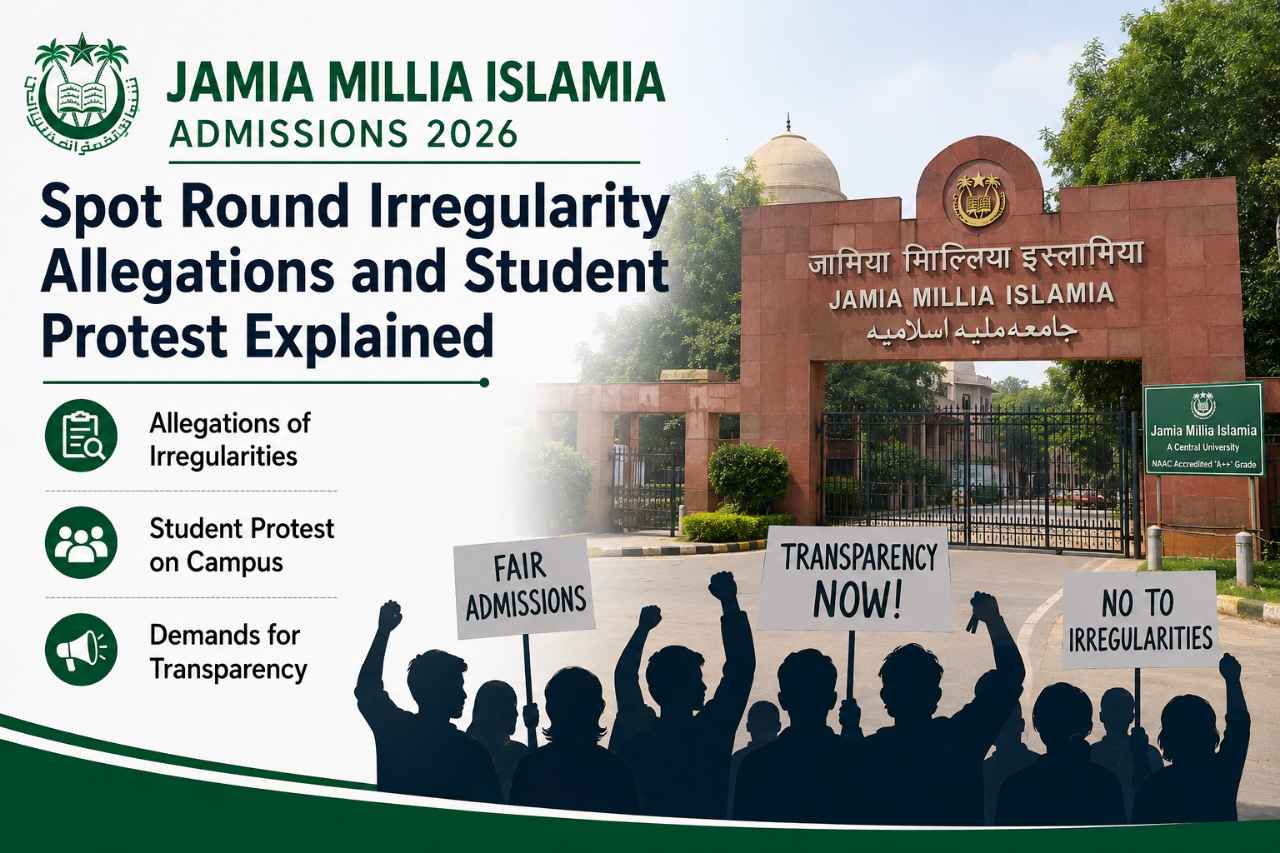

Admission season at central universities is meant to reward merit, follow reservation rules, and leave no deserving candidate behind. In August 2026, that trust came under sharp scrutiny at Jamia Millia Islamia New Delhi, one of India's most respected central universities, when students alleged serious irregularities in the spot admission process for postgraduate and professional programmes.
Reports indicate that candidates with higher waiting-list ranks were reportedly left out while lower-ranked applicants received seats in courses such as MA Gender Studies and B.Ed. Student organisations including NSUI, AISA, and SFI staged a protest at the Central Canteen, demanding cancellation of allegedly irregular admissions, restoration of Jammu and Kashmir quota seats, and greater transparency. The university administration, however, has called the allegations false and baseless.
For thousands of aspirants preparing for Jamia Millia Islamia University admissions every year, this controversy is not just campus news it is a practical lesson in how merit lists, waiting lists, spot rounds, and reserved categories actually work. This guide explains what happened, why it matters, what students can do, and how to protect yourself during admission season at JMI and similar institutions.
What Triggered the Jamia Millia Islamia Admissions 2026 Protest?
The protest at Jamia Millia Islamia began on the evening of August 24, 2026, and continued as student leaders submitted written complaints to the Controller of Examinations (COE). The core grievance is straightforward: students believe the spot admission round did not follow published merit or waiting-list order.
Faizan Ali Khan, NSUI president at JMI and an MA Gender Studies applicant, told media that he ranked 27th on the general waiting list and 12th in the Muslim category for a programme with 30 seats. He alleged that candidates ranked 33rd and 40th on the general list were admitted while he was not. Similar complaints came from B.Ed applicant Insha Rehmani, who claimed she held Rank 4 in the Muslim category and Rank 1 in Muslim OBC, yet a Rank 6 candidate in the same Muslim category was reportedly admitted against a general-category seat.
These are not vague accusations. Students submitted dated written complaints August 19 and August 20, 2026 asking the COE to review seat allocation and explain the criteria used during the spot round held on August 17, 2026. When official explanations did not satisfy them, they escalated to a public sit-in protest.
Timeline of Key Events
- August 17, 2026: Spot admission round conducted (partly offline, as per student allegations).
- August 19, 2026: Written complaint filed regarding MA Gender Studies spot admissions.
- August 20, 2026: B.Ed applicant submits complaint on seat allocation discrepancy.
- August 24, 2026 (5 PM onwards): Protest begins at Central Canteen, JMI.
- August 25, 2026: NSUI, AISA, SFI, and AISRO issue statements; meeting with proctorial team reported as unsuccessful.
Main Allegations Against JMI Spot Admissions 2026
Understanding the protest requires separating individual cases from systemic concerns. Students have raised at least five overlapping issues.
1. Waiting-List Order Not Followed
In a fair spot round, vacant seats after regular counselling are typically offered to the next eligible candidate on the waiting list category-wise and merit-wise. Protesters allege that JMI deviated from this principle by admitting lower-ranked candidates while skipping higher-ranked ones.
Example cited: MA Gender Studies (30 seats) a candidate ranked 27th general and 12th Muslim category allegedly denied admission while lower ranks were selected.
Why this matters: Waiting lists are the legal and procedural safeguard for students who miss initial rounds due to document issues, fee delays, or seat surrender by others. Any break in serial order raises questions of favouritism, manual override, or unpublished criteria.
2. Fewer Merit Lists Than Usual
Students claim JMI released only two admission lists for many courses before moving directly to spot admissions. In previous years, they say, five or six lists were common. Fewer lists mean fewer chances for document correction, fee payment, and orderly seat movement before the final spot round.
Actionable tip for aspirants: After each admission list, download and save PDFs with timestamps. Compare your rank movement list-to-list. If the university jumps to spot round unusually early, raise queries in writing immediately not after the round closes.
3. Shift from Online to Offline Spot Admissions
Another major concern is procedural: student groups allege JMI moved spot admissions offline without adequate notice. AISA JMI stated that some students were called at short notice without clear selection criteria, disadvantaging applicants from outside Delhi-NCR who cannot travel on a few hours' warning.
Central universities in Delhi including Jamia Millia Islamia Management programmes and other departments attract national applicants. An offline, last-minute process creates geographic and financial inequality that online counselling normally reduces.
4. Jammu and Kashmir Quota Seats Not Properly Filled
Reserved seats for J&K residents and Kashmiri migrants are legally and institutionally sensitive. Faizan Ali Khan alleged that in B.Arch, two J&K reserved seats existed but eligible candidates were kept on waiting lists and considered only during spot round rather than in regular selected lists. AISRO JMI similarly claimed reserved seats in architecture and fine arts were not filled as expected.
Reserved category mismanagement hurts both general and reserved candidates: reserved seats left vacant or filled irregularly can distort overall seat matrices and trigger court interventions, as seen at other central institutions over the years.
5. PwD Reserved Seat Concerns
Student statements also flagged Persons with Disabilities (PwD) seats, noting similar issues had occurred in previous years. Under the Rights of Persons with Disabilities Act and UGC norms, PwD reservation must be applied horizontally across categories. Vacant PwD seats should be filled through proper procedures, not left ambiguous after spot round.
Who Is Protesting and What Do They Want?
Multiple student organisations have coordinated demands, reflecting how admission fairness cuts across political lines on campus.
- NSUI (National Students' Union of India): Leading complaints and protest at Central Canteen; seeking review of spot lists.
- AISA (All India Students' Association): Criticising offline spot round, short notices, and selective waiting-list movement.
- SFI (Students' Federation of India): Demanding fair, verifiable, transparent process without favouritism.
- AISRO JMI: Raising J&K and Kashmiri migrant seat issues across courses.
Student Demands at a Glance
| Demand | Reason Stated by Students |
|---|---|
| Cancel irregular spot admissions | Lower-ranked candidates allegedly admitted over higher-ranked ones |
| Restore J&K reservation properly | Reserved seats not filled in regular lists |
| Fill PwD vacant seats fairly | Historical and current under-utilisation concerns |
| COE accountability | Calls for resignation of Controller of Examinations |
| Transparent inquiry | Public clarification of spot round criteria |
After a meeting with the proctorial team on August 25, NSUI secretary Ebin Basil stated in a video message that the administration was not ready to accept student demands and that discussions had failed. Students indicated the sit-in would continue until meaningful dialogue occurred.
How Jamia Millia Islamia Admissions Normally Work
To evaluate the protest fairly, aspirants should know the standard JMI admission framework. Like other central universities, Jamia Millia Islamia University conducts entrance-based selection for most PG and UG programmes, followed by category-wise merit lists and waiting lists.
Typical Stages of JMI Admission Process
- Entrance examination or interview: Course-specific, as per JMI prospectus.
- Merit list publication: Category-wise ranks (General, OBC, SC, ST, EWS, PwD, etc.).
- Admission lists (Round 1, 2, 3…): Selected candidates pay fees and submit documents.
- Waiting list movement: As seats vacate, next eligible candidates are offered admission.
- Spot admission round: Remaining vacant seats filled ideally in strict waiting-list order.
Spot admission is not a discretionary lottery. It exists to ensure no seat remains unfilled once the academic session nears. However, it must follow published rules. Any deviation requires documented justification such as category seat reallocation permitted under official policy not informal selection.
Understanding Waiting Lists vs Spot Round
Waiting list: A ranked queue of candidates who cleared the cutoff but did not get seats in initial rounds. Your position (e.g., 12th in Muslim category) is your legal standing.
Spot round: Final chance when seats remain after withdrawals. The expected rule: call candidates in ascending rank order within the relevant category/sub-category.
When a Rank 6 Muslim category candidate gets a general seat while a Rank 4 Muslim candidate does not, students reasonably ask whether category rules, seat conversion norms, or manual errors are involved. Without public clarification, merit transparency breaks down.
University Response: What JMI Administration Said
Jamia Millia Islamia's chief spokesperson, responding to media queries, stated: "The university rejects and denies the false, unfounded and baseless allegations being made." No detailed point-by-point rebuttal of individual rank cases was reported at the time of the protest.
For students, an outright denial without published clarification of seat allocation logic often intensifies mistrust rather than resolving it. Best practice for any central university facing such allegations includes:
- Releasing category-wise spot round selection logs
- Explaining any seat conversion (e.g., general to reserved or vice versa)
- Confirming why specific waiting-list candidates were skipped
- Independent audit by an admission review committee
Transparency protects the institution as much as applicants. Delhi's higher education ecosystem from JMI to All India Institute of Medical Sciences New Delhi depends on public confidence in merit-based processes.
Why Offline Spot Admissions Raise Fairness Concerns
The shift from online to offline spot counselling is central to this controversy. Online admission systems used widely across Indian universities offer:
- Equal access regardless of location
- Timestamped records of offer and acceptance
- Reduced scope for manual interference
- Clear audit trails for RTI and grievance redressal
Offline spot rounds with short notice favour local candidates who can reach campus quickly. A student from Assam, Kashmir, or rural Rajasthan may lose a rightful seat simply because a notice posted one evening requires physical presence the next morning.
Actionable tip: If you are on a waiting list at any central university, keep travel funds ready during admission season, monitor the admission portal multiple times daily, and join official WhatsApp or email alerts if the university provides them. Document every notice screenshot with date and time.
J&K Quota and Reserved Seats: Legal and Practical Context
Jamia Millia Islamia, like several central universities, reserves seats for J&K residents and Kashmiri migrants under applicable government policies. These seats are not optional extras they are statutory commitments.
When eligible J&K candidates appear only on waiting lists while general seats move in spot round, students suspect reserved vacancies are being handled outside normal sequence. Similar concerns about PwD horizontal reservation suggest a broader need for category-wise seat tracking.
Aspirants comparing universities should note that admission transparency varies. While JMI faces these allegations, institutions such as Jamia Hamdard University and Jamia Hamdard follow their own admission calendars and grievance systems. Always read the specific prospectus not generic assumptions about "Jamia" institutions.
Comparison: Central University Admission Best Practices
| Practice | Student Expectation | Alleged JMI 2026 Gap |
|---|---|---|
| Multiple admission lists | 5–6 lists for orderly seat movement | Only 2 lists before spot round |
| Online counselling | National access, audit trail | Offline spot round with short notice |
| Waiting-list serial order | Higher rank admitted first | Lower ranks admitted over higher ranks |
| Reserved seat filling | J&K, PwD filled in regular rounds | Reserved candidates kept for spot round |
| Grievance response | Written, case-specific replies | General denial reported by media |
What This Means for JMI Aspirants in 2026 and Beyond
If you have applied or plan to apply to JMI programmes whether MA, B.Ed, B.Arch, or professional courses through Jamia Millia Islamia Management and other faculties this protest highlights practical steps you cannot skip.
Before Admission Season Ends
- Save every merit list, waiting list, and spot list PDF.
- Record your category rank and sub-category rank separately.
- Track seat matrix if published (total seats, reserved breakup, filled/vacant).
- File written complaints to COE with specific ranks, dates, and programme names.
- Send copies to the Dean of Students and university email IDs listed in prospectus.
- If unresolved, approach UGC grievance portal or National Student Helpline (Tejas).
If You Are on a Waiting List
Do not assume you are out until the spot round closes officially. Stay reachable by phone and email. Keep documents attested and ready. If you see lower ranks admitted on social media, verify against official PDFs before acting misinformation spreads quickly during protests.
Alternative Planning
Admission disputes can take weeks or months to resolve. Parallel options reduce risk. Consider other Delhi universities, state universities, or entrance exams for related courses. For science aspirants, exams like JAM open doors to MSc programmes nationwide. For medical aspirants watching Delhi's education news, institutions such as AIIMS Delhi follow separate counselling through MCC.
Broader Lessons for Indian Higher Education Admissions
The JMI 2026 controversy reflects national themes: students want verifiable merit, not opaque discretion. Similar protests have occurred at other universities over delayed results, fee hikes, and counselling glitches. The difference here is the specificity named ranks, dated complaints, and coordinated student union documentation.
For Google's E-E-A-T standards, reliable education content must be accurate, balanced, and actionable. The facts reported indicate serious student allegations and a firm university denial. The truth may require institutional inquiry. Until then, applicants should rely on documented evidence, official lists, and formal grievance channels not rumours.
Geo-relevant context matters too: Delhi hosts lakhs of outstation students. Policies that require physical presence for final admission rounds disproportionately affect students from states with fewer direct trains or higher travel costs whether they are coming to JMI, Jamia Hamdard University Engineering, or any central institution in the capital.
Will Admissions Be Cancelled? What Happens Next
Students have explicitly demanded cancellation of admissions made against merit order. Historically, Indian courts and university review committees have occasionally set aside admission lists when procedural violations are proven but outcomes depend on evidence, timing, and session deadlines.
Possible next steps include:
- Internal inquiry by JMI admission review committee
- UGC or Ministry of Education oversight if escalated
- High Court writ petitions by affected candidates
- Revised spot round with corrected waiting-list order
- Status quo if administration stands by current lists
Session start dates, fee deposits, and academic calendars create pressure. Early written action by affected students strengthens any future legal or administrative review.
Conclusion
The Jamia Millia Islamia admissions 2026 spot round protest is a serious reminder that entrance exam scores and waiting-list ranks only matter when the counselling process is transparent, sequential, and accessible to all applicants. Students allege that lower-ranked candidates were admitted over higher-ranked ones in programmes including MA Gender Studies and B.Ed, that fewer merit lists were released than in previous years, that spot admissions moved offline with inadequate notice, and that J&K and PwD reserved seats were not handled properly. NSUI, AISA, SFI, and AISRO have demanded cancellation of irregular admissions, proper reservation implementation, and greater accountability while JMI's administration has rejected the allegations as baseless.
For current and future JMI aspirants, the takeaway is clear: treat admission season like a legal process. Document everything, communicate in writing, compare ranks against official PDFs, and use grievance mechanisms early. Whether you aim for Jamia Millia Islamia New Delhi or keep alternatives ready across India's college ecosystem, informed vigilance is your strongest tool when merit is questioned.
CollegeDwar will continue tracking JMI admission updates, protest developments, and any official clarification from the Controller of Examinations as the 2026 academic session progresses. Stay informed, stay documented, and protect your rightful place in the merit queue.