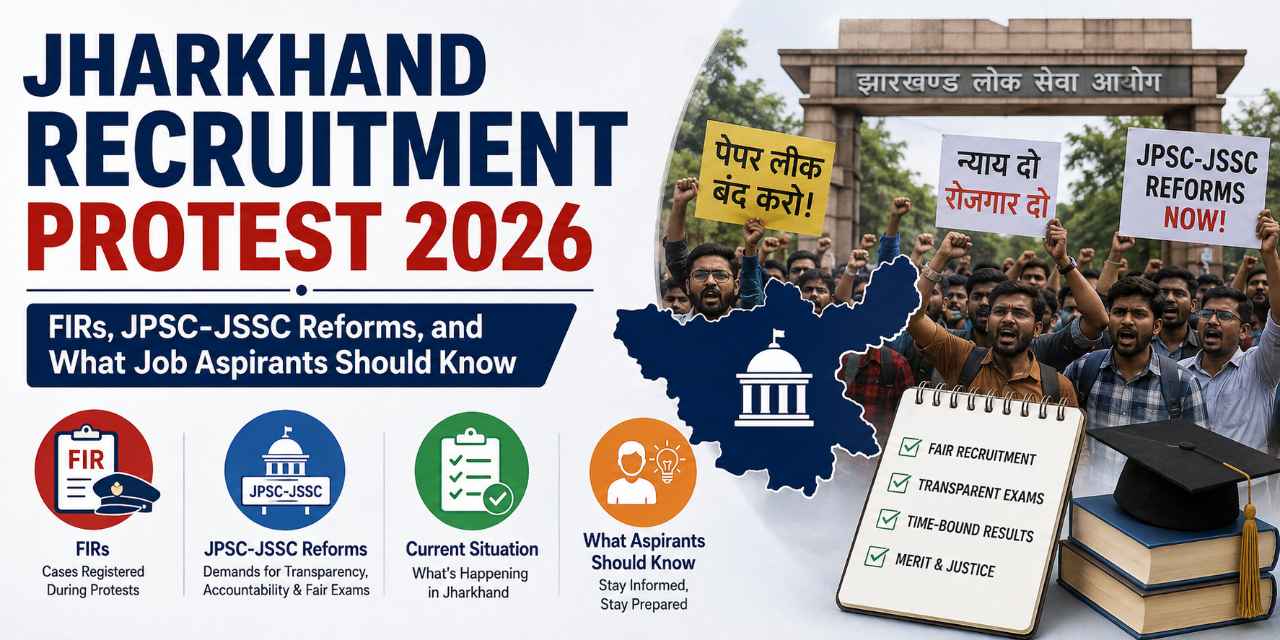

Thousands of government job aspirants in Jharkhand have taken to the streets in August 2026, demanding transparency in public recruitment and protesting alleged irregularities in examinations conducted by the Jharkhand Public Service Commission (JPSC) and Jharkhand Staff Selection Commission (JSSC). What began as demonstrations against cancelled appointments and contested exam results escalated into clashes with police in Giridih, Hazaribag, and Ranchi, leading to multiple First Information Reports (FIRs) naming 28 identified individuals and more than 900 unidentified persons.
For students and graduates across Jharkhand many of whom have spent years preparing for competitive exams this is not merely a news headline. It reflects a deeper crisis of trust in state-level recruitment systems, court-ordered reversals of cancellation notices, and the legal risks associated with public protests. Whether you are a final-year student at Central University of Jharkhand Ranchi, a working professional pursuing degrees through Jharkhand State Open University, or a job seeker tracking JPSC and JSSC notifications from home, understanding this situation is essential for making informed career decisions in 2026.
Background: Why Jharkhand Job Aspirants Are Protesting
Jharkhand's youth unemployment rate has long been a political and social concern. The state offers lakhs of aspirants hope through JPSC civil services examinations, JSSC Combined Graduate Level (CGL) recruitment, and sector-specific hiring for posts such as Child Development Project Officers (CDPOs) and food safety officers. When appointments made through these processes are cancelled or when entire examination cycles are annulled candidates who cleared multiple stages of testing feel cheated out of years of effort.
Student leaders operating under the banner of the JPSC-JSSC Reforms Manch have accused the Hemant Soren-led state government of deception and betrayal. Their core demands include fair re-examination where irregularities are proven, restoration of valid appointments, and structural reforms to prevent repeated cancellation cycles. Protesters argue that administrative flip-flops issuing appointment letters and then withdrawing them through fresh notifications destroy the credibility of government recruitment and push qualified candidates back into uncertainty.
The protests gained momentum after the Jharkhand High Court intervened in several cases. On Thursday, August 20, 2026, the court stayed notifications cancelling the 11th and 13th JPSC examinations. It also stayed orders cancelling appointments of food safety officers. On Friday, August 21, the court further stayed notifications cancelling appointments of CDPOs and candidates recruited through the JSSC-CGL examination. While these judicial orders offered partial relief to affected candidates, protesters maintained that broader reforms remain unaddressed and that the government's claim of meeting "98 percent" of student demands was rejected by agitating groups.
Key Examinations and Posts Under Dispute
- 11th and 13th JPSC examinations Civil services and allied state government posts
- JSSC-CGL recruitment Graduate-level clerical, technical, and administrative posts across departments
- CDPO appointments Child Development Project Officer roles under social welfare schemes
- Food safety officer appointments Regulatory posts under health and food departments
Each of these recruitment streams involves written tests, interviews, document verification, and sometimes years-long waiting periods between notification and joining. When results are overturned administratively, even a favourable court stay may not immediately translate into joining letters creating the frustration that fuelled the August 2026 demonstrations.
Timeline of Protests and Police Action in August 2026
Understanding the sequence of events helps aspirants separate lawful advocacy from actions that may attract criminal charges. Here is a simplified chronology based on reported developments:
- August 20, 2026 (Thursday): Jharkhand High Court stays cancellation of 11th and 13th JPSC exams and food safety officer appointments.
- August 21, 2026 (Friday): High Court stays cancellation of CDPO and JSSC-CGL appointments. Protesters in Hazaribag attempt to burn an effigy of Chief Minister Hemant Soren; police register an FIR at Korra police station.
- August 21–22, 2026: Thousands gather at Gandhi Maidan in Ranchi; scuffles break out between agitators and police during an effigy-burning protest.
- August 22–23, 2026 (Friday–Saturday): Clashes continue in Giridih at multiple locations; police file two FIRs at Town police station.
- August 23, 2026 (Sunday): Officials confirm three new FIRs in Giridih and Hazaribag, in addition to three FIRs already registered at Ranchi's Kotwali police station a day earlier.
Across these incidents, police reported injuries to eight personnel, including four sub-inspectors who serve as officers-in-charge at Korra, Lohsinghna, Sadar, and Bada Bazar police stations in Hazaribag district.
FIR Details: Named Accused and Unidentified Persons
First Information Reports are the starting point of criminal investigation in India. Under the Bharatiya Nyaya Sanhita (BNS), which replaced parts of the older Indian Penal Code framework, charges in these cases relate to assault on police personnel, obstruction of government work, and unlawful assembly. The scale of unnamed accused often recorded as "900-plus unidentified persons" reflects police practice of reserving scope to identify participants through CCTV footage, social media videos, and witness statements.
Ranchi: Kotwali Police Station FIRs
A day before the Giridih and Hazaribag cases were confirmed, three FIRs were registered at Ranchi's Kotwali police station against 14 named individuals and approximately 200 unidentified persons. The alleged offences include obstructing government work and clashing with police during protests linked to recruitment grievances. Ranchi, as the state capital and an educational hub hosting institutions such as Jharkhand University of Technology Ranchi, frequently sees concentrated student mobilisation because access to government offices, the high court, and media centres is easiest here.
Hazaribag: Korra Police Station FIR
In Hazaribag district, Sadar DSP Rupak Kumar Singh confirmed that an FIR was registered against 18 named accused and 700 unnamed people at Korra police station. The complaint was filed based on an application by Sadar Circle Officer Ashutosh Kumar. The alleged incident occurred on August 21, when protesters attempted to burn an effigy of the Chief Minister. Korra police station officer-in-charge Nemdhari Rajak stated that no arrests or detentions had been made immediately, but investigators were analysing CCTV and video footage to identify participants. Personnel booked under the BNS face allegations of assaulting police, obstructing government duty, and unlawful assembly.
Giridih: Two FIRs at Town Police Station
Giridih saw two FIRs related to clashes on Friday and Saturday. The first FIR was filed on the application of ABVP activist Anish Rai. It names JMM leaders and workers, including district president Sanjay Singh among 11 named accused, with 20 unidentified persons. The second FIR, based on Sadar Circle Inspector Manoj Kumar Singh's application, lists around 10 named accused and 200 unidentified persons.
Allegations in Giridih include attempts to halt traffic at five locations, clashes with police during effigy-burning protests, and use of abusive language against the Chief Minister. The involvement of political party workers alongside student groups illustrates how recruitment protests in Jharkhand often intersect with broader political contestation something aspirants should recognise when deciding how to participate in agitations.
Summary Table of FIRs Reported
- Ranchi (Kotwali): 3 FIRs | 14 named + ~200 unidentified (registered earlier)
- Hazaribag (Korra): 1 FIR | 18 named + 700 unidentified
- Giridih (Town): 2 FIRs | ~21 named + ~220 unidentified
- Combined new reporting: 28 named and 900-plus unidentified across Giridih and Hazaribag cases
The JPSC-JSSC Reforms Manch and Digital Advocacy
Organised student pressure in Jharkhand is not limited to street protests. The JPSC-JSSC Reforms Manch has used social media, memoranda, and public rallies to keep recruitment reform on the political agenda. Separately, Ranchi cyber crime police reportedly sought details of the 'JSPCreformanch' account on X (formerly Twitter) over alleged false posts about the state government signalling that online activism is also under scrutiny.
For digitally active aspirants, this is a reminder that statements published online can trigger legal consequences if authorities deem them false or inciting. Students should verify information through official portals jpsc.gov.in, jssc.nic.in, and Jharkhand High Court cause lists before sharing unconfirmed claims that could harm their own career prospects.
High Court Interventions: What Changed and What Did Not
Judicial stays on cancellation notifications represent a significant win for affected candidates on paper. A stay prevents the government from enforcing cancelled appointments or annulled exam cycles until the court fully hears the matter. However, stays are interim orders they do not automatically reinstate candidates or declare examinations valid for all purposes.
Aspirants should understand three practical distinctions:
- Stay vs. final judgment: A stay pauses action; a final judgment decides rights conclusively.
- Court relief vs. administrative compliance: Even after stays, departments may delay joining formalities pending further directives.
- Individual cases vs. systemic reform: Court orders address specific notifications; they do not by themselves redesign JPSC or JSSC governance.
Students planning litigation or supporting legal challenges should maintain complete documentation: admit cards, scorecards, appointment letters, cancellation notices, and newspaper cuttings. Organised records strengthen petitions and help lawyers argue continuity of legitimate expectation a legal principle relevant when candidates have acted on official selections.
What This Means for Government Job Aspirants in Jharkhand
If you are preparing for state government jobs, the August 2026 protests highlight both the opportunity and volatility of Jharkhand recruitment. Lakhs of posts eventually flow through JPSC, JSSC, and departmental examinations but the path is rarely linear. Here are actionable takeaways:
1. Diversify Your Career Pipeline
Relying solely on one examination cycle is risky when cancellations and court battles can reset progress. Consider parallel preparation for:
- Central government exams (SSC CGL, UPSC, railway recruitment boards)
- Public sector undertakings and banking examinations
- Teaching eligibility tests such as CTET and state TET examinations
- Private sector roles aligned with your degree
Graduates from engineering and management programmes at institutions like Arka Jain University Jharkhand or Jharkhand Rai University often combine campus placements with competitive exam preparation to avoid single-track dependency.
2. Track Official Notifications Daily
Protest news spreads quickly on social media, but joining dates, exam schedules, and cancellation notices appear first on official websites. Bookmark JPSC and JSSC portals and enable email alerts where available. Cross-check viral WhatsApp forwards against official PDFs before acting on them or sharing them publicly.
3. Understand the Legal Boundaries of Protest
India recognises freedom of speech and peaceful assembly, but obstruction of public roads, assault on police personnel, and destruction of public property are criminal offences under the BNS. FIRs naming "unidentified persons" often expand after video analysis. Students who attend rallies should assess whether organisers have police permissions, avoid encroaching on law-enforcement duties, and refrain from violence or vandalism even when emotions run high.
4. Engage Through Formal Channels
Memoranda to the Governor, Chief Minister's office, JPSC chairperson, and Public Grievance portals create documented records without exposing participants to the same immediate risks as road blockades. Student unions, alumni associations, and reform groups like the JPSC-JSSC Reforms Manch can pursue structured negotiations while legal teams pursue court remedies.
Higher Education Pathways While Recruitment Remains Uncertain
Not every aspirant can wait indefinitely for contested appointment letters. Pursuing higher education or skill upgrade is a pragmatic way to strengthen your profile for the next recruitment cycle or to pivot toward alternative careers.
Universities and Colleges in Jharkhand Worth Exploring
Jharkhand's higher education ecosystem offers options across disciplines:
- Central University of Jharkhand Ranchi Central university with programmes in humanities, sciences, and education
- Jharkhand University of Technology Ranchi State technical university overseeing engineering and polytechnic education
- Jharkhand Raksha Shakti University Specialized university for security and police sciences
- Jharkhand State Open University Distance and open learning for working aspirants
- The Institute of Chartered Financial Analysts of India University Jharkhand Management and professional programmes
- Arka Jain University Jharkhand Private university with multi-disciplinary courses
- Jharkhand Rai University Private university offering professional degrees
For students eyeing careers in law enforcement or administrative services, degrees from specialised institutions can complement competitive exam preparation. Open university programmes allow aspirants who cannot leave their hometowns such as those in Giridih or Hazaribag to continue studying while monitoring recruitment updates.
Exams and Opportunities Beyond Jharkhand
Some candidates choose to broaden geographic horizons. Entrance examinations for institutions outside the state such as the Amity Entrance Test for Amity campuses, or engineering entrances leading to colleges like Galgotias College of Engineering and Technology offer alternatives when local government hiring stagnates. Migration for education is common among Jharkhand students seeking stable placement ecosystems while keeping home-state exams as a parallel goal.
E-E-A-T Perspective: Trust, Transparency, and Student Welfare
Google's Experience, Expertise, Authoritativeness, and Trustworthiness (E-E-A-T) framework applies strongly to education and career content. Jharkhand's recruitment crisis is fundamentally about trust: trust in examination integrity, in administrative notifications, and in the fairness of corrective action when fraud or procedural lapses occur.
State governments facing similar disputes in Karnataka, Madhya Pradesh, and other states have learned that opaque handling amplifies protests. Students deserve:
- Published investigation findings into alleged irregularities
- Clear timelines for re-examination or reinstatement when courts stay cancellations
- Independent oversight of recruiting commissions
- Counselling support for candidates experiencing mental health strain during prolonged uncertainty
Parents investing in coaching centres in Ranchi, Dhanbad, and Jamshedpur often spending significant savings should ask coaching institutes for realistic guidance rather than promises tied to a single exam cycle. Reputable mentors emphasise syllabus mastery, mock tests, and contingency planning over emotional rhetoric. Coaching hubs near educational institutions in the capital see steady enrolment each year, yet the wisest candidates treat coaching as one input in a broader strategy that includes self-study, current affairs discipline, and mental health care during long waiting periods between exam stages.
Preparing for JPSC and JSSC Examinations in 2026
Despite current unrest, Jharkhand government recruitment will continue to attract applicants because of job security, allowances, and social status. Structured preparation remains the best lever aspirants control.
Recommended Study Framework
- Foundation phase (3–4 months): Cover Jharkhand-specific general knowledge, Indian polity, history, geography, and current affairs with emphasis on state policies and welfare schemes.
- Core phase (4–6 months): Subject-specific preparation for your examination tier JPSC prelims and mains syllabi differ significantly from JSSC-CGL patterns.
- Revision phase (6–8 weeks): Previous-year question papers, timed mock tests, and error logs.
- Interview and document phase: For stages after the written exam, practice articulation of Jharkhand development issues and carry organised files of educational credentials.
Resources and Habits That Reduce Risk
Save PDFs of every notification and amendment on the day they are published websites sometimes remove or replace documents. Join only verified aspirant groups moderated by experienced candidates. Avoid paying unofficial "agents" promising selection; legitimate recruitment never requires bribes. If you believe a result is unfair, consult a qualified lawyer about representation before participating in unplanned street actions that could complicate your background verification later.
Conclusion
The Jharkhand recruitment protest of August 2026 marks a critical moment for the state's job aspirants. With FIRs registered against 28 named individuals and more than 900 unidentified persons across Giridih, Hazaribag, and Ranchi, the human cost of recruitment uncertainty has become visible in police stations and courtrooms not just on examination scorecards. High Court stays on cancelled JPSC examinations and JSSC-CGL appointments offer hope to affected candidates, but they do not instantly heal a broken trust between youth and administration.
For students and graduates, the path forward combines vigilant tracking of official recruitment portals, lawful advocacy through reform platforms such as the JPSC-JSSC Reforms Manch, parallel career planning through Jharkhand's universities and national opportunities, and disciplined exam preparation that survives political and administrative churn. Government jobs in Jharkhand remain worth pursuing but wise aspirants pursue them with open eyes, documented evidence, and a backup plan rooted in education and skills that no cancellation notification can erase.