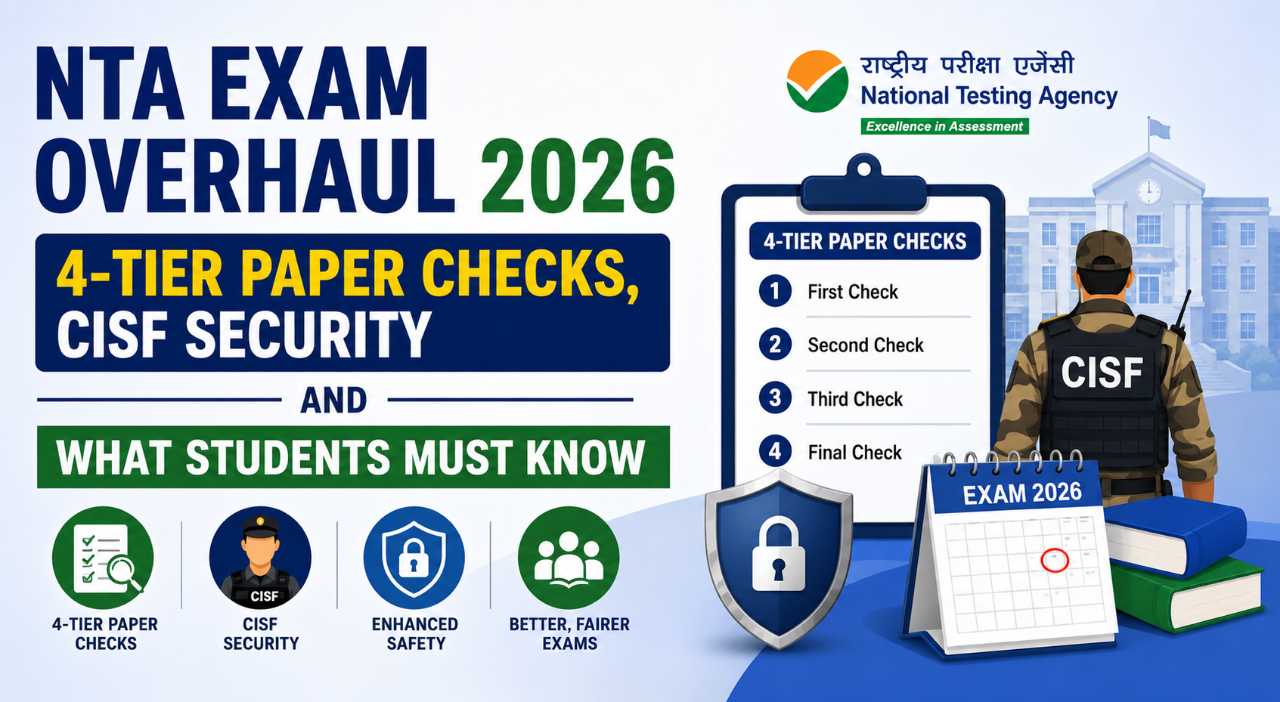

In August 2026, the Ministry of Education unveiled the most sweeping reform package the National Testing Agency (NTA) has seen since its formation. Triggered by the NEET-UG 2024 paper leak and the sudden cancellation of UGC-NET June 2024, the overhaul introduces a four-tier question paper checking system, removes roughly 600 existing subject experts, inducts specialists from cybersecurity and psychometrics, and deploys CISF (Central Industrial Security Force) teams to secure NTA premises. NTA Director General Abhishek Singh briefed Education Minister Pralhad Joshi on August 18, 2026, and the minister cleared the full reform roadmap.
For lakhs of students preparing for NEET-UG, JEE Main, CUET-UG, CUET-PG, UGC-NET, CSIR-NET, and other central admission tests, these changes matter far beyond headlines. They signal how question papers will be created, stored, printed, and delivered and how seriously the government now treats exam integrity. This guide explains every announced reform in plain language, maps which exams are covered, outlines a practical checklist for candidates, and helps you separate official updates from social-media rumours.
Why Did the Government Order an NTA Overhaul?
India's national entrance exam system handles more than one crore applications every year. When trust breaks even once the ripple effect touches medical seats, engineering colleges, central universities, scholarships, and postgraduate research fellowships. The NEET-UG 2024 paper leak led to nationwide student protests, court cases, and a CBI investigation launched in July 2024. Within days, UGC-NET June 2024 was cancelled a day after the exam, leaving NET aspirants who had prepared for months in limbo.
A high-level committee reviewed NTA processes through 2025, studying everything from question-setting workflows to centre frisking and digital vulnerabilities. The August 2026 announcement is the operational outcome: not a cosmetic press release, but structural changes across paper scrutiny, personnel, and physical security. For students eyeing premier institutions from Lady Shri Ram College for Women (LSR), Delhi through CUET, to science research hubs reached via CSIR-NET the message is that exam conduct will be treated as a national-security-grade operation.
Background Timeline Students Should Remember
- June 2024: NEET-UG paper leak triggers protests and legal action.
- June 2024: UGC-NET June session cancelled within 24 hours of the exam.
- July 2024: CBI probe begins into the alleged leak network.
- 2025: Expert committee audits NTA systems and recommends reforms.
- August 18, 2026: Ministry clears four-tier checks, expert panel reset, and CISF deployment.
Key Reforms at a Glance
The ministry's reform memo covers four pillars. Use this summary as a quick reference before we dive into each area.
| Reform Area | What Is Changing | Who It Affects |
|---|---|---|
| Paper scrutiny | Four-tier question paper checking before printing | All NTA exam cycles from 2026 onward |
| Expert panel | ~600 existing experts removed; fresh specialists inducted | Subject matter quality and leak prevention |
| Office security | CISF teams guard NTA premises | Physical protection of papers and data |
| Senior hiring | 20–25 new officials in 2–3 weeks; more phases later | Cybersecurity, psychometrics, paper design |
Understanding the Four-Tier Paper Checking System
The centrepiece of the overhaul is a four-tier question paper checking system. Under the earlier model, papers typically passed through fewer consolidated review stages. The new framework mandates that every question paper undergo four separate, independent checks before it reaches the printing stage. The goal is twofold: catch academic errors (wrong options, out-of-syllabus items, ambiguous wording) and reduce the window for premature leaks by limiting who sees the final paper at each stage.
What Each Tier Likely Covers (Based on Standard Best Practice)
NTA has not yet published the tier-wise protocol in full. Based on global testing-agency norms and the ministry's stated intent, students and parents can expect a structure along these lines:
- Tier 1 – Subject expert draft review: Domain specialists verify syllabus alignment, difficulty balance, and factual accuracy. This replaces part of the old single-panel approach now that 600 legacy experts have been removed.
- Tier 2 – Independent secondary review: A separate panel, without access to Tier 1 identities, re-checks the same paper to eliminate bias and spot errors the first team missed.
- Tier 3 – Psychometric and design audit: New private-sector hires in psychometrics and paper design assess whether questions are fair, unambiguous, and statistically balanced critical for high-stakes tests like JEE Main where one ambiguous item can shift ranks by thousands.
- Tier 4 – Final security and compliance sign-off: A senior authorization layer confirms the paper meets encryption, storage, and printing protocols before it leaves the secure pipeline.
Institutions that depend on NTA scores for admissions whether a student targets Indira Gandhi Delhi Technical University for Women via JEE or pursues a postgraduate MA programme through CUET-PG should expect slightly longer internal timelines for paper finalization. That may translate into earlier notification schedules or tighter gaps between admit card release and exam day. Watch nta.ac.in for exam-specific circulars.
What the Four-Tier System Does Not Change (Yet)
Important clarifications for anxious aspirants:
- Exam syllabus and pattern are not automatically altered by this announcement.
- Scoring logic (normalization for JEE Main sessions, NEET marking scheme) remains governed by existing exam-wise rules until separately notified.
- Centre frisking and biometric rules may tighten further, but centre-level SOPs will come through admit cards and information bulletins.
Expert Panel Reset: 600 Removed, Fresh Specialists Inducted
Alongside the four-tier checks, the ministry ordered the removal of approximately 600 experts from NTA's existing question-setting ecosystem. This is one of the most debated parts of the reform. Officials have framed it as a clean-slate approach after repeated integrity failures, not a comment on individual scholars' competence.
Replacement panels will include fresh subject specialists vetted under stricter conflict-of-interest and non-disclosure norms. Between 20 and 25 senior officials from the private sector particularly in cybersecurity, psychometrics, and question paper design are expected to join within two to three weeks of the announcement, with additional hiring phases planned later.
Why Domain Experts Beyond Academia Matter
Traditional subject professors excel at content accuracy, but modern high-stakes testing also demands:
- Cybersecurity professionals to secure servers, encrypted paper vaults, and staff devices against hacking and insider threats.
- Psychometricians to ensure items measure what they claim and do not unfairly disadvantage any demographic group.
- Assessment designers who understand computerized adaptive testing, multi-session normalization, and large-scale OMR/digital hybrid delivery.
Aspirants aiming for research careers perhaps eventually joining institutes like the Jawaharlal Nehru Centre for Advanced Scientific Research, Bangalore, or the Regional Centre for Biotechnology after clearing CSIR-NET benefit when paper quality and security improve, because fellowship and PhD admissions depend on NET credibility.
CISF Security at NTA Offices: What It Means
The deployment of CISF teams to guard NTA premises elevates exam material from administrative asset to protected national resource. CISF already secures airports, metro networks, and critical government installations; extending that model to NTA headquarters and regional offices restricts unauthorized entry, monitors movement of printed material, and adds 24/7 surveillance.
For students, the visible impact is indirect but reassuring: papers are less likely to leave secure zones through physical breach. Combined with cybersecurity hires, the ministry is addressing both analog leaks (photographed question sheets) and digital leaks (hacked drives or messaging groups). Candidates should still report suspicious "leaked paper" posts on Telegram or WhatsApp official channels take such reports seriously under the new regime.
Which Exams Fall Under the New Rules?
The ministry confirmed that reforms cover every national exam conducted by NTA, not a single test in isolation. Major exams include:
- NEET-UG – Medical and dental undergraduate admissions nationwide.
- JEE Main – Gateway to NITs, IIITs, GFTIs, and the qualifying stage for JEE Advanced.
- CUET-UG – Central university undergraduate admissions; affects applicants to colleges such as Indraprastha College for Women, Delhi, and Bharathidasan Government College for Women, Chennai.
- CUET-PG – Postgraduate admissions including many MA, MSc, and professional programmes.
- UGC-NET – Assistant professor eligibility and JRF awards.
- CSIR-NET – Science research fellowships; relevant for institutes like the Indian Association for the Cultivation of Science.
- Other central tests – Including NPAT-adjacent central scholarships, GPAT, AIAPGET, and university-specific NTA-partnered exams listed on official portals.
Design and creative fields often use separate entrance systems for example, aspirants may simultaneously prepare for the NIFT Entrance Exam while appearing for CUET at institutes like the Centre for Design Excellence, Jaipur. Even when an exam is not NTA-conducted, the government's push for integrity sets a benchmark other boards may follow.
Regional Coaching Hubs and What Changes on the Ground
Cities like Kota remain coaching capitals. Institutes such as the International Academy for Certification and Training, Kota, and nearby degree colleges including SRD Modi College for Women, Kota, serve thousands of JEE and NEET aspirants. The overhaul does not ban coaching; it targets the supply chain of illegal papers. Reputable coaching centres benefit when exams are fair because rank predictors and mock tests align with actual papers. Students should treat any coaching centre claiming "guaranteed leak access" as a red flag and avoid engagement.
Impact on Admissions, Counselling, and College Planning
Stronger paper security can restore timeline predictability a quiet but massive win for admission seasons. After NEET 2024, several state counselling rounds slipped, medical colleges delayed session starts, and students paid double rent in unfamiliar cities. If the four-tier system and CISF deployment work as intended, result declaration and counselling schedules should face fewer court-ordered pauses.
University applicants through CUET should still build balanced college lists across cities and tiers. Delhi remains a magnet for liberal arts and sciences; Rajasthan offers growing options such as Shekhawati College for Education, Losal (Sikar); Hyderabad hosts private universities like the ICFAI Foundation for Higher Education. Sports-specialized paths through institutions such as Major Dhyan Chand Sports University remain separate from NTA's core roster but illustrate how diverse higher education is beyond a single test.
Actionable Tips for 2026–27 Aspirants
- Anchor preparation to official syllabi on nta.ac.in; ignore Telegram "leaked paper" channels.
- Download admit cards immediately when released and read every instruction update frisking rules may change per cycle.
- Carry valid photo ID exactly as registered; mismatches cause denial at centres.
- Build a 60–40 college list for CUET: 60% realistic matches, 40% aspirational choices including institutions like Noorul Islam Centre for Higher Education, Kanyakumari, or Lokbharti University for Rural Innovation where profile fits.
- Track multiple exams if your pathway includes NEET plus state exams, or JEE plus design entrances.
- Report fraud through official NTA grievance portals rather than resharing unverified screenshots.
What Official Details Are Still Pending?
Transparency demands acknowledging gaps. As of the August 2026 announcement:
- The exact tier-wise protocol (who sits on each tier, turnaround time, escalation rules) is not yet public.
- Rollout dates per exam (whether NEET 2027 adopts all tiers before JEE 2027 Session 1, for example) will come through individual information bulletins.
- Criteria for removing 600 experts and selecting replacements have not been shared in granular detail.
- Student-facing centre changes biometrics, barcoded halls, device bans will appear on admit cards, not in the ministry press note.
Responsible exam journalism means waiting for nta.ac.in PDFs rather than speculating. Bookmark the exam-specific microsites (exams.nta.ac.in/neet, jeemain, cuet, etc.) for your test.
E-E-A-T Perspective: Why Trust This Reform Narrative?
Students and parents evaluating online advice should apply Google's E-E-A-T lens Experience, Expertise, Authoritativeness, Trustworthiness:
- Authoritativeness: The reform was cleared by the Ministry of Education after an NTA DG briefing, not a coaching centre blog.
- Trustworthiness: It responds to documented 2024 failures investigated by CBI and reviewed by a 2025 committee.
- Expertise: Hiring psychometric and cybersecurity professionals addresses known weak points in legacy academic-only panels.
- Experience: Candidates who lived through cancelled NET sessions and delayed NEET counselling understand why structural change was inevitable.
Cross-check every claim against primary sources. Secondary explainer articles including this one should guide you to official notifications, not replace them.
Before vs After: How NTA Paper Handling Is Changing
Understanding the shift in plain terms helps parents and first-generation learners plan better. The table below contrasts the pre-2026 workflow with the announced model. Exact operational details may evolve once NTA publishes standard operating procedures.
| Stage | Earlier Practice (Pre-Overhaul) | Post-August 2026 Direction |
|---|---|---|
| Expert selection | Long-serving subject panels with limited rotation | ~600 experts removed; fresh induction with NDAs and conflict checks |
| Paper review | Fewer consolidated checks before printing | Mandatory four-tier independent scrutiny |
| Office access | Standard administrative security | CISF-guarded premises with continuous monitoring |
| Technical oversight | Mostly academic leadership | Private-sector hires in cybersecurity and psychometrics |
| Leak response | Reactive investigations after incidents | Preventive design aimed at shrinking leak windows |
This is not a cosmetic upgrade. Each row addresses a failure mode exposed during 2024 whether unauthorized paper photography, compromised storage, or delayed cancellation decisions that hurt honest candidates hardest.
Exam-Wise Impact: What NEET, JEE, CUET and NET Aspirants Should Expect
NEET-UG Aspirants
Medical entrance remains the highest-stress NTA exam, with more than 20 lakh registrations in recent cycles. The four-tier system should reduce the nightmare scenario of re-tests and court-stayed counselling that MBBS hopefuls faced after 2024. Expect stricter centre protocols metal detectors, transparent stationery rules, and possible device-free zones extending to smartwatches. Your preparation strategy should still centre on NCERT mastery and timed mock tests; reforms protect the exam, they do not replace syllabus depth.
JEE Main and Engineering Pathways
JEE Main's multi-session format already relies on normalization. Adding psychometric review may reduce ambiguous physics and mathematics items that trigger provisional answer-key challenges. Engineering aspirants targeting NITs or state colleges after JEE should note that a cleaner exam cycle helps JoSAA and state counselling stay on schedule. If you also explore allied fields hospitality, design, or certification programmes at institutes such as the College of Hospitality Administration (CHA), Jaipur keep parallel admission calendars on a single planner so JEE delays never catch you off guard.
CUET-UG and CUET-PG Candidates
Central universities depend on CUET for fair, centralized screening. Improved paper security means domain-specific papers (humanities, commerce, sciences) receive the same scrutiny standard. Undergraduates aiming for Delhi campuses and postgraduates targeting an MA degree through CUET-PG should watch for earlier registration windows if NTA builds buffer time into the schedule. Fill maximum course-college combinations allowed, because counselling stability reduces the risk of unfilled seats late in the season.
UGC-NET and CSIR-NET Researchers
NET exams feed the academic pipeline assistant professor eligibility, Junior Research Fellowships, and PhD admissions at institutes ranging from state universities to specialized centres like the International Institute for Population Sciences, Mumbai, and the Sree Chitra Tirunal Institute for Medical Sciences and Technology, Thiruvananthapuram. NET cancellations destroy a year of research planning. The expert-panel reset and tiered checks directly address the credibility collapse that followed June 2024. Doctoral aspirants should still prepare for shifting exam dates by keeping application deadlines for target labs marked on a shared calendar.
Featured Snippet Quick Answer: What changed at NTA in August 2026?
Short answer: The Ministry of Education mandated a four-tier question paper checking system, removed about 600 existing NTA experts, hired 20–25 senior private-sector specialists in cybersecurity and psychometrics within weeks, and deployed CISF teams to secure NTA offices applying to all NTA exams from upcoming 2026 cycles after the NEET and NET crises of 2024.
Conclusion
The August 2026 NTA overhaul is India's most concrete response yet to the exam integrity crises of 2024. A four-tier paper checking system, reset of 600 expert roles, CISF-protected offices, and private-sector talent in cybersecurity and psychometrics together aim to protect every stage of the question paper lifecycle. All NTA exams NEET, JEE Main, CUET, UGC-NET, CSIR-NET, and allied tests will operate under these rules in upcoming cycles.
For students, the practical playbook is unchanged in spirit: prepare honestly, follow official communications, choose colleges wisely from metro universities to specialized institutes like Sri Sathya Sai University for Human Excellence or Major S D Singh University and refuse shortcuts peddled as leaks. Detailed tier protocols and exam-wise timelines will land on nta.ac.in soon; until then, stay calm, stay syllabus-focused, and treat this overhaul as a long-overdue investment in fair admissions for every aspirant.