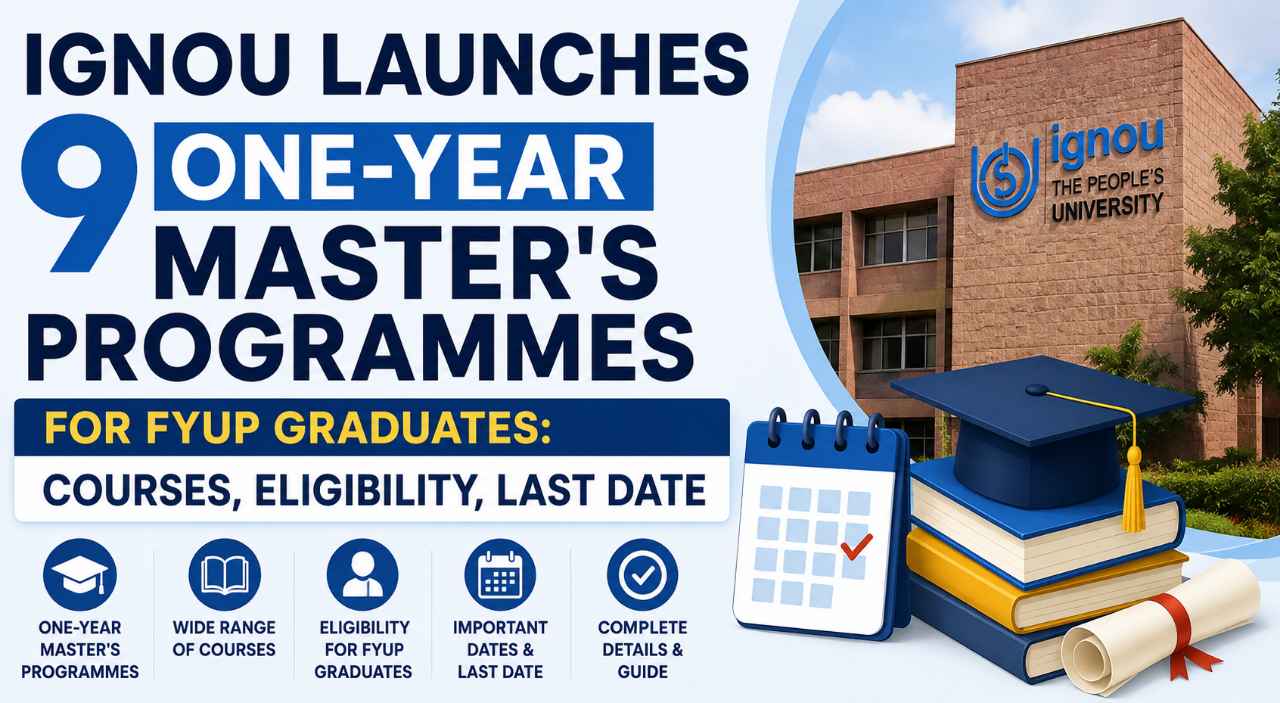
The Indira Gandhi National Open university (IGNOU) has opened a fast-track postgraduate pathway that could change how four-year undergraduate (FYUP) graduates plan their higher studies. Under the National Education Policy (NEP) 2020 framework, IGNOU is offering nine one-year master's degree programmes exclusively for students who have completed a four-year bachelor's degree with honours or honours with research. Instead of the conventional two-year master's route, eligible learners can now complete selected postgraduate degrees in just one academic year through Open and Distance Learning (ODL) and online modes.
If you completed FYUP from a central university such as Delhi University, a state university, or any UGC-recognised institution, this announcement matters for your career timeline, exam eligibility, and education budget. Admissions for the July 2026 session are open, and the last date to apply is 16 August 2026. This guide explains every programme, who qualifies, how to apply on the Samarth portal, and what this means compared with traditional postgraduate study in India.
What Are IGNOU's One-Year Master's Programmes for FYUP Graduates?
IGNOU's new offering is part of India's broader shift toward the 4+1 model envisioned under NEP 2020. In this model, a student who completes a rigorous four-year undergraduate programme—with additional credits, multidisciplinary exposure, and often a research or project component—can enter a one-year postgraduate programme rather than spending two full years on a master's degree.
These are not short-term certificate courses or diplomas. IGNOU has positioned them as full master's degrees delivered through its established ODL infrastructure. The nine programmes span social sciences, commerce, media, and languages—disciplines where postgraduate qualifications are commonly required for teaching, research, civil services, journalism, banking, and higher studies.
For students who already invested four years in an honours programme, the one-year route saves time and typically reduces total tuition compared with a two-year master's. That makes IGNOU especially attractive for working professionals, distance learners, and graduates from towns and cities who may not relocate for full-time campus PG study—whether you are in Delhi, Jaipur, Sikar, Kota, or any other part of India.
Why NEP 2020 and the FYUP Model Matter for Postgraduate Admissions
Before NEP 2020, most Indian universities followed a three-year bachelor's structure followed by a two-year master's—a 3+2 pathway totalling five years of higher education after Class 12. NEP encourages universities to introduce four-year undergraduate programmes (FYUP) with honours, multidisciplinary minors, skill-based courses, and research opportunities.
The logic behind IGNOU's one-year master's is straightforward: FYUP graduates already carry roughly 160 credits or more at the undergraduate level, including depth in a major subject. Under credit-based equivalence, they can complete the remaining postgraduate credits in one year instead of two.
Who Benefits Most from This Pathway?
- FYUP honours graduates who want a master's without losing another year to full-time study
- Aspiring UGC-NET, SET, or PhD candidates who need a postgraduate degree to meet eligibility norms
- UPSC and state PSC aspirants who prefer humanities, commerce, or social science optional subjects at PG level
- Media and communication career seekers targeting roles in journalism, content, and public relations
- Working teachers and educators upgrading qualifications while continuing employment
Students who completed a traditional three-year BA, BSc, or BCom are not eligible for this one-year route at IGNOU. They must continue with the university's standard two-year postgraduate programmes—a distinction every applicant should verify before registering.
Complete List of 9 One-Year Master's Programmes at IGNOU
IGNOU has grouped the nine programmes into three broad streams. Each is a standalone master's degree, not a lateral entry into an incomplete programme. Below is the full list with stream-wise classification:
| Stream | Programme Name | Degree Awarded |
|---|---|---|
| Social Sciences and Management | Master of Arts in Economics | MA Economics |
| Social Sciences and Management | Master of Arts in Sociology | MA Sociology |
| Social Sciences and Management | Master of Arts in History | MA History |
| Social Sciences and Management | Master of Commerce | MCom |
| Media and Mass Communication | Master of Arts in Journalism and Mass Communication | MA JMC |
| Languages and Literature | Master of Arts in English | MA English |
| Languages and Literature | Master of Arts in Hindi | MA Hindi |
| Languages and Literature | Master of Arts in Sanskrit | MA Sanskrit |
| Languages and Literature | Master of Arts in Urdu | MA Urdu |
MA Economics, Sociology, and History
These three programmes suit learners targeting academic careers, policy research, teaching, and competitive examinations. An MA in Economics opens doors to banking, data analysis, and research roles. Sociology supports work in NGOs, social development, and public policy. History remains a strong base for civil services, museology, archival work, and teaching. Institutions focused on social research—such as the International Institute for Population Sciences Mumbai—often attract graduates with strong social science postgraduate backgrounds.
MCom (Master of Commerce)
The one-year MCom pathway helps FYUP commerce graduates deepen knowledge in accounting, finance, taxation, and business law without committing to a two-year programme. While some students also explore professional routes like a Master of Business Administration (MBA), MCom remains the preferred academic master's for teaching, NET in Commerce, and finance-oriented government posts.
MA Journalism and Mass Communication
Media careers demand both skill and formal credentials. The one-year MA JMC at IGNOU allows FYUP graduates—especially those from humanities and social sciences—to enter journalism, digital media, corporate communications, and content strategy with a recognised postgraduate degree.
MA in English, Hindi, Sanskrit, and Urdu
Language master's degrees remain essential for school and college teaching, translation, publishing, and literary research. FYUP graduates with strong language honours can use the one-year route to meet UGC-NET eligibility in their chosen literature subject faster than the traditional two-year track.
Eligibility Criteria: Who Can Apply?
IGNOU has kept eligibility focused and specific. Only candidates who meet all of the following conditions should apply for the one-year master's route:
- Four-year undergraduate degree (FYUP) with Honours or Honours with Research from a recognised university
- Relevant academic background matching the chosen master's programme (check programme-specific rules on the official portal)
- Valid APAAR ID (Automated Permanent Academic Account Registry)—mandatory during online registration
- Completed graduation with required documents such as consolidated mark sheet or degree/provisional certificate
Who Is Not Eligible?
Candidates with a conventional three-year bachelor's degree cannot enrol in these nine one-year programmes. They should explore IGNOU's regular two-year MA, MCom, and other postgraduate offerings instead. Similarly, applicants still awaiting final-year FYUP results should confirm whether provisional admission is permitted for the July 2026 session by reading the latest notification on the admission portal.
If you completed FYUP from a Delhi University college—such as Lady Shri Ram College for Women (LSR) Delhi, Daulat Ram College Delhi, Atma Ram Sanatan Dharma College Delhi, or Indraprastha College for Women Delhi—you may be eligible provided your degree clearly reflects the four-year honours structure. Always cross-check your mark sheet credit count and degree nomenclature before applying.
Important Dates: July 2026 Session and Last Date to Apply
IGNOU has aligned the one-year master's admissions with the July 2026 academic session. The university has also extended the deadline for fresh admissions and re-registration for several ODL and online programmes.
- Admission session: July 2026
- Last date to apply: 16 August 2026
- Portal: ignouadmission.samarth.edu.in
- Re-registration: Existing IGNOU students must also complete re-registration by the extended deadline where applicable
Do not wait until the final day. Server load, document verification issues, and payment failures are common close to deadlines. Set a personal target to finish registration at least three to five days before 16 August 2026.
How to Apply for IGNOU One-Year Master's Programmes Online
All applications are submitted through the IGNOU Samarth admission portal. The process is fully online, but preparation matters. Gather documents, create or retrieve your APAAR ID, and choose your study centre carefully before you begin.
Step-by-Step Application Process
- Visit the official portal at ignouadmission.samarth.edu.in.
- Click on New Registration and create an account using a valid email ID and mobile number.
- Verify your contact details through the OTP process.
- Log in and select the desired one-year master's programme from the July 2026 admission list.
- Choose your preferred regional centre and study centre based on location and programme availability.
- Enter personal details, academic history, and your APAAR ID.
- Upload scanned copies of required documents in the prescribed format and file size.
- Pay the programme fee online through the available payment modes.
- Review every field carefully and submit the application.
- Download and save the acknowledgement receipt and payment proof.
Documents Required for IGNOU One-Year PG Registration
Keep clear, legible scans ready before starting your application. Typical documents include:
- FYUP consolidated mark sheet or final semester mark sheets
- Degree certificate or provisional certificate showing four-year honours completion
- Government photo ID (Aadhaar, passport, voter ID, etc.)
- Recent passport-size photograph
- Scanned signature
- Category certificate (SC/ST/OBC/EWS/PwD) if applicable
- APAAR ID details
File names and sizes must match portal specifications. Blurry uploads are a common reason for application rejection or delay.
Understanding APAAR ID and the Academic Bank of Credits
One requirement that sets this admission cycle apart is the mandatory APAAR ID. APAAR stands for Automated Permanent Academic Account Registry, and it works alongside India's Academic Bank of Credits (ABC) system under NEP 2020. Think of APAAR as a lifelong digital academic identity that stores your credentials, credits, and qualifications in one verified record.
When you enter your APAAR ID during IGNOU registration, the university can validate your FYUP completion and credit history more efficiently. If you do not yet have an APAAR ID, visit the official ABC portal linked through your university or the Ministry of Education resources, authenticate with your Aadhaar-linked details, and generate your ID before starting the Samarth application. Missing or incorrect APAAR entries are among the most common causes of incomplete registrations—resolve this step first, not last.
Fees, Duration, and Mode of Study
Each one-year programme runs for one academic year under the July 2026 session cycle. Delivery is through IGNOU's ODL and online systems, which include printed study material, digital resources, assignments, term-end examinations, and regional centre support.
Exact fee amounts vary by programme and are published on the official admission portal. IGNOU's distance-learning model generally costs less than many full-time private postgraduate programmes—a meaningful advantage for students comparing options at local colleges such as SK Government Post Graduate College Sikar, Mahatma Gandhi Post Graduate Mahavidyalaya Sikar, or Maa Bharati Post Graduate College Kota, where residential or full-time PG study may involve additional expenses.
Is a One-Year IGNOU Master's Valid for NET, UPSC, and PhD?
This is one of the most frequently asked questions—and rightly so. According to IGNOU's announcement and NEP-aligned framing reported across education news sources, these ODL master's degrees are intended to hold the same legal and academic status as conventional two-year postgraduate degrees for purposes such as:
- UGC-NET and state eligibility tests (SET) for assistant professor posts
- UPSC Civil Services and other central government examinations where a master's is required or preferred
- PhD admissions at universities that accept IGNOU postgraduate degrees
- State government recruitment where a recognised master's degree is prescribed
IGNOU is a central university established by an Act of Parliament, and its degrees are generally recognised across India. Still, always verify the latest UGC notifications and the specific recruitment rules of your target employer or university. When in doubt, email the recruiting body or university academic section with your proposed degree details before enrolling.
One-Year Master's vs Two-Year Master's: Which Should You Choose?
| Factor | One-Year IGNOU Master's (FYUP only) | Two-Year Conventional Master's |
|---|---|---|
| Eligibility | Four-year FYUP honours graduates | Three-year or four-year UG graduates (programme-specific) |
| Duration | 1 year | 2 years |
| Mode | ODL / Online | Regular, ODL, or online depending on institution |
| Time to NET/PhD | Faster for eligible FYUP grads | Standard timeline |
| Campus experience | Limited; self-paced learning | Often includes classroom interaction and campus networks |
FYUP graduates who value speed, affordability, and flexibility should strongly consider the one-year route. Those who want intensive campus research exposure may still prefer a two-year regular programme at universities such as Nehru Gram Bharati Deemed To Be University Prayagraj or ICFAI Foundation For Higher Education Hyderabad—but IGNOU fills a crucial gap for learners who cannot relocate.
Career Pathways After a One-Year MA or MCom from IGNOU
Teaching and Research
A master's degree is the gateway to UGC-NET and college teaching. Language MA programmes support school and college lecturer posts; Economics, Sociology, and History feed into social science departments across India. Graduates from education-focused institutions like Shri Ram College of Education Jaipur often pursue PG degrees to strengthen their academic credentials for senior teaching roles.
Civil Services and Public Sector
Humanities and commerce postgraduates regularly appear in UPSC and state PSC merit lists. A recognised MA or MCom satisfies educational requirements for numerous Group A and Group B posts. Law-oriented aspirants sometimes combine social science PG study with preparation for institutions like Dr Ram Manohar Lohiya National Law University Lucknow, though law itself requires a separate LLB pathway.
Media, Content, and Communications
MA Journalism and Mass Communication graduates pursue roles in newsrooms, digital platforms, public relations, and corporate communications. Build a portfolio alongside your degree—assignments alone rarely replace published work samples.
Higher Studies and Interdisciplinary Options
After completing the one-year master's, you may apply for PhD programmes, postgraduate diplomas, or professional certifications. Women learners in STEM who also want management exposure sometimes combine PG humanities study with technical qualifications from institutions like Indira Gandhi Delhi Technical University For Women.
What Happens After Admission Confirmation?
Once your application is accepted, IGNOU assigns you an enrolment number and dispatches programme-specific study material to your registered address. You will receive assignment question papers each semester, attend counselling sessions at your study centre where applicable, and sit for term-end examinations at designated exam centres. Success in ODL programmes depends on consistent monthly progress: read one unit per week, draft assignment answers early, and maintain a calendar of submission and exam dates from day one.
Upon successful completion of all courses, assignments, and examinations within the one-year schedule, IGNOU awards your MA or MCom degree at its convocation or through dispatch of degree certificates as per university norms. That qualification then becomes part of your APAAR-linked academic record for future NET applications, government forms, and PhD admissions.
Actionable Tips for FYUP Graduates Before You Apply
- Verify your degree type: Confirm your certificate states four-year honours or honours with research—not a three-year pass or programme degree.
- Get your APAAR ID early: Create or locate your APAAR ID through the Academic Bank of Credits ecosystem before starting registration.
- Match programme to prior major: Choosing a master's aligned with your honours subject reduces academic friction and improves NET preparation efficiency.
- Pick a convenient study centre: Term-end exams and counselling sessions are tied to regional infrastructure—choose a centre you can reach during exam season.
- Plan assignment schedules: ODL success depends on disciplined monthly study, not last-minute exam cramming.
- Save every receipt: Store acknowledgement pages, fee receipts, and email confirmations in cloud storage.
- Compare with local PG colleges: Review full-time options at nearby institutions—such as SNKP Government Post Graduate College Sikar, Shekhawati Post Graduate Mahavidyalaya Sikar, or Smt Asha Devi Post Graduate Mahavidyalaya Sikar—before committing to distance mode.
Conclusion
IGNOU's launch of nine one-year master's programmes for FYUP graduates is a practical implementation of NEP 2020's flexible, credit-based vision. Eligible students can earn a full MA or MCom in one year through ODL or online study—saving time and money while keeping doors open to UGC-NET, civil services, teaching, media careers, and doctoral research. With the July 2026 session application deadline on 16 August 2026, FYUP honours graduates should act now: confirm eligibility, arrange APAAR ID credentials, prepare documents, and complete registration on ignouadmission.samarth.edu.in well before the last date.
Whether you graduated from a metro college or a regional university, this pathway offers a nationally recognised postgraduate option without forcing you to pause work or relocate. Read the official programme brochure, choose the subject that fits your career plan, and treat this one-year commitment with the same seriousness as any full-time master's—because on paper and in law, that is exactly what it is.