
The University of Delhi (DU) has declared the Round 1 and Round 2 seat allotment results for its newly introduced one-year postgraduate (PG) programmes for the academic session 2026-27. This is a landmark admission cycle aligned with the National Education Policy (NEP) 2020, offering an accelerated master's pathway to eligible graduates who completed the four-year undergraduate programme under the Undergraduate Curriculum Framework (UGCF) 2022.
If you registered through the Common Seat Allocation System for PG (CSAS-PG) on pgportal.uod.ac.in, this guide explains everything you need to know: how to check your allotment, the last date to accept your seat, department verification timelines, fee payment deadlines, and what to do if you were not allotted a programme in either round. Read carefully — missing even one deadline can lead to automatic cancellation of your seat.
What Are DU One-Year PG Programmes?
For decades, a master's degree at Delhi University meant a standard two-year postgraduate course, usually through CUET (PG) and CSAS-PG. From 2026-27, DU has added a separate track: one-year PG programmes designed exclusively for its own four-year UG graduates.
These programmes reflect the NEP 2020 vision of flexible, credit-based higher education. Students who have already earned substantial credits and research exposure during their FYUP can complete a master's in one academic year instead of two — provided their undergraduate major aligns with the PG subject and they meet merit-based eligibility norms.
Key Features of the One-Year PG Route
- Merit-based admission: No separate entrance test or CUET-PG score is required for this track.
- DU-only eligibility: Only graduates of DU's four-year UGCF 2022 programme (including SOL and NCWEB) can apply.
- Subject continuity: Your undergraduate discipline must match the intended MA, MSc, MCom, or other PG programme.
- Accelerated completion: Eligible candidates can earn a master's degree in one year rather than the conventional two.
- Separate from two-year PG: Regular two-year PG admissions continue through CUET (PG) 2026 and the standard CSAS-PG process.
Delhi remains one of India's most sought-after education hubs. While DU's one-year route is unique to its FYUP graduates, students exploring broader options often compare institutions such as Jesus and Mary College Delhi, affiliated colleges across the capital, and national institutes like AIIMS Delhi for specialised pathways in medicine and allied sciences.
DU 1-Year PG Round 1 and Round 2 Allotment Result 2026: Overview
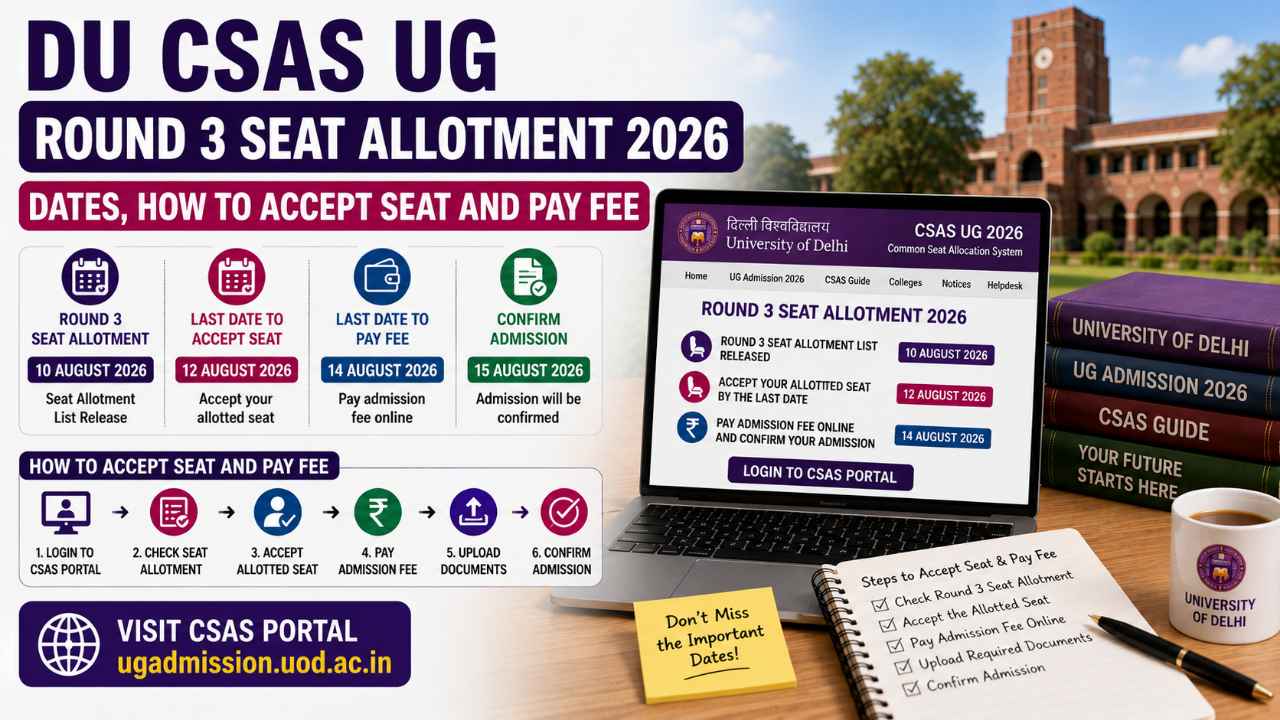
On August 12, 2026, Delhi University announced the combined seat allocation schedule for Round 1 and Round 2 of its one-year PG admissions. Candidates who completed Phase II registration and preference filling on the official portal can now log in to view their allotment status.
Unlike the earlier standalone Round 1 window (declared on August 5 with a tighter acceptance deadline of August 6), the university has now issued a joint schedule covering both rounds together. This gives candidates who were allotted seats in either round a unified window to accept, get verified, and pay fees.
Who Should Check the Allotment Result?
- Candidates who registered for DU one-year PG programmes during the 2026-27 admission cycle.
- Applicants who filled programme and college preferences in CSAS-PG Phase II.
- Students allotted a seat in Round 1 who have not yet completed acceptance or fee payment.
- Candidates receiving a fresh allotment in Round 2, including those upgrading from a lower preference.
If you are a DU FYUP graduate who missed this cycle entirely, remember that conventional two-year PG admissions through CUET (PG) remain open on a separate track. Students who prefer technical or professional degrees outside Delhi may also explore programmes such as BTech Computer Science and Engineering at universities nationwide or management courses at institutions like the University of Petroleum and Energy Studies Management.
Important Dates and Deadlines for Round 1 and Round 2
Deadlines in DU admissions are strict. The university does not typically grant individual extensions for seat acceptance or fee payment. Mark these dates on your calendar immediately after checking your result.
| Activity | Date and Time | Remarks |
|---|---|---|
| Round 1 and Round 2 allotment declared | August 12, 2026 | Results visible on CSAS-PG dashboard |
| Last date to accept allotted seat | August 15, 2026 (11:59 PM) | Mandatory for all allotted candidates |
| Department verification and approval | August 12 – August 17, 2026 (11:59 PM) | Colleges verify documents and eligibility |
| Last date for online admission fee payment | August 18, 2026 (11:59 PM) | Final step to confirm admission |
Action tip: Do not wait until the last hour on August 15 to accept your seat. Portal traffic spikes near deadlines, and technical glitches can cost you a confirmed admission.
How to Check DU One-Year PG Allotment Result 2026
Checking your allotment is straightforward if you have your CSAS-PG login credentials ready. Follow these steps on the official portal.
Step-by-Step: View Your Allotment
- Visit the official DU PG admission portal at pgportal.uod.ac.in or admission.uod.ac.in.
- Click on the CSAS-PG login section for one-year postgraduate programmes.
- Enter your registered email ID, password, and any captcha or OTP if prompted.
- Navigate to the Seat Allotment or Round 1 / Round 2 tab on your dashboard.
- Review the programme name, department, college, category, and allotment round displayed.
- Download or take a screenshot of the allotment letter for your records.
If your dashboard shows "Not Allotted," do not panic immediately. Check whether further rounds, vacant seat lists, or upgrade windows will be announced on the official website. DU typically publishes updated schedules as PDF notices under the admission section.
How to Accept Your Allotted Seat on CSAS-PG
Receiving an allotment is not the same as securing admission. You must actively accept the seat within the prescribed window. Failure to accept by 11:59 PM on August 15, 2026 will result in automatic cancellation, and the seat may be offered to another candidate.
Seat Acceptance Process
- Log in to your CSAS-PG dashboard using your registered credentials.
- Open the allotment details for Round 1 or Round 2, as applicable.
- Click the "Accept Seat" button within the acceptance window.
- Confirm your acceptance when prompted — this action is generally irreversible for that round.
- Monitor your dashboard for verification status updates from the allotted department or college.
Important: Accept only if you genuinely intend to join the allotted programme. Holding a seat without completing verification and fee payment blocks another deserving candidate and may affect your eligibility for subsequent rounds.
What Happens After You Accept?
Once you accept, the concerned department or college begins verifying your uploaded documents against programme-specific eligibility criteria. This includes checking your four-year UG marks or CGPA, category certificate (if applicable), subject continuity, and any additional requirements listed in the Bulletin of Information (BoI) for one-year PG admissions 2026.
During verification (August 12–17, 2026), departments may raise queries on your dashboard. Respond promptly with corrected documents or clarifications. Ignoring a verification query can lead to rejection even after seat acceptance.
Department Verification: Documents and Common Issues
Verification is the bridge between seat acceptance and final admission. Departments cross-check every detail you submitted during registration.
Documents Typically Required
- Four-year UG degree marksheets or grade cards for all eight semesters
- Provisional or final degree certificate (if available)
- Category certificate (SC, ST, OBC-NCL, EWS, PwBD) if applicable
- Photo ID proof (Aadhaar, passport, or voter ID)
- Passport-size photograph as per portal specifications
- Any programme-specific certificates mentioned in the BoI
Common Verification Problems and Fixes
- CGPA mismatch: Ensure the aggregate entered during registration matches your official marksheet. Upload a corrected document if needed.
- Subject mismatch: One-year PG programmes require your UG major to align with the PG subject. If your major does not match, admission may be rejected.
- Blurry uploads: Re-upload clear, legible PDF scans before the verification deadline.
- Category certificate errors: OBC-NCL and EWS certificates must be valid for the current financial year.
Students familiar with DU's undergraduate ecosystem — including colleges like Jesus and Mary College Delhi — should contact their allotted department's admission cell directly if verification is delayed beyond the expected timeline.
Admission Fee Payment: Last Date and Procedure
After your application is verified and approved by the department, you must pay the admission fee online. The last date for fee payment is August 18, 2026, till 11:59 PM.
How to Pay the Admission Fee
- Log in to your CSAS-PG dashboard after receiving verification approval.
- Navigate to the fee payment section linked to your allotted programme.
- Review the fee breakup (tuition, university charges, and other components as notified).
- Choose an online payment mode — debit card, credit card, net banking, or UPI.
- Complete the transaction and download the payment receipt immediately.
- Keep multiple copies of the receipt for college reporting and future reference.
Fee structures vary by programme and college. Refer to the official fee notification on admission.uod.ac.in for exact amounts. SC, ST, and PwBD candidates should confirm applicable fee concessions as per university norms.
Eligibility Recap: Who Can Join DU One-Year PG Programmes?
Understanding eligibility helps you assess whether your allotment is secure or at risk during verification.
Basic Eligibility Criteria
- Degree requirement: Four-year undergraduate degree under UGCF 2022 from the University of Delhi (regular, SOL, or NCWEB).
- Minimum marks: 50% aggregate or equivalent CGPA for UR, OBC-NCL, and EWS candidates; 45% for SC, ST, and PwBD candidates.
- Subject match: Undergraduate major must correspond to the one-year PG programme applied for.
- Merit basis: Seat allocation is based on cumulative academic performance across all eight semesters — no entrance exam score is used.
This route is fundamentally different from CUET (PG)-based two-year admissions, where national test scores determine merit across universities. If you completed a three-year bachelor's degree or graduated from a non-DU institution, the one-year PG pathway does not apply to you.
Round 1 vs Round 2: Understanding the Combined Allotment
Delhi University's decision to release a joint Round 1 and Round 2 schedule simplifies the process for candidates who were allotted seats in either round. Here is how the two rounds typically function within CSAS-PG.
Round 1 Allotment
Round 1 allocates seats based on merit and the preferences you submitted during Phase II registration. Candidates receive their highest available preference for which seats remain vacant. The initial Round 1 result was declared earlier in the cycle (August 5, 2026), with a shorter acceptance window. Candidates who missed that window may now benefit from the extended combined schedule announced on August 12.
Round 2 Allotment
Round 2 accommodates candidates who were not allotted in Round 1, as well as those seeking upgrades to higher-preference programmes. Seats vacated by candidates who did not accept Round 1 allotments are also redistributed in this round.
Upgrade and Cancellation Rules
- If you accept a Round 2 upgrade, your previous lower-preference seat is automatically released.
- If you do not accept within the deadline, your allotment is cancelled with no guarantee of a future round.
- Monitor official notices for announcements on vacant seat lists or additional rounds.
What If You Were Not Allotted a Seat?
Not receiving an allotment in Round 1 or Round 2 does not necessarily mean the end of your postgraduate journey. Consider these alternatives:
- Wait for further rounds: DU may announce additional allocation rounds or vacant seat lists. Check admission.uod.ac.in daily.
- Apply for two-year PG through CUET (PG): The conventional master's route remains available for eligible candidates through national entrance scores.
- Explore other universities: Institutions such as SRM Institute of Science and Technology Chennai, Galgotias College of Engineering and Technology, and University of Petroleum and Energy Studies offer diverse PG programmes across disciplines.
- Consider professional courses: Design aspirants may look at exams like NID DAT, while hospitality candidates can explore options such as a Diploma in Hotel and Hospitality Administration.
Programmes Offered Under DU One-Year PG 2026-27
DU's one-year PG portfolio spans humanities, sciences, commerce, and professional disciplines. While the exact list is published in the official Bulletin of Information, reported programmes include MA degrees in languages and social sciences, MSc programmes in sciences, MCom, and select professional courses introduced under NEP 2020.
More than 1,100 seats are reportedly available across these programmes for the 2026-27 session, adding to DU's existing two-year PG intake of approximately 13,500 seats. The one-year pathway is an additional route — it does not replace traditional two-year master's programmes.
Merit Calculation: How Seats Are Allotted
Since there is no entrance test, your cumulative CGPA or percentage across all eight semesters of the four-year UG programme determines your merit rank. Tie-breaking rules, category reservations, and programme-specific criteria are defined in the official BoI. Higher merit candidates receive their top available preference first; lower merit candidates may be allotted their lower preferences or remain unallotted if seats are exhausted.
CSAS-PG Portal: Tips for a Smooth Admission Experience
Technical preparedness can save you from last-minute stress. Keep these practical tips in mind throughout the admission process.
- Use a stable internet connection when accepting seats or paying fees near deadlines.
- Keep login credentials safe — reset your password before August 15 if you have forgotten it.
- Check email and SMS alerts linked to your registration for official updates from DU.
- Do not use multiple devices to accept or pay simultaneously, as this can cause session errors.
- Save PDF copies of allotment letters, verification approvals, and fee receipts.
- Contact the DU helpline listed on the admission portal for technical issues — not unofficial social media pages.
Students comparing DU with regional alternatives — such as Krishna Institute of Engineering and Technology or Fairfield Institute of Management and Technology — should weigh factors like programme duration, fee structure, placement records, and location alongside admission timelines.
Difference Between One-Year PG and Two-Year PG at DU
Confusion between the two pathways is common. This table clarifies the distinction.
| Parameter | One-Year PG (2026-27) | Two-Year PG (Conventional) |
|---|---|---|
| Eligibility | DU four-year UGCF 2022 graduates only | Open to eligible graduates as per programme norms |
| Entrance exam | None — merit from UG CGPA | CUET (PG) 2026 mandatory |
| Duration | One academic year | Two academic years |
| Portal | pgportal.uod.ac.in (CSAS-PG one-year track) | CSAS-PG through CUET (PG) scores |
| NEP alignment | Direct NEP 2020 accelerated pathway | Standard postgraduate structure |
Why the One-Year PG Model Matters for Indian Higher Education
Delhi University's launch of one-year master's programmes signals a broader shift in Indian higher education. The NEP 2020 framework envisions multiple entry and exit points, credit transfer, and reduced redundancy between undergraduate and postgraduate study.
For FYUP graduates who have already completed research components and advanced coursework during their bachelor's degree, a one-year master's is a logical progression. It reduces time to employment or doctoral study, lowers overall education costs, and aligns India's degree structures with international norms where accelerated master's pathways exist.
However, the model is still in its first admission cycle. Candidates should stay updated through official DU notifications rather than relying on unofficial WhatsApp forwards or unverified coaching-centre claims about deadline extensions.
Conclusion
The DU 1-Year PG Round 1 and Round 2 allotment result 2026 marks a critical milestone for thousands of Delhi University FYUP graduates seeking an accelerated master's degree. With allotment results declared on August 12, 2026, the immediate priority for allotted candidates is clear: accept your seat by August 15, 2026, respond to any verification queries by August 17, and pay admission fees by August 18, 2026.
Log in to pgportal.uod.ac.in, review your CSAS-PG dashboard, and complete every step within the official timeline. Whether you join a DU department for a one-year MA or MSc, pursue a conventional two-year PG through CUET (PG), or explore opportunities at institutions across India, acting on verified information and official deadlines is the surest path to securing your seat.
Stay tuned to admission.uod.ac.in for PDF notices on vacant seats, further rounds, and reporting dates. Your postgraduate journey begins with one timely click — make it count.