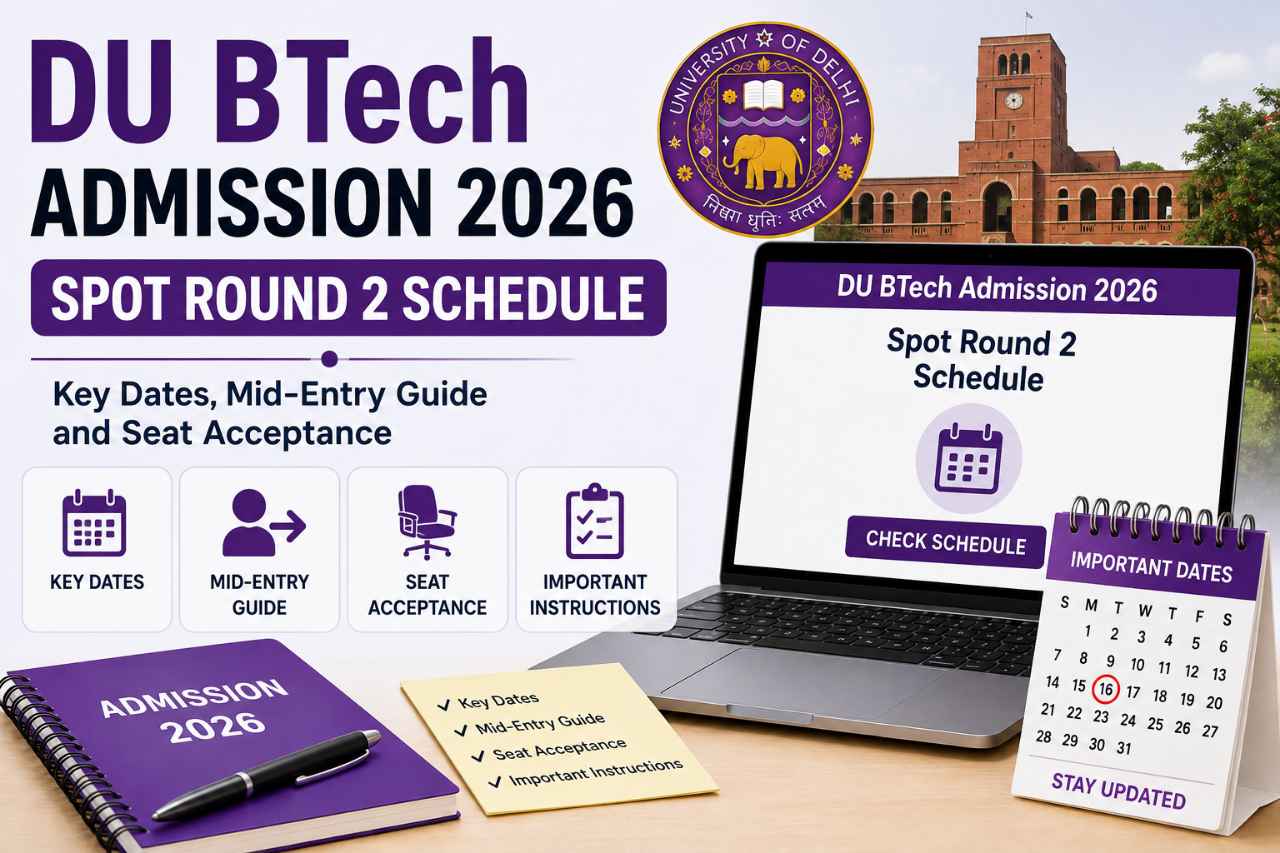

Delhi University (DU) has published the Spot Round 2 schedule for BTech Admission 2026 on the Common Seat Allocation System (CSAS) portal at admission.uod.ac.in. If you missed the earlier counselling rounds or still hold a valid JEE Main 2026 rank, this is one of the last structured chances to secure a seat in Computer Science Engineering (CSE), Electronics and Communication Engineering (ECE), or Electrical Engineering (EE) at DU.
This guide explains the complete Spot Round 2 timeline, who can apply through the mid-entry window, how seat acceptance works, and what documents you need written in plain language for students and parents across India. Information is aligned with the official notice released in August 2026 and verified against published admission updates from the CSAS portal and trusted education news sources.
What Is DU BTech Spot Round 2?
Spot rounds are supplementary counselling phases held after regular CSAS rounds when seats remain vacant. For DU BTech 2026, three regular allocation rounds were completed in June and July 2026. Spot Round 1 results were declared on August 6, 2026. Spot Round 2 now offers remaining seats across CSE, ECE, and EE programmes.
Unlike a routine upgrade round, Spot Round 2 includes a mid-entry window (August 13–14, 2026, till 4:59 PM) that allows entirely new applicants students who never registered on CSAS earlier to enter the process for the first time. This is significant because many candidates who focused on JoSAA, state engineering counselling, or private colleges initially may still want a DU seat if vacancies exist.
Students exploring engineering pathways beyond DU often compare programmes like Bachelor of Technology (BTech) at institutions such as Vel Tech Chennai or DMI College of Engineering Chennai. Understanding DU's spot round helps you make an informed choice between a central university seat and other options.
DU BTech Spot Round 2 Important Dates (General Category)
Missing even one deadline in spot counselling can lead to automatic cancellation of your allotted seat. Mark these dates on your calendar and set reminders at least 24 hours before each cutoff.
| Activity | Date and Time |
|---|---|
| Mid-entry window for fresh candidates | August 13 to 14, 2026 (till 4:59 PM) |
| Declaration of Spot Round 2 seat allocation | August 17, 2026 |
| Acceptance of allotted seat | August 17 to 19, 2026 |
| Verification and approval by faculty | Till August 20, 2026 |
| Last date for online fee payment | August 21, 2026 |
Actionable Tip
Do not wait until the last hour on August 14 for mid-entry registration. Portal traffic spikes before deadlines, and payment gateway failures are common. Complete registration, document upload, and fee payment by the afternoon of August 14 at the latest.
Spot Round 2 Schedule for CW Quota
The Children and Widows (CW) supernumerary quota follows a separate timeline. The mid-entry facility is not available for CW applicants. Only candidates already registered under the CW category can participate in this spot round.
| Activity | Date and Time |
|---|---|
| Declaration of CW quota seat allocation | August 18, 2026 |
| Acceptance of allotted seat | Till 4:59 PM on August 19, 2026 |
| Verification and approval by faculty | Till 4:59 PM on August 22, 2026 |
| Last date for fee payment | August 23, 2026 |
CW candidates should note the later seat declaration date (August 18 versus August 17 for general applicants) and the extended verification window. Keep scanned copies of CW eligibility certificates ready before allocation is announced.
Background: How DU BTech Admission 2026 Reached Spot Round 2
Understanding the admission cycle helps you interpret why spot rounds exist and what seats may realistically be available.
Regular CSAS Rounds (June–July 2026)
DU BTech admissions are conducted through CSAS based on JEE Main 2026 Paper 1 ranks. Three standard rounds of seat allocation, choice filling, and acceptance were held across June and July 2026. Candidates who accepted seats in earlier rounds exited the pool; others who did not accept or were not allocated moved forward or dropped out.
Spot Round 1 (August 6, 2026)
After regular rounds, vacant seats were offered in Spot Round 1. Results were declared on August 6, 2026. Some seats were filled; others remained open, leading to Spot Round 2.
Why Mid-Entry Was Added
DU introduced the mid-entry option in Spot Round 2 based on seat availability. It gives fresh candidates those who never registered during earlier CSAS rounds their first opportunity to enter DU BTech counselling. This is unusual in central university spot rounds and reflects the number of unfilled seats across the three engineering branches.
Programmes Covered in Spot Round 2
Spot Round 2 covers vacant seats in three BTech programmes at Delhi University constituent colleges:
- Computer Science Engineering (CSE) – Highly sought after; typically the first branch to fill in regular rounds. Even in spot rounds, CSE seats may be limited. Students interested in this branch should also explore related pathways such as BTech CSE, BTech Computer Science and Engineering, and BTech CSE specialisations at other institutions for backup planning.
- Electronics and Communication Engineering (ECE) – Core engineering branch with strong placement prospects in telecom, embedded systems, and hardware design.
- Electrical Engineering (EE) – Covers power systems, control engineering, and electrical machine design; often has relatively more vacancies in spot rounds compared to CSE.
Before applying, check the vacant seat matrix on the CSAS portal after login. Seat numbers change after each acceptance and withdrawal cycle.
Who Can Apply Through the Mid-Entry Window?
The mid-entry window is strictly for fresh candidates students who did not register during any earlier CSAS round for DU BTech 2026. To qualify, you must meet all of the following conditions:
- Hold a valid JEE Main 2026 rank in Paper 1 (B.E./B.Tech paper)
- Never have registered on the CSAS portal for DU BTech 2026 in Rounds 1, 2, or 3, or Spot Round 1
- Complete registration between August 13 and 14, 2026, before 4:59 PM
Who Cannot Use Mid-Entry?
- Already registered CSAS candidates – If you participated in any earlier DU BTech round, you cannot re-enter through mid-entry. You may still be eligible for spot allocation if you remain in the active candidate pool check your CSAS dashboard status.
- CW supernumerary quota applicants – Mid-entry is not permitted for the Children and Widows category.
- Ward supernumerary quota applicants – University ward quota candidates are also excluded from mid-entry.
- Candidates without JEE Main 2026 Paper 1 rank – DU BTech admissions are rank-based; no alternative entrance is accepted for these programmes.
If you are a diploma holder seeking lateral entry elsewhere, note that DU's spot round mid-entry is for standard four-year BTech entry via JEE Main, not lateral admission. For lateral pathways, explore options like BTech Lateral CSE at colleges such as MD Mission College Kota.
How to Register for Mid-Entry (Step-by-Step)
Fresh candidates should follow this sequence before 4:59 PM on August 14, 2026:
- Visit the official portal – Open admission.uod.ac.in on a laptop or desktop browser (mobile browsers sometimes cause upload errors).
- Click the CSAS 2026 mid-entry registration link – This appears on the homepage during the active window only.
- Fill personal and academic details – Enter name, date of birth, contact information, Class 10 and 12 board details, and JEE Main 2026 application number and rank accurately. Errors here cause rejection during faculty verification.
- Upload scanned documents – Use PDF or JPG formats within the specified file size limits. Ensure scans are legible and uncropped.
- Pay the registration fee online – Complete payment through the integrated gateway and save the receipt. Submit the application only after payment confirmation.
Late applications are not accepted under any condition once the window closes at 4:59 PM on August 14, 2026.
Documents Required for Verification
Upload these documents to your CSAS profile before seat allotment. Missing or incorrect documents lead to rejection at the faculty approval stage even if you receive an initial seat allocation.
- JEE Main 2026 scorecard and admit card
- Class 10 board marksheet and passing certificate
- Class 12 board marksheet and passing certificate
- Category certificate (SC, ST, OBC-NCL, EWS) if applicable must be issued in the candidate's name and valid for 2026 admissions
- PwD certificate issued by a competent medical authority, if applicable
- Valid photo identity proof (Aadhaar, passport, or driving licence)
- Recent passport-size photograph matching the JEE Main application photo
Verification Tips
Faculty verification runs till August 20, 2026 (general) or August 22, 2026 (CW quota). Respond promptly to any correction requests on the portal. Keep original documents ready; colleges may ask for physical verification at reporting.
How to Accept Your Allotted Seat
Candidates who receive a seat in Spot Round 2 must complete every step in order. Skipping acceptance blocks faculty verification; missing the fee deadline cancels the admission entirely.
- Log in to the CSAS dashboard using your registered credentials.
- Check seat allocation status on August 17, 2026 (general) or August 18, 2026 (CW quota).
- Click Accept before the acceptance window closes (August 19, 2026 for general; 4:59 PM August 19 for CW).
- Wait for faculty verification of uploaded documents. Monitor your dashboard for approval status.
- Pay the admission fee online before August 21, 2026 (general) or August 23, 2026 (CW).
Critical Warning: Seat Allotment Is Final
The seat allotted in Spot Round 2 is final. There is no option to upgrade to a higher-preference programme or withdraw after acceptance. Before clicking Accept, confirm that you are satisfied with the branch and college allotted. This differs from JoSAA rounds where float options exist DU spot round acceptance is binding.
DU Colleges Offering BTech Through CSAS 2026
Delhi University conducts BTech admissions through its constituent and affiliated colleges. While the exact college allotted in Spot Round 2 depends on rank and vacancy, candidates typically receive seats across DU's engineering-enabled campuses. Knowing where programmes are housed helps you evaluate commute, hostel availability, and campus facilities before accepting a spot round seat.
Computer Science Engineering (CSE)
CSE remains the most competitive branch at DU. Colleges that have historically offered CSE include clusters associated with the Cluster Innovation Centre framework and select DU departments with engineering affiliations. Because CSE vacancies disappear quickly even in spot rounds, candidates with ranks beyond the usual general-category closing range should realistically assess whether ECE or EE acceptance is a better outcome than waiting for an uncertain future round.
ECE and EE Programmes
Electronics and Communication Engineering and Electrical Engineering seats tend to remain available longer in supplementary rounds. Both branches provide strong fundamentals for careers in core engineering, public sector undertakings, and postgraduate specialisations. EE graduates often pursue M.Tech in power electronics or control systems; ECE graduates move into VLSI, signal processing, and telecommunications roles.
Common Mistakes Candidates Make During Spot Round 2
Spot counselling moves fast, and small errors cost seats. Avoid these frequent pitfalls observed during previous DU admission cycles:
- Assuming mid-entry allows re-registration – Candidates already on CSAS cannot use the mid-entry link. Check your existing dashboard status instead.
- Uploading blurry document scans – Faculty reviewers reject illegible marksheets and certificates. Scan at 300 DPI minimum and verify readability before upload.
- Ignoring the 4:59 PM cutoff – DU consistently closes windows at 4:59 PM, not midnight. Plan accordingly.
- Accepting without branch preference review – Because spot round acceptance is final, candidates who accept EE or ECE without considering long-term career fit sometimes regret the decision. Research programme curricula on DU college websites before clicking Accept.
- Delaying fee payment – Even after faculty approval, failure to pay by August 21, 2026 (general) or August 23, 2026 (CW) cancels the seat automatically.
- Relying on unofficial WhatsApp groups – Dates and eligibility rules change through official notices only. Trust admission.uod.ac.in over forwarded messages.
JEE Main 2026 Rank: What to Expect in Spot Round 2
While DU does not publish spot-round-specific closing ranks in advance, historical patterns suggest CSE requires the most competitive JEE Main Paper 1 ranks, followed by ECE and then EE. Category-wise relaxation applies for SC, ST, OBC-NCL, EWS, and PwD candidates as per CSAS rules.
Candidates should log in to the CSAS portal after seat matrix publication to see branch-wise vacancy counts. A high vacancy count in EE or ECE may indicate better chances for mid-entry candidates registering during the August 13–14 window. If your rank is modest, accepting a DU seat in a core branch may still outweigh waiting for a private college branch change that may never materialise.
Understanding JEE Main Rank and Seat Prospects
Seat allocation in Spot Round 2 depends on your JEE Main 2026 Paper 1 rank, category, and remaining vacancies. Because CSE typically fills first, candidates with higher ranks (lower numerical rank numbers) have better chances in CSE. ECE and EE may have relatively more openings.
If your rank is not competitive for DU CSE, consider whether accepting EE or ECE at a DU college aligns with your career goals. A DU degree carries strong brand value in Delhi-NCR recruitment. Alternatively, private institutions like Vel Tech Chennai or state counselling seats may offer your preferred branch.
Students planning integrated postgraduate study after engineering can later explore pathways such as BTech-MTech dual degree programmes, though DU's current spot round covers only the three BTech branches listed above.
Category-Wise and Quota Considerations
Beyond the general category timeline, reserved-category candidates must ensure certificates match CSAS requirements. OBC-NCL certificates must be issued on or after April 1, 2026, as per typical DU norms verify the latest notice on the portal. EWS candidates need income and asset certificates from competent authorities. PwD certificates must specify the disability percentage and type recognised under RPwD Act guidelines.
CW and ward supernumerary quotas operate on separate rules. CW candidates cannot use mid-entry but participate in spot allocation if already registered. Ward quota candidates similarly follow distinct timelines outlined in the original CSAS information bulletin. Always cross-check your quota category on the dashboard before seat acceptance.
Comparing DU BTech with Other Engineering Options
Spot round decisions should be made in context. DU BTech offers affordable fees, central university recognition, and Delhi campus exposure. However, seat availability in spot rounds is limited, and branch choice may be restricted.
Other engineering routes include:
- JoSAA/CSAB counselling for NITs, IIITs, and GFTIs often with broader branch options
- State-level engineering counselling (e.g., MHT-CET, KCET, WBJEE-based admissions)
- Private universities with their own entrance exams or JEE Main cutoffs
- General BTech programmes at established colleges nationwide
If design or creative technology interests you alongside engineering, entrance exams like NID DAT open separate pathways these are unrelated to DU BTech but worth knowing if you are still exploring career directions.
Why DU BTech Remains a Strong Choice in 2026
For students who secure a spot round seat, DU BTech offers several advantages worth weighing against private alternatives. Fee structures at central university colleges are significantly lower than most private engineering institutions. The DU brand carries recognition among Delhi-NCR employers, public sector recruiters, and postgraduate programmes nationally.
Delhi's internship and industry ecosystem gives engineering students access to tech firms, startups, PSUs, and research labs. Campus life across DU colleges also exposes students to interdisciplinary peers in commerce, sciences, and humanities a different experience from isolated engineering-only campuses.
That said, branch limitation in spot rounds is real. A seat in EE at DU may be more valuable than no seat at all, but students targeting pure software careers should evaluate whether Computer Science pathways at other accredited institutions better match their goals alongside options like BTech CSE elsewhere. Informed comparison not rushed acceptance is the hallmark of a sound admission decision.
Action Plan for Candidates (Quick Checklist)
- Visit admission.uod.ac.in and log in or begin mid-entry registration.
- Fresh candidates: complete mid-entry by 4:59 PM on August 14, 2026.
- Check seat allocation on the declared date for your category (August 17 or 18, 2026).
- Keep JEE Main scorecard, Class 12 marksheet, and category certificates ready in scanned format.
- Accept the seat and pay the admission fee within the published deadline.
- After August 21, 2026, monitor the portal for updated vacant seat matrix and any notice about a further spot round.
What to Watch After Spot Round 2
DU may publish a vacant seat matrix after August 21, 2026, showing remaining openings. Official notices on the CSAS portal and DU website will announce any revised timelines or additional spot rounds. Subscribe to DU admission alerts and check the portal daily during the acceptance window.
Candidates who miss Spot Round 2 entirely should immediately explore backup admissions at other universities before their application windows close. Engineering admissions across India operate on tight parallel schedules in August.
Conclusion
DU BTech Spot Round 2 is a time-sensitive opportunity for both fresh mid-entry applicants and existing CSAS candidates to secure one of the remaining seats in CSE, ECE, or EE. The mid-entry window on August 13–14, 2026, is particularly important for students who did not register earlier but hold a valid JEE Main 2026 rank. Treat every deadline registration, acceptance, verification, and fee payment as non-negotiable, and remember that spot round seat acceptance is final with no upgrade option.
Prepare your documents today, verify your eligibility category, and log in to admission.uod.ac.in before deadlines pass. Whether you pursue DU or another institution, acting within the official schedule is the single most important step toward securing your engineering seat for the 2026 academic session.