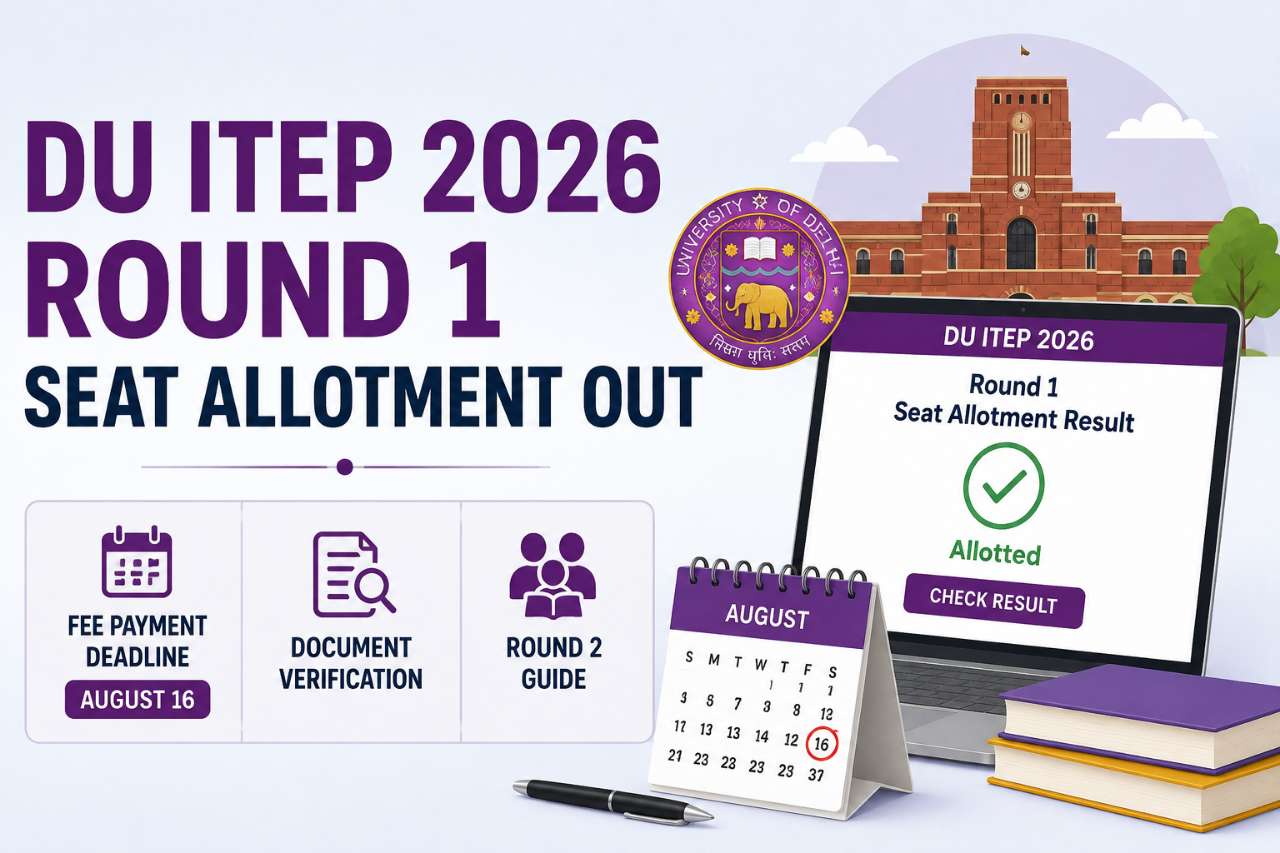

The University of Delhi (DU) has released the ITEP 2026 Round 1 seat allotment on the official portal itep.uod.ac.in. If you appeared in the National Common Entrance Test (NCET) 2026 and applied for the Integrated Teacher Education Programme, this is the most critical stage of your admission journey. Round 1 typically fills the majority of seats at sought-after DU colleges, and missing even one deadline can cost you your allotment permanently for this round.
In this guide, CollegeDwar explains what the Round 1 result means, how to check your allotted college and subject combination, the document verification window, and the fee payment deadline of August 16, 2026. Whether you received your first preference or an unexpected combination, the steps below will help you secure your seat before Round 2 opens on August 18, 2026.
What Is DU ITEP and Why Does Round 1 Matter?
The Integrated Teacher Education Programme (ITEP) is a four-year dual-degree course introduced under the National Education Policy (NEP) 2020. Instead of pursuing a three-year bachelor's degree followed by a separate two-year B.Ed, students complete both qualifications in a single integrated pathway. Graduates are prepared to teach at foundational, preparatory, middle, or secondary school stages depending on their subject specialisation and the stream they choose during admission.
Delhi University offers ITEP through several constituent colleges across arts, science, and commerce streams. Admission is entirely based on NCET 2026 scores conducted by the National Testing Agency (NTA) not through CUET UG 2026. This distinction is important: CUET applicants who did not register for NCET cannot participate in ITEP counselling, even if they hold strong CUET percentiles in relevant subjects.
Why Round 1 Is the Most Important Allotment Round
Round 1 generally absorbs the largest share of ITEP seats at top DU colleges. Candidates who accept their allotment and pay fees on time exit the counselling pool with a confirmed seat. Those who miss the August 16, 2026 payment deadline lose their Round 1 seat entirely and must rely on Round 2, where fewer colleges and subject combinations remain available.
Think of Round 1 as your best opportunity to lock in a preferred college-subject pair. Waiting for Round 2 in hope of an upgrade without first securing a Round 1 seat is risky unless you have explicitly declined the allotment within the portal rules published by DU.
Who Should Read This Guide?
This article is written for NCET 2026 qualifiers who registered for DU ITEP, parents helping with fee arrangements and document uploads, and school counsellors advising students on teacher education pathways under NEP 2020. If you are exploring other Delhi-based professional programmes simultaneously — such as medical courses at institutions like the All India Institute of Medical Sciences Delhi (AIIMS Delhi) — remember that each admission track has its own portal, timeline, and eligibility rules. Mixing up deadlines across programmes is one of the most common reasons students lose confirmed seats.
DU ITEP 2026 Round 1: Important Dates at a Glance
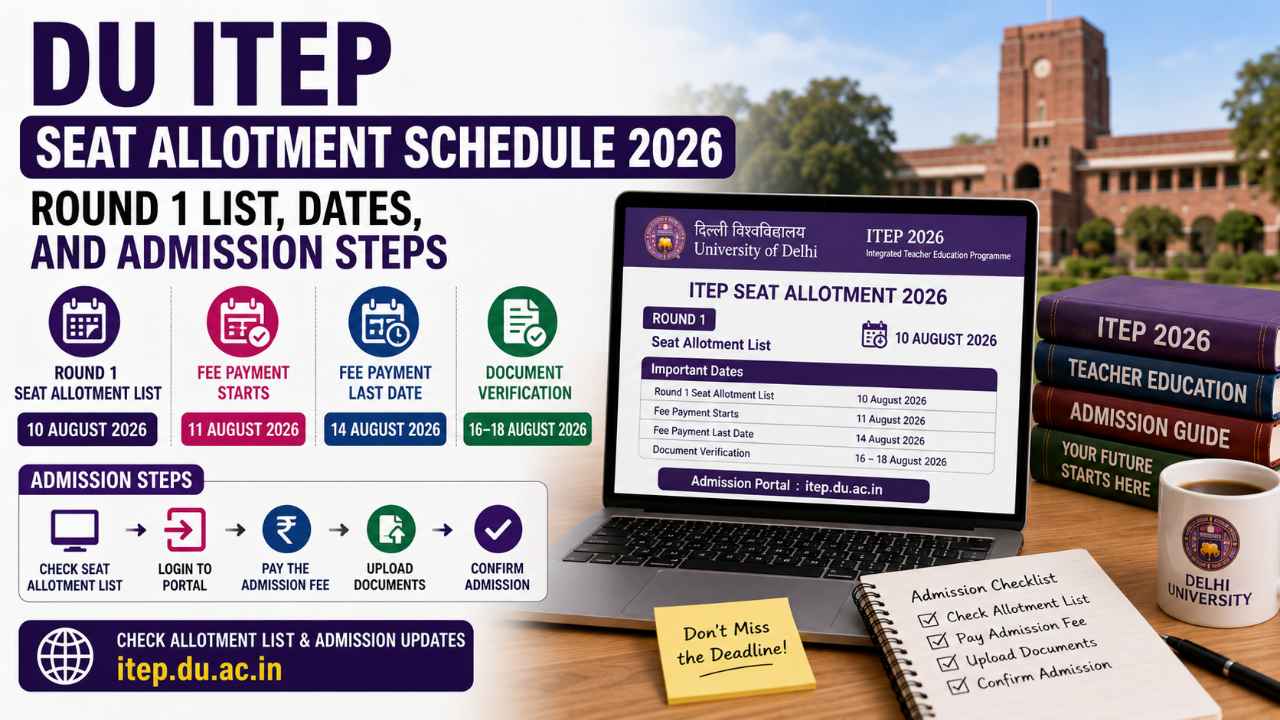
Staying ahead of deadlines is non-negotiable during DU admissions. Below is the official timeline for Round 1 as published alongside the allotment result. Cross-check these dates on itep.uod.ac.in and admission.uod.ac.in before taking any action, as extensions are rare once a round closes.
| Event | Date |
|---|---|
| Round 1 Seat Allotment Released | August 10, 2026 |
| College Document Verification Window | August 10 to August 14, 2026 |
| Seat Acceptance by Candidates | August 12, 2026 |
| Minimum Allocation Scores Published | August 12, 2026 |
| Round 1 Fee Payment Deadline | August 16, 2026 |
| Round 2 Seat Allotment | August 18, 2026 |
The gap between seat acceptance (August 12) and fee payment (August 16) is narrow. Use this window to complete document verification with your allotted college and arrange funds for the full admission fee. Payment options typically include net banking, debit card, credit card, and UPI through the online portal. Set calendar reminders for each milestone so that a single missed step does not block the next stage.
How to Check DU ITEP 2026 Round 1 Seat Allotment
Your allotment status is available only on the official ITEP portal using your NCET login credentials. Do not rely on third-party websites or social media screenshots — always verify results directly on the official portal.
- Visit itep.uod.ac.in.
- Click on the Round 1 seat allotment login link on the homepage.
- Enter your NCET 2026 application number and password.
- View your allotted college name and subject combination on screen.
- Download and save the allotment letter as a PDF for your records.
- Proceed to accept the allotted seat if you wish to continue in Round 1.
What Information Appears on the Allotment Screen?
Typically, the portal displays your NCET rank or score, allotted DU college, ITEP stream (arts, science, or commerce combination), category under which the seat was allocated, and instructions for the next steps. If the screen shows "Not Allotted," you will automatically be considered for Round 2 without any separate registration, provided your NCET candidature remains valid and you meet stream-wise eligibility.
Understanding Minimum Allocation Scores
DU published the minimum allocation scores for Round 1 on August 12, 2026. These cut-off figures indicate the lowest NCET score at which a particular college-subject combination was allotted in Round 1. Reviewing these scores helps you assess whether your allotment aligns with your performance and what to expect in Round 2 if you choose to participate further.
For example, if your score is well above the published minimum for your allotted combination, you may have a realistic chance of an upgrade in a later round — but only if official upgrade rules permit seat retention. Conversely, if your score is close to the cut-off, accepting and paying in Round 1 is usually the prudent choice because competition for remaining seats intensifies in Round 2.
Seat Acceptance, Document Verification, and Fee Payment
Receiving an allotment does not equal confirmed admission. You must complete three linked steps: accept the seat, pass document verification, and pay the admission fee before the deadline. Skipping any one step breaks the chain and can lead to automatic cancellation.
Step 1: Accept the Allotted Seat
Log in to the ITEP portal and formally accept your Round 1 allotment. Seat acceptance is a mandatory online action. Without it, the college cannot initiate verification and the fee payment window will not open for you. Treat acceptance as your written confirmation that you intend to join the allotted college for the 2026 session.
Step 2: Document Verification by the Allotted College
After acceptance, your allotted college verifies uploaded documents during the window of August 10 to August 14, 2026. Ensure all scans are clear, correctly named, and match the details on your NCET application form. Discrepancies in name spelling, date of birth, or category certificates can delay verification and block fee payment.
Documents to keep ready:
- NCET 2026 scorecard and application form
- Class 10 and Class 12 mark sheets with passing certificates
- Category certificate (SC, ST, OBC-NCL, or EWS) if applicable
- PwBD certificate, wherever applicable
- Transfer certificate from the last institution attended
- Recent passport-size photograph and signature scan
- Valid photo identity proof such as Aadhaar
Important: Candidates without a valid category certificate at the time of verification are treated as General category. Upload authentic documents only — misrepresentation can lead to cancellation at any stage, including after admission.
Step 3: Pay the Full Admission Fee
Fee payment opens only after successful online document verification by the college. Pay the complete admission fee through the portal using net banking, debit card, credit card, or UPI. Partial payments are generally not accepted for seat confirmation. Save the payment receipt and provisional admission slip immediately after transaction. If a payment fails, note the transaction reference number and retry without waiting until the last hour on August 16.
Eligibility Criteria for DU ITEP 2026
Before proceeding with Round 1 formalities, confirm that you meet the programme eligibility as defined in the official ITEP 2026 Bulletin of Information:
- You must have appeared in and qualified NCET 2026.
- You must have passed Class 12 from a recognised board.
- Your NCET subject combination determines which ITEP streams you can seek.
- Reserved category candidates receive standard relaxations as per DU norms.
Specific eligibility may vary slightly by ITEP stream and college. For example, science-stream combinations may require particular Class 12 subjects such as Physics, Chemistry, or Mathematics depending on the teaching specialisation. Always cross-reference your NCET application data with the bulletin before accepting a seat in a stream you did not originally opt for during registration.
Category Certificate and Reservation Rules
Reserved category benefits apply only when valid certificates are uploaded and verified within the Round 1 window. OBC-NCL certificates must meet the current income and non-creamy layer criteria. EWS certificates must follow the format prescribed by the Government of India. If your certificate is under renewal or contains outdated formatting, resolve the issue immediately — waiting until Round 2 rarely compensates for verification failure in Round 1.
NCET vs CUET UG: What Teacher Education Aspirants Must Know
A common source of confusion among Delhi aspirants is the difference between NCET and CUET UG. Both are national-level entrance tests conducted by NTA, but they serve different admission pathways:
| Aspect | NCET 2026 | CUET UG 2026 |
|---|---|---|
| Conducting body | NTA | NTA |
| Purpose | ITEP and integrated teacher education admissions | UG admissions to central and participating universities |
| DU ITEP link | Required | Not applicable |
| Portal | itep.uod.ac.in | admission.uod.ac.in (CSAS) |
| Typical aspirant profile | Future school teachers under NEP 2020 | BA, BSc, BCom and other UG programmes |
If you prepared exclusively for CUET and skipped NCET registration, you cannot join DU ITEP in 2026 regardless of your CUET scores. Teacher education under NEP 2020 has its own dedicated entrance pathway, separate from general undergraduate admissions. Planning ahead for NCET in the year you intend to join ITEP is therefore essential for serious teacher education aspirants.
About the Integrated Teacher Education Programme at Delhi University
ITEP represents a structural shift in how India trains school teachers. Under the earlier system, students completed a bachelor's degree and then enrolled in a two-year B.Ed — a five-year pathway in most cases. ITEP compresses this into four years while maintaining academic rigour across both components, aligning teacher preparation with the multidisciplinary vision of NEP 2020.
Subject Streams and Career Outcomes
DU offers ITEP through multiple constituent colleges. Common specialisations include arts, science, and commerce combinations mapped to school teaching stages defined under NEP 2020. After graduation, you can pursue teaching roles in government and private schools, subject to state-level eligibility tests such as CTET or TET where applicable. Some graduates also explore education administration, curriculum design, and NGO-led learning programmes.
Delhi remains one of India's strongest education hubs, home to premier institutions across disciplines. While ITEP prepares future educators, the capital also hosts world-class centres for other fields — medical aspirants often target AIIMS Delhi, consistently ranked among the country's top medical colleges, just as teacher education candidates focus on securing the best DU college through NCET-based allotment. Understanding these parallel admission tracks helps families plan holistically when multiple members pursue higher education in the same city.
Why Choose ITEP Over a Traditional Degree Plus B.Ed Path?
The integrated model reduces total years of study, keeps pedagogy training aligned with subject knowledge from the first year, and reflects the teacher shortages NEP 2020 aims to address. For students certain about a teaching career early in Class 12, ITEP offers a focused route rather than navigating separate UG and B.Ed admission cycles in different years.
What Happens If You Miss the Round 1 Fee Payment Deadline?
If you do not pay the admission fee by August 16, 2026, your Round 1 allotted seat is automatically cancelled. There is no grace period or offline exception communicated in the standard ITEP admission process. You lose the current allotment completely and the seat returns to the vacant pool for subsequent rounds.
However, cancellation in Round 1 does not permanently end your admission chances. You can still participate in Round 2 seat allotment on August 18, 2026, subject to seat availability and your NCET rank. Keep in mind that Round 2 operates with a reduced seat pool, meaning fewer college and subject choices and potentially higher effective cut-offs for remaining combinations.
Should You Hold Out for Round 2 Instead of Accepting Round 1?
This decision depends on your NCET rank relative to published minimum allocation scores and your appetite for risk. If Round 1 gave you a reasonable college-subject match, securing it is usually the safer strategy. Candidates hoping for upgrades should read the official rules on seat retention and upgrade options on admission.uod.ac.in before declining any allotment. Declining without understanding upgrade mechanics has cost many students both their current seat and a better alternative.
Action Plan: Secure Your DU ITEP Seat Before August 16
Use this checklist to avoid last-minute errors during the final days of Round 1:
- Log in to itep.uod.ac.in and verify your Round 1 allotment status.
- Accept the allotted seat within the portal deadline (by August 12, 2026).
- Upload all required documents in the prescribed format for college verification.
- Track verification status daily until the college approves your documents.
- Arrange the full admission fee in your bank account before the payment window opens.
- Complete online fee payment before August 16, 2026.
- Download and store the fee receipt and provisional admission slip.
- Note the Round 2 date (August 18, 2026) if you plan to seek an upgrade.
Practical Tips to Avoid Common Mistakes
- Check email and SMS regularly: Colleges may send verification queries through registered contact details.
- Use a stable internet connection for payment: Failed transactions near the deadline can cause panic; retry immediately and keep transaction reference numbers.
- Match names across documents: Ensure your NCET application name matches Class 10 and Class 12 certificates exactly.
- Do not share login credentials: Complete all portal actions yourself to prevent unauthorised seat changes.
- Contact the allotted college helpline: If verification is pending on August 14, reach out with your application number for status updates.
- Keep scanned backups offline: Store document PDFs on your device so re-uploads are quick if the portal rejects a file for size or clarity.
What to Expect in ITEP 2026 Round 2
Round 2 seat allotment is scheduled for August 18, 2026, shortly after the Round 1 fee payment window closes. This round accommodates candidates who were not allotted in Round 1, those whose Round 1 seats were cancelled due to non-payment, and potentially candidates seeking upgrades depending on official rules.
Vacant seats from Round 1 — arising from non-acceptance, failed verification, or non-payment — are reintroduced into the Round 2 pool. Monitor both itep.uod.ac.in and admission.uod.ac.in for vacancy notices and upgrade guidelines. Round 2 will follow a similar workflow: login, check allotment, accept seat, verify documents, and pay fees within the announced deadline.
How to Prepare for Round 2 While Completing Round 1
If you received a Round 1 allotment you are satisfied with, prioritise fee payment and ignore Round 2 speculation. If you were not allotted, begin organising documents now so verification in Round 2 is immediate. If you received a lower preference, compare your NCET score against published minimum allocation scores for higher-preference combinations — this data-driven approach beats guessing whether a better seat might open up.
Conclusion
The DU ITEP 2026 Round 1 seat allotment marks a decisive milestone for thousands of NCET-qualified candidates aiming to build a teaching career through Delhi University's integrated four-year programme. With the allotment already released on August 10, 2026, the focus now shifts entirely to seat acceptance, document verification, and fee payment by August 16, 2026.
Round 1 offers the best chance to secure a preferred college and subject combination. Treat every deadline as final, keep documents organised, and complete payment only after verification clears. Candidates who miss this window can still appear in Round 2 on August 18, 2026, but with fewer options. Stay updated through official DU portals, save every receipt, and approach the process methodically — your confirmed ITEP seat is worth the careful attention this week demands.