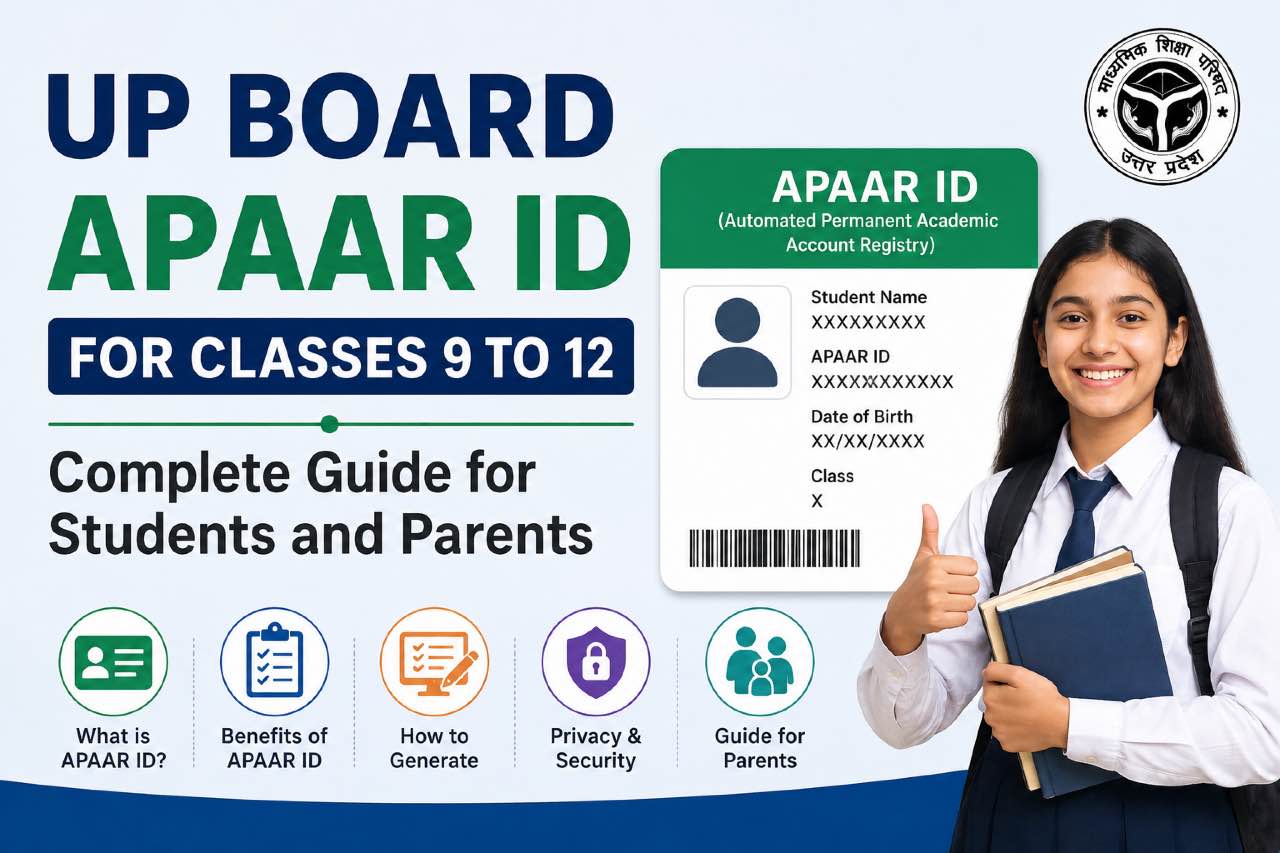

If your child studies in a UP Board school in Classes 9 to 12, you may have received a notice from the school asking you to create an APAAR ID (Automated Permanent Academic Account Registry). This is not a routine formality—it is part of a national push under the National Education Policy (NEP) 2020 to give every student a permanent digital identity that stays with them from school through college and beyond.
In August 2026, the Uttar Pradesh Board of Secondary Education formally requested that students in Classes 9 to 12 submit their APAAR ID details during advance registration and examination application processes. Schools have been directed to work toward 100% coverage before registration deadlines close. Parents across Lucknow, Kanpur, Varanasi, Agra, Meerut, and other districts are now searching for clear, step-by-step guidance—and this article provides exactly that.
What Is APAAR ID and Why Does UP Board Want It Now?
APAAR ID is a 12-digit permanent digital identity assigned to each student under the government's One Nation, One Student ID framework. It is linked to the Academic Bank of Credits (ABC) and DigiLocker, allowing students to store marksheets, transfer certificates, skill certificates, and other academic records in one secure digital vault.
Think of APAAR ID as an Aadhaar for your academic life. Just as Aadhaar gives you a unique identity for government services, APAAR ID gives you a unique identity for education—from Class 1 enrolment to PhD completion. When you apply for college admission, scholarships, or government schemes later, institutions can verify your records digitally instead of asking for photocopies of every certificate.
The UP Board Context: Registration vs Examination Forms
According to officials, the UP Board is currently handling two parallel processes:
- Classes 9 and 11: Advance registration for the upcoming academic session
- Classes 10 and 12: Examination application form filling for board exams
During both processes, schools are encouraged to collect and enter APAAR ID details for every enrolled student. Parth Sarathi Sen Sharma, Additional Chief Secretary, Secondary Education, has highlighted that this pre-registration phase is the ideal window to complete APAAR ID creation before records are locked for the academic year.
Is APAAR ID Mandatory for UP Board Registration?
This is the question most parents ask first—and the answer is clear.
No, APAAR ID is not mandatory for completing UP Board registration or examination application forms. Board Secretary Bhagwati Singh has confirmed that students can submit their forms without an APAAR ID and will not be penalised or denied registration on that basis alone.
However, the Board has strongly recommended that schools, teachers, and parents create APAAR IDs for all students. Singh stated that although the ID is optional at this stage, it is in the best interests of students to secure their digital educational future. School principals have been asked to ensure APAAR IDs are entered before advance registration deadlines and to guide parents through the creation process.
In practical terms: your child's board registration will proceed without APAAR ID, but missing it now may create friction later when applying for scholarships, college admissions, or document verification during higher education.
Key Benefits of APAAR ID for UP Board Students
Creating an APAAR ID today can save significant time and stress when your child moves from school to college. Here are the main advantages:
- Digital certificate storage: Mark sheets, transfer certificates, and skill certificates can be stored securely on DigiLocker and accessed anytime.
- Reduced document loss risk: Physical certificates can be damaged, misplaced, or delayed during verification. Digital records eliminate this problem.
- Scholarship and scheme access: Many state and central scholarships require verified academic records. APAAR-linked DigiLocker accounts simplify this process.
- Seamless college admissions: When your child applies to institutions—whether a local college in Uttar Pradesh or a premier institute elsewhere—verified digital records speed up admission.
- Credit transfer under NEP 2020: The Academic Bank of Credits allows students to accumulate and transfer credits across institutions. APAAR ID is the backbone of this system.
- Lifetime academic tracking: From Class 9 board registration to a professional degree, one ID tracks the entire journey.
How APAAR ID Connects to Higher Education and Careers
For students planning higher studies after Class 12, APAAR ID is increasingly relevant. Whether your child aims for engineering at Graphic Era University Engineering, management at Galgotias Business School, or law at National Law School of India University Bangalore, admission offices are moving toward digital document verification.
Students from UP who relocate for higher education—to Delhi for programmes at Fore School Of Management Delhi or Delhi School Of Management, or to Chennai for courses at Madras School Of Economics Chennai—will find that having pre-verified digital records reduces last-minute document rush during counselling.
Who Needs to Create APAAR ID in Uttar Pradesh?
The current UP Board directive specifically targets:
- All students in Class 9 (advance registration)
- All students in Class 10 (examination application)
- All students in Class 11 (advance registration)
- All students in Class 12 (examination application)
While the national APAAR framework covers all school-going children, UP Board's immediate focus is on secondary and senior secondary students because they are actively filling registration and exam forms right now.
Role of Schools, Teachers, and Parents
The UP Board has assigned shared responsibility across three stakeholders:
School principals must track APAAR ID coverage class-wise, enter IDs in registration portals before deadlines, and organise help desks or awareness sessions for parents.
Teachers should remind students during class, share official circulars on WhatsApp groups where permitted, and assist parents who face technical difficulties.
Parents must initiate APAAR ID creation using the student's Aadhaar-linked mobile number, provide consent during the process, and share the 12-digit ID with the school for entry in board forms.
Documents Required for APAAR ID Creation
Before you begin, keep these ready:
- Student's Aadhaar number (mandatory for identity verification)
- Aadhaar-linked mobile number (for OTP verification)
- Parent or guardian Aadhaar (required for consent authentication)
- School UDISE+ code (your school will provide this; it links the student to the correct institution)
- Recent passport-size photograph (digital upload may be required on some portals)
- Student's date of birth proof (as per school records, usually already linked to Aadhaar)
If the student's mobile number is not linked to Aadhaar, visit the nearest Aadhaar enrolment centre first. Without OTP verification, APAAR ID creation cannot proceed.
Step-by-Step: How to Create APAAR ID for UP Board Students
Follow this process carefully. The entire procedure typically takes 15 to 30 minutes if documents are ready.
Step 1: Access the APAAR Portal or DigiLocker
APAAR ID creation is integrated with the DigiLocker ecosystem and the ABC (Academic Bank of Credits) portal. Your school may share a direct link, or you can visit the official APAAR registration page through the Ministry of Education's portal. Avoid third-party websites or apps that claim to create APAAR IDs for a fee—the service is free.
Step 2: Select Student Registration
On the portal, choose the option to register as a student. Enter the student's Aadhaar number and verify using the OTP sent to the Aadhaar-linked mobile number.
Step 3: Provide Parental Consent
Since APAAR ID involves minors (Classes 9 to 12 students are typically under 18), parental consent is mandatory. The parent or guardian must authenticate using their own Aadhaar-linked mobile number and OTP. This step ensures data privacy compliance under applicable regulations.
Step 4: Enter School Details
Input the school's UDISE+ code, board name (UP Board of Secondary Education), current class, and academic session. Cross-check these details with your child's school ID card or admission receipt to avoid errors.
Step 5: Review and Submit
Verify all entered information—name spelling must match Aadhaar and school records exactly. Submit the form and wait for confirmation. You will receive a 12-digit APAAR ID upon successful registration.
Step 6: Share APAAR ID with School
Write down or screenshot the APAAR ID and share it with your child's class teacher or school office immediately. The school will enter this ID in the UP Board advance registration or examination application portal before the deadline.
Step 7: Link DigiLocker Account
After APAAR ID generation, link or create a DigiLocker account for the student. This enables automatic storage of future marksheets and certificates issued by UP Board and other educational bodies.
Common Mistakes to Avoid During APAAR ID Registration
Based on patterns seen across states implementing APAAR, parents should watch out for these errors:
- Name mismatch: If the name on Aadhaar differs from school records (e.g., missing middle name), resolve it before APAAR registration.
- Wrong UDISE code: Entering an incorrect school code links the student to the wrong institution. Always confirm with the school office.
- Using parent's mobile without Aadhaar link: OTP must go to the student's Aadhaar-linked number for student verification, and parent's number for consent.
- Delaying until deadline day: Portal traffic spikes near registration deadlines, causing timeouts. Complete APAAR ID creation at least one week before the school's internal deadline.
- Ignoring school communication: Some schools send specific instructions or batch-wise schedules. Read school notices carefully.
- Paying unauthorised agents: APAAR ID creation is free. Do not pay anyone claiming to expedite the process.
APAAR ID vs Other Student IDs: Quick Comparison
Parents often confuse APAAR ID with other identifiers. This table clarifies the difference:
| Identifier | Purpose | Issued By | Mandatory for UP Board? |
|---|---|---|---|
| APAAR ID | Permanent academic digital identity; stores certificates and credits | Ministry of Education via ABC/DigiLocker | No (recommended) |
| Aadhaar | General identity and address proof | UIDAI | Often required for school admission |
| UP Board Registration Number | Board exam enrolment for current session | UP Board | Yes |
| UDISE+ Student ID | School-level enrolment tracking | Department of School Education | Assigned by school |
| ABC Account ID | Credit deposit and transfer under NEP | Academic Bank of Credits | Linked via APAAR ID |
Timeline: What UP Board Students Should Do Now
Given that advance registration and exam form deadlines are active, here is a practical timeline for parents:
- Week 1: Gather Aadhaar documents, confirm UDISE code with school, check mobile-Aadhaar linkage.
- Week 2: Create APAAR ID online and note the 12-digit number.
- Week 3: Submit APAAR ID to school; verify entry in registration or exam portal.
- Before deadline: Follow up with school if ID is not yet entered; confirm receipt in writing or via school app.
- After board results: Ensure Class 10 and 12 marksheets are uploaded to DigiLocker via APAAR-linked account.
Impact on Scholarships, Schemes, and Future Admissions
Several government programmes increasingly prefer or require digitally verified academic records:
- Central Sector Scheme of Scholarships for college and university students
- UP state scholarships for SC, ST, OBC, and minority students
- PM Yasasvi scheme and other NEP-aligned financial aid programmes
- AICTE and UGC-linked fellowship applications
- Study abroad document verification through DigiLocker
Students who plan vocational paths—such as nursing programmes at institutions like Mahatma Gandhi General Nursing School Sikar or Satya Sai School Of Nursing Sikar—also benefit from having verified Class 10 and 12 marksheets available digitally during counselling.
For students eyeing professional courses in architecture at School Of Planning Architecture Bhopal, design at International School Of Design Jaipur, or engineering at Indian Institute Of Technology Indian School Of Mines Dhanbad, early APAAR ID creation ensures your academic portfolio is ready when entrance exam results are declared.
What Schools Must Do to Achieve 100% APAAR Coverage
The UP Board's directive asks schools to target complete coverage before registration deadlines. Responsible schools are typically:
- Sending written notices and SMS reminders to parents
- Organising APAAR ID help camps on campus with computer and internet access
- Maintaining class-wise trackers showing which students have submitted IDs
- Assigning one nodal teacher per section to follow up with pending cases
- Escalating cases where Aadhaar issues block registration to district education offices
Parents should proactively ask their school about the internal deadline—it may be earlier than the UP Board's final cutoff to allow data entry and error correction.
Privacy, Security, and Data Safety Concerns
Some parents worry about sharing their child's Aadhaar-linked data. Here is what you should know:
APAAR ID operates under the Ministry of Education's digital infrastructure with DigiLocker, which uses secure authentication protocols. Parental consent is explicitly required for minors. The system stores academic records—not financial or health data. You control DigiLocker sharing permissions when a college or employer requests document access.
If you notice unauthorised access or incorrect data linked to your child's APAAR ID, contact your school first, then raise a ticket through the official APAAR or DigiLocker helpdesk. Do not share APAAR ID or Aadhaar details on unofficial Telegram groups or social media pages.
APAAR ID and the Broader NEP 2020 Vision
The One Nation, One Student ID initiative is one pillar of NEP 2020's digital transformation agenda. Other connected reforms include:
- Academic Bank of Credits (ABC): Students can earn credits from multiple institutions and combine them toward a degree.
- National Credit Framework (NCrF): Standardises credit recognition across general, vocational, and professional education.
- DigiLocker for education: Board certificates, degree certificates, and skill badges in one place.
- Multiple entry and exit: Students can pause and resume degrees without losing earned credits—tracked via APAAR ID.
UP Board's push for Classes 9 to 12 aligns Uttar Pradesh with states already reporting high APAAR adoption. Early compliance gives UP students parity when competing for seats at national institutions—from Thiagarajar School Of Management Chennai to Teri School Of Advanced Studies New Delhi.
What Happens If You Do Not Create APAAR ID?
Since APAAR ID is not mandatory for current UP Board registration, there is no immediate penalty. Your child can appear for board exams and receive results normally. However, the following challenges may arise later:
- Manual submission of physical marksheets during every college application
- Delays in scholarship verification due to lack of digital records
- Difficulty transferring credits if the student switches institutions under NEP provisions
- Additional steps if APAAR ID becomes mandatory for higher education admissions in future cycles
Given that the process is free and takes under 30 minutes, education experts recommend completing it now rather than waiting for a future mandate.
Conclusion
The UP Board's request for APAAR ID creation among Classes 9 to 12 students marks an important step toward digitising academic records in India's most populous state. While the ID is not mandatory for registration or exam forms today, the Board, school principals, and education officials have made their recommendation clear: create APAAR IDs now to secure your child's digital educational future.
Parents should treat this as a one-time setup task with long-term benefits. Gather Aadhaar documents, create the APAAR ID through the official portal with parental consent, and share the 12-digit number with your child's school before the advance registration deadline. Schools, in turn, must guide families and aim for 100% coverage as directed.
Whether your child eventually pursues management, law, engineering, nursing, or any other path after Class 12, having a verified digital academic identity through APAAR ID and DigiLocker will make admissions, scholarships, and document verification significantly smoother. Start today—do not wait for the deadline rush.