In August 2026, the indian institute of Science Education and Research (IISER) Pune campus became the focus of national attention after a tragic incident involving a girl student found outside a hostel building. More than 10 days later, the institute issued a formal statement outlining counselling support, staffing changes at its Mental Wellbeing Centre, and cooperation with an ongoing police investigation. For students preparing for IISER admissions, parents evaluating residential science colleges, and educators tracking campus safety in India, the episode raises urgent questions about mental health infrastructure, institutional response timelines, and what meaningful student support looks like after a crisis.
This guide explains what IISER Pune has publicly shared, how its response compares with practices at peer institutes, and what actionable steps students and families can take when academic pressure, hostel life, and research expectations intersect. The information below is based on publicly reported facts and general higher-education guidance; it is not a substitute for official institute communications or professional mental health care.
What Happened at IISER Pune: Timeline and Official Response
According to an official statement reported on August 27, 2026, a girl student at IISER Pune was discovered lying outside a hostel building on the campus on August 16, 2026, at around 9:45 pm. Campus authorities arranged an ambulance and rushed her to hospital, but she could not be saved.
The institute said it informed the student's parents and local police at the same time and pledged full cooperation with the investigation. A condolence gathering was held on August 17, attended by students, faculty, and staff. Classes were cancelled for the day following the incident.
Key facts at a glance
- Date of incident: August 16, 2026 (approximately 9:45 pm)
- Location: Outside a hostel building on IISER Pune campus
- Immediate action: Ambulance transfer to hospital; parents and police notified
- Campus response: Condolence meeting on August 17; counselling drive announced in late August
- Investigation status: Police probe reported as underway at the time of the statement
Residential campuses like IISER Pune combine intense academic schedules with long hours in laboratories, limited family contact, and peer competition among high-achieving science students. When a serious incident occurs, families understandably expect rapid transparency. The gap of more than 10 days between the incident and the detailed public statement about counselling has been widely discussed in education circles, highlighting a broader challenge: institutions must balance investigation protocols, privacy concerns, and community grief while still communicating clearly with students who remain on campus.
IISER Pune's Counselling Drive: What It Includes
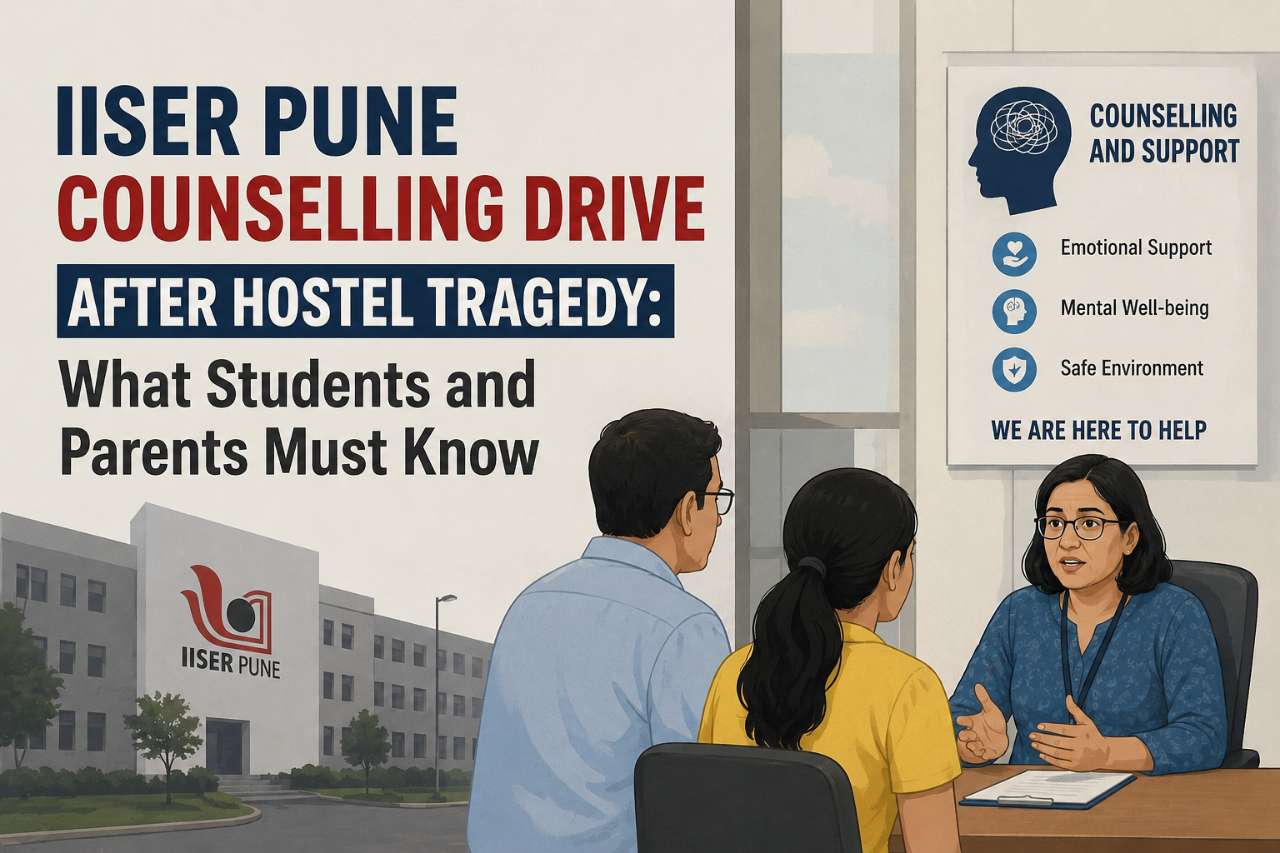
In its statement, IISER Pune said its Mental Wellbeing Centre arranged immediate one-on-one and group counselling sessions across campus. Guided group sessions led by a specialised counsellor were organised for students, staff, and faculty members. The institute also noted that counselling support was being extended to the deceased student's friends, classmates, and other affected members of the campus community.
Staffing expansion at the Mental Wellbeing Centre
Before the incident, IISER Pune reportedly had two full-time counsellors. Following the tragedy, the institute:
- Hired two additional counsellors to provide immediate support
- Announced plans to hire one to two more full-time counsellors
- Organised both individual and group counselling formats across campus
Expanding counsellor headcount is a concrete step, but students and parents should also ask how appointments are booked, whether after-hours crisis support exists, and whether hostel wardens and faculty are trained to refer distressed students without delay.
Academic accommodations under consideration
IISER Pune stated it is considering academic accommodations and flexible attendance policies for affected students. After traumatic events, rigid attendance rules and back-to-back exam schedules can worsen anxiety. Institutes that temporarily relax deadlines, offer remedial academic support, and allow phased return to laboratory work often see better long-term student recovery outcomes.
Why Campus Mental Health Matters at Research-Intensive Institutes
IISERs are among India's most selective science institutions. Admission typically flows through channels such as the IAT (IISER Aptitude Test), KVPY (where applicable historically), JEE Advanced ranks, and state/national board merit routes. Once enrolled, students enter a five-year integrated BS-MS programme or doctoral pathways where research output, publication pressure, and funding competition begin early.
Common stress triggers for IISER students
- Academic intensity: Core courses in mathematics, physics, chemistry, and biology with fast pacing
- Research expectations: Early lab exposure and project milestones
- Residential adjustment: First-time hostel life, food habits, and homesickness
- Social isolation: Small cohorts where peer comparison feels constant
- Career uncertainty: Pressure to pursue PhD, competitive exams, or industry transitions
Mental health support is not a substitute for structural reforms—reasonable course loads, anti-ragging enforcement, gender-safe hostel policies, and faculty sensitivity training all matter. Counselling centres work best when embedded in a campus culture that treats help-seeking as normal rather than stigmatising.
Understanding IISER Admission Pathways and Campus Life
Students who aim for IISER Pune typically prepare through the IISER Aptitude Test (IAT), which assesses aptitude in mathematics, physics, chemistry, and biology. High ranks in JEE Advanced and exceptional board exam performance can also open IISER seats through separate channels announced each admission cycle. Because every IISER follows a similar integrated BS-MS model, admitted students spend most of their undergraduate years living on campus, attending lectures, completing laboratory rotations, and eventually selecting research specialisations.
Campus life at IISER Pune includes hostel accommodation, dining facilities, sports and cultural clubs, and access to research laboratories from early semesters. This immersive environment builds scientific rigour but also means that personal challenges—relationship difficulties, family emergencies, financial stress, or academic setbacks—unfold inside a closed residential community. That is precisely why on-campus counselling infrastructure matters before a crisis, not after one.
What one-on-one counselling at a university typically covers
When IISER Pune's Mental Wellbeing Centre offers one-on-one sessions, students can usually discuss anxiety, depression symptoms, grief, academic burnout, sleep problems, and interpersonal conflict in a confidential setting. Counsellors may use short-term talk therapy, relaxation techniques, and referral to psychiatric services when medication evaluation is needed. Group sessions, meanwhile, help normalise shared experiences—exam stress, homesickness, or collective grief after a campus tragedy—so students realise they are not alone.
How IISER Pune Compares With Other IISER Campuses
India has seven IISER campuses, each with integrated science programmes and residential facilities. While IISER Pune's recent statement focused on post-incident counselling, families comparing institutes should review wellbeing infrastructure across locations.
| IISER Campus | What to verify before admission |
|---|---|
| IISER Pune | Counsellor count, hostel safety protocols, crisis helpline, warden training |
| IISER Mohali | Residential support systems, medical centre tie-ups, peer support groups |
| IISER Kolkata | Urban campus safety, transport, after-hours mental health access |
| IISER Bhopal | Hostel grievance redressal, anti-ragging committee activity |
| IISER Thiruvananthapuram | Counselling appointment wait times, faculty mentorship structures |
| IISER Berhampur | On-campus medical facilities, student wellness programmes |
| IISER Tirupati | Newer campus infrastructure, hostel warden accessibility |
No ranking table can capture day-to-day student experience. Before choosing an IISER, attend open days if available, speak with current students privately, and read institute handbooks on hostel rules, leave policies, and disciplinary procedures.
Pune as a Higher Education Hub: Context Beyond IISER
IISER Pune sits in a city that hosts dozens of universities and research centres. Students who do not secure IISER seats often explore other Pune institutions with strong science, engineering, and professional programmes.
Notable options in the region include Savitribai Phule Pune University, Symbiosis International Deemed University Pune, Indian Institute of Information Technology Pune, Defence Institute of Advanced Technology Girinagar Pune, Deccan College Postgraduate Research Institute Pune, Gokhale Institute of Politics and Economics Pune, Bharati Vidyapeeth Pune, and Dr DY Patil Vidyapeeth Pune.
Pune's education ecosystem offers alternatives, but residential research institutes share similar wellbeing challenges: high expectations, compact peer groups, and limited off-campus support networks for out-of-state students. Additional Pune institutions worth exploring include Film and Television Institute of India Pune, MIT Art Design and Technology University Pune, NICMAR University Pune, DES Pune University, Sri Balaji University Pune, Alard University Pune, D Y Patil University Pune Ambi, and Tilak Maharashtra Vidyapeeth Pune.
National Mental Health Resources for College Students in India
Beyond campus counselling, Indian students can access government-supported helplines that operate nationwide. Tele-MANAS, launched under the National Mental Health Programme, provides free tele-mental health assistance through dialling 14416 or 1-800-891-4416. The Kiran Mental Health Rehabilitation Helpline (1800-599-0019) offers 24/7 support in multiple languages. Students in immediate physical danger should call 112 for emergency services.
These national services complement institute-level support at places like Vinayaka Missions Research Foundation Salem, Ram Krishna Dharmarth Foundation RKDF University, IIS University Jaipur, and IIS Deemed to be University Jaipur. Every residential college should display these numbers prominently in hostel common rooms, laboratory notice boards, and student portals—not bury them in lengthy policy PDFs.
Police Investigation and Institutional Accountability
IISER Pune stated it is extending full support to the ongoing police investigation. Until official findings are released, speculation about circumstances helps neither the grieving family nor the student community. Responsible reporting and campus conversation should focus on verified facts and systemic improvements.
What accountability looks like in practice
- Transparent communication: Regular, factual updates without compromising investigation or privacy
- Independent review: Internal committees examining hostel safety, CCTV coverage, and emergency response times
- Student representation: Including elected student body members in wellbeing policy discussions
- External expertise: Partnering with NIMHANS or similar centres for trauma-informed campus training
- Policy publication: Making counselling access steps, helplines, and grievance routes publicly available year-round—not only after crises
Recent episodes at other premier institutes, including student protests following deaths at IIT Delhi and similar conversations at universities nationwide, show that students increasingly demand permanent structural change rather than temporary counselling drives alone.
What Aspiring IISER Students Should Know Before Admission
If you are preparing for IISER admission through IAT, JEE Advanced, or board merit routes, academic preparation is only one part of readiness. Residential science education requires emotional preparation as well.
Pre-admission checklist for students and parents
- Research the Mental Wellbeing Centre: Ask about counsellor-to-student ratio and appointment wait times
- Understand hostel rules: Curfew timings, visitor policies, and grievance mechanisms
- Plan support networks: Identify a faculty mentor, senior student contact, and family check-in schedule
- Learn crisis numbers: Save Tele-MANAS (14416 or 1-800-891-4416), Kiran (1800-599-0019), and local hospital contacts
- Discuss academic pressure openly: Set realistic expectations about grades, research, and comparison with peers
- Review exit and leave policies: Know how to take medical or mental health leave without penalty
Admission to IISER is a significant achievement. Sustaining wellbeing through five years of integrated study requires the same intentionality as mastering organic chemistry or quantum mechanics.
Broader Trends in Student Mental Health Across Indian Higher Education
The IISER Pune episode is not isolated. Across India, residential universities—from central institutes to state universities and private deemed universities—are revisiting counselling capacity, attendance flexibility, and student grievance systems.
Institutions such as ICFAI Foundation for Higher Education Hyderabad, Koneru Lakshmaiah Education Foundation Guntur, and Vignan's Foundation of Science Technology and Research Guntur operate in different academic segments, yet all enroll large numbers of students living away from home for the first time. The lesson applies universally: wellbeing infrastructure must be proactive, staffed adequately, and visible before emergencies occur.
Signs a student may need immediate support
- Withdrawal from friends, labs, or classes for more than a few days
- Sudden drops in academic performance or incomplete assignments
- Sleep disruption, unexplained illness, or persistent fatigue
- Expressing hopelessness, worthlessness, or thoughts of self-harm
- Increased substance use or risky behaviour
Friends and roommates are often the first to notice changes. Institutes should train students in basic referral skills—how to listen without judgment and how to escalate to counsellors or medical staff.
Role of Parents and Guardians in Residential College Life
Parents of IISER and similar institute students sometimes assume that admission to a premier campus guarantees smooth progression. In reality, the transition from school to residential research education is among the most vulnerable periods in a student's life.
Practical steps parents can take include scheduling regular video calls without making every conversation grade-focused, learning the name and contact route of the hostel warden, asking directly about mood and friendships, and responding calmly if a child mentions wanting counselling. Treating mental health support as routine healthcare removes stigma and encourages early intervention.
If a student reports unsafe hostel conditions, bullying, or inadequate medical response, document concerns in writing to institute grievance cells and follow up until acknowledged. Premier brand names do not automatically mean premier daily care.
Building a Long-Term Campus Wellbeing Framework
Reactive counselling drives after tragedies are necessary but insufficient. Institutes serious about student safety should publish annual wellbeing reports, fund peer-support programmes, conduct hostel safety audits before each academic year, and integrate mental health literacy into orientation week. Faculty advisers should receive training to recognise distress signals without becoming untrained therapists themselves.
Student bodies can play a constructive role by organising study-support groups, wellness walks, and anonymous feedback channels. When students at universities such as Hyderabad Central University or IIT Delhi have protested after deaths on campus, their demands frequently centre on permanent counsellor hiring, dean accountability, and attendance reforms—policy changes that benefit entire cohorts, not only those directly affected by a single incident.
Actionable tips for current IISER Pune students
- Save the Mental Wellbeing Centre contact details on your phone today
- Attend group counselling even if you feel "fine"—community healing matters
- Speak with your academic advisor if you need deadline extensions
- Check on hostel mates who have become unusually quiet or absent
- Use Tele-MANAS after hours if campus offices are closed
What IISER Pune's Response Signals for Future Applicants
The institute's late-August statement emphasised commitment to the safety and wellbeing of students and campus residents, along with additional measures initiated in that direction. Hiring counsellors and offering flexible attendance are positive steps. Long-term credibility will depend on whether these changes remain funded, staffed, and accessible when media attention fades.
For 2026 and 2027 aspirants, IISER Pune remains a top destination for integrated science education. The tragedy underscores that choosing a college should include evaluating how an institute supports students—not only what it teaches. Compare IISER Pune with IISER Mohali, IISER Kolkata, and other campuses on both academic and wellbeing parameters.
Conclusion
The death of a girl student outside an IISER Pune hostel on August 16, 2026, is a profound loss for her family, friends, and the wider campus community. The institute's subsequent counselling drive—featuring one-on-one and group sessions, expanded Mental Wellbeing Centre staffing, and consideration of academic accommodations—addresses immediate grief support but also opens a necessary conversation about permanent student safety systems at India's research universities.
For students eyeing IISER Pune, parents evaluating residential science colleges, and educators shaping campus policy, the takeaway is clear: world-class laboratories mean little without world-class care for the people who work in them. Verify counselling access before you enroll, know crisis helplines before you need them, and treat mental health with the same seriousness as entrance exam preparation. Meaningful change on Indian campuses will come when counselling is not an emergency add-on but a core, funded, year-round part of how institutes operate—at IISER Pune and every college that asks young people to live, study, and dream far from home.