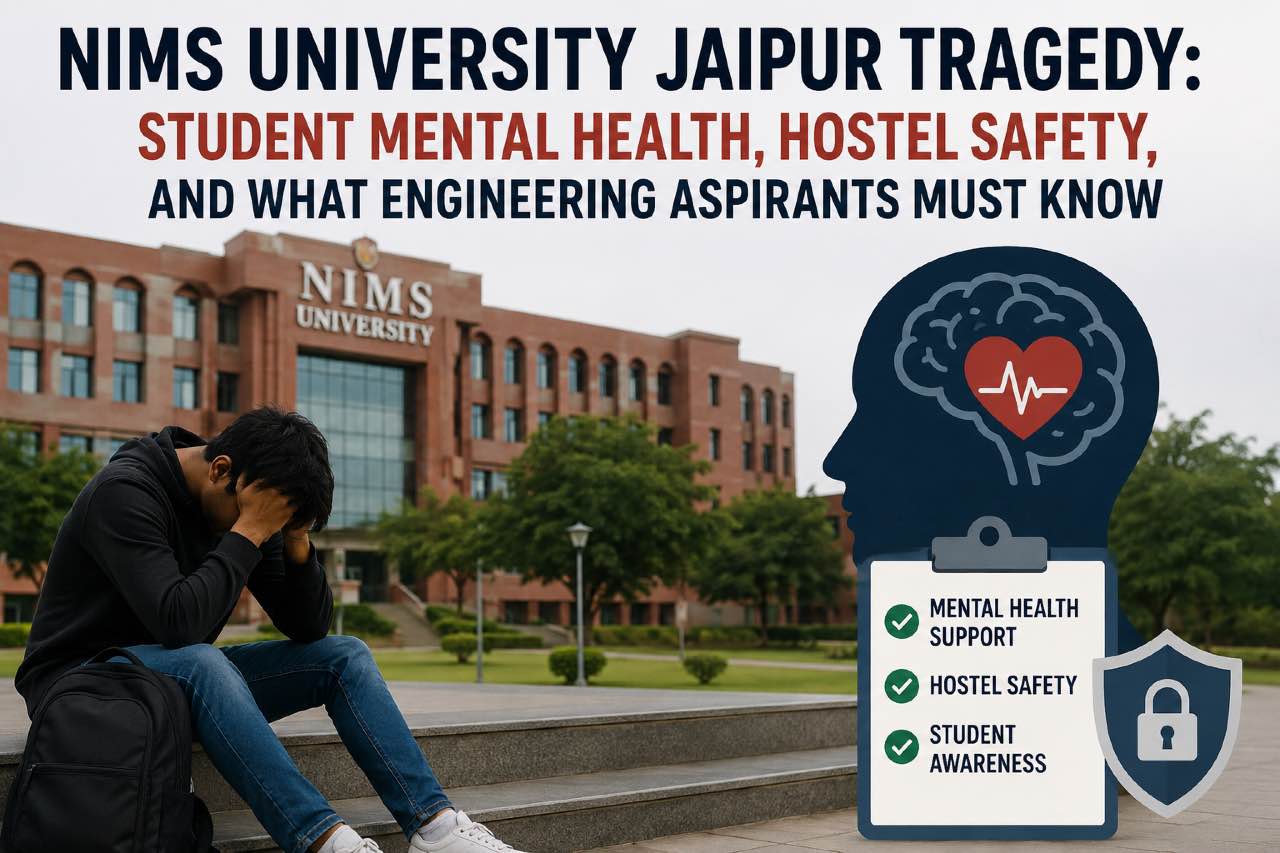
On August 26, 2026, news reports confirmed that a first-year BTech student at NIMS University Jaipur died in a hostel incident on the university campus. According to police statements cited in media reports, the student was identified as Aditya Tiwari from Lucknow, Uttar Pradesh. The incident has once again placed the spotlight on student mental health, hostel safety, and the pressures faced by young engineering aspirants who leave home for the first time to pursue technical education in Rajasthan and across India.
CollegeDwar covers this development not to sensationalise a tragedy, but to help students, parents, educators, and college administrators understand what such incidents reveal about campus life, how to recognise distress early, and where to find credible support. If you or someone you know is struggling, please reach out immediately to Tele-MANAS at 14416 or 1-800-891-4416, or contact your campus counsellor, warden, or a trusted adult.
What We Know About the NIMS University Jaipur Incident
According to a report published by Careers360 on August 26, 2026, police said that Aditya Tiwari, a first-year BTech student, died after falling from the 15th floor of a hostel building at NIMS University Rajasthan Jaipur. The information reached police around 8:30 pm on Tuesday, officials stated.
Key details reported so far include:
- The student was a first-year BTech student and a resident of Lucknow, Uttar Pradesh.
- He was staying at the university's Garnik hostel and shared a room with two other students.
- His roommates were not in the room at the time and had stepped outside the premises.
- Police noted that the student had not attended classes for two days before the incident.
- The body was sent for post-mortem examination, and investigation was underway at the time of reporting.
- Police recovered the student's mobile phone but could not examine it immediately as the device was locked.
At the time this article was prepared, authorities had not publicly confirmed a motive. Suicide investigations in India typically involve police inquiry, statements from peers and hostel staff, review of attendance and academic records, and examination of digital evidence where legally permitted. Until an official conclusion is released, readers should treat unverified social media claims with caution and rely on verified news and institutional statements.
Why Absence From Class Can Be an Important Signal
Two days of missed classes may seem minor in academic terms, but for a first-year student living in a hostel, sudden disengagement can sometimes coincide with emotional distress, illness, family crisis, bullying, or academic overwhelm. Hostel wardens, class coordinators, and faculty mentors are often the first adults who notice a pattern break. Responsible campuses treat unexplained absence not merely as an attendance issue, but as a possible wellbeing alert—especially during the first semester when homesickness and adjustment stress peak.
About NIMS University Jaipur and Engineering Education in the City
NIMS University Jaipur is among several private universities in Rajasthan's capital that offer BTech and allied professional programmes. Jaipur has emerged as a major education hub, attracting students from Uttar Pradesh, Bihar, Madhya Pradesh, Haryana, and northeastern states who seek engineering seats through entrance exams, direct admission, or management quota routes.
Students comparing institutions in the region often evaluate options such as Poornima University Jaipur, JECRC University Jaipur, Jaipur National University, and Suresh Gyan Vihar University Jaipur, alongside government and semi-government colleges elsewhere in Rajasthan like University of Rajasthan (UNIRAJ) and health-focused institutions such as Rajasthan University of Health Sciences (RUHS) Jaipur.
When choosing a BTech college, students and parents understandably focus on placements, fees, rankings, and infrastructure. Events like the one reported at NIMS University remind us that non-academic infrastructure—counselling access, hostel supervision, anti-ragging enforcement, grievance redressal, and emergency response—is equally critical to a safe learning environment.
What First-Year BTech Students Should Verify Before Joining
Before confirming admission, ask direct questions during campus visits or via official email:
- Is a licensed counsellor available on campus, and what are the appointment hours?
- How are hostel wardens trained to handle mental health concerns?
- What is the anti-ragging committee's contact number, and is it displayed in hostels?
- Is there a 24x7 medical or emergency desk for resident students?
- How does the college follow up when a student misses multiple classes?
- Are parents notified about serious wellbeing concerns while respecting student privacy laws?
These questions apply whether you are joining a Jaipur-based university or institutions in other education clusters such as University College of Engineering Kota, Career Point University Kota, Delhi Technological University (DTU), or Netaji Subhas University of Technology (NSUT) Delhi.
Student Mental Health and Engineering Pressure in India
Engineering remains one of the most sought-after career pathways in India. From JEE Main and JEE Advanced to state-level engineering entrance tests and private university exams, students spend years in coaching centres preparing for highly competitive admissions. Even after securing a seat, the pressure rarely disappears—it often changes shape.
First-year BTech students frequently report:
- Homesickness and loneliness, especially when moving from smaller towns to large campus hostels.
- Academic shock, when school-level toppers struggle with college-level mathematics, programming, or lab work.
- Financial stress, when families take education loans and expect rapid returns through placements.
- Social comparison, amplified by social media and peer groups in coaching-dominated cultures.
- Fear of failure, linked to backlogs, attendance shortages, and branch-change anxiety.
- Unresolved ragging or harassment, which can severely harm confidence and safety.
National conversations on student wellbeing have grown since high-profile cases in coaching hubs like Kota and on university campuses. The Government of India's Tele-MANAS programme, university counselling cells, and NGO helplines such as iCall (9152987821) and Vandrevala Foundation (9999666555) exist because distress among young adults is a documented public health concern—not an individual weakness.
Engineering Colleges With Strong Support Systems
Leading institutions increasingly publish mental health policies, peer-support programmes, and faculty mentor systems. While no campus is immune to tragedy, students researching alternatives may compare how different universities communicate wellbeing services. Private universities such as Lovely Professional University Engineering, Amity University Noida, Chitkara University Engineering, and Graphic Era University Engineering often highlight counsellor access in their student handbooks—prospective students should verify these claims through current students or alumni rather than marketing brochures alone.
Hostel Life: Opportunities, Risks, and Responsibilities
For thousands of Indian students, the hostel is their first experience of independent living. It can build resilience, friendships, and life skills. It can also become isolating when roommates are absent, schedules clash, or a student feels unable to share problems with family back home.
In the NIMS University case reported by Careers360, the student shared a room with two others who were outside the premises at the time of the incident. This detail underscores an often-overlooked reality: high-capacity hostels are not continuously supervised living spaces. Wardens, security staff, and resident assistants cannot monitor every room. That makes peer awareness, open communication, and rapid escalation pathways essential.
Common Hostel Challenges for First-Year Students
- Adjusting to food, language, and cultural differences in a new state.
- Irregular sleep cycles due to late-night study, gaming, or social activity.
- Limited private space to process emotional setbacks.
- Stigma around seeking counselling, especially among male students.
- Uncertainty about whom to contact during a night-time crisis.
What Responsible Hostel Management Looks Like
Colleges with mature hostel systems typically implement:
- Daily or weekly warden check-ins during the first month of admission.
- Clear night emergency numbers posted on every floor.
- Anti-ragging squads with anonymous complaint options.
- Referral ties with campus counsellors and nearby hospitals.
- Attendance-linked wellbeing alerts when students miss classes repeatedly.
- Orientation sessions that normalise help-seeking behaviour.
Jaipur is not the only city where these standards matter. Similar expectations apply at residential campuses linked to Galgotias University Greater Noida, BML Munjal University, Manav Rachna University Engineering, and University of Petroleum and Energy Studies Dehradun.
Warning Signs That a College Student May Need Immediate Help
Mental health struggles are not always visible. However, students, roommates, faculty, and parents can watch for patterns that suggest urgent support is needed:
- Sudden withdrawal from classes, labs, clubs, or friendships.
- Marked changes in sleep, appetite, hygiene, or energy levels.
- Expressing hopelessness, worthlessness, or being a burden to family.
- Increased substance use or reckless behaviour.
- Giving away personal belongings or saying goodbye-like messages.
- Sharp decline in academic performance after previously doing well.
- Repeated mentions of failure despite objective achievements.
- Visible distress after bullying, breakup, financial news, or exam results.
If you notice these signs in a hostel mate or classmate, do not promise to keep suicidal thoughts a secret. Stay with the person, remove immediate means of harm if safe to do so, and contact a counsellor, warden, Tele-MANAS (14416), or local emergency services. Early intervention saves lives.
How Faculty and Mentors Can Respond
Professors and lab instructors often see academic decline before hostel staff do. A simple, private conversation—"You have missed several sessions; are you facing any difficulty we can help with?"—can open the door to support. Faculty should know the official referral pathway on their campus and avoid dismissive responses such as "everyone feels stressed in engineering."
Legal and Regulatory Framework for Campus Safety in India
Indian higher education institutions operate under multiple obligations relevant to student welfare:
- UGC regulations on curbing the menace of ragging in higher educational institutions.
- Institutional anti-ragging committees with defined complaint and enquiry procedures.
- National Medical Commission / AICTE norms for medical and technical institutions regarding campus facilities and grievance mechanisms.
- Tele-MANAS and state mental health programmes that colleges can integrate into orientation.
- Police and magisterial inquiry in cases of unnatural death on campus premises.
After a serious incident, colleges should communicate factually with students and parents, avoid blame-oriented messaging, and cooperate fully with investigators. Transparency about support services—without compromising the privacy of the deceased student's family—is part of responsible institutional leadership.
What Parents Can Do Before and After Sending a Child to Hostel
Parents play a critical role in reducing the emotional distance that hostel life can create. Practical steps include:
- Discuss realistic expectations about BTech difficulty, backlogs, and career timelines.
- Save the warden, counsellor, and local guardian contact details before admission day ends.
- Schedule regular video calls, but also encourage campus friendships and activities.
- Watch for changes in tone, not just grades, during weekly conversations.
- Validate setbacks instead of comparing the child with relatives or neighbours.
- Know the college's leave and emergency visit policy for parents.
If a student mentions wanting to drop out or transfer, treat it as a serious conversation rather than a threat to family honour. Many students thrive after changing branch, college, or course track—with support from institutions like GGSIPU, Integral University Engineering, or Harcourt Butler Technical University.
Choosing a BTech College With Safety and Support in Mind
Rankings and package figures dominate admission season discourse, but a balanced college comparison should include wellbeing indicators. Use this checklist when shortlisting campuses:
| Factor | Questions to Ask | Why It Matters |
|---|---|---|
| Counselling | Is there a full-time counsellor? Average wait time? | Early support prevents crisis escalation |
| Hostel supervision | Warden-student ratio? Night emergency protocol? | Residential students need rapid help access |
| Anti-ragging | Is the UGC-mandated committee active and public? | Harassment drives dropout and distress |
| Attendance alerts | Does the college contact students or parents after repeated absence? | Missed classes can signal deeper issues |
| Medical tie-ups | Nearest hospital? Ambulance availability? | Physical and psychiatric emergencies need speed |
| Peer support | Are senior mentors or student wellness clubs active? | Peers often notice distress first |
Whether you are exploring DIT University Engineering, GLA University Engineering, IES University, or government medical pathways through University College of Medical Sciences (UCMS) Delhi, the principle remains the same: academic quality and emotional safety should be evaluated together.
Peer Support: What Roommates and Classmates Can Do
In multi-storey hostels like the Garnik hostel mentioned in news reports, roommates and floor mates are often closer to a student's daily emotional state than faculty or family hundreds of kilometres away. Small, consistent actions can make a measurable difference during the vulnerable first semester of BTech.
If a roommate has been skipping meals, avoiding conversations, or staying in bed while others attend labs, a gentle check-in matters more than waiting for a formal crisis. Ask direct but caring questions: "You have not been to class lately—is everything okay?" Avoid jokes about laziness or weakness. Offer to walk together to the counselling cell, mess hall, or a faculty mentor's office. If the student resists help but shows warning signs, inform the warden or counsellor privately—protecting life takes priority over friendship confidentiality when suicide risk is present.
Student clubs, NSS units, and senior mentor programmes at campuses such as Jamia Hamdard University Engineering, Gautam Buddha University Engineering, and Lingayas University Engineering can normalise conversations about stress before emergencies arise. Colleges that invest in peer mental health literacy during orientation create cultures where asking for help feels practical rather than shameful.
Media Coverage and Responsible Reporting on Campus Tragedies
Reports such as the Careers360 article serve a public interest function when they rely on verified police statements and avoid speculation. Responsible coverage:
- Uses non-sensational language and avoids graphic detail.
- Includes helpline information where appropriate.
- Does not treat suicide as a criminal act or a subject for rumour.
- Focuses on systemic lessons—counselling gaps, hostel oversight, academic pressure—alongside the facts of the case.
Readers researching NIMS University Jaipur admissions should consult official university channels for any institutional statements and avoid sharing unverified messages that may harm the deceased student's family or trigger vulnerable readers.
Helplines and Resources for Students in Distress
If you are in immediate danger or worried about someone else, use these resources:
- Tele-MANAS: 14416 or 1-800-891-4416 (24x7, government-supported tele-mental health service)
- KIRAN Mental Health Helpline: 1800-599-0019
- iCall (TISS): 9152987821 (Monday to Saturday)
- Vandrevala Foundation: 9999666555 or 18602662345 (24x7)
- Your campus counsellor, warden, or local police emergency number (112)
These services are free, confidential within legal limits, and staffed by trained listeners who understand the pressures of student life in India.
Conclusion
The death of a first-year BTech student at NIMS University Jaipur is a sobering reminder that engineering admission is only the beginning of a demanding journey. Hostel life, academic transition, financial expectations, and emotional isolation can overwhelm even capable students. As investigations continue, the higher education community must respond with compassion for the bereaved family and with action for those still on campus.
Students deserve colleges that monitor wellbeing as seriously as attendance. Parents deserve transparent information about hostel safety and counselling access. Institutions in Jaipur, Kota, Delhi NCR, and across India must treat mental health infrastructure as non-negotiable—not an optional brochure bullet point. If this article prompts one student to ask for help, or one parent to check in more openly with a hostel-resident child, it serves a purpose beyond the headlines.
Remember: struggling in BTech does not mean you have failed as a person. Support exists, recovery is possible, and reaching out is a sign of strength—not weakness.