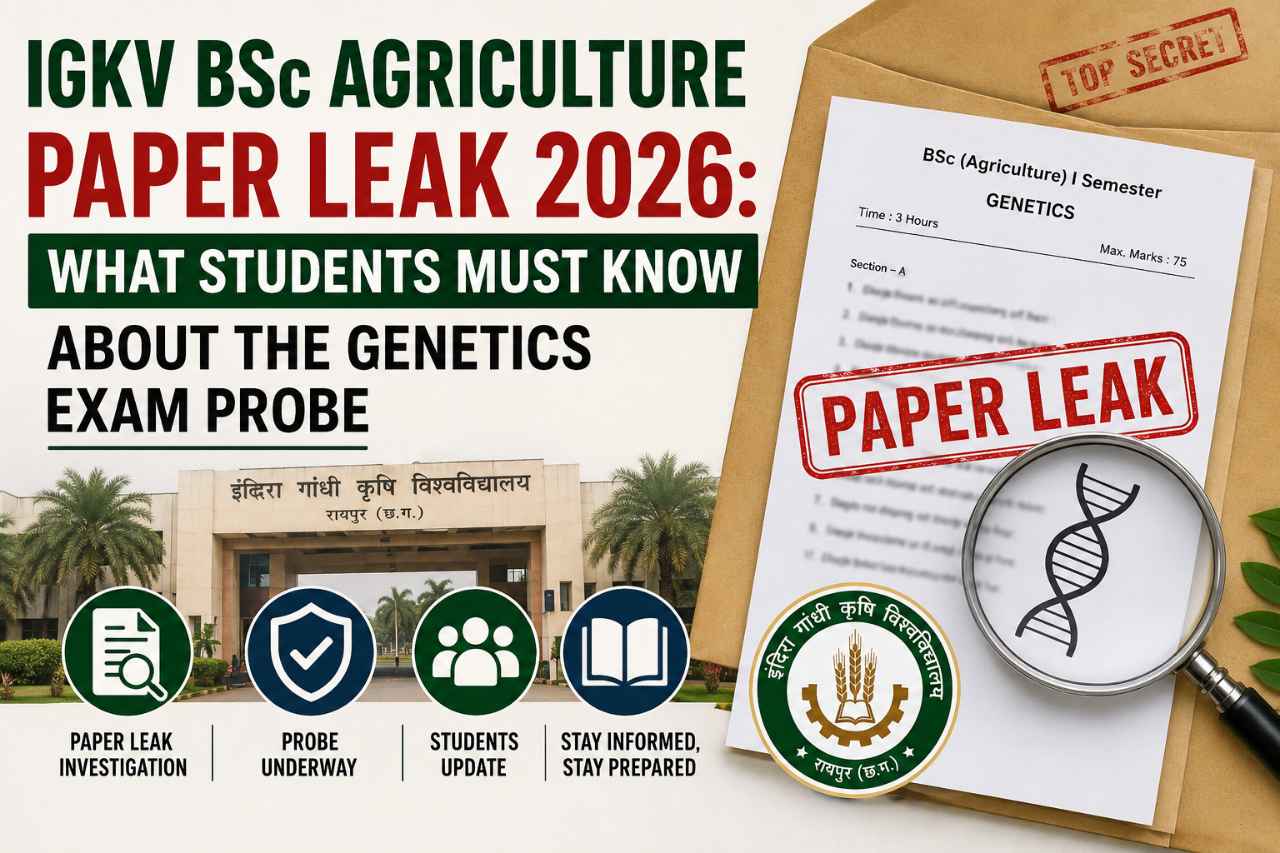

In August 2026, Indira Gandhi Krishi Vishwavidyalaya (IGKV), Raipur once again found itself at the centre of a question-paper controversy. The state-run agriculture university has written to the Telibandha police station seeking a formal probe into the alleged leak of the APB-5121 Fundamentals of Genetics examination, which was conducted across 28 affiliated agricultural colleges on August 19, 2026. According to official statements reported in the media, the matter surfaced after a national Hindi daily published a report and a journalist shared a PDF containing alleged questions and answers with the university's Information and Public Relations Officer through WhatsApp.
For thousands of BSc Agriculture students in Chhattisgarh and beyond, this is not an isolated incident. Within the same month, IGKV had already cancelled examinations, formed inquiry committees, and seen arrests linked to earlier alleged leaks. If you are preparing for agriculture admissions, currently enrolled in an affiliated college, or planning to study at a krishi vishwavidyalaya, understanding how universities respond to paper leaks—and how you can protect your academic future—is essential. This article breaks down the latest IGKV development in clear language, places it in the wider context of exam integrity in Indian higher education, and offers practical guidance for affected students.
What Happened in the IGKV Fundamentals of Genetics Paper Leak Case?
The latest complaint from Indira Gandhi Krishi Vishwavidyalaya Raipur concerns the second-year BSc Agriculture subject APB-5121: Fundamentals of Genetics. The exam was held on August 19, 2026, at multiple centres linked to the university's network of agricultural colleges.
Key facts reported in the official complaint and subsequent media coverage include:
- IGKV wrote to the Station House Officer (SHO), Telibandha police station, requesting a police investigation.
- A five-member university committee was constituted to examine the allegations.
- During a preliminary inquiry, the committee inspected envelopes containing question papers that had been dispatched to an agricultural college and later returned to the university.
- The inspection reportedly found signs of tampering in the envelopes, including the one holding the Fundamentals of Genetics paper—patterns similar to those noted in an earlier leak case already under police investigation.
- Documents submitted to police reportedly include the newspaper report, the WhatsApp PDF, the original question paper, and the inquiry committee's preliminary report.
As of the latest updates, Telibandha police confirmed receiving the complaint and stated that the matter was under investigation. No final outcome—such as cancellation, re-examination, or disciplinary action—had been publicly announced for the Genetics paper at the time of reporting.
Why Envelope Tampering Matters in University Exams
In most state agricultural universities, question papers follow a controlled chain of custody: papers are printed securely, sealed in tamper-evident envelopes, sent to college nodal officers, opened only at the exam centre under supervision, and unused papers returned in the same sealed format. When envelopes show cuts, resealing marks, or mismatched seals, it raises serious concerns that content may have been accessed before the scheduled exam time.
For students, this technical detail matters because universities often treat envelope tampering as credible evidence strong enough to trigger police complaints, internal probes, and—in confirmed cases—exam cancellation and re-tests.
Timeline: IGKV Paper Leak Cases in August 2026
To understand the gravity of the Genetics exam complaint, it helps to view it alongside other IGKV-related leak reports from the same month. The following timeline is based on publicly reported events:
| Date | Subject / Event | Reported Action |
|---|---|---|
| August 7, 2026 | BSc Agriculture First Year – Plant Pathology exam | Exam cancelled on August 24 after a separate police investigation confirmed a leak |
| August 19, 2026 | BSc Agriculture – APB-5121 Fundamentals of Genetics | Alleged leak reported; IGKV sought Telibandha police probe; five-member committee formed |
| August 20, 2026 | BSc Agriculture Second Year – Entomology exam | Question paper cancelled after alleged leak surfaced on exam morning |
| August 22, 2026 | Entomology leak investigation | One professor and five students from a private college in Durg district arrested |
| August 27, 2026 | Genetics paper complaint | University formally approached police; inquiry committee submitted preliminary findings |
This sequence shows why students and parents are anxious: multiple papers, multiple colleges, and overlapping police and university inquiries within a single academic cycle.
About IGKV and Its Network of Agricultural Colleges
Indira Gandhi Krishi Vishwavidyalaya Raipur is Chhattisgarh's premier state agriculture university. It conducts examinations not only on its main campus but also through a wide network of affiliated and associated institutions across the state. When IGKV holds a centralised exam like Fundamentals of Genetics, students in numerous colleges sit the same paper on the same date—making security and fair conduct critical.
Chhattisgarh hosts several other higher-education institutions that agriculture aspirants often compare while researching options. For instance, students exploring horticulture and forestry may look at Mahatma Gandhi Udhyanikee Evam Vanikee Vishwavidyalaya Durg CG, while those interested in broader state-level programmes may review Guru Ghasidas Vishwavidyalaya Bilaspur. However, for core BSc Agriculture degrees under the IGKV umbrella, the Raipur-based krishi vishwavidyalaya remains the central examining authority.
How BSc Agriculture Exams Are Structured at State Agriculture Universities
At universities like IGKV, the BSc Agriculture programme typically spans four years and includes subjects ranging from agronomy and soil science to plant pathology, entomology, and genetics. Second-year papers such as Fundamentals of Genetics build foundational knowledge for advanced crop improvement, biotechnology, and breeding courses later in the programme.
Examination patterns generally include:
- Theory papers with short answers, long answers, and objective sections
- Practical and viva components for laboratory-based subjects
- Internal assessments conducted at the college level
- End-semester university exams administered centrally by IGKV
Because final degrees are awarded by the university—not individual colleges—any integrity issue in a central exam can affect students across all 28 centres, even those who had no involvement in wrongdoing.
Previous IGKV Leak Cases: Entomology and Plant Pathology
Entomology Exam Cancellation and Arrests in Durg
On August 20, 2026, IGKV cancelled the second-year BSc Agriculture entomology examination after an alleged leak came to light on the morning of the test. Two days later, on August 22, police arrested one professor and five students linked to a private college in Chhattisgarh's Durg district in connection with that case.
The Durg connection is significant for students researching colleges in the region. Durg is home to institutions such as Mahatma Gandhi Udhyanikee Evam Vanikee Vishwavidyalaya Durg CG, and news of arrests at a private college raises questions about supervision, affiliation norms, and exam-day protocols—not just about one exam paper.
Plant Pathology Paper Cancelled After Police Confirmation
Earlier in August, IGKV cancelled the first-year Plant Pathology examination originally held on August 7, 2026. Unlike cases still under preliminary review, this cancellation followed a police investigation in a separate matter that reportedly confirmed the paper had been leaked. For first-year students, such cancellations often mean delayed results, supplementary schedules, and additional preparation pressure before the next semester.
What Happens When a University Reports a Paper Leak to Police?
When an institution like IGKV approaches local police, a standard sequence of actions usually follows. While each case differs, students can generally expect the steps below:
- Complaint registration: The university submits a written complaint with supporting evidence—tampered envelopes, leaked PDFs, witness statements, and committee reports.
- Preliminary police inquiry: Officers trace how the paper may have left the secure chain, including printing units, transport, college storage, and digital circulation on WhatsApp or social media.
- Forensic and digital investigation: Police may examine phones, laptops, CCTV footage, and messaging metadata where legally permitted.
- University academic decision: Based on inquiry findings, the university may uphold the exam, cancel it, or order a re-examination for all or affected centres.
- Disciplinary and legal outcomes: Staff or students found responsible may face criminal charges, rustication, debarring, or other penalties under university statutes.
Importantly, a police complaint does not automatically cancel an exam. Cancellation typically follows when the university is satisfied that confidentiality was compromised to an extent that makes the test unfair or invalid.
Impact on BSc Agriculture Students: Results, Re-Exams, and Fairness
Paper leaks hurt the majority of honest students the most. Even if only a small group accesses questions in advance, the credibility of the entire cohort's performance comes under scrutiny. Common consequences include:
- Delayed semester results while investigations continue
- Re-examinations scheduled on short notice, sometimes during holidays or practical seasons
- Increased scrutiny at exam centres, including tighter identity checks and seating arrangements
- Stress during placements and higher-study applications, especially for final-year students needing transcripts
- Psychological pressure on students who fear being judged despite preparing honestly
If you are studying at an IGKV-affiliated college, remember that re-exams—when announced—apply to all registered candidates for that paper unless the university explicitly limits them to specific centres. Treat any unofficial WhatsApp forwards of so-called leaked papers as potential misinformation or traps that could lead to disciplinary action.
Paper Leaks and Exam Integrity Across Indian Agriculture Universities
IGKV is not the only institution where exam security has faced public scrutiny. Agriculture universities nationwide conduct high-stakes tests for thousands of students aiming for careers in farming, agribusiness, research, and rural development. Comparable state-level institutions include:
- Jawaharlal Nehru Krishi Vishwavidyalaya Jabalpur
- Bidhan Chandra Krishi Vishwavidyalaya Nadia
- Rajmata Vijayaraje Scindia Krishi Vishwa Vidyalaya Gwalior
- Uttar Banga Krishi Vishwavidyalaya Cooch Behar
- GB Pant University of Agriculture and Technology Pantnagar
Many of these universities affiliate numerous colleges and conduct decentralised exams—creating similar security challenges. National-level scrutiny of testing agencies such as the NTA has also intensified debate over whether centralised, technology-driven exam delivery can reduce leak risks. For agriculture students, ICAR AIEEA and state counselling processes add another layer where merit and transparency matter deeply.
Lessons from Other Agriculture and Allied Institutions
Students comparing programmes at Banda University of Agriculture and Technology Banda, Rajasthan College of Agriculture and Technology Jaipur, or D Y Patil Agriculture and Technical University should evaluate not only placement records and fees but also how transparently an institution communicates exam disruptions. Universities that publish timely notices on official websites and controller-of-examination portals tend to reduce student panic compared with those that rely on informal campus rumours.
Understanding Fundamentals of Genetics in the BSc Agriculture Syllabus
APB-5121 Fundamentals of Genetics is a core theoretical subject that introduces students to Mendelian inheritance, gene structure, chromosome behaviour, molecular genetics basics, and applications in crop improvement. For second-year learners, this paper connects classroom concepts to field realities such as hybrid seed production, disease resistance breeding, and quality trait selection.
Typical topics covered in genetics papers at agriculture universities include:
- History and scope of genetics in agriculture
- Cell division, linkage, and crossing over
- Gene interactions and quantitative inheritance
- Mutation, polyploidy, and cytoplasmic inheritance
- Introduction to biotechnology tools used in plant breeding
Because genetics underpins modern agriculture—from high-yield varieties to climate-resilient crops—exam integrity in this subject is especially important. A leaked paper does not merely give a few students an score advantage; it devalues the scientific training that future agronomists and extension officers need when advising farmers across Chhattisgarh and India.
How IGKV Can Strengthen Exam Security: Practical Reforms
While police investigations address individual cases, long-term credibility requires structural reform. Experts and student bodies across India have repeatedly suggested measures that IGKV and similar universities could adopt:
- Digital sealing and barcode tracking for each question-paper packet from print to centre
- Randomised question sets or multiple paper codes within the same subject to reduce value of leaks
- Centralised opening protocols with video recording at exam centres
- Strict accountability for nodal officers at affiliated private colleges
- Whistle-blower channels that allow anonymous reporting before exam day
- Rapid public notices on the official IGKV website and affiliated college boards
- Independent audit of the entire exam logistics vendor chain each semester
Students should advocate for these reforms through elected representatives, college unions, and formal feedback mechanisms—not through social media campaigns that spread unverified leaks further.
What Should IGKV BSc Agriculture Students Do Right Now?
If you appeared for the Fundamentals of Genetics exam on August 19, 2026, or were affected by earlier cancelled papers, follow these actionable steps:
1. Rely Only on Official Notifications
Check the IGKV official website, your college notice board, and controller-of-examinations circulars daily. Do not trust Telegram channels, anonymous Twitter accounts, or WhatsApp groups claiming insider information about cancellations or re-exam dates.
2. Preserve Your Admit Card and Exam Documents
Keep admit cards, attendance sheets, and any centre instructions safely. If a re-exam is ordered, these documents may be required for verification.
3. Avoid Sharing or Forwarding Leaked Material
Even receiving a leaked PDF passively can create legal and disciplinary risk. Delete such content and report it to your college principal or university exam cell if appropriate.
4. Continue Syllabus Preparation
Cancelled or disputed papers often lead to re-tests covering the same official syllabus. Maintain notes for Fundamentals of Genetics, Entomology, and Plant Pathology so you are not caught unprepared if fresh dates are announced suddenly.
5. Document Your Exam-Day Experience
If you noticed irregularities—late paper delivery, unusual centre behaviour, or rumours of leaks before the exam—write a factual account with dates and times. Formal representations may help innocent students if investigations expand.
6. Seek Support for Mental Health
Repeated leak news can cause anxiety, especially for first-generation learners from rural Chhattisgarh. Use college counselling cells, helplines, and peer support groups rather than isolating yourself during uncertain periods.
Admissions Perspective: Should Aspirants Still Choose IGKV?
Prospective students often ask whether exam controversies should influence college choice. A balanced view looks at multiple factors:
- Academic reputation and ICAR recognition of the BSc Agriculture programme
- Affiliation network and access to research farms, KVKs, and extension activities
- Transparency of governance and speed of official communication during crises
- Alternative options such as other krishi vishwavidyalayas or ICAR-accredited private agriculture colleges
A single news cycle—however serious—does not erase IGKV's role as a major agriculture education hub in central India. However, aspirants should monitor whether the university implements credible reforms before the next major exam season. Comparing institutions like IGKV Raipur with JNKVV Jabalpur or RVSKVV Gwalior on course structure, fees, and placement support remains a sensible approach.
Legal and Disciplinary Dimensions Students Should Understand
Question-paper leaks in India can attract serious consequences under laws related to cheating, criminal breach of trust, and cyber circulation of stolen content. Students arrested in the Durg entomology case illustrate that enforcement may extend beyond touts to include institutional insiders and learners who actively participate in leak networks.
University ordinances typically allow:
- Immediate cancellation of exam candidature for involved students
- Debarring from future university exams for a specified period
- Withholding of results pending inquiry outcomes
- Referral of staff members to service disciplinary committees
Innocent students are rarely punished, but associating with leak groups—even out of curiosity—can complicate inquiries. Maintain a clear distance from any offer of guaranteed questions.
Media, Whistle-Blowing, and the Role of Journalism
In the Genetics paper case, reporting by a national Hindi daily and subsequent sharing of a PDF with the university's Information and Public Relations Officer played a role in triggering the official response. Responsible journalism can expose systemic weaknesses, but students should note that circulating unverified leaks online may violate exam rules regardless of intent.
Raipur also hosts specialised institutions such as Kushabhau Thakre Patrakarita Avam Jansanchar Vishwavidyalaya Raipur, reflecting the city's growing role as an education centre. Ethical reporting and official university channels together serve the public interest better than viral WhatsApp forwards.
Affiliated Colleges and Shared Responsibility
When IGKV conducts exams across 28 agricultural colleges, each centre shares responsibility for secure storage, timely opening, and proper conduct. Private colleges, government colleges, and university departments may follow different administrative cultures, but the exam cell standards must remain uniform.
Affiliated institutions in Chhattisgarh operate within a broader ecosystem that includes general universities such as Hemchand Yadav Vishwavidyalaya, tribal-region institutions like Sant Gahira Guru Vishwavidyalaya Sarguja Ambikapur, and specialised campuses in Jagdalpur linked to Shaheed Mahendra Karma Vishwavidyalaya Jagdalpur. Agriculture students, however, should note that BSc Agriculture degree exams are ultimately controlled by IGKV regardless of where they attend classes.
Re-Examination Policy: What History Suggests
Although each case is decided on facts, Indian universities—including agriculture vishwavidyalayas—generally follow predictable patterns when leaks are confirmed:
- Full cancellation and fresh date: All candidates reappear for a new paper with revised logistics.
- Centre-specific action: Rare, but possible if tampering is traced to one location only.
- Result withholding: Marks are not released until inquiry closure.
- No change: If investigation finds insufficient proof, the original exam may stand.
Given that Plant Pathology and Entomology papers were already cancelled in August 2026, students preparing for Genetics should mentally plan for a similar outcome until IGKV publishes a definitive order. Building a revision timetable now reduces last-minute panic.
Broader Context: Exam Integrity Debate in Indian Higher Education
The IGKV incidents unfold amid a wider national conversation on exam integrity—from UGC NET re-exams to NEET counselling disputes and demands for restructuring testing agencies. Student organisations have argued that repeated leaks expose weak custody systems rather than isolated bad actors alone.
For agriculture education specifically, integrity matters beyond marks. Graduates advise farmers, manage crop diseases, and handle plant genetics in real-world settings. A degree earned through unfair means undermines public trust in agricultural extension—the very foundation of krishi vishwavidyalaya missions since institutions like GB Pant University Pantnagar pioneered the land-grant model in India.
Checklist for Parents and Guardians
Parents of BSc Agriculture students often feel helpless when news breaks about paper leaks. A simple checklist can help families respond calmly:
- Ask your ward to show official college notices rather than social media screenshots.
- Discourage payment to anyone promising leaked papers or guaranteed pass assistance.
- Encourage continued study instead of waiting for rumours to settle.
- Contact the college office in writing if your ward reports centre irregularities.
- Monitor IGKV announcements jointly so misinformation does not spread within the family WhatsApp group.
Supportive family behaviour reduces student temptation to seek shortcuts during stressful exam seasons.
Conclusion
The alleged leak of the IGKV BSc Agriculture Fundamentals of Genetics question paper is the latest in a troubling series of exam-security incidents at Indira Gandhi Krishi Vishwavidyalaya Raipur in August 2026. With tampered envelopes reported, a five-member inquiry committee in place, and Telibandha police investigating the complaint, students await a formal decision on whether the August 19 examination will stand or be cancelled.
If you are an IGKV student, prioritise official notices, avoid leaked material, and stay prepared for possible re-examinations. If you are an aspirant, weigh IGKV's academic strengths alongside its governance response in the coming months. Exam leaks are a shared failure of institutions and society—but honest students protect their futures best through transparency, preparation, and patience while due process runs its course.