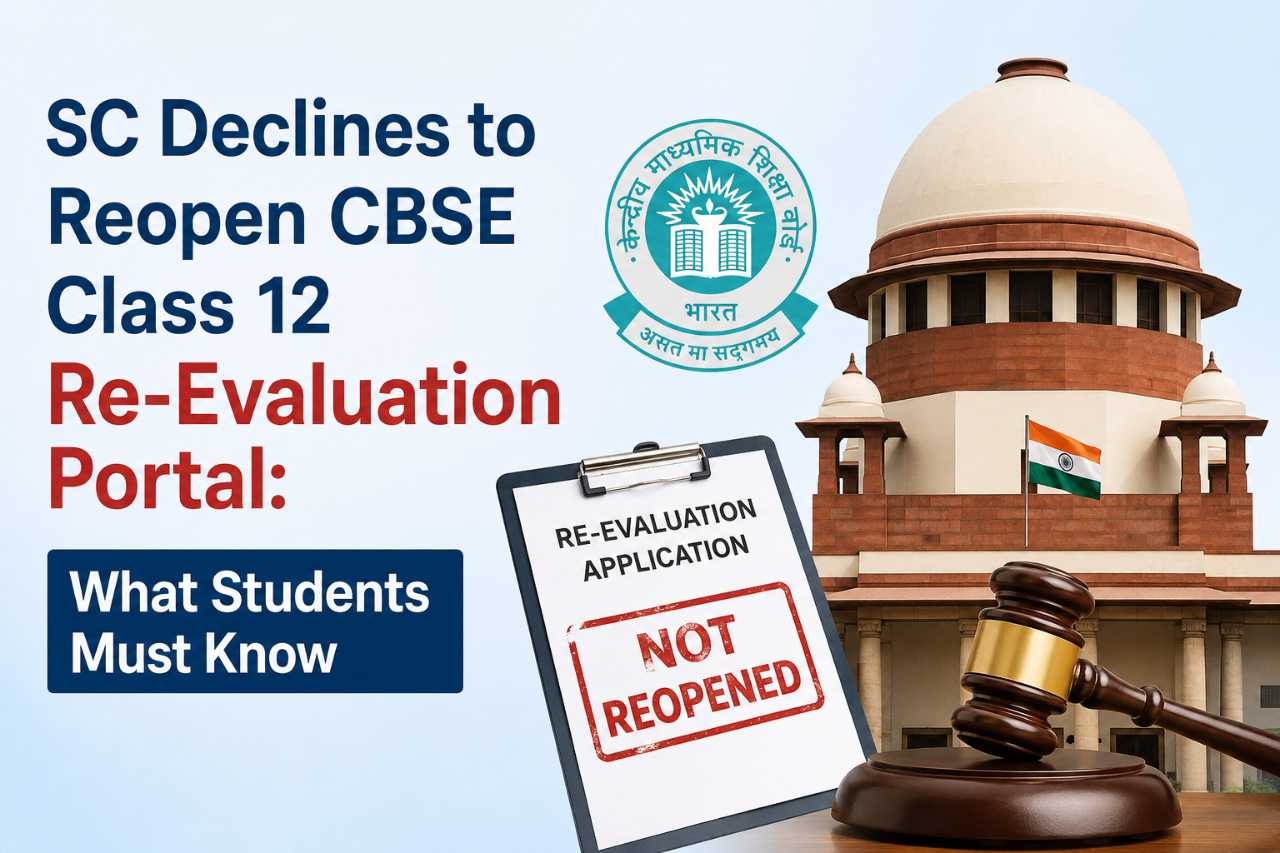
The Supreme Court of India on Tuesday, August 25, 2026, declined to direct the Central Board of Secondary Education (CBSE) to reopen its online portal for re-evaluation of Class 12 answer sheets. The decision affects lakhs of students who appeared for CBSE Class 12 board exams and were hoping for another chance to challenge marks awarded through the board's new On-Screen Marking (OSM) system. For students planning undergraduate admissions at top Delhi colleges such as Lady Shri Ram College For Women LSR Delhi or Indraprastha College For Women Delhi, the ruling underscores one hard reality: exam grievance windows are time-bound, and missing them can limit post-result options.
This article explains what the Supreme Court said, how CBSE's OSM and re-evaluation process work, what the 1.68 lakh applications mean, and what Class 12 students can realistically do now for college admissions, improvement exams, and future planning.
Supreme Court Verdict: Key Points at a Glance
On August 25, 2026, a bench of Chief Justice of India Surya Kant and Justices Joymalya Bagchi and V Mohana heard a petition challenging CBSE's OSM-based evaluation and seeking reopening of the re-evaluation portal for Class 12 students who missed the deadline or faced technical issues.
Quick summary of the ruling:
- The Supreme Court refused to order CBSE to reopen the re-evaluation portal.
- The bench noted the portal was open to all candidates for a specified period.
- Reopening the window, the court observed, could trigger fresh claims from other students as well.
- Chief Justice Surya Kant used a plain analogy: if you do not use the bus, you miss the bus.
- The petitioner's counsel sought only one additional week; the court did not grant it.
- Solicitor General Tushar Mehta, representing CBSE, stated that 1.68 lakh students had successfully applied during the notified window.
- He also pointed out that the Delhi High Court had already dismissed a similar challenge.
For students and parents, the message is procedural rather than punitive. India's highest court did not comment on whether OSM is perfect or flawed. It focused on whether courts should extend an administrative deadline that CBSE had already closed after giving equal notice to all candidates.
What Is CBSE On-Screen Marking (OSM)?
Before understanding re-evaluation, it helps to know what OSM actually means. CBSE's On-Screen Marking system is a digital evaluation method in which examiners assess scanned copies of physical answer booklets on a computer screen instead of marking original paper scripts by hand in the traditional way.
How OSM Works in Practice
- After the Class 12 board exam, physical answer sheets are scanned and uploaded into a secure digital system.
- Qualified examiners log in and mark responses on screen using structured marking tools.
- The system is designed to improve tracking, reduce handling errors, and support faster processing of large volumes of scripts.
- Students do not receive the original handwritten booklet during routine result publication; grievance processes rely on scanned images and board records.
CBSE has gradually expanded digital evaluation for efficiency and transparency at scale. However, the petition before the Supreme Court alleged that scanning and digital marking introduced new problems for some students, including missing pages, blurred scans, incomplete evaluation of certain answers, and difficulty reading scanned content.
Why OSM Became Controversial
Students who trusted the familiar paper-checking model often found OSM unfamiliar. Complaints typically fell into these categories:
- Incomplete scanning: One or more pages of an answer booklet allegedly did not appear in the digital copy.
- Illegible scans: Handwriting or diagrams became unreadable after scanning.
- Partial evaluation: Some answers or pages were marked as unchecked or awarded zero despite attempted responses.
- Technical barriers during grievance: Some students claimed the re-evaluation portal crashed or slowed during the application window.
These concerns are serious because Class 12 marks directly affect CUET scores, merit lists, scholarship eligibility, and admission to programmes at institutions ranging from Delhi University colleges to professional courses across India.
CBSE Class 12 Re-Evaluation Portal: What Happened
CBSE opened an online portal allowing Class 12 candidates to apply for re-evaluation or related verification of OSM-marked answer sheets within a notified timeframe. The board publicised the window through official websites, school circulars, and standard communication channels used for board exam services.
According to submissions made by CBSE before the Supreme Court, 1.68 lakh Class 12 students successfully applied during that period. That number is significant. It shows that a large section of students understood the deadline and completed the process despite high post-result anxiety and server load.
The Petitioner's Argument
The counsel for the petitioner told the court that many students could not apply because the website crashed or became inaccessible. The request was modest in scope: reopen the portal for one week so affected students could file applications. The Supreme Court, however, was not persuaded that a judicial direction to reopen was appropriate after the board had already run a universal window.
CBSE and Government's Stand
Solicitor General Tushar Mehta argued that the process was open to everyone equally, that a substantial number of students had already used it, and that reopening would reopen the floodgates for new claims. He also cited the Delhi High Court's earlier dismissal of a similar plea, suggesting lower courts had already examined comparable arguments.
Timeline of Events: From OSM Rollout to Supreme Court Order
Understanding the sequence helps students see why the August 2026 order feels final for this admission cycle.
- Board exams and OSM evaluation: CBSE Class 12 papers were evaluated using scanned scripts under the On-Screen Marking framework.
- Result declaration: Marks were published online and through schools, triggering the post-result services window.
- Re-evaluation portal opened: CBSE notified a fixed period during which students could apply for script review.
- 1.68 lakh applications received: CBSE told the Supreme Court that a large number of candidates completed applications successfully.
- Delhi High Court dismissal: An earlier similar petition against the process was dismissed, as cited by the Solicitor General.
- August 25, 2026 Supreme Court hearing: The apex court declined to direct reopening despite website crash claims and a one-week extension request.
Why the Supreme Court Said No to Reopening
Courts in exam-related matters often balance student welfare with administrative finality. Boards must declare results, process re-checking requests, and release revised marks within timelines that do not delay admissions nationwide.
The Supreme Court's reasoning, as reported, rested on these principles:
- Equal opportunity already provided: The portal was not limited to a select group; all eligible Class 12 candidates could apply within the notified dates.
- Finality of deadlines: Extending one petitioner's timeline could unfairly benefit late applicants while undermining rules communicated to everyone.
- Risk of cascading claims: A reopened window may encourage fresh applications beyond the original grievance set, complicating evaluation logistics.
- Judicial restraint in policy timelines: The court did not appear ready to micromanage CBSE's exam administration calendar after the board closed a publicly notified process.
Chief Justice Surya Kant's remark that students who missed the bus cannot demand a special ride reflects a common judicial view: exam boards publish windows, and candidates are expected to act promptly once results are declared.
Comparison Table: Traditional Marking vs CBSE OSM
Students preparing for future board cycles should understand how evaluation methods differ.
| Aspect | Traditional Paper Marking | CBSE On-Screen Marking (OSM) |
|---|---|---|
| Script format | Physical answer booklet handled by examiner | Scanned digital copy viewed on computer |
| Speed and scale | Slower for very large candidate pools | Designed for faster processing at national scale |
| Student access | Photocopy requests refer to original sheets | Grievance relies on scan quality and digital records |
| Common concerns | Arithmetic totalling, unchecked answers | Missing scans, blur, partial digital evaluation |
| Re-evaluation route | Recheck through board portal within deadline | Same portal logic, but reviewers work on scans |
Impact on Class 12 Students and College Admissions
The Supreme Court decision does not change published CBSE Class 12 results for students who did not apply for re-evaluation. For admission season, that means:
- Your current marks remain the basis for CUET, state university merit lists, and private college applications unless you had already applied and receive revised marks through the closed process.
- Students aiming for competitive cutoffs at colleges like Indra Gandhi Delhi Technical University For Women must plan around the marks now on their marksheet.
- Those who successfully applied before the deadline should track CBSE updates for re-evaluation outcomes and revised mark sheets.
- Students who missed the window must explore alternative pathways rather than waiting for a portal reopening that the Supreme Court has declined to order.
Regional Impact Across India
CBSE Class 12 students are spread across every state. Admission consequences vary by goal:
- Delhi NCR and North India: DU and other central universities depend heavily on Class 12 percentages alongside CUET scores.
- South India: Students eyeing institutions such as Bharathidasan Government College For Women Chennai or state universities must align board marks with local counselling calendars.
- West and Central India: State boards and CBSE students compete in mixed merit pools; even small mark changes can shift seat allocation.
- Hyderabad and Telangana region: Aspirants considering ICFAI Foundation For Higher Education Hyderabad should confirm current eligibility using final CBSE marks.
How the Ruling Affects CUET and State Counselling
Central Universities Entrance Test (CUET) and state-level undergraduate counselling often run parallel to CBSE post-result services. When re-evaluation closes without revised marks, students must align documents with what appears on the current marksheet.
If you already applied and receive improved marks, update your CUET profile and college forms immediately. Delays can cost seat confirmation. If you missed the window, counselling decisions should assume existing marks unless you qualify for improvement exams in a later session. Students in states served by open universities—such as Madhya Pradesh Bhoj Open University Bhopal, Netaji Subhash Open University Kolkata, or UP Rajarshi Tandon Open University Allahabad—should verify whether their target programme accepts improvement marks from the next CBSE cycle.
What Can Students Do Now? Practical Options After the SC Order
Missing the re-evaluation window is disappointing, but it is not the end of a student's academic journey. Here are realistic next steps.
1. Track Outcomes if You Already Applied
If you are among the 1.68 lakh students who applied successfully, monitor CBSE's official portals and school notifications for re-evaluation results. Download revised mark sheets promptly and update documents for counselling.
2. Explore Improvement and Compartment Routes
CBSE offers improvement exams and compartment examinations for eligible candidates in subsequent sessions. Check the latest CBSE academic calendar on cbse.gov.in for application dates, subject rules, and fees. Improvement can help if you plan to reappear in specific subjects rather than challenge evaluation of the current booklet.
3. Use CUET and Other Entrance Exams Strategically
Many universities now weigh entrance tests alongside board marks. A strong CUET performance can offset a borderline Class 12 percentage for several undergraduate programmes. Focus preparation on domains aligned with your target course.
4. Consider Open and Flexible Degree Pathways
Students who need time to improve qualifications or want distance options can explore open universities. Institutions such as Indira Gandhi National Open University, Yashwantrao Chavan Maharashtra Open University, Nalanda Open University Patna, Karnataka State Open University Mysore, Tamil Nadu Open University Chennai, and Dr B R Ambedkar Open University Hyderabad offer undergraduate programmes with different admission models. These are not substitutes for resolving a marking dispute, but they expand long-term options.
5. Look at Regional Colleges and Skill-Based Programmes
Not every strong career path runs through a handful of metro universities. Colleges such as SRD Modi College For Women Kota and Vardhman Mahaveer Open University Kota serve students in Rajasthan's education hub, while other state open universities support learners in Jharkhand, Odisha, Uttarakhand, and beyond through networks like Jharkhand State Open University, Odisha State Open University, and Uttarakhand Open University.
6. Maintain Proper Documentation
Keep screenshots, payment receipts, login attempts, and school correspondence if you plan further representations to CBSE regional offices. While the Supreme Court declined reopening, well-documented grievances may still help in individual administrative reviews where policy allows.
Parent and School Checklist After the SC Decision
Parents and school coordinators play a critical role once litigation options narrow.
- Confirm whether the student applied for re-evaluation before the deadline.
- Collect official CBSE correspondence only from cbse.gov.in or school notice boards.
- Prepare backup admission lists across realistic cutoffs rather than waiting on uncertain portal reopening.
- Discuss improvement exams early if the student is set on crossing a specific percentage threshold.
- Explore accredited colleges and universities on trusted platforms before paying any counselling fee.
Re-Evaluation vs Verification vs Photocopy: Know the Difference
Students often confuse CBSE post-result services. Understanding terms prevents missed opportunities in future cycles.
- Verification of marks: Re-totalling or confirming that marks entered in the result match the evaluated script totals.
- Re-evaluation / rechecking of OSM scripts: A deeper review of scanned answers and marking, often with fees per subject.
- Obtaining photocopy of evaluated answer book: Access to scanned copies so students can decide whether to seek re-evaluation.
In OSM-era exams, viewing the scanned script before applying for re-evaluation is especially important. If pages are missing or unreadable, that evidence supports a targeted grievance within the active window.
Lessons for Future CBSE Batches
The August 2026 Supreme Court order offers clear takeaways for Class 10 and Class 12 students in upcoming sessions:
- Act on day one of result declaration: Do not wait until the last hours of the grievance window.
- Use multiple devices and stable internet: Portal congestion is common immediately after results.
- Keep school informed: Many schools help with CBSE portal applications and fee payments.
- Download proof of application instantly: Save acknowledgement PDFs and transaction IDs.
- Read official notices only: Avoid relying on social media rumours about extended deadlines.
Delhi High Court's Earlier Role in the Same Dispute
According to submissions before the Supreme Court, a similar challenge to CBSE's OSM-related process had already been dismissed by the Delhi High Court. That prior judgment strengthened CBSE's argument that courts had reviewed the issue and allowed the board's timeline to stand.
For litigants, sequential dismissal at the High Court and refusal of reopening at the Supreme Court suggests that future relief, if any, would likely require new facts, policy changes by CBSE itself, or administrative remedies rather than repeated judicial extensions of the same deadline.
What CBSE and the Ministry May Do Next
The Supreme Court did not strike down OSM. CBSE is expected to continue digital evaluation while addressing operational complaints. Union Education Ministry reviews of CBSE exam processes have periodically focused on strengthening academic and examination systems. Students should watch official announcements on cbse.gov.in and the Ministry of Education channels for any updated SOPs on scanning quality, helplines, or grievance redressal.
Independent of this case, boards nationwide are digitising evaluation. That trend makes digital literacy around post-result services part of exam preparedness, much like knowing exam centre rules or sample paper patterns.
Conclusion
The Supreme Court's refusal to direct CBSE to reopen the Class 12 re-evaluation portal is a reminder that board exam grievance systems run on strict timelines. With 1.68 lakh students having already applied, the court chose not to extend the window for others, including those citing website crashes. The ruling does not resolve every concern about OSM, but it clarifies the legal position for 2026 admissions: the notified re-evaluation period is closed unless CBSE voluntarily reopens it.
For affected students, the focus should now shift to counselling, improvement exams, entrance tests, and choosing colleges that match current marks and career goals. Whether you aim for a premier women's college in Delhi, a professional institute in Hyderabad, or a flexible degree through an open university, timely action after results remains the most reliable strategy in India's competitive higher education landscape.