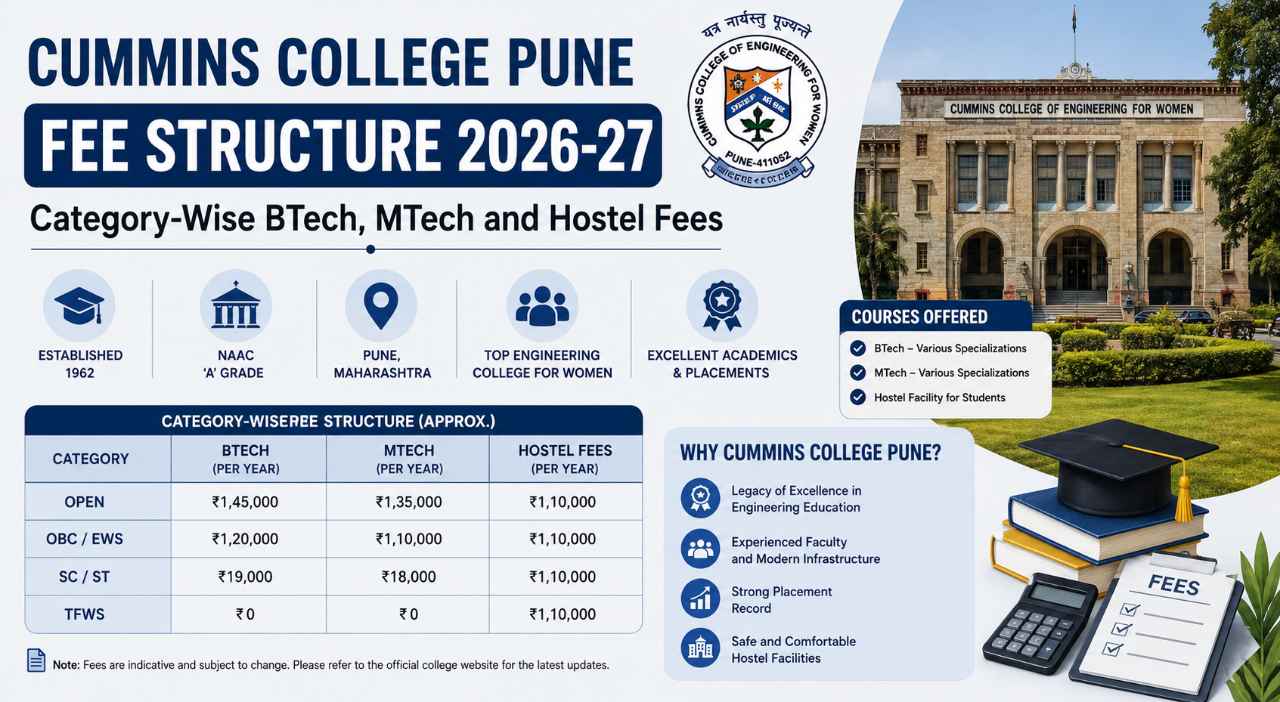

Maharshi Karve Stree Shikshan Samstha's (MKSSS) Cummins College of Engineering for Women in Pune has officially published its fee structure for the academic year 2026-27 on cumminscollege.org. For thousands of aspiring women engineers across Maharashtra and beyond, this notification is one of the most practical documents in the admission cycle it tells you exactly how much you will pay, which components are waived for reserved categories, and what additional charges apply for hostel accommodation.
If you are planning to pursue a BTech, Direct Second Year (DSY), MTech, or PhD programme at this autonomous institution, understanding the category-wise breakdown is essential before MHT CET counselling begins. This guide explains every fee slab notified under the Fees Regulating Authority (FRA), Governemnt of Maharashtra, along with actionable tips for scholarship applicants, hostel seekers, and students comparing Cummins College with other engineering institutes in India.
About MKSSS Cummins College of Engineering for Women, Pune
Established under the legacy of Maharshi Karve's vision for women's education, Cummins College of Engineering for Women (CCOEFW) is one of Pune's most respected autonomous engineering institutes exclusively for women. Affiliated with Savitribai Phule Pune University and approved by AICTE, the College offers undergraduate and postgraduate programmes in branches such as Computer Engineering, Information Technology, Mechanical Engineering, Electronics and Telecommunication, and Instrumentation.
The institute is known for strong industry linkages, a disciplined campus culture, and consistent placement outcomes in IT, core engineering, and research roles. Because it operates as an autonomous college under MKSSS, fee revisions follow the FRA framework rather than ad-hoc internal decisions giving students and parents a transparent, government-regulated fee model each academic year.
Students evaluating Cummins College alongside institutes such as Government College of Engineering Chennai or private colleges like Rajalakshmi Engineering College Chennai will notice that Maharashtra's category-based fee waiver system makes a significant difference especially for SC, ST, and other reserved-category candidates.
Cummins College Pune Fee Structure 2026-27: Key Highlights
The 2026-27 fee circular covers first-year BTech, Direct Second Year admissions, MTech, PhD, and hostel charges. Here are the headline figures every candidate should know:
- First Year BTech (Open, Maharashtra): Rs 2,08,436 per year
- First Year BTech (Open, Outside Maharashtra): Rs 2,08,936 per year
- First Year BTech (SC/ST): Rs 11,936 per year
- First Year BTech (OBC, EBC, EWS, SEBC, VJNT, SBC, TFWS): Rs 37,567 per year
- Direct Second Year (Open, Maharashtra): Rs 2,04,189 per year
- MTech (Open category): Rs 1,33,300 per year
- PhD programme: Rs 41,150 per year
- Hostel fees: Rs 97,790 to Rs 1,37,813 depending on hostel and room type
These figures include tuition fee, development fee, caution money (refundable deposit), university eligibility fee, university fee, and insurance charges as applicable. Always download the official circular for the complete component-wise split, as minor administrative heads may not appear in summary tables.
First Year BTech Fee Breakdown 2026-27 (Category-Wise)
The first-year BTech fee is the most searched section of the Cummins College fee notification. Below is the category-wise breakdown based on the official 2026-27 structure:
Open Category (Maharashtra and OMS)
For Open category students from Maharashtra, the total annual payable amount is Rs 2,08,436, comprising:
- Tuition Fee: Rs 1,70,869
- Development Fee: Rs 25,631
- Caution Money: Rs 10,000 (refundable)
- Additional heads: University eligibility fee, university fee, and insurance charge
Outside Maharashtra State (OMS) Open category candidates pay a slightly higher total of Rs 2,08,936. The difference of Rs 500 typically reflects state-specific administrative charges. OMS students should confirm domicile-related documentation during CAP registration to avoid category misclassification.
SC and ST Category
SC and ST candidates benefit from full tuition and development fee waivers under Maharashtra's social justice schemes. Their total payable amount is just Rs 11,936, which covers caution money, university fees, insurance, and other mandatory heads representing nearly a 95% reduction compared to the Open category total.
Actionable tip: Reserved-category students must complete caste validity certificate verification, income certificate submission (where applicable), and scholarship portal registration on time. Missing a deadline can temporarily place you in the Open fee slab during admission.
OBC, EBC, EWS, SEBC, VJNT, SBC, and TFWS Categories
Candidates under these categories pay Rs 37,567 annually. Tuition fee is waived, but the development fee of Rs 25,631 along with caution money and statutory charges apply. TFWS (Tuition Fee Waiver Scheme) seats available to economically weaker Open category students with high merit follow a similar fee pattern.
Special Categories: PMSSS and GOI J&K
Students admitted under the Prime Minister's Special Scholarship Scheme (PMSSS) pay Rs 12,436, while candidates under the Government of India Jammu & Kashmir scholarship scheme pay Rs 36,436, which includes a subsidised tuition component of Rs 15,000 and development fee of Rs 5,000 plus caution money.
Complete First Year BTech Fee Table
For quick reference, here is the consolidated category-wise table for First Year BTech 2026-27:
- Open (Maharashtra): Tuition Rs 1,70,869 | Development Rs 25,631 | Caution Rs 10,000 | Total Rs 2,08,436
- Open (OMS): Tuition Rs 1,70,869 | Development Rs 25,631 | Caution Rs 10,000 | Total Rs 2,08,936
- SC and ST: Tuition Nil | Development Nil | Caution Rs 10,000 | Total Rs 11,936
- VJNT, SBC, TFWS: Tuition Nil | Development Rs 25,631 | Caution Rs 10,000 | Total Rs 37,567
- OBC, EBC, EWS, SEBC: Tuition Nil | Development Rs 25,631 | Caution Rs 10,000 | Total Rs 37,567
- PMSSS: Tuition Nil | Development Nil | Caution Rs 10,000 | Total Rs 12,436
- GOI J and K: Tuition Rs 15,000 | Development Rs 5,000 | Caution Rs 10,000 | Total Rs 36,436
Direct Second Year (DSY) Fee Structure 2026-27
Students entering Cummins College through lateral entry after a diploma programme follow a separate fee slab. For the academic year 2026-27:
- Open category (Maharashtra): Rs 2,04,189 total annual fee
- Reserved categories (SC, ST, VJNT, SBC, OBC, EBC, EWS, SEBC): Rs 11,689 total annual fee
DSY admissions in Maharashtra are processed through the State CET Cell's MAH DSE CAP (Direct Second Year Engineering Centralised Admission Process). If you are a diploma holder comparing lateral entry options, also review fee structures at institutes like NIET Engineering College or Galgotias College of Engineering to understand how Maharashtra's FRA-regulated waivers compare with private colleges in other states.
Actionable tip: DSY candidates should verify that their diploma is approved by the MSBTE or equivalent board and that their CAP registration category matches their scholarship documents exactly.
MTech and PhD Fee Details for 2026-27
MTech Programmes
Cummins College offers MTech programmes for postgraduate engineering aspirants. The 2026-27 fee structure is as follows:
- Open category: Rs 1,33,300 per year
- SC Scholarship candidates (annual family income under Rs 2.5 lakh): Rs 11,300 per year
- VJNT, SBC, OBC Freeship and Scholarship candidates: Rs 27,213 per year
MTech admissions typically require a valid GATE score or institute-level entrance criteria. Scholarship-linked fee slabs depend on both category and verified family income, so keep income certificates updated before document verification.
PhD Programme
The full annual fee for the PhD programme at Cummins College for 2026-27 is set at Rs 41,150. This covers research registration, academic charges, and statutory fees as notified in the official circular. PhD candidates should separately budget for research materials, conference travel, and any lab-specific requirements not included in the base fee.
Hostel Fee Structure 2026-27 at Cummins College Pune
Cummins College operates multiple hostels for outstation students. Hostel fees are separate from academic tuition and vary by facility and room occupancy:
- Baya Karve Hostel (3-seater): Rs 1,37,813 per year
- Sir Sasoon David Hostel (3-seater): Rs 1,24,290 per year
- Sir Sasoon David Hostel (4-seater): Rs 97,790 per year
- Chitale Hostel (4-seater): Rs 99,290 per year
Hostel allotment is typically merit- and distance-based, with priority given to students from outside Pune. Four-seater rooms are the most economical option, saving roughly Rs 38,000 to Rs 40,000 annually compared to three-seater accommodation at Baya Karve Hostel.
When budgeting total cost of attendance, add academic fees and hostel charges together. For example, an Open category first-year student in a Sir Sasoon David 4-seater room would pay approximately Rs 3,06,226 per year (Rs 2,08,436 + Rs 97,790) before personal expenses, books, and transport.
Students from other cities comparing hostel costs may also explore options at colleges such as SSN College of Engineering Chennai or Jaipur Engineering College JEC Jaipur, though fee models differ significantly across states.
Why the FRA Fee Framework Matters for Students
All fees at Cummins College are notified under the Fees Regulating Authority (FRA), Government of Maharashtra. This regulatory body ensures that private and unaided professional colleges cannot charge arbitrary fees beyond approved limits. For students, this means:
- Transparency: Every fee component is published on the official website before admission.
- Category equity: Reserved-category waivers are built into the structure, not negotiated case-by-case.
- Legal protection: Overcharging beyond the FRA-approved structure can be challenged through the CET Cell or FRA grievance channels.
- Year-on-year predictability: While fees may increase marginally each year, the percentage hike is regulated.
Understanding FRA norms also helps when comparing Cummins College with government institutes like Government Engineering College Ajmer or Rajiv Gandhi Government Engineering College Alwar, where fee structures follow state government norms rather than FRA slabs for unaided colleges.
Admission Pathway and MHT CET Counselling Link
First-year BTech admissions at Cummins College are primarily through Maharashtra's Centralised Admission Process (CAP) based on MHT CET scores. Here is how the admission and fee payment cycle typically works:
- Appear for MHT CET: Register, prepare, and score well in the state engineering entrance exam.
- CAP registration: Register on the State CET Cell portal, fill college and course preferences, and lock your choice list.
- Seat allotment: Accept the allotted seat at Cummins College within the given deadline.
- Document verification: Submit category certificates, domicile proof, and academic records at the FC (Facilitation Centre) or online as directed.
- Fee payment: Pay the category-specific fee as per the 2026-27 structure at the time of admission confirmation.
- Reporting to college: Complete institute-level formalities and collect your admission letter.
TFWS and minority quota seats have separate eligibility criteria. Always cross-check the latest CAP information brochure on the CET Cell website alongside the Cummins College fee circular.
Scholarships and Fee Waivers: What Reserved Category Students Must Do
The dramatic fee difference between Open and reserved categories at Cummins College is not automatic it depends on verified documentation and timely scholarship applications. Follow this checklist:
- Obtain a valid caste certificate and caste validity certificate from the Maharashtra competent authority.
- Secure an income certificate if applying for income-based scholarships (especially for SC scholarship on MTech).
- Register on the Maharashtra Directorate of Technical Education (DTE) scholarship portal before deadlines.
- Carry original and photocopied documents to FC verification.
- Confirm your category status on the CAP allotment letter matches your fee category.
SC and ST students paying only Rs 11,936 instead of Rs 2,08,436 represents one of the strongest fee support systems among women's engineering colleges in western India. Missing a single document can delay your waiver, so treat scholarship paperwork with the same urgency as your entrance exam preparation.
How Cummins College Fees Compare with Other Engineering Colleges
Fee comparison helps parents and students make informed decisions. Cummins College's Open category BTech fee of approximately Rs 2.08 lakh sits in the mid-to-upper range for autonomous unaided engineering colleges in Maharashtra. Here is a contextual comparison:
- vs. Government colleges: Government engineering colleges in Maharashtra charge significantly lower fees but have limited seats and extremely high cutoffs.
- vs. Pune private colleges: Several Pune institutes charge comparable or higher fees without the same legacy or women-only campus environment.
- vs. North India private colleges: Institutes like Inderprastha Engineering College, Dronacharya College of Engineering, and Chandigarh Engineering College follow different state fee policies without Maharashtra's integrated category waiver system.
- vs. Chennai private colleges: Colleges such as Panimalar Engineering College Chennai and Velammal Engineering College Chennai may offer co-ed campuses at varying fee points, but reserved-category benefits differ by Tamil Nadu state policy.
When comparing, always calculate total cost of attendance including hostel, transport, and personal expenses not just tuition fee.
Total Cost of Attendance: A Practical Budgeting Example
Understanding individual fee heads is only half the financial planning exercise. Smart aspirants calculate total cost of attendance (TCA) before locking Cummins College in their CAP preference list. Here is a realistic budgeting scenario for an Open category student from outside Pune:
- First Year BTech academic fee: Rs 2,08,436
- Hostel (Sir Sasoon David, 4-seater): Rs 97,790
- Books and study materials: Rs 8,000 to Rs 12,000 (approximate)
- Personal expenses and transport: Rs 15,000 to Rs 25,000 per year
- Total estimated first-year spend: Rs 3,30,000 to Rs 3,45,000
For reserved-category students paying Rs 11,936 in academic fees, the same hostel and living costs still apply making early scholarship confirmation even more critical. Parents should also factor in annual fee revision trends under FRA, which typically allow modest year-on-year increases rather than sudden jumps.
Students who plan to stay in private PG accommodation near Karvenagar or Kothrud instead of college hostels should compare monthly rent (typically Rs 6,000 to Rs 12,000 in Pune) against hostel fees that include meals and security. In many cases, on-campus hostel accommodation offers better value despite the higher upfront annual payment.
Placement Outlook and Return on Investment
Fee decisions should always be weighed against career outcomes. Cummins College consistently reports strong placement statistics in software development, data analytics, core manufacturing, and higher studies abroad. Major recruiters from IT services, product companies, and engineering firms visit the campus each year.
When evaluating return on investment, divide your total four-year spend (academic plus hostel) by expected starting salary bands in your target branch. Computer and IT graduates often recover their investment within two to three years of employment, while core branches may take longer but offer stable long-term career paths. Comparing this ROI with alternatives such as St Josephs College of Engineering Chennai or BPIT Engineering College helps you make a data-driven choice rather than relying on reputation alone.
Documents Required for Fee Payment and Admission Confirmation
Keep these documents ready when paying Cummins College fees during admission:
- MHT CET scorecard and CAP allotment letter
- Class 10 and Class 12 mark sheets and passing certificates
- Transfer certificate and migration certificate (if applicable)
- Domicile certificate (for Maharashtra category claims)
- Caste certificate and caste validity certificate (for reserved categories)
- Income certificate (for scholarship-linked categories)
- Aadhaar card and passport-size photographs
- Gap certificate (if there is an academic gap)
- Medical fitness certificate (if required by the institute)
Important Dates and What to Watch in 2026
While exact counselling dates are announced by the State CET Cell, students should monitor these milestones:
- MHT CET 2026 result declaration and merit list publication
- CAP Round 1, 2, and 3 seat allotment schedules
- Institute-level round for vacant seats (if applicable)
- Scholarship portal opening and closing dates on DTE Maharashtra
- Hostel application and allotment notifications on cumminscollege.org
- Academic session commencement for 2026-27
Set calendar reminders for each deadline. Late fee payment or missed document verification can result in seat cancellation a risk no serious aspirant should take.
Conclusion
The MKSSS Cummins College of Engineering for Women Pune fee structure for 2026-27 brings much-needed clarity for BTech, DSY, MTech, and PhD aspirants. Open category students should budget approximately Rs 2.08 lakh per year for first-year BTech, while reserved-category candidates especially SC and ST students benefit from fee waivers that reduce the annual payable amount to under Rs 12,000. Hostel charges range from Rs 97,790 to Rs 1,37,813 depending on the facility and room type.
Download the official fee circular from cumminscollege.org, identify your exact category, complete scholarship documentation on time, and track the MHT CET CAP schedule closely. Whether you are a Maharashtra domicile student or an OMS candidate, planning your finances now will make the admission process smoother when seat allotment begins. For broader college comparisons across India, explore profiles of institutes like Hindustan College of Engineering Chennai, Maharishi Arvind College of Engineering Jaipur, and JIMS Engineering College on CollegeDwar to build a well-rounded shortlist.