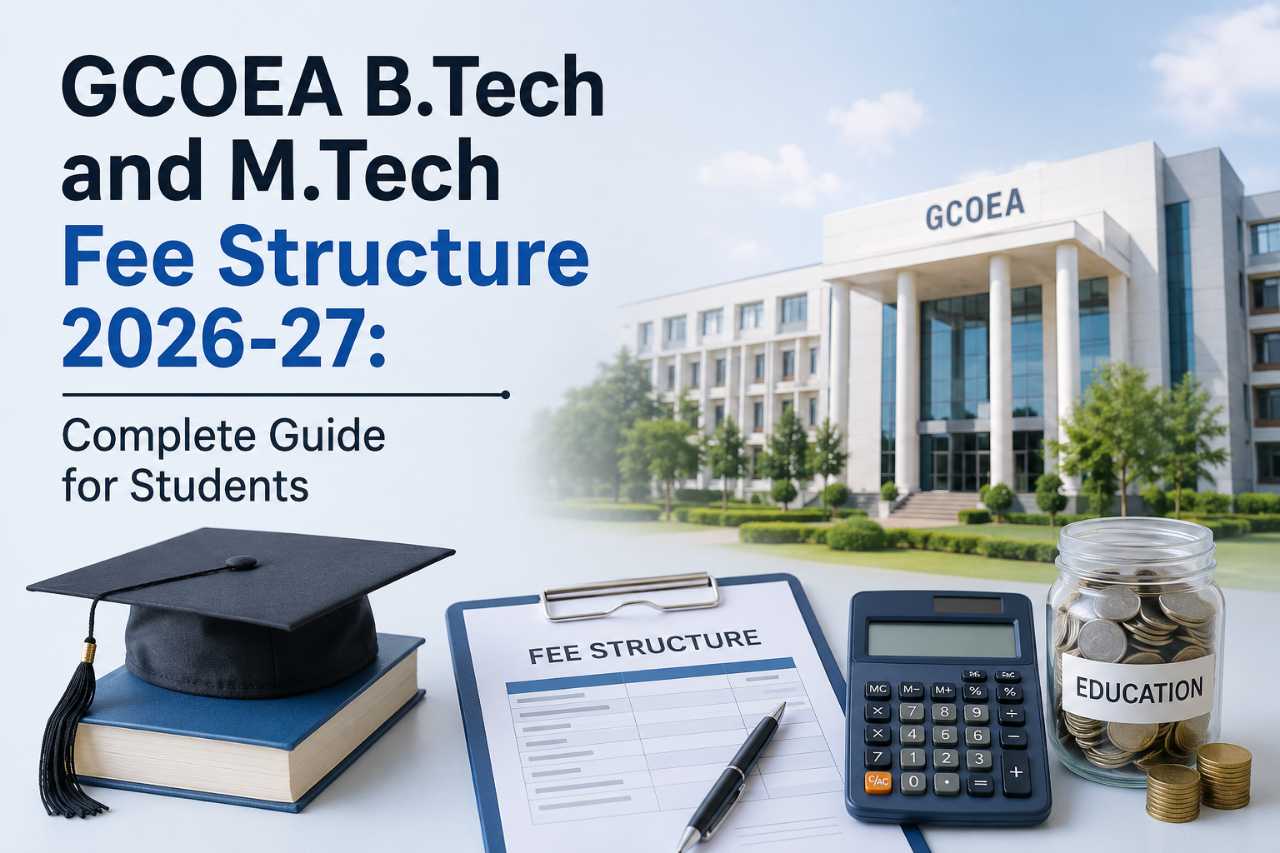

The Government College of Engineering, Amravati (GCOEA) has published its updated B.Tech and M.Tech fee structure for the 2026-27 academic session, giving Maharashtra engineering aspirants a clear picture of what a government engineering degree will cost before CAP counselling rounds conclude. For families comparing affordable public institutes with private options, this notification is one of the most practical documents on the admission checklist.
GCOEA is an autonomous government engineering college affiliated with Sant Gadge Baba Amravati University. It admits undergraduate students primarily through MHT CET and the State Common Admission Process (CAP), and postgraduate students through GATE-based or institute-level criteria depending on the programme. Because fees at government colleges follow state norms and category rules, the published structure helps open, reserved, and economically weaker category students plan tuition, deposits, and hostel expenses realistically.
This guide explains the 2026-27 fee breakdown for Bachelor of Technology (B.Tech) and M.Tech programmes at GCOEA, how annual components add up, what lateral-entry candidates pay, and how to verify figures on official portals. Use it alongside your CAP allotment letter and category certificate to avoid last-minute payment confusion.
About GCOEA: Why This Fee Update Draws Attention
Established in 1964, GCOEA is among the oldest government engineering institutions in Maharashtra. It holds autonomous status, NAAC accreditation, and a consistent record of campus placements in IT services, core manufacturing, and public-sector undertakings. For Vidarbha students, it represents a rare combination: a legacy government brand, relatively low total tuition, and branch options spanning computer science, electronics, civil, and mechanical engineering.
Each academic year, the college publishes a revised fee schedule approved under state government norms. The 2026-27 release is especially important because CAP timelines for B.E./B.Tech and M.Tech admissions overlap with document verification windows on the State CET Cell portal. Students who treat fee planning as an afterthought often scramble for bank drafts or loan sanctions at the last minute. Reading the notification early gives you time to arrange finances, compare with private alternatives, and apply for scholarships before deadlines close.
Why GCOEA Fee Structure 2026-27 Matters for Students
Engineering admission in Maharashtra is merit-driven, but merit alone does not finish the process. Once you receive a seat through CAP, the institute shares a fee schedule that lists tuition, development charges, exam fees, insurance, and other statutory heads. Paying the wrong amount or missing a deadline can delay document verification or seat confirmation.
GCOEA remains among the most sought-after government engineering colleges in the Vidarbha region. Its fee levels are significantly lower than many private institutes such as Galgotias College of Engineering and Technology or Krishna Institute of Engineering and Technology, while still offering strong placement outcomes in core and IT branches. That makes the official 2026-27 fee release especially relevant for cost-conscious students targeting quality public education.
Who Should Check the New Fee Notification?
- MHT CET 2026 qualifiers allotted a B.Tech seat at GCOEA in CAP Round 1, 2, or 3
- Diploma holders seeking direct second-year admission through lateral entry
- GATE-qualified graduates or working professionals applying for part-time M.Tech programmes
- Parents and guardians estimating total four-year or two-year education cost, including hostel and transport
- Education loan applicants who need an official fee document for bank sanction
GCOEA B.Tech Fee Structure 2026-27: Overview
The four-year B.Tech programme at GCOEA covers seven major specialisations: Computer Science and Engineering, Information Technology, Electronics and Telecommunication Engineering, Electrical Engineering, Mechanical Engineering, Civil Engineering, and Instrumentation Engineering. Total programme cost for the 2026-27 batch typically falls between ₹3.37 lakh and ₹3.41 lakh for most branches, though the exact figure depends on branch-specific charges and student category.
When reading the notification, distinguish between first-year payable amount and total course fee. First-year dues at admission are usually higher because they combine tuition, exam fees, development fund, student welfare charges, and one-time items. Later years may show a slightly different breakup even if the cumulative total stays predictable.
Branch-Wise B.Tech Total Fees (Indicative 2026-27)
Based on the institute's published structure and prior academic patterns, expect the following approximate totals for open-category students admitted through CAP:
- Computer Science and Engineering: around ₹3.37 lakh (total); first year near ₹85,087
- Electrical Engineering: around ₹3.37 lakh; first year near ₹85,087
- Civil Engineering: around ₹3.37 lakh; first year near ₹85,268
- Mechanical Engineering: around ₹3.41 lakh; first year near ₹85,160
- Electronics and Telecommunication Engineering: around ₹3.41 lakh; first year near ₹85,160
- Information Technology: around ₹3.41 lakh; first year near ₹85,160
- Instrumentation Engineering: around ₹3.41 lakh; first year near ₹85,160
Some third-party aggregators also cite a consolidated B.Tech total near ₹2.67 lakh for certain reporting categories; that figure may reflect a subset of fee heads or an older fee slab. Always treat the official GCOEA PDF as the final authority when you pay at admission.
Students interested specifically in computing branches can also explore broader course guides such as B.Tech CSE and B.Tech CSE specialisations to understand how GCOEA's CSE fee compares with private colleges in cities like Chennai, where institutes such as SRM Institute of Science and Technology Chennai, Sathyabama Institute of Science and Technology Chennai, and RMK College of Engineering and Technology Chennai often charge substantially higher total tuition.
First-Year Fee Components Explained
A typical GCOEA B.Tech first-year bill includes multiple heads rather than a single tuition line. Understanding each head helps you question discrepancies and apply for fee reimbursement correctly.
- Tuition fee: commonly around ₹15,000 in the first year for several branches, with the remaining tuition spread across subsequent years
- Examination fee: approximately ₹2,500 per year in many programmes
- Development and other institutional charges: often the largest component in year one, frequently in the ₹67,000 range when combined with statutory funds
- Insurance, identity, and administrative charges: smaller but mandatory items listed separately in the official PDF
Actionable tip: Download the PDF fee circular from the GCOEA official website or MIS portal and match each line item with your CAP fee receipt. Keep both copies for scholarship and EBC (Economically Backward Class) reimbursement files.
Year-Wise Fee Planning for a Four-Year B.Tech Degree
Although the first admission payment is the largest single transaction, smart budgeting looks at all four years. After year one, annual payable amounts may drop slightly because some one-time charges do not repeat. Still, exam fees, development fund contributions, and maintenance levies continue each year.
A practical approach is to divide the total course fee by four and then adjust upward for year one. For a ₹3.37 lakh programme, the rough annual average is about ₹84,250, which aligns closely with observed first-year figures near ₹85,000. Set aside a contingency of 5–10 percent for annual revisions approved by the fee regulatory committee.
B.Tech Lateral Entry Fee Structure 2026-27
Diploma holders entering the second year through lateral admission follow a three-year fee track instead of four. At GCOEA, total lateral-entry cost generally ranges from ₹2.53 lakh to ₹2.57 lakh, depending on branch. Popular lateral branches include Computer Science and Engineering, Mechanical Engineering, Electrical Engineering, Civil Engineering, Electronics and Telecommunication Engineering, and Information Technology.
First-year lateral fees are often consolidated, with some branches showing a single tuition block near ₹85,636 in the first year. Because lateral students skip the first-year B.Tech curriculum, their overall spend is lower than standard entry, making GCOEA an attractive option for polytechnic graduates in Amravati and nearby districts.
For a wider view of lateral pathways, read about B.Tech Lateral Entry in CSE and compare state government colleges with private options in Rajasthan or Uttar Pradesh if you are also considering migration for better branch allotment.
GCOEA M.Tech Fee Structure 2026-27
GCOEA offers part-time M.Tech programmes across multiple specialisations, including Structural Engineering, Geotechnical Engineering, Computer Science and Engineering, Thermal Power Engineering, Production Engineering, Electrical Power Engineering, Electronics and Communication Engineering, Environmental Engineering, and related advanced streams. The total two-year M.Tech fee is approximately ₹1.73 lakh across these programmes, with first-year dues near ₹84,620.
M.Tech Fee Breakup at a Glance
- Total programme fee: about ₹1,73,000 for two years
- First-year payable: about ₹84,620 including tuition, exam, and institutional charges
- Second-year payable: roughly similar, subject to minor annual adjustments
- Tuition component: roughly ₹15,000 in the first year for many specialisations
- Examination fee: around ₹2,500 annually
- Other fees: approximately ₹67,120 in year one, covering development and statutory heads
Compared with full-time residential M.Tech programmes at private universities such as University of Petroleum and Energy Studies or Vel Tech Chennai, GCOEA's part-time structure suits working engineers in Vidarbha who want a postgraduate credential without relocating to metro cities. That said, part-time schedules demand disciplined attendance on weekends or evening slots, so factor transport and leave from employment into your real cost, not just tuition.
M.Tech Specialisations and Equal Fee Slabs
Unlike some private universities where premium branches carry surcharges, GCOEA generally maintains a uniform M.Tech fee slab across specialisations such as Structural Engineering, Geotechnical Engineering, CSE, Thermal Engineering, Production Engineering, Electrical Power Systems, and Environmental Engineering. This predictability simplifies choice filling: you can prioritize academic fit rather than fee divergence.
Category-Wise Fees, Scholarships, and Concessions
Maharashtra government engineering colleges apply category-based fee rules. Open-category students generally pay the full fee reflected in the published structure. Reserved category candidates SC, ST, VJ/NT, OBC, SBC may receive concessions or full tuition waivers subject to valid caste and income certificates uploaded during CAP verification.
Common Concession Schemes Students Should Explore
- Social Welfare scholarships for SC/ST students covering tuition and maintenance in many cases
- EBC scholarship for open-category students meeting income limits
- Minority scholarships where applicable, processed through the state scholarship portal
- Fee reimbursement for girls under specific state schemes in eligible categories
- Central sector schemes for economically weaker students with strong merit ranks
Even when tuition is waived, some non-tuition heads may still apply. Always confirm with the GCOEA accounts section after document verification. Carry originals and photocopies of income certificate, caste certificate, domicile, and CAP allotment printout.
Actionable tip: Apply for scholarships immediately after admission. Late applications are a common reason students miss reimbursement for the first semester.
Hostel, Mess, and Other Costs Beyond Tuition
The published B.Tech and M.Tech fee structure covers academic charges but not full living expenses. GCOEA provides hostel facilities for a limited number of students; hostel and mess fees are billed separately and may change yearly.
- Hostel rent: typically lower than private paying-guest accommodation in Amravati city
- Mess charges: monthly, based on meal plan selected
- Transport: relevant for day scholars commuting from nearby towns
- Books, lab materials, and project costs: variable by branch; CSE and IT students may need laptop upgrades
- Exam form and revaluation fees: occasional add-ons not always in the main prospectus table
When comparing total cost of attendance, add these living expenses to tuition. A government seat at GCOEA plus modest hostel spending often remains cheaper than a self-financed seat at institutes like Vedant College of Engineering and Technology Kota, Modern Institute of Technology and Research Centre Kota, or Lords Institute of Engineering and Technology Jaipur, even before scholarships.
How GCOEA Admissions Link to the Fee Payment Timeline
Fee payment does not happen in isolation it follows CAP milestones. For B.Tech, candidates register on the State CET Cell portal, fill choices, accept allotment, verify documents, and then pay the institute-advised amount within the deadline stated in the allotment letter.
Typical CAP-Linked Steps Before Fee Payment
- Register and pay CAP counselling fee on the official MHT CET portal
- Fill and lock college-branch preferences including GCOEA options
- Accept seat allotment when GCOEA appears in your round
- Complete e-verification or physical document verification at FC or online as notified
- Pay partial admission fee or full first instalment as per GCOEA instructions
- Report to campus on the date mentioned in the admission schedule
Missing the partial admission fee deadline can lead to seat cancellation and a penalty in subsequent CAP rounds. Treat the fee notification and CAP calendar as linked documents.
GCOEA vs Private Engineering Colleges: Fee Perspective
Understanding GCOEA's 2026-27 fees is easier with context. Private engineering colleges frequently quote totals between ₹6 lakh and ₹12 lakh for four-year B.Tech programmes, excluding hostel. Even mid-tier private institutes in northern India such as Bhartiya Institute of Engineering and Technology Sikar, Shekhawati Institute of Engineering and Technology Sikar, or Gurukul Institute of Engineering and Technology Kota often exceed GCOEA's cumulative tuition by a wide margin.
That difference does not automatically mean one choice is better; private colleges may offer different infrastructure or city exposure. However, for students whose priority is low debt and strong core engineering value, GCOEA's transparent government fee schedule is a major advantage. Use college comparison pages and course hubs on CollegeDwar to weigh fees against cutoffs, placements, and branch availability.
Accepted Payment Modes and Refund Rules
GCOEA typically accepts online payment through designated gateways, demand draft in favour of the institute, or NEFT/RTGS to the official account mentioned in the fee circular. Cash payments, if allowed at all, are usually capped at a low limit under government treasury norms.
Refund policies follow State CET Cell and institute rules. If you cancel a seat before reporting, a portion of the admission fee may be forfeited as processing charges. If you upgrade to another college in a subsequent CAP round, understand whether the paid amount is adjusted or refunded by the outgoing institute. Keep cancellation application copies and bank passbook entries for audit.
Documents Needed for Fee Payment and Verification
Keep the following ready before you pay GCOEA fees during admission:
- CAP allotment letter and seat acceptance printout
- MHT CET scorecard and application ID
- Class 10 and 12 mark sheets and leaving certificates
- Domicile certificate for Maharashtra state quota claims
- Caste, validity, and non-creamy layer certificates if applicable
- Income certificate for EBC or scholarship claims
- Aadhaar-linked bank details for online payment and refunds
- Passport-size photographs as per admission form specifications
For M.Tech admissions, add GATE scorecard, degree certificates, and experience letters if required by the specialization.
Important Reminders Before You Pay
- Pay only through official GCOEA or government-approved payment modes listed in the notification
- Save every receipt with transaction ID; you will need it for scholarship reconciliation
- Verify that the branch name on the receipt matches your CAP allotment
- Ask the accounts office for a written breakup if your bank needs it for loan disbursement
- Re-check the 2026-27 PDF if you deferred admission from an earlier round fees may be updated annually
- Do not rely on social media screenshots; download the fee PDF directly from the official domain
Conclusion
The release of the GCOEA B.Tech and M.Tech fee structure for 2026-27 gives Maharashtra engineering aspirants a reliable baseline for financial planning. B.Tech students should budget roughly ₹3.37 lakh to ₹3.41 lakh over four years for most branches, lateral-entry diploma holders around ₹2.53 lakh to ₹2.57 lakh over three years, and M.Tech candidates about ₹1.73 lakh over two years, plus hostel and living costs where applicable.
Always cross-check these figures with the official GCOEA fee circular and your CAP allotment letter before payment. Combine category scholarships, timely document verification, and careful comparison with private alternatives to make a decision that fits both your rank and your family budget. For broader programme research, explore CollegeDwar course pages on B.Tech and M.Tech, and compare institutes across states before you lock your CAP choices.