
Choosing between a government quota seat and a management quota seat for MBBS in India is not just an admissions decision—it is a long-term financial commitment that can differ by more than ₹50 lakh over the full course. For NEET UG 2026 aspirants and their families, understanding how tuition is set under each quota, how state counselling works, and where fees actually land in 2026 is essential before filling choices in MCC or state rounds.
This guide explains the difference between government and management quota MBBS fees in plain language, compares major states side by side, and offers practical tips for budgeting, counselling, and avoiding costly mistakes. Whether you are targeting a government medical college or evaluating private options after NEET results, use this page as a starting point—and always cross-check the latest prospectus from your state counselling authority.
What Are Government Quota and Management Quota MBBS Seats?
In India, almost every MBBS seat is allotted only through NEET UG and official counselling. Within that framework, the same private medical college may charge very different annual tuition depending on which quota your seat belongs to.
Government Quota Seats
Government quota seats include:
- Seats in government medical colleges (highly subsidised tuition)
- Regulated seats in private and deemed universities where fees are fixed closer to state-approved rates
- All India Quota (AIQ) seats filled through MCC for 15% of government college capacity
- State quota seats filled through state counselling boards for the remaining 85%
These seats are merit-based. Tuition is controlled by state governments or regulatory bodies. In most government colleges, annual fees stay well under ₹1 lakh, and the total tuition over 4.5 academic years often remains under ₹8 lakh—before hostel and living costs.
Management Quota Seats
Management quota (also called institutional, B-category, or open quota in some states) refers to seats in private medical colleges where the institution charges higher, self-financing tuition. These seats still require a valid NEET score and admission through counselling in most states—they are not "direct admission" seats outside the law.
Management quota annual tuition typically ranges from roughly ₹12 lakh to ₹30 lakh, depending on the state, college reputation, and NMC fee norms. Over 4.5 years, total tuition alone can cross ₹60 lakh to ₹1 crore at premium institutions.
Why the Same College Can Show Two Very Different Fee Slips
A student admitted to College X on a government-regulated seat might pay ₹60,000–₹2 lakh per year. Another student in the same batch on a management quota seat may pay ₹15–25 lakh per year for identical classrooms, hospitals, and degree. The MBBS degree and NEET requirement are the same; only the notified fee tier changes.
NMC Rules That Shape MBBS Fees in 2026
The National Medical Commission (NMC) sets the broad regulatory framework for medical education fees in India. Key points NEET aspirants should know for 2026 admissions:
- 50% fee cap in private colleges: From 2022 onwards, NMC requires that at least half of seats in private medical colleges be charged at government-regulated rates—not at open management rates.
- 4.5-year tuition cap: Under updated NMC norms applicable to 2026 admissions, tuition is charged for 4.5 academic years of the MBBS course. The compulsory rotatory internship year does not carry tuition fees.
- State-level fixation: While NMC sets principles, exact rupee amounts are notified by state fee fixation committees, university affiliations, or bodies such as KEA (Karnataka), DMER (Maharashtra), or KNRUHS (Telangana).
- Deemed universities: Deemed medical universities follow MCC counselling and publish separate fee structures, often higher than state private colleges.
Actionable tip: Download the official fee notification PDF for each college on your choice list. Do not rely on third-party WhatsApp lists or agent brochures alone.
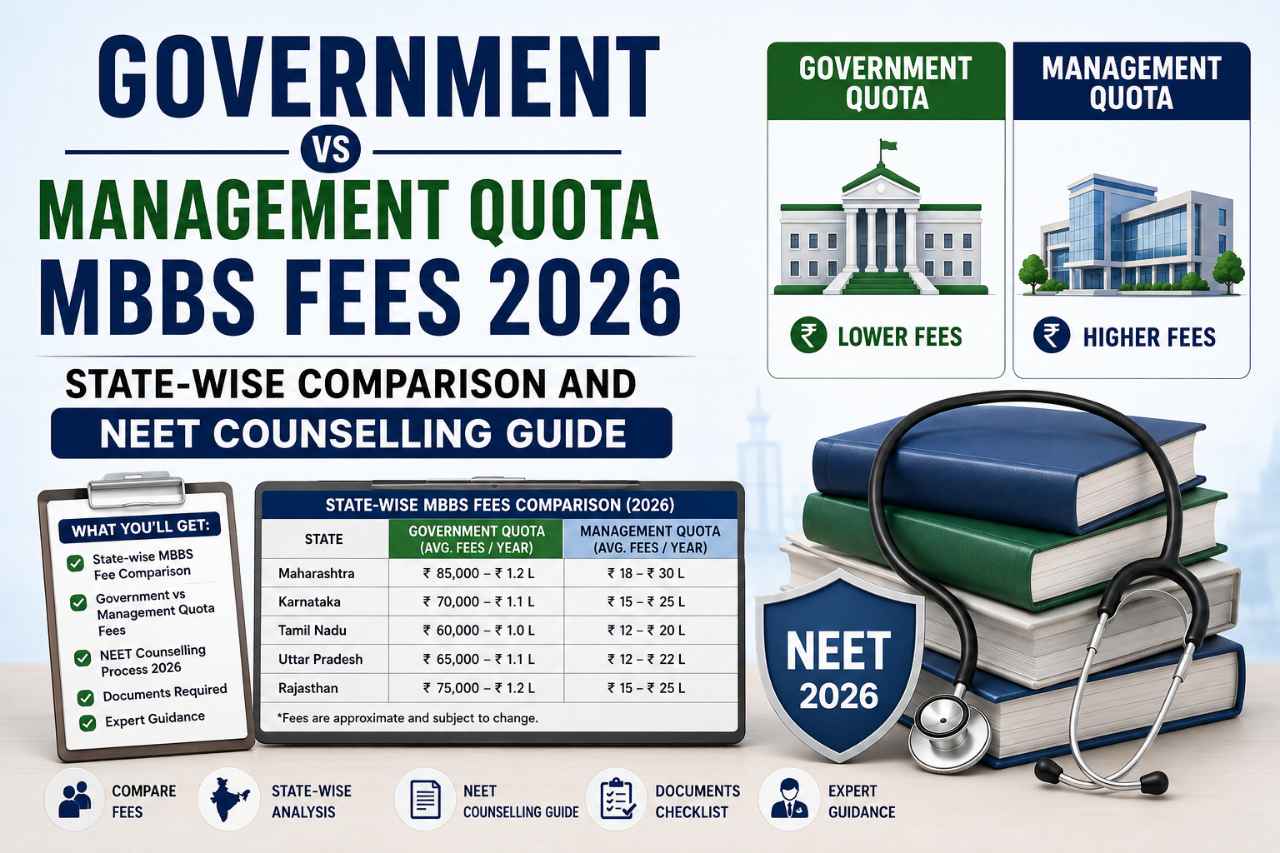
State-Wise Comparison: Government vs Management Quota MBBS Fees 2026
Fee bands below reflect annual tuition for indicative planning. Hostel, mess, university charges, deposits, and equipment costs are extra. Figures are compiled from state counselling notifications and published college fee structures for the 2026 admission cycle; always verify on the official portal before payment.
| State | Government Quota (Per Year) | Management Quota (Per Year) |
|---|---|---|
| Tamil Nadu | ₹11,000 (govt colleges) | ₹12 lakh – ₹13.5 lakh |
| Karnataka | ₹64,350 (govt); ~₹10.92 lakh (regulated private quota) | ₹10.92 lakh – ₹25 lakh+ |
| Maharashtra | ₹1.62 lakh (govt); ₹6.21L–₹15.57L (private regulated) | ₹6.2 lakh – ₹15.6 lakh (FRA-capped tiers) |
| Rajasthan | ₹70,340 | ₹18.9 lakh – ₹35 lakh |
| Madhya Pradesh | ₹60,000 | ₹7 lakh – ₹16 lakh |
| Telangana | ₹13,000 – ₹50,000 (govt) | ₹11.55 lakh – ₹14 lakh (Category B) |
| Andhra Pradesh | ₹13,000 – ₹50,000 (govt) | ₹11 lakh – ₹14 lakh |
| Kerala | ₹6 lakh – ₹7.5 lakh (private regulated) | ₹16 lakh – ₹22 lakh |
| Gujarat | ₹4 lakh – ₹6 lakh (regulated private) | ₹15 lakh – ₹19 lakh |
| Punjab / Haryana | ₹2 lakh – ₹3 lakh | ₹16 lakh – ₹22 lakh |
| West Bengal | ₹5,000 – ₹50,000 (govt) | ₹14 lakh – ₹17 lakh |
| Uttar Pradesh | ₹40,000 – ₹1.5 lakh (govt) | ₹12 lakh – ₹20 lakh |
| Delhi NCR | ₹5,000 – ₹1 lakh (govt/central institutes) | ₹15 lakh – ₹25 lakh (private NCR) |
Tamil Nadu: Lowest Government Tuition, Moderate Management Fees
Tamil Nadu government medical colleges charge among the lowest tuition in India—around ₹11,000 per year. Management quota seats in self-financing colleges typically fall in the ₹12–13.5 lakh range. For merit-strong candidates with Tamil Nadu domicile or eligible AIQ options, government seats offer exceptional value. The state's transparent fee committee process also makes it easier for parents to predict costs before counselling begins.
Karnataka: Structured Multi-Tier System via KEA
Karnataka is often cited for its transparent tier system through KEA (Karnataka Examinations Authority). Government college fees start near ₹64,350, while the widely quoted regulated private quota fee is around ₹10,92,852 per year at many colleges—making Karnataka a popular destination for all-India candidates who miss government seats but want regulated private fees. Management or other quota tiers can rise to ₹25 lakh or more at premium campuses in Bengaluru and coastal regions.
Maharashtra: FRA-Regulated Private Fees
Maharashtra uses a Fee Regulatory Authority (FRA) model. Government medical college tuition is roughly ₹1.62 lakh per year. Private college regulated seats range from about ₹6.2 lakh to ₹15.6 lakh, with management tiers capped at up to three times the open quota fee at many institutions. Mumbai, Pune, and Nagpur clusters dominate seat availability. Candidates should read the CAP seat matrix carefully because quota labels directly map to FRA-approved amounts.
Rajasthan: Wide Gap Between Govt and Management Tiers
Rajasthan illustrates one of India's sharpest fee gaps. Government quota tuition near ₹70,340 contrasts with management quota bands of ₹18.9 lakh to ₹35 lakh at private colleges in Jaipur, Udaipur, and Kota regions. Students exploring Rajasthan's higher education landscape—including institutions like Sawai Man Singh Government College Jaipur—should note that government-funded colleges across disciplines remain far more affordable than private medical seats in the same state.
Madhya Pradesh and Uttar Pradesh: Large Seat Pools, Varied Pricing
MP government MBBS fees hover around ₹60,000 per year, while management quota seats range from ₹7 lakh to ₹16 lakh. Bhopal, Indore, and Jabalpur host both government and private medical colleges. Uttar Pradesh offers a large number of private medical colleges with management fees between ₹12 lakh and ₹20 lakh, while government seats in colleges across Lucknow, Prayagraj, and Varanasi remain far cheaper. Both states publish updated fee lists on their medical education portals before each NEET round.
Southern and Western States: Telangana, Kerala, and Gujarat
Telangana's KNRUHS system splits private seats into Category A (government rate), Category B (management, roughly ₹11.55–14 lakh), and Category C (NRI). Kerala and Gujarat offer regulated private tiers in the ₹6–7.5 lakh and ₹4–6 lakh bands respectively, with management seats notably higher. Andhra Pradesh mirrors Telangana's broad structure, making the two Telugu-speaking states attractive for candidates seeking sub-₹15 lakh management tiers compared with North Indian premium colleges.
Total Course Cost: Government vs Management Quota
Looking at the full MBBS journey—not just Year 1—clarifies why quota choice matters:
- Government quota (govt college): Total tuition often ₹3 lakh – ₹8 lakh over 4.5 years
- Regulated private quota: Total tuition roughly ₹25 lakh – ₹50 lakh
- Management quota: Total tuition frequently ₹55 lakh – ₹1.35 crore
- NRI quota: Can exceed ₹1 crore in tuition alone at top deemed universities
Add hostel, mess, travel, and living expenses of ₹6–15 lakh over the course, and the financial spread becomes even wider. Families comparing MBBS with other professional degrees in metro cities should run this full-cost calculation early.
Hidden Costs Beyond Tuition: What Families Often Miss
Tuition is only part of the MBBS budget. Plan for these recurring and one-time expenses:
- Hostel and mess: ₹1.5 lakh – ₹3 lakh per year in most private colleges
- University and examination fees: ₹50,000 – ₹2 lakh (often front-loaded in Year 1)
- Books, instruments, and lab kits: ₹50,000 – ₹1 lakh annually in early years
- Refundable security deposit: ₹1 lakh – ₹3 lakh (one-time)
- NRI quota charges: Often USD 30,000–110,000 per year—highest tier at many colleges
Example: A management quota seat quoted at ₹18 lakh tuition may effectively cost ₹22–24 lakh per year once hostel, mess, and mandatory charges are included.
Education Loans, Bonds, and Service Rules
Many families financing management quota seats rely on education loans of ₹50 lakh to ₹1 crore. Public and private banks typically require a co-applicant with stable income and may ask for collateral on high-value loans. Compare interest rates, moratorium periods (often course duration plus 6–12 months), and prepayment terms before signing.
Some states attach service bonds to subsidised government seats—requiring rural posting for 1–3 years or paying a penalty of ₹10–50 lakh if you leave early. These bonds reduce upfront cost but limit immediate career mobility. Read bond clauses in the allotment letter before accepting any government or regulated seat.
How NEET UG 2026 Counselling Connects Quota Type to Fees
Your fee tier is determined by the seat you accept—not by a separate payment to an agent.
Step 1: MCC Counselling (Round 1 Onward)
MCC handles AIQ seats (15% in government colleges), central institutions (AIIMS, JIPMER, etc.), and all deemed university seats. AIQ government seats carry low tuition; deemed seats are typically expensive.
Step 2: State Counselling
Each state fills 85% government seats and most private seats. Domicile rules, reservation, and fee tiers vary. Register on your state portal immediately after NEET results.
Step 3: Understand Seat Matrix Codes
Prospectuses label seats as Government, Private (Regulated), Management, Institutional, NRI, or similar. The code in the seat matrix—not the college brochure headline—determines your fee.
Step 4: Upgradation and Free Exit
Use upgradation wisely in early rounds to move from expensive private tiers toward government seats. Know free-exit rules so you do not lose security deposits unnecessarily.
Government vs Management Quota: Quick Decision Framework
Use this framework before locking choices:
- Calculate total course cost, not just Year 1 tuition (multiply by 4.5 years plus hostel).
- Compare loan burden: Education loans for ₹60 lakh+ require strong co-applicant income and affect family finances for 10–15 years.
- Check bond and service rules: Some states impose rural service bonds on subsidised seats—factor opportunity cost.
- Verify NMC recognition and clinical load: A cheaper seat at a weak hospital attachment may cost more in PG preparation time.
- Keep realistic NEET rank benchmarks from last year's state merit lists for each quota tier.
Delhi NCR and Career Planning Beyond MBBS
Many NEET aspirants from Delhi NCR weigh medical fees against other professional degrees. While MBBS remains a separate admission track, families in the capital region often compare total education investment across fields. Delhi hosts numerous management and professional institutes—such as the Management Development Institute, Delhi School of Management, and International Management Institute IMI Delhi—where annual fees are high but still far below a management-quota MBBS at a premium NCR private medical college.
Students who pursue medicine and later consider hospital administration or healthcare MBA pathways sometimes explore programmes at institutions like Fore School Of Management Delhi, Lal Bahadur Shastri Institute Of Management, or Guru Gobind Singh Indraprastha University Management. These are separate career tracks, but understanding the full cost of an MBBS seat helps families make informed parallel plans.
In neighbouring Noida and Greater Noida, institutes such as Greater Noida Institute Of Management, Galgotias College Of Management, and Jagan Institute Of Management Studies Jims Rohini serve students who re-evaluate career options after competitive exam results. Institutes like New Delhi Institute Of Management and Maharaja Agrasen Institute Of Management Studies also illustrate how Delhi NCR families often weigh multiple higher-education pathways when NEET ranks do not align with affordable medical seats.
Red Flags: What to Avoid During MBBS Admission 2026
- "Direct admission" without NEET counselling: Illegal for MBBS seats.
- Unverified fee quotes from consultants: Always match against the state seat matrix.
- Donation demands outside notified fees: Report to NMC and state anti-ragging/fee cells.
- Confusing NRI quota eligibility: NRI seats have specific criteria; fake NRI claims can lead to cancellation.
- Ignoring bond penalties: Leaving a subsidised seat mid-course can trigger heavy fines.
Expert Tips for NEET 2026 Aspirants and Parents
Start fee research before NEET results. Build a spreadsheet with college name, quota type, Year 1 tuition, hostel, and total 4.5-year projection.
Prioritise government and regulated seats in choice filling. Even if your rank is borderline, list affordable regulated private seats above expensive management tiers unless budget is confirmed.
Use domicile strategically. States like Karnataka, Telangana, and Maharashtra have distinct rules for local vs all-India candidates—domicile can unlock lower fee tiers.
Plan education loans early. Compare interest rates, moratorium periods, and collateral requirements for loans above ₹40 lakh.
Keep documentary proof ready: Category certificates, domicile, income proof, and NEET scorecard—delays can cost a seat in fast-moving mop-up rounds.
Track official updates weekly during counselling season. Fee fixation orders, seat additions, and court stay orders can change available tiers overnight. Bookmark MCC, your state NEET portal, and NMC notifications.
Conclusion
Government quota MBBS seats in India remain the most affordable path to a medical degree, with annual tuition often under ₹1 lakh and total course tuition frequently below ₹8 lakh. Management quota seats at the same private institutions can cost ₹12 lakh to ₹30 lakh per year—or more in Rajasthan and premium deemed universities—pushing total investment beyond ₹60 lakh over 4.5 academic years.
For NEET UG 2026, success is not only about rank but about informed choice filling. Compare state-wise fee tables, read NMC and state notifications, budget for hidden costs, and treat every seat acceptance as a binding financial contract. Merit still opens the widest doors; planning ensures those doors lead somewhere your family can sustain.
Disclaimer: Fee figures are indicative for academic year 2026–27 based on published notifications and may change after state fee fixation orders. Always confirm on official MCC and state counselling websites before admission.