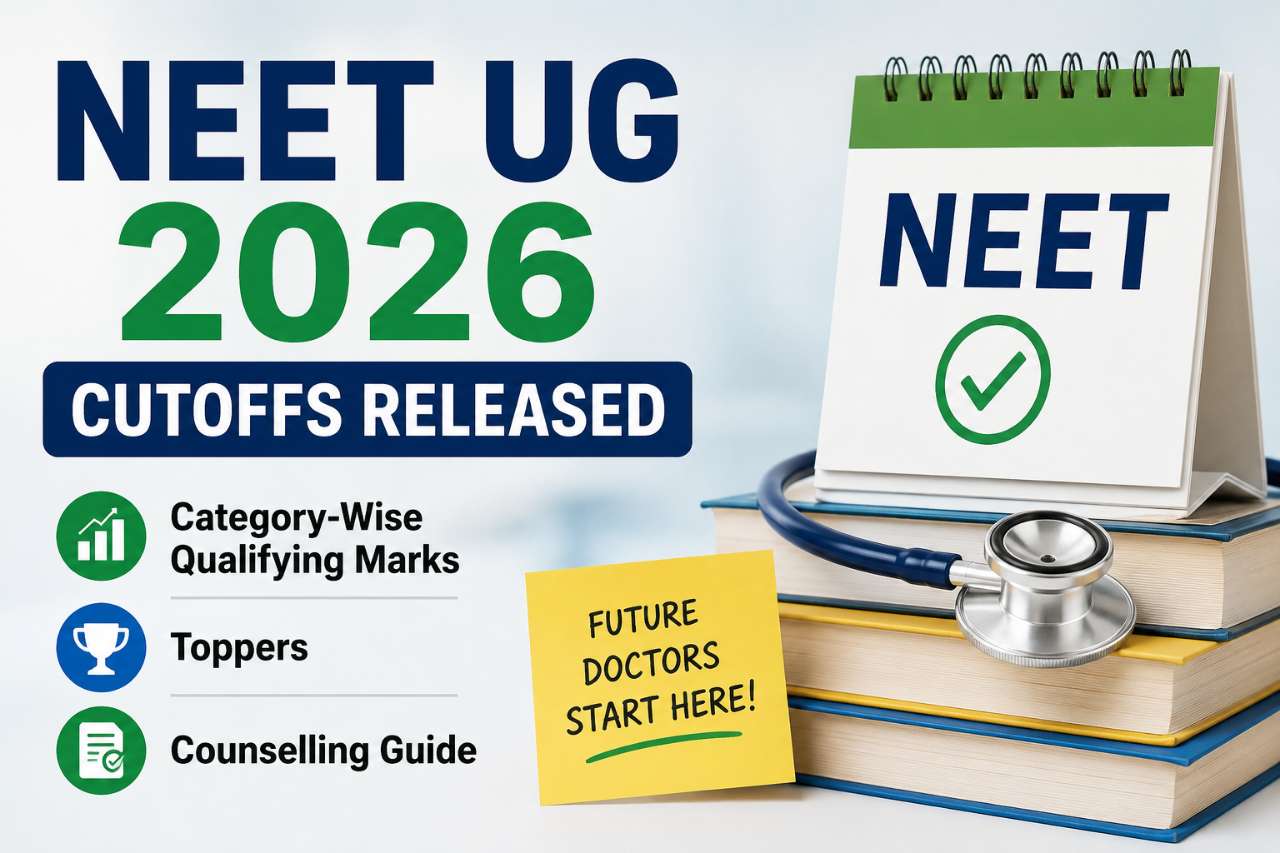

The National Testing Agency (NTA) has officially released the NEET UG 2026 result and category-wise qualifying marks on July 16, 2026, at neet.nta.nic.in. A total of 11.21 lakh candidates have cleared the qualifying threshold this year, making it one of the most competitive medical entrance cycles in recent memory. For students planning MBBS, BDS, AYUSH and other allied health programmes, understanding these cutoffs is the first step toward counselling and seat allotment.
If you are preparing for or tracking India's flagship medical entrance exam, our detailed NEET UG exam guide covers eligibility, syllabus, exam pattern and important dates in one place. The 2026 cutoff announcement marks a turning point: qualifiers from all 36 states and union territories can now download scorecards and begin planning their college preferences for the upcoming admission season.
NEET UG 2026 Result at a Glance
The NEET (National Eligibility cum Entrance Test) is the single gateway for undergraduate medical and dental admissions across India. Conducted by NTA, NEET UG evaluates candidates on Physics, Chemistry and Biology (Botany and Zoology) through 180 multiple-choice questions worth a maximum of 720 marks.
Key highlights from the NEET UG 2026 result declaration include:
- Result date: July 16, 2026
- Total qualifiers: 11,21,000 (approximately 11.21 lakh)
- Official portal: neet.nta.nic.in
- Highest marks scored: 715 out of 720 (joint toppers)
- Women representation: 58% of all qualified candidates
- Geographic reach: Qualifiers from every state and UT in India
NTA's role ends with result declaration and cutoff publication. Seat allocation, merit lists and admission counselling are handled separately by the Medical Counselling Committee (MCC), state authorities and AYUSH bodies topics covered later in this article.
NEET UG 2026 Category-Wise Qualifying Marks
Qualifying marks in NEET UG are not the same as College admission cutoffs. They represent the minimum score a candidate must achieve within their category to be declared eligible for counselling. NTA uses percentile-based criteria, which means the actual mark range can shift each year depending on overall exam difficulty and candidate performance.
The category-wise qualifying marks for NEET UG 2026 are as follows:
| Category | Qualifying Percentile | Qualifying Marks (out of 720) |
|---|---|---|
| Unreserved (UR) / General EWS | 50th percentile | 715 to 213 |
| OBC (Non-Creamy Layer) | 40th percentile | 212 to 177 |
| SC (Scheduled Caste) | 40th percentile | 212 to 177 |
| ST (Scheduled Tribe) | 40th percentile | 212 to 177 |
| UR-PwBD (Persons with Benchmark Disabilities) | 45th percentile | Refer to individual scorecard |
| OBC / SC / ST-PwBD | 40th percentile | Refer to individual scorecard |
Why the General Category Cutoff Reached 715
The upper limit of 715 marks for the General and EWS categories is historic. It equals the maximum possible score in NEET UG 2026, meaning the cutoff range now spans from a perfect score down to 213 marks. This is the highest General category qualifying range recorded in NEET UG history, reflecting extraordinary performance at the top end of the merit spectrum.
For context, when two or more candidates score the maximum marks, the percentile system still recognises them at the 100th percentile band. The lower bound of 213 marks indicates how far the qualifying threshold extended for General category students who cleared the 50th percentile requirement this year.
Reserved Category Cutoffs: OBC, SC and ST
Candidates belonging to OBC, SC and ST categories needed to secure marks between 212 and 177 to qualify, based on the 40th percentile criterion. While the percentile requirement is lower than the General category, competition for reserved quota seats during state and central counselling remains intense especially in popular government medical colleges.
Candidates claiming reservation benefits must ensure their category certificates, income certificates (for EWS and OBC-NCL) and other supporting documents are valid and match the details submitted during NEET registration. Discrepancies discovered during document verification at counselling can lead to seat cancellation.
NEET UG 2026 Toppers and Overall Performance Trends
This year's NEET UG result produced joint toppers Aryan Gupta and Panshul Bansal, each scoring a perfect 715 out of 720 marks. Their achievement underscores the exceptionally high calibre of top performers in the 2026 examination cycle.
Broader performance trends worth noting include:
- Gender representation: Women accounted for 58% of all qualified candidates a positive indicator of growing female participation in medical education.
- Score concentration at the top: Multiple high scorers above 690 marks were reported in this cycle, tightening competition for premier institutions such as AIIMS, JIPMER and top state government colleges.
- Pan-India qualification: Every state and union territory produced qualifiers, reflecting the nationwide reach of NEET as a standardised medical entrance examination.
Students aiming for postgraduate specialisation after completing MBBS will eventually appear for NEET PG, which follows a separate schedule and cutoff framework. Building a strong foundation during undergraduate years remains critical for that next milestone.
Category-Wise Qualified Candidate Count
Beyond cutoff marks, the distribution of qualified candidates across categories helps aspirants understand the competitive landscape during counselling. The approximate category-wise qualifier numbers for NEET UG 2026 are:
| Category | Candidates Qualified |
|---|---|
| General (Unreserved) | 2,91,000 (approx.) |
| Scheduled Caste (SC) | 1,59,000 (approx.) |
| Scheduled Tribe (ST) | 63,716 |
| General EWS | 95,026 |
| Persons with Benchmark Disabilities (PwBD) | 3,666 |
These figures highlight that while over 11 lakh candidates qualified, the number of MBBS seats available across government and private colleges is substantially lower typically in the range of approximately 1 lakh MBBS seats nationally. This supply-demand gap is precisely why even qualified candidates must strategise carefully during choice filling.
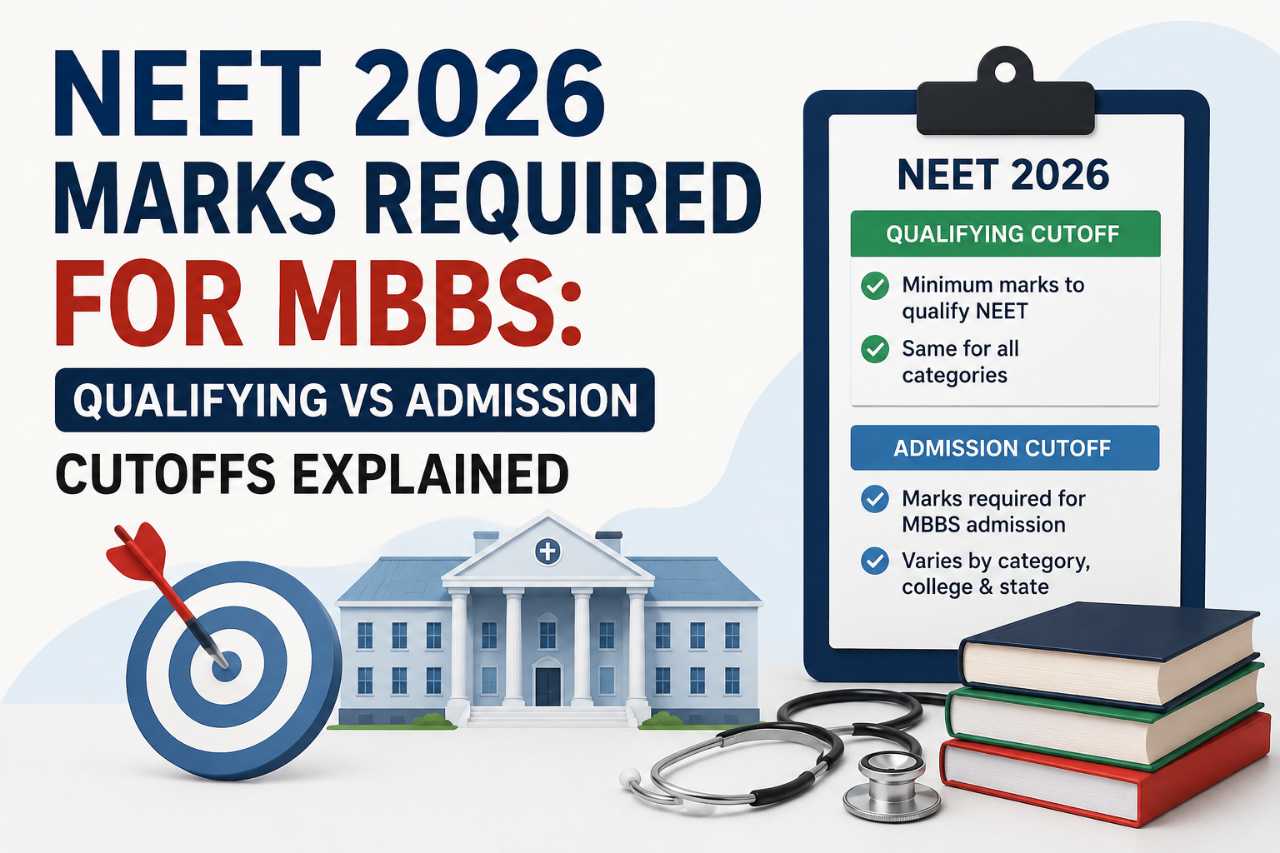
Qualifying Marks vs Admission Cutoff: Know the Difference
One of the most common misconceptions among first-time NEET aspirants and parents is confusing qualifying marks with college-specific admission cutoffs. These are fundamentally different benchmarks.
What Qualifying Marks Mean
Qualifying marks, announced by NTA along with the result, confirm that a candidate is eligible to participate in counselling. Clearing the qualifying threshold does not guarantee admission to any medical College. It simply means your name can appear in counselling merit lists managed by MCC, state authorities or AYUSH committees.
What Admission Cutoffs Mean
Admission cutoffs are the last rank or lowest marks at which a seat was allotted in a specific college, course and quota during a particular counselling round. These cutoffs vary based on:
- College reputation and location
- Seat quota (All India Quota vs State Quota)
- Category (General, EWS, OBC, SC, ST, PwBD)
- Course type (MBBS vs BDS vs AYUSH)
- Round number (Round 1 cutoffs are typically higher than mop-up rounds)
Practical example: A General category candidate scoring 400 marks has cleared the 2026 qualifying range (213–715) but may not secure a government MBBS seat in a top state like Maharashtra, Karnataka or Delhi. Conversely, a candidate scoring 650+ has strong chances at premier institutions during early MCC rounds. Always compare your score against previous years' closing ranks for your target colleges rather than relying solely on qualifying marks.
What Happens After NEET UG 2026 Result Declaration?
Once NTA publishes results and cutoffs, the admission process transitions to counselling authorities. Each body manages a specific seat pool and follows its own registration timeline, fee structure and choice-filling protocol.
| Course Stream | Counselling Authority | Seat Share |
|---|---|---|
| MBBS and BDS (All India Quota) | Medical Counselling Committee (MCC) at mcc.nic.in | 15% of government seats |
| MBBS and BDS (State Quota) | Respective State Counselling Authorities | 85% of government seats plus state private colleges |
| BAMS, BUMS, BSMS, BHMS (AYUSH) | AYUSH Admissions Central Counselling Committee (AACCC) | Central and participating state AYUSH institutions |
MCC Counselling for All India Quota
The Medical Counselling Committee (MCC) conducts online counselling for 15% All India Quota seats in government medical and dental colleges, along with seats in central institutions such as AIIMS, JIPMER, AFMC and ESIC medical colleges. Qualified candidates must register on mcc.nic.in, pay the counselling fee, complete choice filling and participate in each round they are eligible for.
Actionable tips for MCC counselling:
- Register immediately when the schedule is announced late registration means missed rounds.
- Research closing ranks of previous years for each college on your list.
- Fill choices in order of genuine preference, not just perceived prestige.
- Keep security deposit funds ready; refund timelines vary by round outcomes.
- Download allotment letters promptly and complete reporting within deadlines.
State Quota Counselling
The remaining 85% of government seats and most private college seats are allocated through state-level counselling. Each state whether Uttar Pradesh, Tamil Nadu, Rajasthan, West Bengal or others operates its own portal, domicile rules and fee policies. Candidates must register separately on their domicile state's counselling website even if they participate in MCC All India Quota rounds.
Important: Domicile requirements, reservation policies and private college fee structures differ significantly across states. Verify eligibility criteria on the official state portal before paying registration fees.
AYUSH Course Counselling
Candidates interested in BAMS, BHMS, BUMS or BSMS programmes must follow the AACCC counselling process. AYUSH admissions run on a parallel track to MBBS/BDS counselling, with separate registration, choice filling and seat allotment rounds. Many students who qualify NEET UG pursue AYUSH courses as a meaningful alternative pathway into regulated medical practice.
Why the 2026 Cutoff Rise Matters for Aspirants
The elevated General category qualifying range signals sharper competition for MBBS and BDS seats in the 2026–27 admission cycle. Several factors contribute to this trend:
- Improved coaching access: Wider availability of online test series, mock exams and structured preparation platforms has raised average scores nationwide.
- Increased attempt count: Repeat candidates with prior NEET experience often score higher in subsequent attempts.
- Concentrated top performance: A larger pool of candidates scoring above 600 and 650 marks pushes closing ranks upward at elite institutions.
- Growing applicant base: NEET remains the sole entry point for undergraduate medical education in India, keeping applicant volumes consistently high.
For students who cleared the exam, this environment makes realistic college list planning essential. Include a mix of ambitious, moderate and safe choices based on verified previous-year data rather than assumptions.
Action Plan for NEET UG 2026 Qualified Candidates
If you have qualified NEET UG 2026, the weeks following result declaration are among the most consequential in your admission journey. Follow this structured action plan:
- Download and verify your scorecard from neet.nta.nic.in immediately. Check your name, category, marks, percentile and application number for accuracy.
- Calculate your All India Rank (AIR) and category rank these determine your position in counselling merit lists.
- Shortlist target colleges across government, private and deemed universities based on your rank, budget and location preferences.
- Register on MCC portal (mcc.nic.in) when All India Quota counselling opens.
- Register on your state counselling portal for 85% state quota and private college seats.
- Prepare documents: Class 10 and 12 mark sheets, NEET admit card, scorecard printout, category certificate (if applicable), photo ID, domicile proof and passport-size photographs.
- Arrange finances: Keep counselling registration fees, security deposits and college tuition fee estimates ready.
- Track official notifications daily on MCC, state portals and AACCC websites until seat allotment is complete.
Document Checklist for Counselling
- NEET UG 2026 scorecard and admit card
- Class 10 certificate for date of birth proof
- Class 12 mark sheet and passing certificate
- Category certificate (SC/ST/OBC-NCL/EWS) in prescribed format
- PwBD certificate (if applicable) from designated medical authority
- Domicile or residence proof for state quota
- Identity proof (Aadhaar, passport or voter ID)
- Recent passport-size photographs
Options If You Did Not Qualify NEET UG 2026
Not clearing NEET can feel discouraging, but it does not close the door on a successful career. Many students explore alternative pathways aligned with their interests and strengths:
- Reattempt NEET UG: Analyse subject-wise weaknesses using your scorecard and create a focused preparation plan for the next cycle. Review our NEET UG preparation resources for structured guidance.
- AYUSH and allied health courses: Some programmes have separate or lower entry requirements; research institution-specific criteria.
- Paramedical and nursing programmes: B.Sc Nursing, BPT and related courses offer strong healthcare career paths.
- Management and commerce: Students pivoting away from science careers may consider entrance exams like CAT for MBA and PGDM programmes at leading business schools.
- Arts and humanities: Pursuing an MA (Master of Arts) or related undergraduate degrees opens careers in education, public policy, media and research.
Choosing an alternative path is not a setback it is a strategic decision based on updated priorities, aptitude and long-term goals.
Key Dates and Portals to Bookmark
Staying informed through official channels protects you from misinformation during the hectic post-result period. Bookmark these portals:
- NEET UG result and scorecard: neet.nta.nic.in
- All India Quota counselling: mcc.nic.in
- State counselling: Your respective state's medical education/counselling authority website
- AYUSH admissions: AACCC official portal (aayushcounselling.nic.in during active sessions)
Avoid relying on unverified social media posts for registration deadlines. Always cross-check dates on official government websites.
Conclusion
The NEET UG 2026 cutoff announcement confirms a landmark result cycle: 11.21 lakh qualifiers, a historic General category range of 715 to 213 marks, and joint toppers scoring a perfect 715. For candidates who cleared the examination, the focus now shifts entirely to counselling strategy registering on MCC and state portals, filling choices wisely and keeping documents ready for verification.
Remember that qualifying marks open the door to counselling, but your All India Rank, category rank and college preferences ultimately determine where you study. Use previous years' closing rank data, maintain realistic choice lists and track every official notification through July and August 2026. Whether you are aiming for a government MBBS seat through All India Quota, exploring state private colleges, or considering AYUSH programmes, informed planning today prevents costly mistakes during seat allotment tomorrow.
For ongoing updates on eligibility, exam pattern and preparation strategies, continue following our NEET exam hub and the dedicated NEET UG page on CollegeDwar.