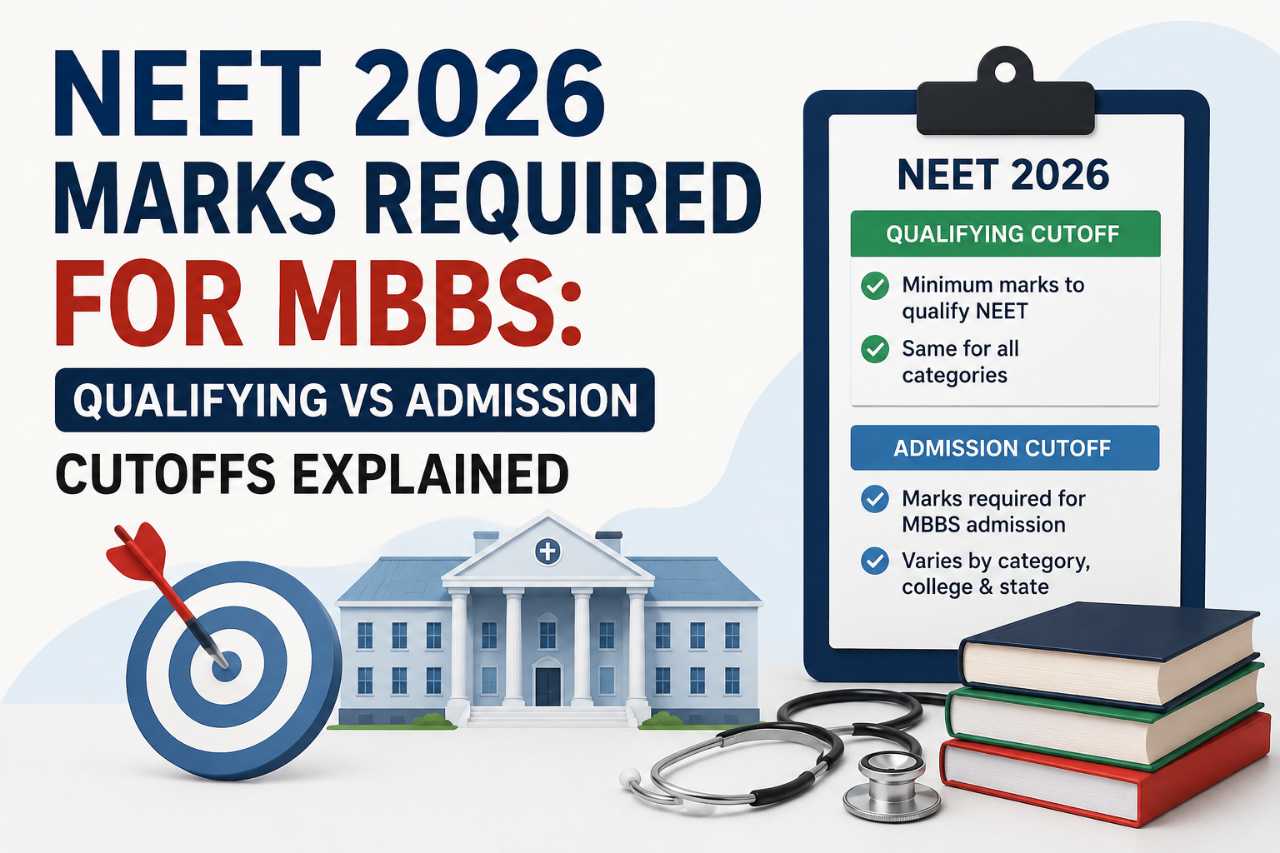

If you are preparing for medical entrance in India, one question keeps coming up: how many marks are required in NEET for MBBS in 2026? The honest answer is that it depends on what you mean by "required." Clearing the exam is very different from securing a seat in a government medical college. Thousands of students qualify every year but still miss out on MBBS admission because they aimed only for the minimum passing score.
This guide breaks down NEET UG qualifying marks, admission cutoffs, rank trends, and practical target scores for MBBS aspirants. Whether you are in Class 12, a dropper, or a parent helping your child plan, the goal is simple: set a realistic score target before counselling begins not after results are out.
Every year, more than 20 lakh students register for NEET, but only a fraction secure government MBBS seats. Understanding the gap between qualifying and admission cutoffs is the first step toward building a preparation plan that actually matches your college ambitions.
NEET 2026 Qualifying Marks for MBBS: Category-Wise Breakdown
The National Testing Agency (NTA) does not fix absolute passing marks in advance. Instead, NEET uses a percentile-based qualifying cutoff. Your score is compared with all candidates, and only those above the prescribed percentile become eligible for counselling.
Based on NEET 2024–2025 trends, the expected NEET 2026 qualifying ranges are:
- General / EWS: 50th percentile — roughly 135 to 145 marks (out of 720)
- OBC / SC / ST: 40th percentile — roughly 110 to 120 marks
- General-PwD: 45th percentile — roughly 120 to 135 marks
- OBC/SC/ST-PwD: 40th percentile — roughly 110 to 125 marks
These figures are estimates. The official NEET 2026 qualifying cutoff will be announced only after results are declared. Treat them as planning references, not guarantees.
NEET 2026 Expected Qualifying Marks Table
| Category | Qualifying Percentile | Expected Marks Range (out of 720) |
|---|---|---|
| General / EWS | 50th percentile | 135 – 145 |
| OBC | 40th percentile | 110 – 120 |
| SC | 40th percentile | 110 – 120 |
| ST | 40th percentile | 110 – 120 |
| General-PwD | 45th percentile | 120 – 135 |
| OBC/SC/ST-PwD | 40th percentile | 110 – 125 |
The wide mark ranges in official NEET results (for example, 686–144 for General in some years) reflect percentile calculation across the entire candidate pool, not a fixed passing score. What matters for MBBS is where your score places you in the rank list.
Important Points About NEET Qualifying Marks
- Qualifying in NEET only makes you eligible for counselling; it does not reserve an MBBS seat.
- The qualifying threshold is usually far below the marks needed for government colleges.
- Even reserved-category students should aim well above the minimum to stay competitive in state and All India Quota (AIQ) rounds.
- NTA publishes category-wise cutoff scores along with the result—always verify the official notification.
Qualifying Marks vs Admission Cutoff: The Difference Every Aspirant Must Know
Confusion between these two terms causes poor planning every year. Here is the distinction in plain language:
Qualifying marks are the minimum NEET score needed to pass the exam and enter the counselling process. If you score below this, you cannot participate in MBBS seat allotment for that year.
Admission cutoff is the closing score or rank at which a specific college filled its last seat in a given counselling round. This number is always higher—often dramatically higher—than the qualifying cutoff.
Example: A General category student may qualify with around 140 marks but need 600+ marks to secure a seat in a reputed government medical college. That gap explains why "I passed NEET" and "I got MBBS admission" are not the same statement.
Previous Year NEET Cutoffs for MBBS: What Past Data Tells Us
Historical cutoffs help you estimate NEET 2026 marks required for MBBS, especially in government institutions. While exact numbers change every year, the pattern is consistent: top colleges demand top scores.
NEET 2025 Qualifying Cutoff (Reference)
- UR/EWS: 50th percentile — cutoff score around 144
- OBC/SC/ST: 40th percentile — cutoff score around 113–133
- UR/EWS-PwD: 45th percentile
- OBC/SC/ST-PwD: 40th percentile
Marks vs Rank: NEET 2025 Trend
Your rank matters more than raw marks during counselling. Approximate NEET 2025 rank ranges were:
- 686–651 marks: Rank 1 to 73
- 650–600 marks: Rank 74 to around 1,259
- 600–551 marks: Rank around 1,260 to 10,658
For General category students targeting government MBBS, scores above 550 often remain competitive in several states, while 600+ opens doors to stronger colleges and early counselling rounds.
Rajasthan Government Medical Colleges: NEET 2025 Closing Ranks
Rajasthan is a useful benchmark because it has multiple government MBBS colleges and attracts students from coaching hubs like Kota and Sikar. NEET 2025 closing ranks (indicative) included:
- Sawai Man Singh Medical College, Jaipur: Closing rank around 2,363
- RUHS College of Medical Sciences, Jaipur: Closing rank around 3,572
- Sardar Patel Medical College, Bikaner: Closing rank around 4,616
- Government Medical College, Kota: Closing rank around 7,809
- Jawaharlal Nehru Medical College, Ajmer: Closing rank around 7,073
Students preparing in Kota often benchmark against colleges like Government Medical College Kota. Kota remains one of India's largest NEET preparation hubs, where residential coaching and structured test series shape student expectations early. Alongside dedicated NEET institutes, the city also hosts broader academic institutions such as MD Mission College Kota, SRD Modi College for Women Kota, and International Academy for Certification and Training Kota. Regardless of where you study, the takeaway is the same: coaching cities produce high scorers, which pushes national cutoffs upward even when the paper difficulty stays moderate.
Expected NEET 2026 Cutoff for Government MBBS Colleges
No one can predict NEET 2026 admission cutoffs with certainty before the exam. However, based on seat availability, competition, and recent trends, these ranges are reasonable working estimates for planning:
- Top-tier government colleges (General): 650–690 marks
- Mid-tier state government colleges (General): 580–630 marks
- Lower-tier or remote government colleges (General): 500–580 marks
- OBC / EWS (mid-tier colleges): 530–600 marks
- SC / ST: 350–500 marks, with wide state-wise variation
Category-Wise Expected Admission Ranges (2026 Projection)
Top-tier government college, General (UR): 650–690 marks for premier institutions in highly competitive states and AIQ seats.
Mid-tier government college, General (UR): 580–630 marks for many state-level medical colleges.
Lower-tier / remote government college, General (UR): 500–580 marks where competition is comparatively lower.
Reserved categories: Cutoffs depend on state reservation policy, seat matrix, and candidate pool. Always check your domicile state's previous-year allotment data.
Minimum NEET Marks for MBBS: Government vs Private Colleges
Students frequently ask how many marks are required in NEET for MBBS in government college versus private college. The gap is significant.
Government Medical Colleges
- General category: Often 580–650+ marks depending on state and college reputation
- OBC / EWS: Typically 30–70 marks below General closing scores in the same college
- SC / ST: Lower cutoffs, but top government seats still require strong preparation
Private Medical Colleges
- General category: Often 350–500+ marks for many private institutions, though popular colleges charge higher fees and may close at stronger scores
- Management / NRI quotas: May have separate fee structures and cutoffs
- Deemed universities: Cutoffs vary widely; research college-wise data before choosing
Private MBBS is an option when government seats are out of reach, but consider tuition, hostel costs, bond conditions, and long-term career plans. After MBBS, specialization requires another competitive exam NEET PG so your foundation in undergraduate years still matters.
Factors That Change NEET 2026 Marks Requirements
The "required marks" for MBBS are not fixed. They shift based on:
- Exam difficulty: A tougher NEET paper usually lowers cutoffs; an easier paper pushes them up.
- Number of applicants: More candidates generally increase competition.
- Seat matrix changes: New government colleges or increased seats can ease cutoffs in some states.
- State domicile rules: Home-state students may benefit from state quota seats.
- Reservation policy: Category-wise seat distribution directly affects closing ranks.
- Counselling round: Round 1 cutoffs are usually highest; later rounds may dip slightly.
- Choice filling strategy: Smart college ordering can secure a seat at a modest rank.
A score that secured government MBBS in one state may fall short in another. Always analyse state-specific data, not national averages alone.
AIQ vs State Quota: How Counselling Affects Required Marks
MBBS seat allotment in India runs through multiple counselling channels, and each channel has its own cutoff behaviour. Understanding this helps you interpret why the same NEET score leads to different outcomes for different students.
All India Quota (AIQ)
MCC conducts AIQ counselling for 15% of government seats in participating states (except some exempt states). AIQ cutoffs are typically higher than state quotas because the applicant pool is national. Top AIQ seats often close within the first few thousand ranks for General category candidates.
State Quota
Remaining government seats are filled through state counselling authorities. Domicile requirements apply in most states, which reduces competition for resident students. A student scoring 590 may miss an AIQ seat but still secure a government MBBS seat under Rajasthan, Uttar Pradesh, or Madhya Pradesh state quota—depending on that year's seat matrix.
Deemed and Private Universities
Deemed universities conduct their own counselling under MCC, while private colleges follow state or consortium processes. Fees range widely—from under ₹10 lakh total in some institutions to ₹1 crore or more in premium private medical colleges. Lower admission cutoffs do not always mean affordable education, so research fee structures alongside closing ranks.
State-Wise Variation: Why One Score Works in One State but Not Another
India's federal admission structure means NEET marks hold different value across states. Key reasons for variation include:
- Seat density: States like Tamil Nadu, Karnataka, and Maharashtra have more medical colleges, which can moderate cutoffs.
- Competition intensity: Delhi, Rajasthan, and Uttar Pradesh see large applicant volumes relative to seats.
- Domicile protection: Up to 85% seats may be reserved for state residents in state quota.
- New college openings: When new government medical colleges launch, closing cutoffs in that state often dip for 1–2 years.
Before setting your NEET 2026 target, download the previous year's state counselling PDF for your home state. Search for your category's closing rank in at least five colleges you would realistically attend.
Recommended Target Marks for NEET 2026 MBBS Aspirants
Instead of aiming for the bare qualifying score, use these practical targets:
- General / EWS: Aim for 600+ marks as a safe zone for government MBBS chances in most states
- OBC: Target 550–600+ marks depending on your state
- SC / ST: Target 450–500+ marks, and higher if you want top-tier colleges
- All categories: Add a 20–30 mark buffer above last year's closing cutoff of your dream college
If you are studying in a competitive preparation cluster whether in Kota, Sikar, Delhi, or Hyderabad peer scores are often high. That raises percentiles even when the paper is moderate. Students in Sikar's academic environment, near institutions like Shekhawati College for Education Losal Sikar, should remember that local coaching strength does not reduce the national competition in NEET.
Subject-Wise Preparation Tip for Score Building
NEET 2026 is expected to remain moderately difficult overall: Physics typically feels toughest, Chemistry is concept-heavy, and Biology carries the highest weight (90 questions). Since Biology alone is 360 marks, scoring 300+ in Biology is often the fastest way to cross 600 overall.
NEET 2026 Exam Pattern: What Has Stayed the Same
For aspirants worried about pattern changes, NEET 2026 is expected to follow the established post-COVID format:
- Total questions: 180 MCQs
- Subjects: Physics (45), Chemistry (45), Biology (90)
- Total marks: 720
- Duration: 3 hours (180 minutes)
- Marking: +4 for correct, −1 for incorrect, 0 for unattempted
- Language options: Multiple regional languages plus English and Hindi
Understanding the pattern helps you convert attempts into marks more efficiently critical when cutoffs are decided by rank, not effort alone.
How to Score 500+, 600+, and 650+ in NEET 2026
Marks milestones are useful because they map roughly to admission tiers. Here is what each benchmark typically represents:
500+ Marks: Foundation for MBBS Admission
Scoring 500+ means roughly 125 correct answers with controlled negative marking. This range can unlock MBBS seats in some private colleges and lower-tier government institutions for reserved categories. To reach 500+, master NCERT Biology thoroughly, secure easy Chemistry chapters (Biomolecules, Polymers, Chemistry in Everyday Life), and avoid reckless guessing in Physics.
600+ Marks: Competitive Government MBBS Zone
600 marks require about 150 correct answers with limited errors—roughly 75% accuracy across 200 worthwhile attempts. At this level, students typically have strong Biology (270+), decent Chemistry (130+), and functional Physics (100+). Daily timed practice, full-length mocks twice a week, and error notebooks are non-negotiable at this stage.
650+ Marks: Top-Tier College Territory
650+ places you among the top fraction of NEET candidates. This demands near-complete NCERT command, advanced problem practice in Physics, and exceptional speed in Biology. Students targeting 650+ should minimise unforced negative marks by attempting only well-reasoned questions in uncertain Physics and Chemistry items.
NEET 2026 Counselling Timeline: When Cutoffs Matter
Marks become seats only during counselling. The typical annual sequence after NEET results is:
- Result and answer key: NTA releases scores, ranks, and qualifying cutoffs.
- AIQ Round 1–Mop-up: MCC allots 15% government seats and deemed university seats.
- State Round 1–Stray vacancy: State authorities allot 85% government seats and most private seats.
- Reporting and admission: Document verification at allotted colleges.
Cutoffs usually drop slightly between Round 1 and later rounds as candidates move to allotted seats and vacancies open. However, relying on stray-round luck is risky—most students should target Round 1–ready scores.
How to Use NEET Marks Estimates While Planning MBBS Admission
Follow this structured approach so your preparation aligns with real admission outcomes:
- Set a qualifying baseline: Know category-wise minimums, but never stop there.
- Shortlist target colleges: Pick 5–10 government and private colleges across tiers.
- Study previous cutoffs: Use last 2–3 years' closing ranks for each college and quota.
- Calculate your buffer: Aim 20–30 marks above the highest cutoff in your shortlist.
- Track mock test ranks: Compare Allen/Aakash/residential test ranks with historical NEET ranks.
- Plan counselling paths: AIQ, state quota, deemed universities, and private options.
- Keep financial backup ready: Private MBBS costs vary from lakhs to over a crore for the full course.
Common Mistakes Students Make When Estimating NEET Marks
- Confusing qualify with admit: Passing NEET does not mean MBBS admission.
- Ignoring state quota: Domicile rules can dramatically change your chances.
- Using one college's cutoff nationally: AIIMS-level data does not apply to every government college.
- Waiting for result day to plan: College research and fee planning should start months earlier.
- Skipping mock test analysis: Score improvement comes from reviewing errors, not just taking tests.
Conclusion: How Many Marks Are Required in NEET 2026 for MBBS?
To answer the headline question directly: at minimum, General category students need roughly 135–145 marks to qualify NEET 2026, while reserved categories need roughly 110–120 marks but those numbers only open the counselling door. For government MBBS, General aspirants should realistically target 600+ marks, with 580+ sometimes working in select states and college tiers. For private MBBS, cutoffs may start lower, but costs and college quality vary widely.
The smartest strategy is to separate three goals: qualify NEET, score high enough for your preferred college tier, and prepare counselling options in advance. Use official NTA data when it releases, cross-check state counselling portals, and build your study plan around rank and college cutoffs—not just passing marks.
Start early, track your mock scores against real cutoffs, and keep at least one backup admission path ready. Whether you dream of AIIMS-level institutions or a trusted state government college, the marks you need in NEET 2026 will always be higher than the marks needed to simply qualify. Plan for admission not just participation and you will enter counselling with clarity instead of confusion.