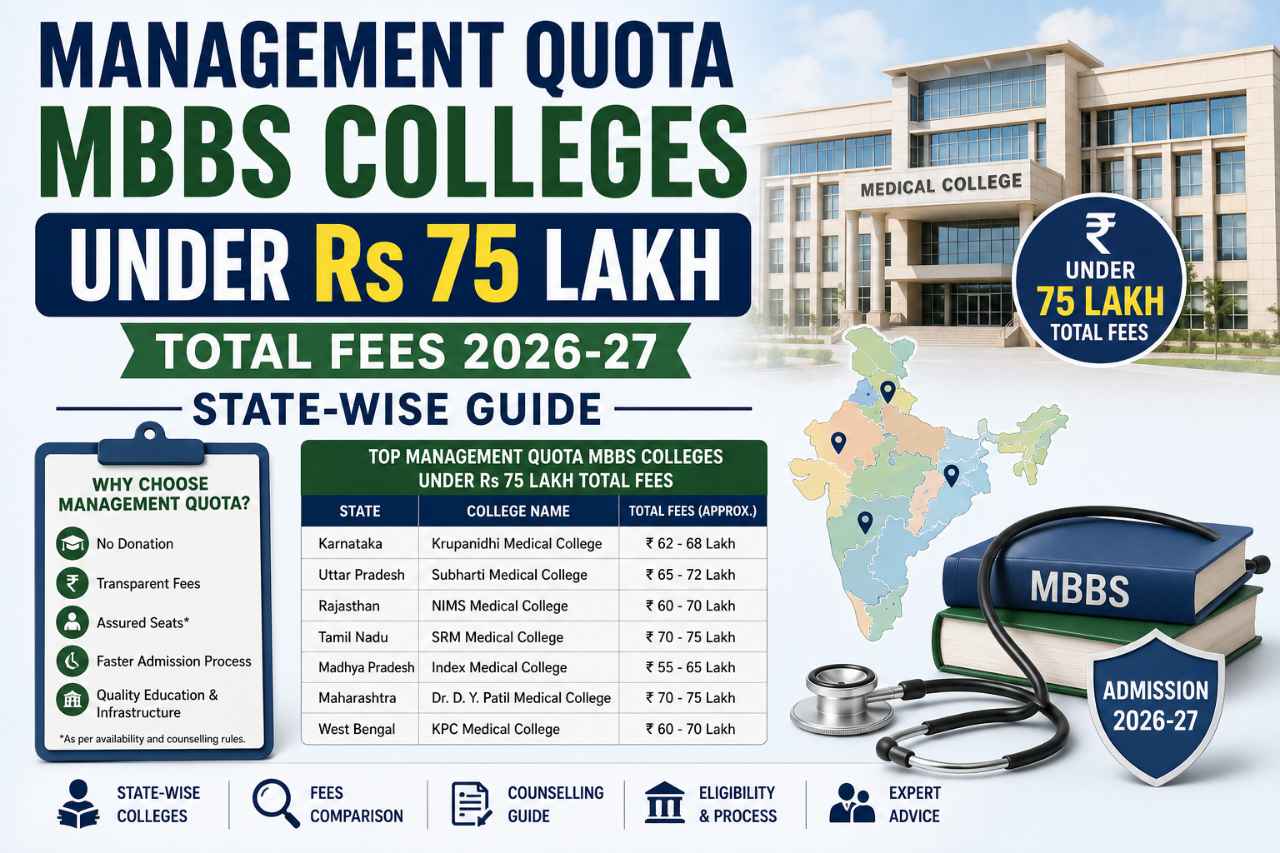

For NEET UG 2026 aspirants who miss government medical college cutoffs but still want an MBBS degree without spending more than Rs 1 crore, management quota seats in NMC-approved private and deemed institutions offer a practical middle path. Under the National Medical Commission fee framework for 2026-27, several colleges across Kerala, Karnataka, Bihar, Uttar Pradesh, and Jharkhand keep total course fees under Rs 75 lakh for the full 4.5-year programme (including internship, where applicable).
This guide explains what management quota means, which states offer the most affordable options, how fees compare with merit and NRI seats, and the step-by-step admission process. Whether you are counselling in Kerala, exploring Tier-2 Karnataka colleges, or comparing options near Government Medical College Kota, use this as a planning reference — always verify the latest fee order on official state FRA and college portals before paying any amount.
What Is Management Quota in MBBS?
Management quota refers to a fixed percentage of MBBS seats in private and deemed medical colleges that institutions fill at a fee higher than government-regulated merit seats but typically lower than NRI quota rates. The NMC permits colleges to reserve roughly 15% to 35% of seats under this category, subject to state Fee Regulatory Authority (FRA) approval.
Important clarification: management quota is not admission without NEET. Every candidate must qualify NEET UG 2026 and participate in state counselling or the college's authorised admission process. Cutoffs for management seats are usually lower than open merit seats in the same college, which makes them attractive for students with moderate NEET scores who can manage higher tuition.
How Management Quota Differs From Merit and NRI Seats
- Merit seats: Allotted through state NEET counselling at FRA-capped fees; highest competition and lowest cutoffs.
- Management quota: Open to Indian citizens with valid NEET scores; fees are higher but often stay within Rs 75 lakh total in select states.
- NRI quota: Requires NRI or OCI eligibility proof; annual fees frequently exceed Rs 20–25 lakh, pushing total course cost above Rs 1 crore.
Under the 2022 NMC regulation, up to 50% of seats in private medical colleges must follow the government fee structure of the state. The remaining seats—including management and NRI—can be priced differently. Students targeting budget-friendly private MBBS should prioritise states where FRAs actively cap annual tuition.
NMC Fee Rules for MBBS 2026-27: What Changed
The National Medical Commission has tightened fee transparency for the 2026-27 academic session. Key points every aspirant should note:
- State FRAs (Fee Regulatory Authorities) approve annual tuition for private medical colleges before admissions open.
- Annual tuition in budget-friendly states ranges from approximately Rs 8 lakh to Rs 22 lakh for management quota.
- Internship year: Under updated NMC norms, the compulsory rotatory internship year no longer carries tuition fees at many institutions — a significant saving compared to older fee structures.
- Total course cost must be calculated for 4.5 years (four academic years plus internship), including hostel, caution deposit, and university charges.
Always cross-check the approved fee on the NMC website (nmc.org.in) and the respective state medical counselling portal. Fee orders can differ between academic years, and colleges in the same city may charge vastly different amounts.
State-Wise Management Quota Fee Range Under Rs 75 Lakh
Not every state keeps management quota MBBS within Rs 75 lakh. Rajasthan's top private colleges, for instance, often charge Rs 26–35 lakh per year, pushing totals above the budget. However, Kerala consistently offers the lowest management quota fees in India, while Bihar, Jharkhand, Uttar Pradesh, and Tier-2 Karnataka cities provide strong value.
| State | Annual Tuition (Rs Lakh) | Approx. Total 4.5-Year Fee (Rs Lakh) |
|---|---|---|
| Kerala | 15 – 22 | 67 – 75 |
| Bihar | 8 – 15 | 36 – 67 |
| Uttar Pradesh | 10 – 16 | 45 – 72 |
| Jharkhand | 10 – 15 | 45 – 67 |
| Karnataka (Tier-2 cities) | 11 – 15 | 49 – 67 |
Kerala: Lowest Management Quota Fees in India
Kerala's FRA maintains relatively strict fee caps on private medical colleges. Annual management quota tuition typically falls between Rs 15 lakh and Rs 22 lakh, keeping the full programme near the Rs 75 lakh ceiling. Colleges in Kochi, Thrissur, and Palakkad participate in Kerala NEET UG counselling. Students from other states can apply under All India or management categories depending on seat matrix rules.
Action tip: Register on the Kerala Commissioner for Entrance Examinations (CEE) portal immediately after NEET results. Kerala fills management seats quickly due to high demand from South Indian aspirants.
Karnataka: Tier-2 Cities Offer Best Value
While Bengaluru deemed universities may exceed Rs 1 crore total, Tier-2 Karnataka colleges in Mangalore, Mysuru, and smaller cities keep fees manageable. Representative annual tuition ranges:
- KMC Mangalore: Rs 15–18 lakh per year
- JSS Medical College, Mysuru: Rs 13–15 lakh
- Father Muller Medical College: Rs 12–14 lakh
- AJ Institute of Medical Sciences: Rs 11–14 lakh
- Sapthagiri Medical College: Rs 11–14 lakh
Total 4.5-year costs at these institutions often stay under Rs 70 lakh before hostel extras. Confirm the latest KEA (Karnataka Examinations Authority) fee schedule before choice filling.
Bihar, Uttar Pradesh, and Jharkhand: Budget-Friendly Options
These states host several private medical colleges with annual tuition between Rs 8 lakh and Rs 16 lakh. Institutions such as Rama Medical College (UP) and Hind Institute of Medical Sciences (UP) are frequently cited for lower fee brackets. Bihar and Jharkhand counselling portals publish seat matrices showing management quota availability college-wise.
Students from Delhi NCR sometimes explore UP colleges as a cost-effective alternative to capital-region private institutes, where even management seats can be substantially pricier. For context, premier government institutions like Maulana Azad Medical College (MAMC) Delhi, Vardhman Mahavir Medical College (VMMC) Delhi, and University College of Medical Sciences (UCMS) Delhi charge minimal government fees — but their NEET cutoffs are among the highest in India.
Rajasthan: Select Colleges Within Budget
Rajasthan is a mixed picture. Many Jaipur and Kota private colleges charge Rs 26–35 lakh annually, crossing Rs 75 lakh easily. However, aspirants should monitor FRA notifications for newer or Tier-2 institutions that may offer lower management fees. Government options such as Government Medical College Kota and Shri Kalyan Government Medical College Sikar remain the most affordable path for Rajasthan domicile students who secure merit seats through REAP counselling.
Private alternatives in the Kota region — including Sudha Medical College and Hospital Kota and United Medical College — should be evaluated individually. Compare total package costs, hospital attachment quality, NMC recognition status, and previous years' NEET cutoff trends before committing. The Sikar belt, known for coaching hubs and emerging healthcare infrastructure near Sikar College of Management Sikar, is also drawing students seeking affordable education clusters in Rajasthan.
Key Colleges Offering Management Quota Under Rs 75 Lakh
Beyond state-level averages, these NMC-approved institutions are commonly referenced for management quota fees within the Rs 75 lakh total budget. Always reconfirm figures on official portals before counselling:
| College | State | Annual Fee (Rs Lakh) |
|---|---|---|
| KMC Mangalore | Karnataka | 15 – 18 |
| JSS Medical College, Mysuru | Karnataka | 13 – 15 |
| Father Muller Medical College | Karnataka | 12 – 14 |
| AJ Institute of Medical Sciences | Karnataka | 11 – 14 |
| Sapthagiri Medical College | Karnataka | 11 – 14 |
| Rama Medical College | Uttar Pradesh | 10 – 14 |
| Hind Institute of Medical Sciences | Uttar Pradesh | 10 – 15 |
Karnataka Tier-2 colleges dominate this list because they combine established hospital infrastructure with FRA-regulated pricing. Kerala colleges may not always appear in public fee tables, but their totals consistently approach — without exceeding — the Rs 75 lakh mark when hostel is excluded.
Management Quota vs NRI Quota: Key Differences
Confusion between these two quotas causes costly admission mistakes every year. Here is a clear comparison:
| Parameter | Management Quota | NRI Quota |
|---|---|---|
| Eligibility | Indian citizens with NEET UG score | NRI/OCI/foreign national criteria |
| Typical annual fee | Rs 8 – 22 lakh (state-dependent) | Rs 20 – 35+ lakh |
| Total course budget | Often under Rs 75 lakh in select states | Frequently exceeds Rs 1 crore |
| Counselling | State portal or college-level | Separate NRI category in counselling |
| Documents | NEET scorecard, academic records | Additional NRI status proof required |
If your family budget is capped at Rs 75 lakh, management quota in Kerala, Bihar, or Tier-2 Karnataka is far more realistic than NRI seats at deemed universities.
Eligibility Criteria for Management Quota MBBS 2026-27
Candidates must satisfy NEET UG 2026 and academic requirements before applying:
- NEET UG 2026: Valid scorecard with minimum percentile — 50th for General/EWS, 40th for SC/ST/OBC/PwD.
- Age: Minimum 17 years as on 31 December 2026; upper age limits follow NMC and state rules.
- Class 12: Physics, Chemistry, Biology/Biotechnology, and English with aggregate marks as per NMC and state norms (typically 50% for General, relaxed for reserved categories).
- Domicile: Required only for state quota seats; All India and management categories may have different rules.
- NMC registration: The college must appear on the NMC's list of recognised medical institutions.
Documents Required for Management Quota Admission
Keep scanned originals ready before counselling registration opens:
- NEET UG 2026 scorecard and rank letter
- Class 10 certificate (date of birth proof)
- Class 12 marksheet and passing certificate
- Photo ID (Aadhaar, passport, or voter ID)
- Category certificate (SC/ST/OBC/EWS/PwD) if applicable
- Domicile or residence certificate for state quota
- Transfer/migration certificate (often at joining)
- Passport-size photographs as per portal specifications
- Income certificate (if applying for fee concessions or scholarships)
- Anti-ragging affidavit and medical fitness certificate (at admission)
Colleges may demand additional undertakings for management quota fee payment schedules. Read the prospectus carefully — some institutions require a substantial upfront deposit separate from first-year tuition.
Hidden Costs Beyond Tuition: Plan Your Full Budget
The Rs 75 lakh figure covers tuition for many colleges, but real expenses often run higher. Budget separately for:
- Hostel and mess: Rs 1.5–3 lakh per year in most private colleges
- Caution deposit: Refundable but payable upfront (Rs 50,000–2 lakh)
- Examination and university fees: Rs 20,000–1 lakh annually
- Books, instruments, and lab coats: Rs 50,000–1.5 lakh in early years
- Clinical rotation travel: Variable in rural posting years
A realistic all-in budget for a Rs 70 lakh tuition college may reach Rs 85–90 lakh over 4.5 years. Students comparing Rajasthan options near institutions like Pragati Medical College of Pharmacy Kota or exploring healthcare education hubs in Sikar — home to Government Yoga and Naturopathy Medical College Sikar — should factor in local living costs, which are generally lower than metro cities.
2026-27 Admission Timeline: What to Track After NEET Results
Management quota admissions follow a predictable calendar once NEET UG 2026 results are announced. Missing a single deadline can cost you a seat even if your score qualifies:
- Week 1–2 post-results: MCC conducts All India Quota and deemed university counselling registration. Simultaneously, states like Kerala and Karnataka open their portals.
- Week 3–4: Round 1 choice filling and seat allotment for most state counsellings. Management quota seats are often released alongside merit seats in the same matrix.
- Month 2: Round 2 and mop-up rounds. Unfilled management seats become more accessible as higher-ranked candidates settle into government colleges.
- Month 3 onwards: Stray vacancy rounds and limited college-level admissions for remaining management quota seats.
Set calendar reminders for Kerala CEE, KEA, BCECEB (Bihar), Jharkhand NEET counselling, and UP DGME portals. Fee payment windows after allotment are typically 24–72 hours — keep banking arrangements ready.
How to Apply for Management Quota MBBS Seats
The admission pathway varies by state, but the broad process remains consistent. Follow these steps systematically after NEET UG 2026 results are declared.
Step 1: Verify College Recognition and Fees
Visit nmc.org.in and download the list of recognised medical colleges. Cross-check each institution's annual fee on the state FRA website. Avoid unverified agents promising seats without NEET.
Step 2: Register on the State NEET UG Counselling Portal
Most states — Kerala, Karnataka, UP, Bihar, Jharkhand, Rajasthan — conduct centralized counselling through dedicated portals (e.g., KEA for Karnataka, CEE Kerala, MCC for All India Deemed). Create an account, pay the registration fee, and complete document verification online or in person.
Step 3: Choice Filling and Locking
During choice filling, list colleges in order of preference. Include both merit and management quota options if the portal allows separate categories. Lock choices before the deadline — unlocked choices may not be considered.
Step 4: Seat Allotment and Reporting
After each counselling round, check allotment results. If allotted a seat, report to the college within the stipulated window with original documents and pay the admission fee to confirm the seat.
Step 5: Participate in Mop-Up or Stray Vacancy Rounds
Unfilled management quota seats may appear in mop-up rounds or college-level stray vacancy counselling. Monitor official notices — these rounds offer last-chance admissions at potentially unchanged fee rates.
Step 6: Direct College Application (Where Permitted)
Some states allow direct management quota applications at the college after state rounds conclude. Obtain the official application form from the college website, submit NEET documents, and follow the institution's fee payment timeline. Never pay unofficial middlemen.
Red Flags and Safety Tips for Management Quota Admissions
Management quota attracts fraud every admission season. Protect yourself with these checks:
- Never pay cash to agents claiming guaranteed seats — legitimate admissions happen only through official portals.
- Verify the college's NMC recognition status independently; do not rely on WhatsApp brochures alone.
- Demand a printed fee receipt referencing the FRA order number for the 2026-27 session.
- Confirm that the seat category (management, not NRI) matches your eligibility and budget.
- Visit the college campus or attend virtual open houses before final payment when possible.
Action Plan for NEET UG 2026 Aspirants
- Shortlist 8–10 NMC-approved colleges with total fees under Rs 75 lakh using state FRA data.
- Track NEET UG 2026 result date and counselling registration deadlines for target states.
- Prepare document scans in the correct format (usually PDF under 200 KB–1 MB per file).
- Arrange first-year tuition and deposit funds before Round 1 allotment.
- Bookmark Kerala CEE, KEA, BCECEB (Bihar), and UP NEET counselling portals for schedule updates.
- Compare at least three states — Kerala for lowest fees, Karnataka for infrastructure, UP/Bihar for budget flexibility.
- Speak directly with college admission offices to confirm 2026-27 management seat count and fee order number.
Why the Rs 75 Lakh Budget Matters in 2026
Top deemed medical universities in metro cities routinely charge Rs 1.2–1.8 crore for the full MBBS programme. By targeting management quota in regulated states, students can save Rs 40–50 lakh or more while still graduating from NMC-recognised institutions eligible for FMGE/NExT and postgraduate pathways.
The 50% government fee seat mandate also means half the seats in many private colleges follow lower merit fees — if your NEET score is borderline, apply to both merit and management categories simultaneously. A single-point improvement in rank can shift you from management to merit pricing.
For students based in North India exploring broader education ecosystems — from medical colleges in Kota and Sikar to allied health institutes and even management programmes at institutions like Swami Vivekanand College of Management Jaipur as a backup career path — the key is early research and official-source verification.
Conclusion
Management quota MBBS admission in 2026-27 can stay within a Rs 75 lakh total fee budget if you target the right states and colleges. Kerala leads on affordability, while Bihar, Jharkhand, Uttar Pradesh, and Tier-2 Karnataka offer strong alternatives with annual tuition as low as Rs 8–15 lakh. NEET UG 2026 qualification remains non-negotiable, and every seat must be pursued through official counselling or authorised college channels.
Start by verifying NMC recognition, compare state FRA fee orders, prepare documents early, and register on counselling portals the day they open. With disciplined planning, an MBBS degree from a recognised private college is achievable without crossing the Rs 75 lakh tuition threshold — leaving room in your budget for hostel, books, and living expenses throughout the 4.5-year journey.