
For thousands of NEET UG aspirants across India, the biggest question after the exam is not just where to study medicine, but how much it will cost. The good news for 2026 is clear: most government medical colleges in India charge annual MBBS tuition well below Rs 10 lakh per year. In fact, many premier institutes charge only a few thousand rupees annually, making government seats the most affordable and respected route to becoming a doctor.
This guide from CollegeDwar explains which government MBBS colleges stay under the Rs 10 lakh ceiling, how fees differ by state, what your total five-year budget should look like, and the step-by-step admission process through NEET UG counselling. Whether you are targeting Delhi's top institutes or exploring options in Rajasthan, Karnataka, or Maharashtra, use this article as your practical starting point for the 2026 admission cycle.
Why Governement MBBS Colleges Are So Affordable in 2026
Government medical colleges receive direct funding from the central or state government. This public subsidy keeps tuition symbolic at institutes like All India Institute Of Medical Sciences Delhi (AIIMS Delhi), where annual tuition is just Rs 1,628. The National Medical Commission (NMC) regulates fee structures, seat allocation, and curriculum standards, ensuring transparency across all recognised MBBS programmes.
By contrast, private and deemed medical universities often charge Rs 8 lakh to Rs 30 lakh per year. That gap explains why government MBBS cut-offs through NEET UG remain extremely competitive year after year. For middle-class families, a government seat can mean the difference between pursuing medicine and abandoning the dream entirely. Students in states like Rajasthan now have more local options from Government Medical College Kota to Shri Kalyan Government Medical College Sikar without needing to consider costly private alternatives.
Who Regulates MBBS Fees in India?
The NMC sets broad guidelines, while individual state governments and University affiliations publish official fee schedules each academic session. Central institutes such as AIIMS and JIPMER follow uniform all-India fee norms. State government colleges release prospectus documents before counselling, listing tuition, development charges, and category-wise concessions. Always verify fees on the official college or state counselling portal not third-party listings alone.
Fee committees at the state level review proposals from medical colleges annually. Any increase must typically stay within NMC-prescribed limits for government institutions. This regulatory framework is why no government college has crossed the Rs 10 lakh per year tuition threshold the ceiling is policy-driven, not market-driven.
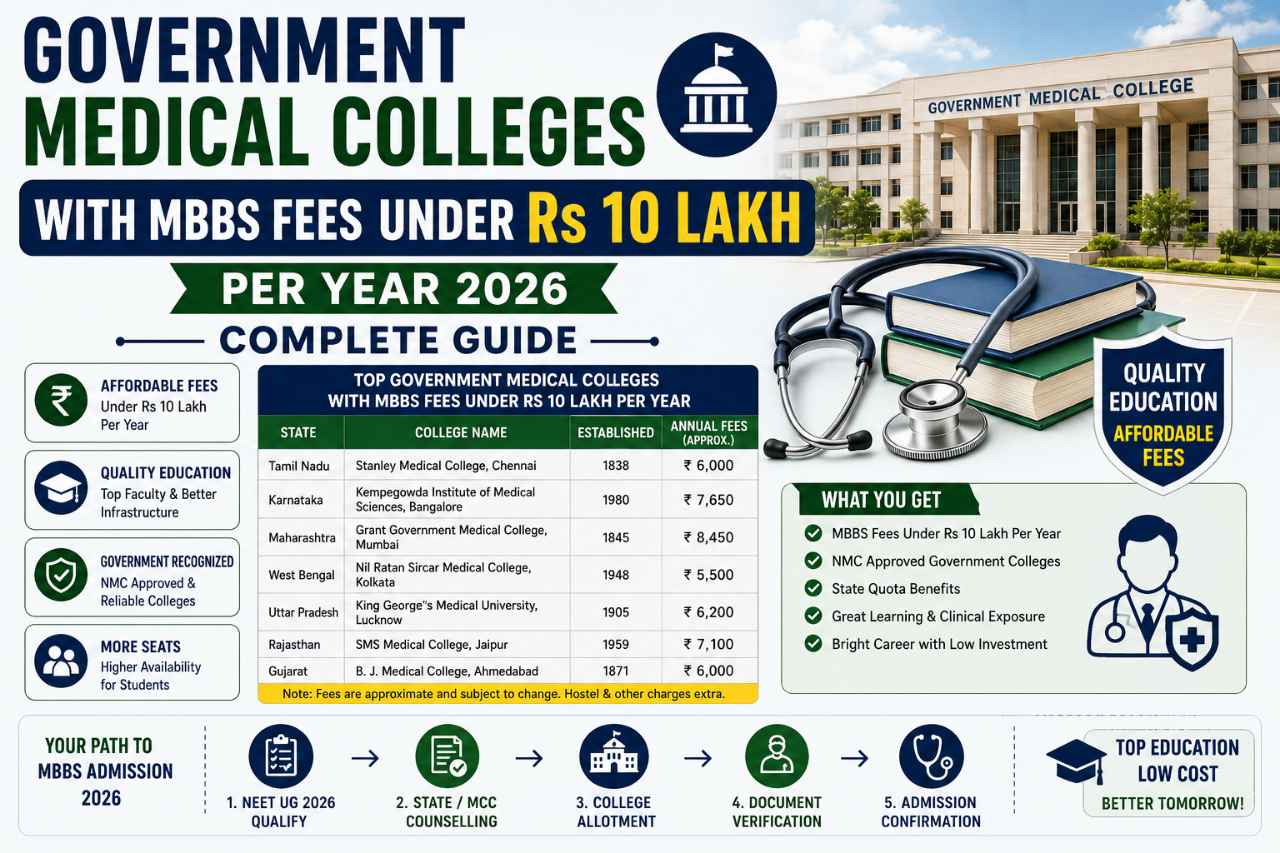
Top Government Medical Colleges With MBBS Fees Under Rs 10 Lakh
Several central and state institutions lead India's affordability chart. Every college listed below charges far less than Rs 10 lakh per year in tuition. Delhi dominates the cheapest tier, but affordable options exist nationwide.
| College | Location | Annual MBBS Tuition (Approx.) |
|---|---|---|
| Lady Hardinge Medical College (LHMC) | New Delhi | Rs 1,360 |
| AIIMS Delhi | New Delhi | Rs 1,628 |
| Maulana Azad Medical College (MAMC) Delhi | New Delhi | Rs 2,610 |
| Vardhman Mahavir Medical College (VMMC) Delhi | New Delhi | Under Rs 10,000 |
| University College Of Medical Sciences (UCMS) Delhi | New Delhi | Under Rs 10,000 |
| JIPMER Puducherry | Puducherry | Rs 6,770 |
| Karnataka Government Medical Colleges | Karnataka | Rs 64,350 |
| Maharashtra Government Medical Colleges | Maharashtra | Rs 1,62,100 |
Even Maharashtra among the higher-charging states for government MBBS stays well under the Rs 10 lakh per year mark. Central government colleges consistently occupy the top affordability spots, making them the benchmark for value in medical education. Every listed college here charges less than Rs 2 lakh per year in tuition alone, and the most expensive government options still remain a fraction of private college fees.
State-Wise MBBS Fee Snapshot in Government Colleges
Fee structures vary significantly across regions. Understanding these differences helps you plan both your college preference list and your family budget before NEET UG counselling begins.
Delhi: The Lowest Fees in the Country
Delhi hosts the lowest MBBS tuition fees in India. Institutes affiliated with Delhi University and those under the central government charge between Rs 1,360 and Rs 10,000 per year in tuition. MAMC Delhi, VMMC Delhi, and UCMS Delhi are perennial top choices for NEET toppers. Hostel, mess, and examination fees are billed separately but remain modest compared to private alternatives.
Delhi's government medical ecosystem also benefits from high patient footfall at attached hospitals like Lok Nayak, Safdarjung, and GTB Hospital. Clinical exposure a critical part of MBBS training comes at no extra tuition cost, adding enormous value beyond the fee tag.
Central Institutes: AIIMS and JIPMER
All AIIMS branches nationwide follow a low, uniform fee structure similar to AIIMS Delhi. JIPMER Puducherry charges Rs 6,770 annually after an initial first-year component of Rs 14,920. Both fill seats through NEET UG merit under the All India Quota (AIQ), making them accessible to candidates from any state who score high enough.
New AIIMS campuses established under the Pradhan Mantri Swasthya Suraksha Yojana (PMSSY) in states like Rajasthan, Madhya Pradesh, and Odisha also follow similarly low fee norms. This expansion gives students affordable government MBBS seats closer to their home states.
Rajasthan: Growing Government Medical Infrastructure
Rajasthan has expanded its government medical college network significantly. Government Medical College Kota and Shri Kalyan Government Medical College Sikar offer MBBS seats at state-regulated fees typically ranging from Rs 25,000 to Rs 1,00,000 per year depending on category and college. Mahatma Gandhi University Medical Sciences Jaipur is another key destination for Rajasthan domicile students.
Cities like Jaipur, Kota, and Sikar now host multiple health-science institutions. Allied colleges such as Government Nursing College Kota and Government Ayurved Mahavidyalaya Sikar serve students exploring complementary healthcare pathways. For MBBS specifically, Rajasthan domicile candidates should prioritise state quota registration to access the full seat matrix.
Karnataka and Maharashtra: Moderate State Fees
Karnataka government medical colleges charge around Rs 64,350 per year affordable by national standards and far below private colleges in Bengaluru. Maharashtra government colleges charge approximately Rs 1,62,100 annually, the highest among commonly cited states, yet still under Rs 10 lakh. Both states run their own NEET UG counselling for the 85% state quota.
Other States Worth Noting
Tamil Nadu, West Bengal, Uttar Pradesh, and Gujarat operate large government medical college networks with fees generally between Rs 20,000 and Rs 80,000 per year. Southern states tend to offer lower fees than western and northern states outside Delhi. Students should download the latest fee circular from their target state's medical education department before finalising preferences.
Category-Wise Fee Concessions
Reserved category students SC, ST, OBC, and EWS in many states often receive additional tuition waivers or nominal fees. Some states waive tuition entirely for SC/ST candidates at government colleges. Check your state medical counselling authority's notification for exact rules before registering.
Total MBBS Course Cost at Government Colleges
The MBBS programme spans 4.5 years of academic study plus a one-year compulsory rotating internship. Total tuition over this period tells a compelling affordability story.
- LHMC Delhi: Total tuition stays under Rs 7,000 for the entire course.
- AIIMS Delhi: Total tuition under Rs 10,000 across five years.
- JIPMER Puducherry: Rs 14,920 in the first year plus Rs 6,770 in subsequent years.
- Maharashtra government colleges: Total tuition under Rs 8,20,000 over five years.
- Rajasthan government colleges: Typically Rs 2,00,000 to Rs 5,00,000 total tuition depending on the institute and category.
Beyond Tuition: Hostel, Mess, and Other Charges
Published tuition fees usually cover academic instruction and basic administrative costs. Most students also pay separately for:
- Hostel accommodation (Rs 5,000–Rs 30,000 per year at many government colleges)
- Mess and food charges (Rs 30,000–Rs 50,000 per year)
- Library, laboratory, and examination fees
- Uniforms, books, and clinical equipment
- One-time admission and security deposits (often refundable)
Even after adding these expenses, the total cost of living and studying at a central institute like AIIMS or MAMC typically stays under Rs 1,00,000 per year a fraction of what a single year at a private medical college costs. At Government Medical College Kota, total living costs are often lower than in metro cities, making it an economical choice for Rajasthan students.
Government vs Private MBBS Fees: A 2026 Comparison
Understanding the fee gap helps set realistic NEET score targets. Government seats are subsidised public goods; private seats reflect market pricing.
| Parameter | Government MBBS | Private MBBS |
|---|---|---|
| Annual tuition | Rs 1,360 – Rs 1,62,100 | Rs 8,00,000 – Rs 30,00,000 |
| Total 5-year tuition | Under Rs 10 lakh (most states) | Rs 40 lakh – Rs 1.5 crore |
| Admission route | NEET UG merit via MCC/state counselling | NEET UG + management/NRI quota |
| Cut-off trend | Very high (600+ for top colleges) | Lower, but fees are prohibitive |
| Degree recognition | NMC-approved, same NEET pathway | NMC-approved if listed |
This comparison explains why even a one-year delay to improve your NEET score can save a family Rs 40 lakh or more over the course of the degree. Coaching for NEET may cost Rs 1–3 lakh per year; five years at AIIMS Delhi costs less in tuition than many students spend on two years of preparation.
NEET UG and Counselling: The Gateway to Affordable MBBS
Every government MBBS seat in India is filled through NEET UG, conducted annually by the National Testing Agency (NTA) at neet.nta.nic.in. There is no separate entrance exam for AIIMS or JIPMER anymore a single NEET score determines eligibility for all government, private, and deemed university seats.
All India Quota vs State Quota
The Medical Counselling Committee (MCC) manages counselling for:
- 15% All India Quota (AIQ) seats in state government colleges open to candidates from any state.
- 100% seats at central institutions like AIIMS, JIPMER, BHU, and AFMC.
- Central university and deemed university seats as notified.
State counselling authorities handle the remaining 85% state quota seats, generally reserved for domicile candidates. If you are a Rajasthan student, you must register separately with the Rajasthan medical counselling cell to access seats at Government Medical College Kota or Shri Kalyan Government Medical College Sikar under state quota.
Expected NEET UG 2026 Cut-Offs for Government Colleges
Cut-offs vary by category, quota, and college reputation. As a general reference for 2026 planning:
- AIIMS Delhi / top Delhi colleges: 700+ for General category under AIQ.
- Good state government colleges: 550–650 for General category under state quota.
- Newer government colleges: 450–550, depending on state and seat availability.
- Reserved categories: Lower by 50–150 marks depending on state rules.
These are indicative ranges always refer to the previous year's official closing ranks published by MCC and your state authority. Cut-offs can shift based on paper difficulty, seat additions from new colleges, and changes in NEET registration numbers.
Regional Spotlight: Affordable Government Medical Colleges Worth Watching
Delhi NCR
Delhi remains India's medical education capital for affordability and clinical exposure. Beyond AIIMS Delhi, students should research Maulana Azad Medical College (MAMC) Delhi, VMMC Delhi, and UCMS Delhi. All offer world-class teaching hospitals and annual fees under Rs 10,000.
Rajasthan
Rajasthan students benefit from a growing network of government health institutions. Government Medical College Kota serves the Hadoti region, while Shri Kalyan Government Medical College Sikar strengthens access in the Shekhawati belt. Jaipur hosts Mahatma Gandhi University Medical Sciences Jaipur, alongside numerous allied health colleges. Explore more options on the Jaipur colleges page for a wider view of higher education in the capital city.
South and West India
Karnataka, Tamil Nadu, Kerala, and Maharashtra operate established government medical college networks. Fees in southern states tend to be lower than Maharashtra. Students willing to relocate under AIQ can sometimes secure affordable seats outside their home state provided their NEET score is competitive enough.
Documents Required for Government MBBS Admission 2026
After seat allotment, every candidate must verify original documents at the allotted college. Prepare these in advance to avoid last-minute delays:
- NEET UG 2026 scorecard and admit card
- Class 10 certificate and marksheet (for date of birth proof)
- Class 12 marksheet and passing certificate
- Category certificate (SC/ST/OBC/EWS) if applicable
- Domicile or residence certificate for state quota seats
- Photo ID (Aadhaar, passport, or voter ID)
- Migration certificate and character certificate from last attended institution
- Passport-size photographs (keep at least 10 copies)
- Medical fitness certificate as prescribed by the college
Any mismatch between NEET application details and submitted certificates can lead to seat cancellation. Double-check spellings, category codes, and domicile validity dates before reporting.
Actionable Tips for NEET UG 2026 Aspirants
- Start with official sources: Download the latest fee prospectus from each target college and your state counselling website.
- Build a tiered college list: Include dream (AIIMS/MAMC), realistic (home state top colleges), and safe (newer government colleges) options.
- Register for both AIQ and state counselling: Missing either registration can cost you a seat they are separate processes with separate fees.
- Track category certificates: SC/ST/OBC/EWS/PwD documents must be valid and match your NEET application details exactly.
- Budget for hidden costs: Even at LHMC, plan Rs 50,000–Rs 80,000 per year for hostel, mess, books, and personal expenses in Delhi.
- Monitor fee revision notifications: States occasionally revise fees before a new session watch official announcements in June–July 2026.
- Understand the bond clause: Some states require a service bond after MBBS with a penalty for non-compliance. Factor this into your decision.
Why Fees Stay Low: The Policy Perspective
India faces a persistent shortage of doctors, especially in rural and underserved areas. Subsidised medical education is a deliberate policy tool to train physicians without burdening students with crushing debt. Government colleges attach affiliated teaching hospitals, where students gain clinical experience as part of their training infrastructure costs are borne by the public exchequer, not passed fully to students.
Students at AIIMS Delhi effectively pay less for five years of MBBS than many aspirants spend on a single year of NEET coaching. That is not an accident it reflects India's commitment to keeping public health education accessible. The doctor-population ratio target of 1:1000 by 2030 depends on expanding affordable government seats, which is why new medical colleges continue to be announced each budget cycle.
What to Watch in the 2026 Admission Cycle
NEET UG 2026 counselling schedules from MCC and state authorities typically release between June and August. Keep an eye on:
- Official NEET UG result declaration and answer key challenges
- MCC AIQ registration dates at mcc.nic.in
- State-wise MBBS fee revisions before the academic session
- New government medical college inaugurations adding seats to the matrix
- Supplementary and stray vacancy rounds for unfilled government seats
Missing a counselling registration deadline even by a day can eliminate your chance at a government seat regardless of your NEET score. Set calendar reminders for every official notification from NTA, MCC, and your state authority.
Conclusion
Government medical colleges remain the most affordable and credible path to an MBBS degree in India for 2026. From Rs 1,360 per year at LHMC Delhi to roughly Rs 1.62 lakh per year in Maharashtra, every government institution stays well under the Rs 10 lakh annual ceiling often by a wide margin. The trade-off is fierce competition through NEET UG, but the reward is a nationally recognised degree at a fraction of private college costs.
Start your preparation early, register for NEET UG and both counselling channels on time, and build a college list that balances ambition with realistic cut-off data. Whether your goal is MAMC Delhi, Government Medical College Kota, or Shri Kalyan Government Medical College Sikar, the pathway is the same: a strong NEET score, careful counselling choices, and timely document verification. CollegeDwar will continue tracking fee updates and counselling schedules to keep your admission journey on track.