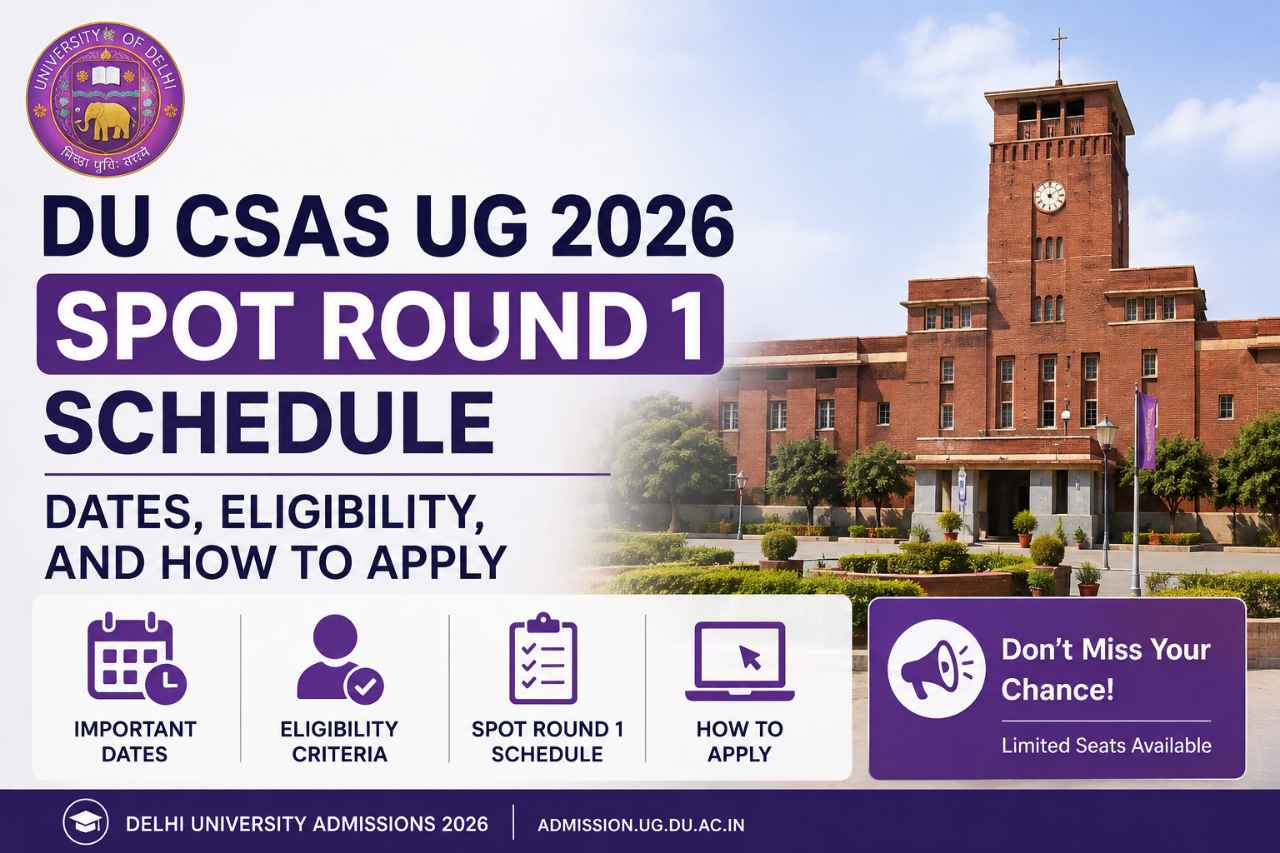

Delhi University has officially released the schedule for CSAS UG 2026 Spot Round 1, giving thousands of CUET-qualified students one more structured chance to secure an undergraduate seat before the academic session moves forward. If you registered on the DU admission portal but remain unplaced in any college as on 22 August 2026, this round is designed specifically for you.
Spot admission is not a casual leftover process. It follows the same merit, category, and preference logic as regular CSAS rounds, but with stricter rules: no upgrade, no withdrawal, and mandatory acceptance if a seat is allotted. Missing a deadline here can permanently remove you from DU UG admissions for 2026-27.
This guide explains the complete Spot Round 1 timeline, eligibility, step-by-step application process, documents, common mistakes, and practical tips written for students and parents navigating Indian higher education admissions with clarity and confidence.
What Is DU CSAS UG Spot Round 1?
The Common Seat Allocation System (CSAS) is Delhi University's centralised undergraduate admission framework for programmes offered through CUET UG scores. After multiple regular allotment rounds, upgrade windows, and special-category admissions (CW, ECA, Sports, and performance-based programmes), some seats remain vacant across colleges and programmes.
Spot Round 1 is the first dedicated admission phase where only unadmitted CSAS applicants can apply afresh for vacant programme-college combinations listed category-wise on the official portal. Unlike earlier rounds where you could freeze a seat or opt for upgrade, spot rounds operate under a final-allocation policy.
Why DU Conducts Spot Rounds
Spot rounds serve three practical purposes in the Indian university admission ecosystem:
- Seat utilisation: Ensures sanctioned intake across 70+ DU colleges is filled wherever possible.
- Merit-based second chance: Gives eligible candidates who missed earlier rounds due to preference strategy, category mismatch, or late document issues a fair opportunity.
- Process closure: Helps the university complete admissions before classes and internal academic calendars advance.
According to the official CSAS framework, vacant seats for spot admission are declared only after the preceding upgradation process for already-admitted candidates is completed. This is why Spot Round 1 follows Upgrade Window-II and related special-category timelines in August 2026.
DU CSAS UG 2026 Spot Round 1 Schedule: Key Dates
The University of Delhi published the Spot Round 1 calendar alongside Upgrade Window-II and Round-II schedules for CW, ECA, Sports, and performance-based programmes. Mark these dates on your calendar and set reminders at least 24 hours before each deadline.
| Activity | Date and Time | Day |
|---|---|---|
| Display of vacant seats for Spot Round 1 | 23 August 2026 | Sunday |
| Apply for Spot Round via CSAS dashboard | 23–24 August 2026 (till 11:59 PM) | Sunday–Monday |
| Declaration of Spot Round 1 allocation | 25 August 2026 | Tuesday |
| Accept allocated seat | 25–27 August 2026 (till 11:59 PM) | Tuesday–Thursday |
| College verification and approval | 28 August 2026 (till 4:59 PM) | Friday |
| Last date for online fee payment | 29 August 2026 (till 11:59 PM) | Saturday |
Critical cutoff: You must be unadmitted to any DU college as on 22 August 2026. From 11:59 PM on 22 August, dashboards of already-admitted candidates enter freeze mode they cannot withdraw or upgrade once spot admission begins.
Context: Upgrade Window-II Before Spot Round
Before vacant seats are displayed, DU runs Upgrade Window-II for candidates who already hold a seat and wish to move to a higher preference. Understanding this window helps you interpret which seats may open up for spot applicants:
- Upgrade and preference reorder: 16–17 August 2026 (till 11:59 PM)
- Declaration of upgraded allocations with auto-acceptance: 19 August 2026
- Round-II results for CW, ECA, Sports, and performance-based programmes: 19 August 2026
- Seat acceptance and college verification for special categories: 19–22 August 2026
- Last fee payment date for preceding phase: 22 August 2026 (till 11:59 PM)
Vacant seats published on 23 August reflect withdrawals, non-acceptance, upgrade movements, and unfilled category seats after these processes conclude.
Who Is Eligible for Spot Round 1?
Eligibility for DU CSAS Spot Round 1 is narrow by design. You qualify if all of the following apply:
- You successfully registered and applied through CSAS (UG) 2026 on admission.uod.ac.in.
- You are not admitted to any Delhi University college as on 22 August 2026.
- You actively opt for Spot Admission on your dashboard during the application window.
- You select only those programme + college combinations that show vacant seats for your category.
Who Cannot Participate?
- Candidates already admitted to any DU college (their dashboards remain frozen).
- Applicants who did not register through CSAS UG 2026.
- Students who fail to opt in for spot admission before the 24 August deadline.
- Candidates allotted a seat in Spot Round 1 who refuse acceptance they forfeit all further CSAS eligibility.
Example: Priya had BA (Hons) Political Science as her top choice but received no allotment in regular rounds. She remains unadmitted on 22 August. She can apply in Spot Round 1 for any vacant BA programme at colleges listing seats for her General category, provided she selects valid combinations on her dashboard.
How Seat Allocation Works in Spot Round 1
Spot round allocation is merit-driven but independent of earlier round cutoffs. The minimum CUET score required in Spot Round 1 may differ from Round 1 or Round 2 because only unplaced applicants who opt in are considered against freshly declared vacancies.
According to the official CSAS document, allocation follows this order of criteria:
- Availability of seats in the chosen programme-college combination
- Programme-specific merit (CUET subject scores as per programme rules)
- Order of college preference submitted by the candidate
- Category (General, OBC, SC, ST, EWS, PwBD, etc.)
- Any additional rules in CSAS UG 2026, BoI (UG) 2026, or portal notifications
Important Rules You Must Not Ignore
- No upgrade during spot rounds: Once spot admission starts, upgrade options are suspended for all candidates.
- No withdrawal during spot rounds: Already-admitted students cannot exit to re-enter the pool.
- Mandatory acceptance: If you receive a seat, you must accept it. Refusal removes you from CSAS UG 2026 entirely.
- Final allocation: A seat allotted in Spot Round 1 cannot be upgraded in a later spot round.
- Independent cutoff: Minimum allocation scores for each spot round stand on their own.
These rules exist to prevent seat blocking and ensure committed admissions. Treat every preference you submit as a binding choice, not a trial option.
Step-by-Step: How to Apply for DU CSAS Spot Round 1
The entire process happens online through your CSAS dashboard. No separate offline form is required at the university level, though college verification may need physical documents later.
Before 23 August: Preparation Checklist
- Log in to your CSAS dashboard and confirm your admission status shows unplaced.
- Keep CUET UG 2026 scorecard, category certificate, and identity documents ready.
- Research DU colleges by programme location, faculty reputation, and cutoff trends from earlier rounds.
- Discuss realistic preferences with family: spot round choices are final once accepted.
- Arrange fee payment method (UPI, net banking, or card) for the 29 August deadline.
During 23–24 August: Submit Spot Preferences
- Visit admission.uod.ac.in and log in with your CSAS credentials.
- Open the Spot Admission section when it goes live after vacant seats are displayed.
- Review the category-wise vacancy list for each programme and college.
- Select programme-college combinations with available seats matching your category.
- Arrange preferences carefully higher preference colleges are considered first within merit rules.
- Submit and download or screenshot confirmation before 11:59 PM on 24 August 2026.
After Allocation on 25 August
When results are declared on 25 August, log in immediately. If allotted:
- Accept the seat between 25 and 27 August (by 11:59 PM).
- Upload or present documents as directed for college verification by 28 August (4:59 PM).
- Pay admission fees online by 29 August (11:59 PM).
If not allotted, monitor official announcements for possible Spot Round 2. DU may conduct additional spot rounds if vacancies remain, but do not assume a second round plan backup options early.
Documents Required for Spot Round Admission
Keep both digital scans and originals ready. Requirements largely mirror regular CSAS admission:
- CUET UG 2026 scorecard and admit card
- Class XII mark sheet and passing certificate
- Class X certificate for date of birth proof
- Category certificate (SC/ST/OBC/EWS/PwBD) if applicable
- Photo ID (Aadhaar, passport, or other approved ID)
- Recent passport-size photographs
- Transfer certificate and migration certificate (may be submitted within notified timeline post-admission)
- Character certificate from last institution attended
- Income and EWS certificate if claiming EWS quota
- CW, ECA, or Sports certificates only if applicable to your admission category
Colleges may request additional programme-specific documents. Check your allotted college's admission page on the day of seat acceptance.
Strategic Tips for Spot Round Success
Spot admission rewards preparation and realistic decision-making more than last-minute hope. Use these actionable strategies:
1. Prioritise Seat Certainty Over Brand Name
A seat in a slightly lower-preference college is infinitely better than holding out for a dream college that has zero vacancies in your category. Review the vacancy list objectively before ordering preferences.
2. Study Programme-Specific Merit Rules
Different DU programmes use different CUET subject combinations for merit calculation. BA programmes, B.Com, B.Sc, and professional courses each follow distinct normalisation rules defined in CSAS. Verify which subjects count for your target programme so you understand your competitive position.
3. Do Not Treat Spot Round Like Upgrade
In regular rounds, students often pick higher-cutoff colleges first knowing they may upgrade later. That strategy fails here. Every preference should be a college you are willing to join immediately.
4. Monitor the Portal Multiple Times Daily
During the 23–24 August window, technical traffic spikes are common. Apply early on 23 August once vacancies appear, rather than waiting until midnight on 24 August.
5. Keep Backup Plans Active
Parallel options reduce stress. State universities, private institutions, and other central universities may still have admission windows open in August. Students interested in design fields can simultaneously prepare for exams such as the NID DAT (National Institute of Design Design Aptitude Test), which opens pathways to premier B.Des programmes outside the DU ecosystem. Spot round and alternative exams are not mutually exclusive until you accept a final DU seat.
Spot Round vs Regular CSAS Rounds: Quick Comparison
| Feature | Regular CSAS Rounds | Spot Round 1 |
|---|---|---|
| Eligible candidates | All registered CSAS applicants | Only unadmitted candidates as on 22 Aug 2026 |
| Seat choice | Full preference list from registration | Only vacant programme-college combos shown |
| Upgrade option | Available in upgrade windows | Not available |
| Withdrawal option | Allowed with fee before spot phase | Not allowed once spot round begins |
| Seat acceptance | Freeze or upgrade choices | Mandatory if allotted |
| Cutoff trend | Based on all applicants | Based only on spot applicants; independent cutoff |
Common Mistakes That Cost Students a DU Seat
- Missing the opt-in step: Simply being eligible does not auto-enroll you you must select Spot Admission on the dashboard.
- Choosing unavailable category seats: You can pick only combinations with vacancies for your exact category.
- Late acceptance: Failing to accept between 25–27 August forfeits your allocation and CSAS eligibility.
- Ignoring fee deadline: Seat acceptance without fee payment by 29 August can invalidate admission.
- Uploading incorrect documents: Mismatch in name spelling or category certificate format delays college approval.
- Assuming a better college will appear later: Spot Round 1 seats are final; there is no upgrade path within the round.
What Happens After Spot Round 1 Fee Payment?
Once you pay fees by 29 August 2026, your admission moves into college-level onboarding:
- Collect official admission confirmation from the college portal or admission office.
- Complete orientation and class commencement formalities as notified.
- Submit pending certificates (migration, transfer, character) within the grace period if allowed.
- Register for DU enrollment number and programme-specific foundation courses.
The academic session for DU UG 2026-27 had already commenced in July 2026 for early joiners; spot round admits should integrate quickly and contact their college about any coursework already underway.
Conclusion
DU CSAS UG 2026 Spot Round 1 is a time-bound, merit-based final opportunity for students who remain unplaced after regular allotments and upgrade windows. Vacant seats appear on 23 August 2026, applications close on 24 August at 11:59 PM, results arrive on 25 August, and the entire admission cycle including acceptance, verification, and fee payment concludes by 29 August 2026.
Success requires three things: confirming your eligibility early, submitting thoughtful and realistic preferences during the spot window, and treating any allotted seat as a firm commitment. The rules are strict no upgrade, no withdrawal, mandatory acceptance but they also make the process transparent for genuine applicants seeking a Delhi University degree in 2026-27.
Keep your CSAS dashboard active, rely only on admission.uod.ac.in for official updates, and act before every deadline. For students exploring parallel creative-education paths while awaiting outcomes, resources like the NID DAT exam guide can help you stay prepared without losing focus on the DU spot admission timeline.