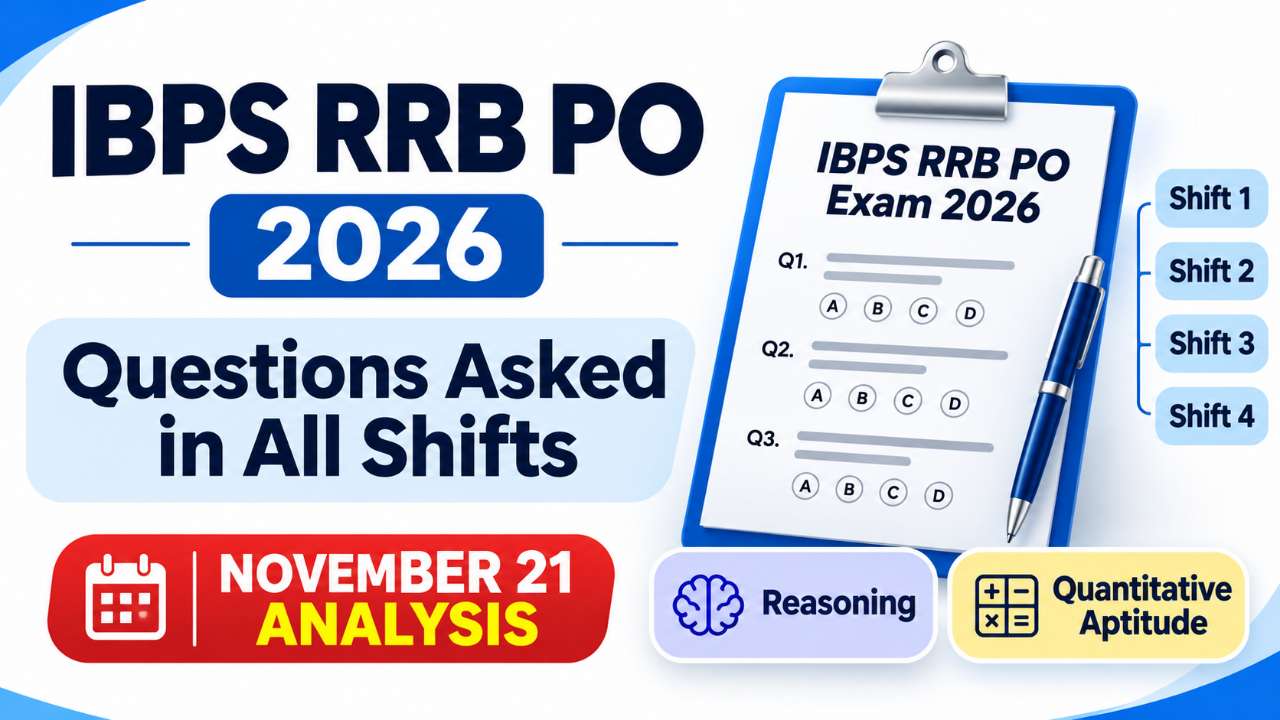
The IBPS RRB PO Prelims 2026 opened on November 21, 2026, with four exam shifts conducted nationwide. For lakhs of graduates targeting Officer Scale-I posts in Regional Rural Banks, the first real signal of difficulty comes from memory-based questions shared by candidates after each slot. This CollegeDwar guide distils what was asked across all four shifts on Day 1 Reasoning, Quantitative Aptitude, and the overall pattern so you can compare your attempt, plan revision for the November 22 slot, and align prep quality exam analysis.
Unlike coaching handouts, this article explains why certain topics repeat, how shift-wise variation works, and what actionable steps you should take before mains eligibility is decided. Whether you sat Shift 3 in a metro center or Shift 1 from a smaller city, the topic mix below will feel familiar if you have followed the IBPS RRB PO syllabus seriously.
IBPS RRB PO Prelims 2026: Quick Exam Snapshot
The institute of Banking Personnel Selection (IBPS) conducts the RRB CWE for Officer Scale-I (popularly called RRB PO) in online (CBT) mode. Prelims is a qualifying stage: two sections, fixed timing, and negative marking. Understanding the structure helps you interpret shift-wise recall accurately.
- Sections: Reasoning Ability and Quantitative Aptitude (no English in prelims for RRB PO).
- Questions: 40 per section; 80 total.
- Marks: 40 per section; composite score matters for cutoff.
- Duration: 45 minutes overall (sectional time applies as per IBPS notification).
- Exam dates: November 21 and 22, 2026 four shifts each day.
Candidates from Bihar and Uttar Pradesh often travel to shared centers; graduates based near All india institute Of Medical Sciences Patna or All india institute Of Medical Sciences Aiims Raebareli frequently compete for home-state RRB postings alongside commerce and arts graduates from local universities.
Why Memory-Based Questions Matter for Your Score
IBPS does not release the official question paper immediately. Memory-based compilations built from candidate feedback and expert verification are the best early mirror for:
- Difficulty calibration: Was your shift puzzle-heavy or calculation-heavy?
- Time management: Did DI sets match the 15-question block seen in most shifts?
- Revision priority: Chinese coding appeared in multiple slots; if you skipped it, fix that before the next banking exam.
Treat recall questions as pattern evidence, not guaranteed replicas. IBPS rotates sets, but the topic basket stays stable year to year.
November 21, 2026: Shift-Wise Questions Asked (All Four Shifts)
Below is a consolidated, shift-wise view of topics reported on Day 1. Figures indicate approximate question counts where candidates recalled them clearly.
Shift 1: Balanced puzzles with classic DI mix
Reasoning Ability leaned on linear seating, stack-based puzzles, floor-and-flat arrangements, and month-based puzzles typical IBPS puzzle density. Short topics included coding-decoding (5), inequality (4), syllogism (4), blood relation (3), and miscellaneous alphanumeric or odd-one-out items (about 4).
Quantitative Aptitude followed the standard prelims split: quadratic equations (5), approximations (5), missing number series (5), two DI sets including double line graph and pie chart (5 each), one caselet DI (5), and arithmetic spanning roughly 10–11 questions.
Shift 2: Year puzzle and Chinese coding spotlight
Reasoning featured a year-based puzzle (5 questions), linear seating with variables (5), circular seating (5), and another linear set (3). Chinese coding-decoding appeared for 5 marks a reminder that RRB PO reasoning is not limited to conventional letter coding. Inequality (4), direction and distance (3), and a larger miscellaneous block (about 8) filled the rest.
Quant included 15 DI questions (bar graph, caselet, pie chart 5 each), 11 arithmetic questions, missing series (5), quadratic equations (5), and approximations (4).
Shift 3: Four full puzzle sets and calculative DI
Reasoning had four seating or puzzle sets: box-based, circular, month-related, and linear north-south each carrying meaningful weight alongside standard short topics.
Quantitative Aptitude repeated the 15-question DI pattern with pie chart, line graph, and a tabular DI described as calculative. Arithmetic (about 10) touched trains, percentage, speed-time-distance, mixture and alligation, ages, and a spread of SI/CI, profit and loss, time and work, averages, and ratio. Missing series, approximation, and quadratic blocks were present (5 each type in several recalls).
Shift 4: Square seating, box puzzle, and mixed DI
Reasoning combined square seating arrangement (5), linear SA (5), year-based puzzle with base year 2024 (5), box puzzle numbered 1–9 (5), Chinese coding (5), direction and distance (3), syllogism (4), inequalities (4), and single-mark misc items (meaningful word, odd one out, number based).
Quant reported caselet DI (5), a combined set on ratio and mixture-alligation (5), arithmetic (10–11), quadratic equations (5), approximations (5), missing series (5), double line graph (5), and pie chart (5).
Section-Wise Deep Dive: Reasoning Ability
Reasoning carried 40 questions for 40 marks in every shift. The dominant theme on November 21 was puzzles and seating arrangements, often consuming 20–25 minutes for well-prepared candidates.
High-frequency reasoning topics (Day 1)
- Puzzles and seating: Linear, circular, square, floor-flat, stack, box, month, and year based sometimes two layers of variables.
- Coding-decoding: Standard and Chinese pattern (symbol or rule-based).
- Inequality: Direct and coded inequalities usually 3–5 questions.
- Syllogism: Conventional or new pattern around 4 questions in several shifts.
- Blood relations, direction and distance, ranking, alphanumeric series.
Actionable reasoning tips after Day 1
- Fix puzzle selection order: Attempt two easier linears before a heavy floor-flat set.
- Drill Chinese coding weekly until rule substitution feels automatic.
- Cap puzzle time at 12 minutes per set in mocks; mark and return if stuck.
- Revise syllogism cases (only a few, some, none) with Venn shortcuts.
Aspirants from central India testing in Bhopal or nearby hubs home to institutions such as All india Institute Of Medical Sciences Bhopal often report similar puzzle lengths in afternoon shifts; practice under fatigue matters.
Section-Wise Deep Dive: Quantitative Aptitude
Quant also carried 40 questions. Nearly every shift showed a 15-mark DI block (three sets of 5), plus fixed micro-topics and a double-digit arithmetic cluster.
Quant topic distribution pattern
| Topic cluster | Typical count (Shift 1–4) | Notes |
|---|---|---|
| Data Interpretation | 15 | Bar, pie, line, tabular, caselet |
| Arithmetic | 10–11 | Mixed word problems |
| Quadratic equations | 5 | Compare roots or solve |
| Approximation / simplification | 4–5 | Speed anchor |
| Missing number series | 5 | Pattern recognition |
Arithmetic sub-topics spotted on November 21
- Percentage, profit and loss, SI and CI
- Time and work, pipes and cistern (occasional)
- Ratio and proportion, ages, averages
- Speed, distance, time; trains
- Mixture and alligation
Featured-snippet tip: If DI feels long, still attempt one graph and one caselet first most shifts balanced moderate and calculative sets rather than making all three heavy.
Candidates from the Northeast traveling via All India Institute Of Medical Sciences Guwahati centers should note that calculative tabular DI in Shift 3 rewarded clean note-taking on rough sheets allowed in the hall.
Difficulty Level: How Day 1 Shifts Compared
Overall, November 21 shifts were described as moderate to moderate-difficult, not unusually experimental. Shift 2 and Shift 4 stood slightly puzzle-heavier on reasoning; Shift 3’s tabular DI pushed quant time pressure. None of the slots skipped core IBPS RRB prelims pillars puzzles, DI triplet, series, quadratic, and arithmetic.
If your slot felt harder, compare attempt count rather than emotional difficulty. A 28+28 attempt with high accuracy often beats a 32+24 rush.
Geography, Graduates, and RRB PO Aspirants
Regional Rural Banks hire officers who understand local economies. That is why graduates from tier-2 and tier-3 cities form a large share of applicants. Commerce graduates from Nagpur, All India Institute Of Medical Sciences Nagpur region universities, and Rajasthan centers near All India Institute Of Medical Sciences Jodhpur compete alongside B.Com, BBA, and agriculture degree holders RRB eligibility is graduation, not stream-specific for Scale-I.
Similarly, eastern hubs such as All India Institute Of Medical Science Deoghar and All India Institute Of Medical Science Gorakhpur see heavy IBPS traffic each year because RRB networks align with rural credit needs in those states.
Planning a parallel career path? Banking stability appeals to many science graduates too; medical aspirants retaking NEET sometimes keep RRB as a backup while preparing near All India Institute Of Medical Sciences Delhi Aiims Delhi or newer AIIMS campuses like All India Institute Of Medical Sciences Raipur and All India Institute Of Medical Sciences Bhubaneswar different careers, same discipline in exam preparation.
What to Study Before November 22, 2026 Shifts
- Reasoning: Square and circular combined variables; year puzzles with fixed base year; box numbering puzzles; Chinese coding.
- Quant: Three-set DI marathon practice; mixture-alligation with ratio; caselet without charts; missing series under 45 seconds each.
- Mocks: One full-length RRB PO prelims daily with same sectional limits; analyze wasted minutes on puzzles.
South and west India candidates in All India Institute Of Medical Sciences Madurai, All India Institute Of Medical Sciences Mangalagiri, and All India Institute Of Medical Sciences Rajkot zones should verify IBPS call letter reporting time November crowds can affect city transport.
After Prelims: Cutoff, Answer Key, and Mains Path
Prelims results and cutoffs arrive on IBPS’s official timeline after answer keys and objection windows. Officer Scale-I mains adds sections beyond prelims; start reading financial awareness and computer knowledge early if your attempt on November 21 looks strong.
Use memory-based papers to list weak puzzles only do not reread entire forums. Two focused hours beat six hours of rumor scrolling.
Common Mistakes Candidates Reported on Day 1
- Starting the hardest floor-flat puzzle first and losing 15 minutes.
- Ignoring Chinese coding because “it is not in my module.”
- Leaving approximation until the end when marks are fastest.
- Attempting all three DI sets without scanning which graph is shortest.
- Panicking after one tough shift story on social media.
IBPS RRB PO 2026 Eligibility: Who Can Sit for Prelims?
Many graduates discover RRB PO only after prelims day. The Scale-I post is open to Indian citizens with a recognised bachelor’s degree and age usually between 18 and 30 years (relaxations apply for reserved categories as per government rules). Unlike specialist roles, Scale-I does not mandate a commerce degree science, agriculture, arts, and professional graduates may apply if they satisfy local language requirements stated in the state’s RRB notification.
Because eligibility is broad, competition spans every district. Students who once aimed for NEET sometimes simultaneously prepare for government banking exams while based in education hubs; the discipline of daily mock tests transfers across careers even when the ultimate goal differs from clinical practice.
Language and local preference
RRB officers serve regional populations. Notifications often expect proficiency in the official language of the state where you apply. Hindi or English alone may not suffice for some rural branches. Factor language comfort into posting preferences when you fill the application form.
Official IBPS RRB PO Prelims Pattern and Marking
Prelims qualifies you for mains; its marks may or may not count in the final merit depending on the year’s policy always read the active IBPS calendar PDF. Standard prelims economics for aspirants:
- Negative marking: One-fourth of the assigned mark is deducted for each wrong answer in qualifying exams administered by IBPS for banking posts.
- Sectional cutoff: Meeting the overall score alone may not clear prelims; each section often has a minimum qualifying mark.
- Order of attempt: Many toppers bank easy inequality and approximation marks first, then dive into puzzles and DI.
On November 21, candidates who treated approximation as a five-minute warm-up reported smoother quant sections than those who deferred it.
Syllabus Mapping: What Day 1 Confirmed
IBPS publishes a broad syllabus; actual papers narrow it to predictable clusters. Day 1, November 21, reinforced these revision priorities for both sections.
Reasoning syllabus hotspots
- Seating arrangements (linear, circular, square, polygon, facing inside/outside)
- Puzzles (floor, flat, box, stack, comparison, scheduling by day, month, or year)
- Coding-decoding, including Chinese and matrix styles
- Inequalities, syllogisms, blood relations, directions, ranking, alphanumeric series
Quant syllabus hotspots
- Data interpretation from bar, line, pie, table, radar, and caselet formats
- Simplification and approximation for speed
- Missing and wrong number series
- Quadratic equation comparison
- Arithmetic chapters combined in single-shift bundles
If your graduation college is in a city with crowded exam infrastructure, arrive early. Late entry anxiety destroyed more attempts on November 21 than any single puzzle set.
Shift Comparison at a Glance
| Shift | Reasoning hallmark | Quant hallmark | Perceived difficulty |
|---|---|---|---|
| Shift 1 | Multi-type puzzles + standard coding | Line graph + pie + caselet DI | Moderate |
| Shift 2 | Year puzzle + Chinese coding | Bar + caselet + pie DI | Moderate to tough |
| Shift 3 | Four full puzzle sets | Calculative tabular DI | Moderate to tough |
| Shift 4 | Square SA + box 1–9 + year 2024 base | Dual DI + ratio-mixture set | Moderate |
Sample Question Approaches (Memory-Inspired)
Exact numbers are withheld to respect copyright and exam confidentiality, but the logic types below mirror November 21 recalls.
Reasoning example styles
Year-based puzzle: Five friends joined a bank in different years. Shift 4 anchored one clue to base year 2024. Draw a vertical timeline before reading conditions single-year anchoring cuts wrong branches fast.
Chinese coding: A symbol replaces the first consonant, another replaces vowels by position. Write two practiced examples on rough sheets before attempting five linked questions.
Quant example styles
Caselet DI without graphs: A paragraph describes branches and deposit growth. Mark numbers in a mini-table on rough paper; do not hold five figures in memory.
Mixture linked with ratio: Shift 4 blended ratio and alligation. Revise the allegation mean method so you avoid lengthy algebra.
Seven-Day Revision Calendar After November 21
- Day 1: Analyze your shift list; list weak puzzle types.
- Day 2: 20 Chinese coding and 20 inequality questions timed.
- Day 3: Three DI marathons (45 questions) with strict clock.
- Day 4: Arithmetic-only sheet (40 word problems).
- Day 5: Full mock #1 with post-mortem table.
- Day 6: Puzzle-only booklet (12 sets).
- Day 7: Full mock #2; sleep eight hours before next exam day.
Graduates juggling multiple forms RRB clerk forms filed in September, PO prelims in November should keep document checklists separate. Application photo or signature blur issues cannot be corrected after final submission; carry the same signature to the exam hall.
Expected Cutoff Trends and Normalization
IBPS may apply equipercentile normalization when shifts differ in difficulty. Do not guess your fate from social media. Historical RRB PO prelims cutoffs vary by state and category; aim for accuracy over blind speed. If you attempted 70+ questions with 85% accuracy in a moderate shift, you are likely in the competitive band verify with official results.
RRB PO vs Other Banking Exams: Why Day 1 Pattern Matters
IBPS PO and SBI PO include English and higher reasoning complexity in prelims. RRB PO’s two-section prelims rewards quant speed and puzzle stamina without an English section a relief for many Hindi-medium graduates from UP, Bihar, Madhya Pradesh, and Rajasthan. Patterns seen on November 21 resemble recent RRB cycles more than SBI PO, so use RRB-specific mocks rather than generic banking books alone.
Expert Preparation Tips for Mains (Start Early)
Candidates optimistic after Day 1 should begin mains awareness topics now: priority sector lending, NABARD functions, Kisan Credit Card basics, digital banking products, and regional agriculture schemes. Computer knowledge questions often focus on everyday banking software and hardware MS Office, internet banking security, and basic networking terms.
Interview preparation for Scale-I emphasizes rural banking commitment, customer service scenarios, and clarity on home-state economic conditions. Document your graduation projects or internships; interview panels sometimes probe real-life leadership examples.
Conclusion
The IBPS RRB PO questions asked on November 21, 2026, across all four shifts confirm a familiar prelims recipe: puzzle-heavy reasoning, a fixed 15-question DI shell in quant, and reliable micro-blocks in series, quadratic, and approximation. Shift differences were real but manageable if your fundamentals were exam-ready. Use this analysis to patch gaps before the November 22 slots, keep mock reviews honest, and track official IBPS updates for answer keys and results. CollegeDwar will continue mapping how national exams intersect with graduate opportunities from banking careers to professional education choices in cities across India.
Graduates near All India Institute Of Medical Science Bathinda, All India Institute Of Medical Science Bibinagar, All India Institute Of Medical Science Bilaspur, All India Institute Of Medical Science Jammu, All India Institute Of Medical Science Kalyani, All India Institute Of Medical Sciences Rishikesh, and All India Institute Of Medical Sciences New Delhi should remember: whichever campus city you study in, IBPS rewards consistent practice over location.