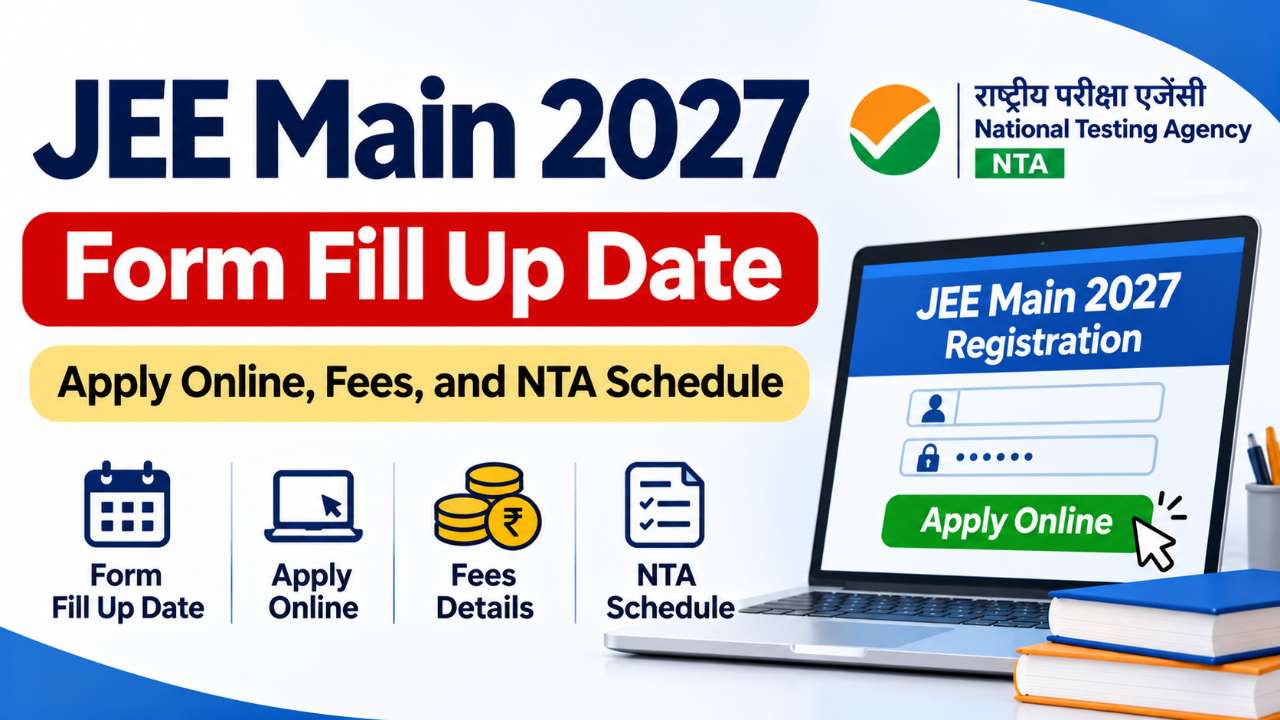
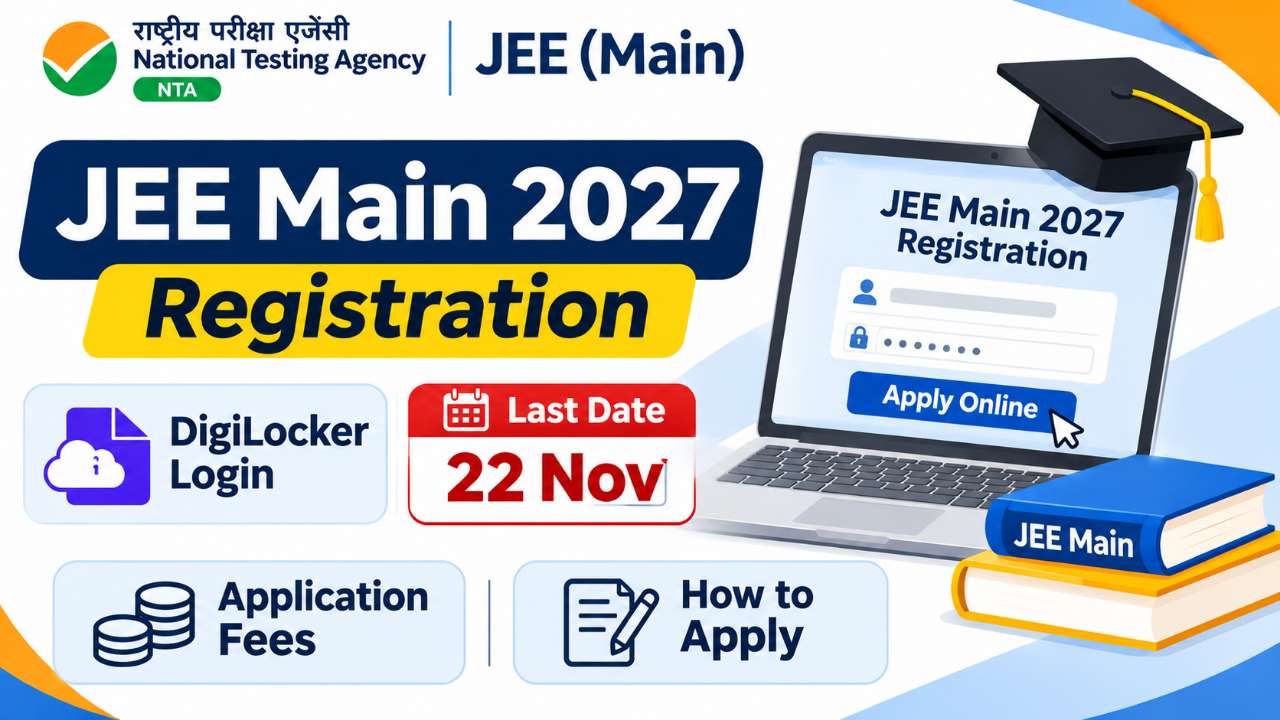
The National Testing Agency (NTA) has opened JEE Main 2027 Session 1 registration on jeemain.nta.nic.in. If you are a Class 12 student—or have recently completed school—and dream of studying B.Tech, B.Arch, or B.Planning at NITs, IIITs, and other centrally funded institutions, this is your first big admission milestone. A major change this year is the Meri Pehchaan login through DigiLocker (also via e-Pramaan or Jan Parichay), which verifies your identity before you fill the form. The regular registration window closes on 22 November 2026 without a late fee; after that, NTA accepts applications with a late charge until 26 November 2026, followed by a short correction window from 27 to 29 November 2026.
Session 1 exams are scheduled for 20, 21, 22, 23, 24, and 28 January 2027. Lakhs of students have already started the process—thousands are still at the payment stage—so planning your documents and DigiLocker access early avoids last-minute stress. This guide from CollegeDwar explains dates, fees, eligibility, the new login system, and practical tips so you can complete registration confidently and align your prep with the JEE Main exam pattern.
JEE Main 2027 Registration: Key Dates at a Glance
Missing a deadline can cost money or lock you out of Session 1. Mark these NTA timelines on your calendar and set reminders on your phone at least three days before each cut-off.
- Session 1 application (regular fee): Open now — closes 22 November 2026
- Late fee application: 23 to 26 November 2026
- Application correction window: 27 to 29 November 2026
- Session 1 examination: 20, 21, 22, 23, 24, and 28 January 2027 (multiple shifts)
- Session 2 examination: 2 to 7 April 2027 (separate registration later)
- Admit card (expected, based on past trends): Around mid-January 2027—check NTA notices
Actionable tip: Complete payment before 22 November 2026. NTA statistics show many candidates submit the form but delay fee payment; only paid applications are fully valid, and the confirmation page downloads only after successful payment.
What Is New in JEE Main 2027 Registration?
NTA has tightened identity verification and added flexibility for some applicant groups. Understanding these updates helps you choose the right login path and avoid rejection at the verification stage.
Meri Pehchaan and DigiLocker Login (Mandatory)
For most Indian residents, registration now begins through Meri Pehchaan, using one of:
- DigiLocker — link your Aadhaar-linked mobile number and ensure your Class 10/12 credentials are available if requested
- e-Pramaan — government single sign-on option
- Jan Parichay — alternative Meri Pehchaan route on the portal
If DigiLocker shows “document not found,” upload or fetch your marksheet through the DigiLocker app before starting the JEE form. Weak mobile network during OTP can break the session—use stable connectivity and complete the flow in one sitting.
NRI Candidates Without Aadhaar
NTA now allows Non-Resident Indian (NRI) applicants without Aadhaar to register using a valid Indian passport. On jeemain.nta.nic.in, choose the option such as “Apply through the NRI (Having No Aadhaar)” under Session 1 registration, then complete personal and academic details as instructed.
Fresh Application After Mistakes
If you entered wrong details after generating an application number or even after paying the fee, NTA has indicated that candidates may submit a fresh application in certain error scenarios. Still, treat your first submission as final-quality: double-check name spelling (as per Class 10 certificate), category, and exam city preferences before payment.
Eligibility Criteria for JEE Main 2027
Eligibility decides whether you can sit for the exam and which paper you should select. There is no upper age limit for JEE Main 2027.
Year of Passing / Appearing
You may apply if you:
- Passed Class 12 or equivalent in 2025 or 2026, or
- Are appearing for Class 12 or equivalent in 2027
Subject Requirements (Paper 1 — B.E./B.Tech.)
For engineering programmes, you must have studied Physics and Mathematics as compulsory subjects in Class 12, plus at least one of Chemistry, Biotechnology, Biology, or Technical Vocational subject. Architecture (Paper 2A) and Planning (Paper 2B) have their own paper choices and aptitude components—select only the paper you are prepared for.
Link to IIT Admission
JEE Main ranks open doors to NITs, IIITs, IIEST Shibpur, and other JoSAA-participating institutes. For IITs, you must qualify JEE Main, appear for JEE Advanced (IIT Delhi has announced Advanced on 23 May 2027), and meet institute-specific criteria. Treat Main Session 1 as both an admission exam and an Advanced qualifier opportunity.
JEE Main 2027 Application Fee Structure
Fees are payable online; payment gateway service charges are extra. Keep debit/credit card, net banking, or UPI ready.
| Category | Fee (Session 1 — indicative as per NTA) |
|---|---|
| Unreserved (UR) male | Rs 1,000 |
| UR female / Third gender (UR) | Rs 800 |
| Gen-EWS / OBC-NCL male | Rs 900 |
| Gen-EWS / OBC-NCL female / Third gender | Rs 800 |
| SC / ST / PwD / Transgender | Rs 500 |
If payment succeeds but the confirmation page does not generate, NTA guidance suggests attempting payment again; duplicate amounts from failed transactions are typically refunded by the agency—save all transaction IDs.
Documents and Digital Preparations
Keep scanned images and certificates ready before you log in via DigiLocker. Typical requirements include:
- Aadhaar (or passport for eligible NRI route)
- Active mobile number and email ID (not your parents’ alone—use one you check daily)
- Class 10 certificate or marksheet (date of birth proof)
- Class 12 marksheet, admit card, or enrollment proof
- Category certificate (Gen-EWS / OBC-NCL / SC / ST) in the prescribed format, if applicable
- PwD certificate / UDID, if applicable
- Recent photograph and signature as per NTA image specifications (usually JPG, clear background, stated file size)
Photograph and signature mismatch with admit card is a common centre-entry issue—use a recent passport-style photo, not a cropped group picture.
How JEE Main 2027 Session 1 and Session 2 Work
NTA conducts JEE Main in two sessions per year. You must apply separately for Session 1 and Session 2. If you miss Session 1 registration entirely, you can still aim for Session 2 in April 2027 when that window opens— but you lose a chance at an early rank and January exam practice.
Your best of two scores (across sessions in a year, as per prevailing NTA/score policy) is generally used for admissions and Advanced eligibility—verify the latest Information Bulletin on the official site for the exact normalisation and best-score rule for 2027.
Exam Pattern Snapshot (Paper 1 — B.E./B.Tech.)
Knowing the pattern helps you register for the right paper and plan mock tests alongside form filling.
- Physics: 20 MCQs + 5 numerical value questions (100 marks)
- Chemistry: 20 MCQs + 5 numerical value questions (100 marks)
- Mathematics: 20 MCQs + 5 numerical value questions (100 marks)
- Total: 75 questions, 300 marks (subject to official marking scheme in the bulletin)
On exam day, candidates generally cannot leave the centre before the allotted time ends—plan food, water, and travel accordingly.
After Registration: Admissions Path and Other Exams
JEE Main is the highway to top engineering and technology colleges, but Indian higher education offers parallel routes. If you are still exploring interests:
- Design aspirants may prepare for NID DAT alongside or instead of engineering papers.
- Hotel management candidates target NCHMCT JEE for IHMs and allied programmes.
- Humanities postgraduates later pursue programmes such as an MA—unrelated to JEE but useful if you are mapping a long-term academic plan with family.
After results, JoSAA and state counselling allocate seats. Many students also consider established private universities—for example, exploring campus options like Plastindia International University as a backup alongside government institutes.
Common Registration Mistakes to Avoid
- Wrong category or OBC-NCL / EWS certificate validity — certificates must match NTA format and financial year rules.
- Exam city preferences filled randomly — choose cities where you can reach comfortably for all shift possibilities.
- Name mismatch with Class 10 records — affects admit card and counselling.
- Stopping after “saved” but unpaid application — payment confirms your seat in the process.
- Ignoring correction window — use 27–29 November 2026 to fix allowed fields without panic.
Preparation Tips While You Complete the Form
Registration week should not pause your studies. Batch administrative tasks into one evening: DigiLocker setup, scans, fee payment, confirmation PDF. Shift back to syllabus coverage—NCERT-first for Chemistry and basics, problem practice for Mathematics and Physics. Session 1 in late January gives roughly two months after the November registration rush; use weekly mock tests to build stamina for multiple shift timings.
Conclusion
JEE Main 2027 Session 1 registration is live with a hard stop on 22 November 2026 for standard fees, DigiLocker-linked Meri Pehchaan login for most applicants, and exams from 20–28 January 2027. Complete your application and payment early, keep documents aligned with school records, and use the correction window if needed. Pair this process with disciplined prep and a clear goal—whether that is an NIT seat, an IIT path via JEE Advanced, or a broader set of options across Indian colleges. For ongoing updates, bookmark CollegeDwar’s JEE Main hub and the official NTA portal.