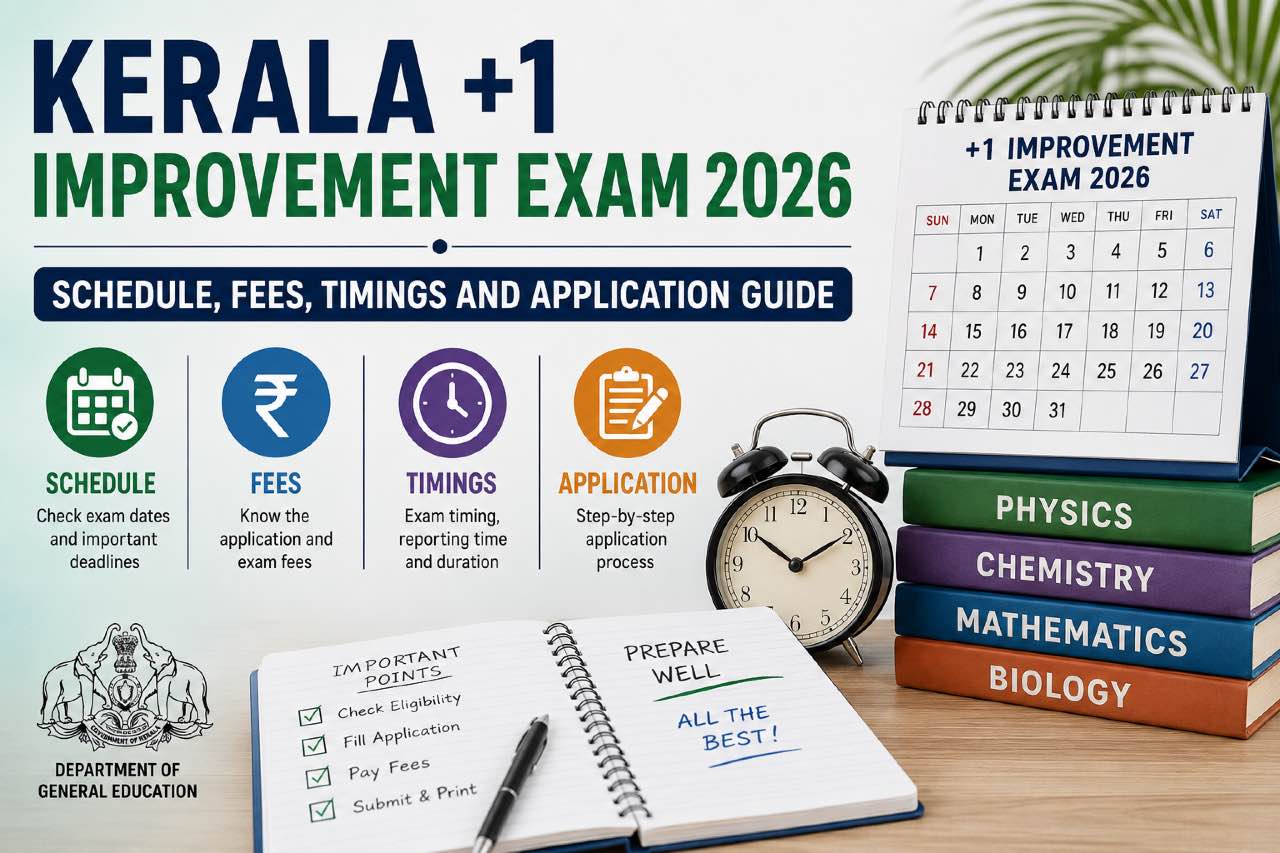

If you appeared for the Kerala first-year higher secondary examination and want to improve your marks or clear a failed paper, the Kerala +1 improvement exam 2026 is your second chance. The Department of General Education, Government of Kerala, has released the official schedule on the HSE portal at hseportal.kerala.gov.in/hse. Exams will be held from October 12 to 17, 2026, giving students a structured window to retake specific subjects before moving into Plus Two or planning higher education.
For thousands of Kerala students, Class 11 results shape stream choices, scholarship eligibility, and confidence before board exams in Class 12. An improvement or supplementary attempt can strengthen your academic profile for university admissions across Kerala—from general degree programmes at the University of Kerala, Thiruvananthapuram to specialised courses at institutions like Kerala University of Digital Sciences, Innovation and Technology. This CollegeDwar guide explains who can apply, key deadlines, fees, subject-wise dates, exam timings, and practical preparation tips—in clear, student-friendly language aligned with official notifications.
What Is the Kerala Plus One Improvement Exam 2026?
The Kerala first-year higher secondary improvement and supplementary examination is conducted by the Directorate of Higher Secondary Education (DHSE), Kerala. It serves two main purposes:
- Improvement: Students who passed all papers but want better marks in one or more subjects can reappear to upgrade their scores.
- Supplementary / compartment: Students who failed in one or more subjects get another opportunity to pass before continuing to Plus Two or re-admission pathways.
The 2026 cycle covers regular students, lateral entry candidates, re-admission cases, compartment applicants, and special category students as defined in the official notification. Schools act as the primary application channel—students do not apply independently online without school coordination.
Why This Exam Matters for Higher Education
Strong Plus One marks support merit-based admissions, internal ranking in schools, and eligibility for professional programmes. Students aiming for health sciences may later pursue courses under Kerala University of Health Sciences; agriculture aspirants often target Kerala Agricultural University, Thrissur; and those interested in fisheries and marine studies look at Kerala University of Fisheries and Ocean Studies, Kochi. Even when entrance exams matter, your HSE mark sheet remains an important academic record.
Important Dates for Kerala +1 Improvement Exam 2026
Missing a deadline can disqualify your application or attract late fine. Mark these dates on your calendar and confirm with your school principal:
| Event | Last Date |
|---|---|
| Application submission (regular, lateral entry, re-admission, compartment, special category) | September 10, 2026 |
| Fee remittance at treasury by school principal (without fine) | September 11, 2026 |
| Application with late fine of Rs 600 | September 15, 2026 |
| Fee remittance with fine at treasury by principal | September 16, 2026 |
| Online registration and data upload through DHSE portal (by school) | September 16, 2026 |
| Examination dates | October 12–17, 2026 |
Action tip: Submit your form at least two days before the deadline so your school can verify documents and complete treasury payment without last-minute rush.
Kerala +1 Improvement Exam Timetable 2026 (Subject-Wise)
Exams are held in forenoon (FN) and afternoon (AN) sessions. Below is the general subject schedule for non-Art streams:
| Date & Session | Subjects |
|---|---|
| October 12, 2026 (FN) | Physics, Sociology, Anthropology |
| October 12, 2026 (AN) | Geography, Music, Social Work, Geology, Accountancy |
| October 13, 2026 (FN) | Part I English |
| October 14, 2026 (FN) | Mathematics, Part III Languages, Sanskrit Sastra, Psychology |
| October 14, 2026 (AN) | Economics, Electronic Systems |
| October 15, 2026 (FN) | Part II Languages, Computer Science and Information Technology |
| October 15, 2026 (AN) | Home Science, Gandhian Studies, Philosophy, Journalism, Computer Science, Statistics |
| October 16, 2026 (FN) | Chemistry, History, Islamic History & Culture, Business Studies, Communicative English |
| October 17, 2026 (FN) | Biology, Electronics, Political Science, Sanskrit Sahithya, Computer Application, English Literature |
Students should cross-check their registered subject codes on the hall ticket. If you registered for multiple papers, ensure none clash on the same session.
Art Subject Schedule 2026
Candidates in the Art stream follow a separate timetable:
- October 12 (FN): Main
- October 13 (FN): Part I English
- October 13 (AN): Subsidiary
- October 14 (FN): Sanskrit
- October 15 (FN): Part II Languages
- October 16 (FN): Literature
- October 17 (FN): Aesthetic
Art students planning design or fashion careers may later explore entrance routes such as the NIFT entrance exam, while those focused on performing arts often research institutions like Kerala Kalamandalam, Thrissur. Your Plus One improvement result can still influence portfolio school applications and scholarship documentation.
Exam Fee Structure for 2026
Fees are paid per paper through the school, with treasury remittance handled by the principal. Know your category before applying:
Regular, Lateral Entry and Re-admission Candidates
- Examination fee: Rs 175 per paper
- Certificate fee: Rs 40
Compartment Candidates
- Supplementary exam + Second Year HSE (March 2027) fee: Rs 225 per paper
- Certificate fee (two certificates): Rs 80
Late Fine
Applications submitted after September 10, 2026 (up to September 15) attract a late fine of Rs 600, in addition to regular examination fees. Avoid this unnecessary cost by applying on time.
Example: A regular improvement candidate retaking Physics and Chemistry pays Rs 175 × 2 = Rs 350, plus Rs 40 certificate fee, totalling Rs 390 before any late fine.
Exam Timings and Session Rules
Understanding session timings helps you plan travel, especially if your exam centre is outside your home district. As per the official notification:
Subjects Without Practicals
- Forenoon (FN): 9:30 AM to 12:15 PM (includes 15 minutes cool-off time)
- Afternoon (AN): 2:00 PM to 4:45 PM (includes 15 minutes cool-off time)
Subjects With Practicals (Except Biology and Music)
- FN: 9:30 AM to 11:45 AM (15 minutes cool-off)
- AN: 2:00 PM to 4:15 PM (15 minutes cool-off)
Biology
Biology is conducted from 9:30 AM to 11:55 AM, including 25 minutes of cool-off time—15 minutes for Botany and Zoology sections and 10 minutes specifically for Zoology.
Music
Music examination runs from 2:00 PM to 3:45 PM, including 15 minutes cool-off time.
Exam-day tips: Reach the centre by 9:00 AM for FN papers and 1:30 PM for AN papers. Carry your hall ticket, school ID, and permitted stationery. Mobile phones and smart watches are typically not allowed inside the hall.
Who Should Apply for the Improvement Exam?
Not every student needs to reappear. Apply if you fall into one of these groups:
- Mark upgraders: You passed but need higher marks for competitive exams or college cut-offs.
- Compartment candidates: You failed one or more subjects and must clear them to progress to Plus Two.
- Re-admission / lateral entry students: Your academic continuity depends on clearing pending papers under DHSE rules.
- Special category applicants: As notified by DHSE for the 2026 cycle.
If you are unsure about eligibility, meet your school HSE coordinator before September 10, 2026. Principals verify register numbers, previous mark sheets, and category codes before forwarding applications.
Improvement vs Supplementary: Know the Difference
Many students confuse these two categories, yet the fee structure and academic purpose differ. Improvement candidates have already passed the subject but want a higher grade—useful when you need stronger marks for scholarships or to meet subject-wise minimums for future courses. Supplementary or compartment candidates have a fail grade and must secure pass marks to receive a complete first-year certificate. Compartment applicants pay Rs 225 per paper because the fee bundle also covers registration linkage with the Second Year HSE examination scheduled for March 2027. Speak clearly with your school about which category applies to you before paying fees, as category changes after portal upload are difficult.
Special Category and Re-admission Cases
Lateral entry students who joined Class 11 after a break, and re-admission candidates returning after discontinuation, must follow the same September 2026 deadlines as regular students. Special category provisions—such as disability accommodations or other notified concessions—are processed only when valid certificates are attached at the time of application. Do not assume concessions apply automatically; your principal must tick the correct code during online upload.
How to Prepare for Kerala Plus One Improvement 2026
A focused six-week plan between application confirmation and exams can make a measurable difference:
Week 1–2: Diagnose Weak Areas
- Collect your March/April 2026 mark sheet and identify exact topics where marks dropped.
- Solve at least five previous-year questions per chapter for your chosen subject.
- For Mathematics and Science papers, revise formulas daily using a small notebook.
Week 3–4: Structured Revision
- Follow the Kerala SCERT / DHSE textbook line by line for your paper.
- Join school-supported revision classes if available.
- Practice timed mock tests using FN/AN duration limits.
Week 5–6: Exam Simulation
- Attempt full-length model papers under exam conditions.
- Review cool-off time usage—read the full question paper before answering.
- For Biology and practical subjects, rehearse diagram labelling and step-wise answers.
Students eyeing veterinary and animal science programmes at Kerala Veterinary and Animal Science University, Wayanad should prioritise Biology and Chemistry if those are their improvement papers. Similarly, science stream students bound for Central University of Kerala, Kasaragod benefit from strong Plus One foundations in core subjects.
Subject-Wise Quick Tips
- Physics and Chemistry: Master numerical problems from electrostatics, organic conversions, and chemical bonding. Show complete working—partial steps often earn method marks.
- Mathematics: Focus on calculus, probability, and trigonometry from the Kerala HSE syllabus. Speed improves with daily 90-minute timed drills.
- Biology: Practise labelled diagrams for plant and animal physiology. Use the notified cool-off minutes to plan Botany and Zoology sections separately.
- Commerce papers (Accountancy, Business Studies, Economics): Revise journal entries, cost concepts, and definitions. Presentation clarity matters in theory sections.
- Languages and English: For Part I and Part II papers, review grammar, essay structures, and comprehension formats used in previous DHSE papers.
- Computer Science / IT: Balance theory definitions with output-tracing and logic questions common in Kerala HSE question patterns.
Resources Worth Using
Rely first on your school textbook and classroom notes because DHSE papers align closely with the prescribed syllabus. Previous-year question papers—available through schools and official study materials—help you spot repeated topics. Free online revision is useful, but verify that content matches the current Kerala syllabus before investing long hours. Group study works well for languages and humanities; solo timed practice suits Mathematics and Science better.
Hall Ticket, Exam Centre and Reporting Guidelines
Once your school completes portal registration, DHSE issues hall tickets with your name, register number, subject codes, exam centre address, and session (FN/AN). Collect your hall ticket personally and verify every detail immediately. Report discrepancies to your principal before exam week—corrections are nearly impossible once exams begin.
Exam centres are usually higher secondary schools designated by DHSE. You may be allotted a centre different from your own school, especially in district headquarters with high candidate volume. Visit the centre a day early if possible to plan transport and identify the exact block or room. Kerala’s monsoon transition into October can bring rain; keep admit card and ID in a waterproof pouch.
On exam day, reporting time is typically 30 minutes before the session start. Invigilators brief candidates on cool-off rules during this window. Listen carefully—cool-off time is reading time, not writing time. Violating instructions can lead to disciplinary action regardless of academic performance.
Documents Required for Application
Keep these ready when visiting your school office:
- Previous HSE first-year mark sheet / provisional grade sheet
- Admission register number and date of birth proof
- Passport-size photographs (as specified by school)
- Parent/guardian consent form if required by institution
- Fee amount in the format accepted by your school (cash or demand draft as directed)
- Disability or special category certificates, if applicable
Schools upload candidate data to the DHSE portal after treasury fee confirmation. Ask for an application receipt or acknowledgement slip for your records.
After the Exam: Results and Next Steps
DHSE typically publishes improvement and supplementary results on the official HSE portal and through schools. Once results are out:
- Download and verify your revised mark sheet for spelling, subject codes, and grades.
- Inform your school if you need corrected certificates.
- Update marks in scholarship or college application forms where applicable.
- Plan Plus Two registration or re-admission based on cleared subjects.
Improved marks can strengthen your profile when exploring undergraduate options across Kerala’s public universities and national institutions within the state.
How Plus One Marks Link to College Admissions
Although most degree admissions in Kerala rely primarily on Plus Two results, your Class 11 record still appears on consolidated academic transcripts and may be reviewed for internal scholarships, hostel merit lists, and some professional preparatory programmes. Science students building a NEET or JEE foundation often retake Physics, Chemistry, or Biology to close knowledge gaps before Class 12 board intensity rises. Commerce students improving Accountancy or Economics enter Plus Two with stronger conceptual clarity for CA Foundation or B.Com honours pathways. Humanities students benefit from upgraded marks in History, Political Science, or languages when applying for competitive BA programmes or civil services foundation courses later.
Kerala’s diverse university ecosystem—from general arts and science colleges under the University of Kerala to niche institutions in digital sciences, health, agriculture, and fisheries—rewards consistent academic performance across both years of higher secondary education. Treat the improvement exam as an investment in that continuity rather than a formality.
Re-evaluation and Mark Verification
After results, DHSE notifies procedures for photocopy requests, revaluation, or recounting where applicable. Read the official circular carefully—deadlines are short and fees non-refundable even if marks unchanged. Keep your original mark sheet safe; laminated copies are useful for immediate applications while you await revised certificates from the school.
Common Mistakes to Avoid
- Waiting until the last day: Treasury processing delays can void on-time status even if you submit the form on September 10.
- Registering for wrong subject codes: Double-check with teachers—errors are hard to fix after portal upload.
- Ignoring AN session timing: Geography, Music, and several commerce/humanities papers are afternoon sessions.
- Skipping cool-off practice: Many students lose time because they never practised reading the full paper first.
- Not carrying valid ID: Without hall ticket and identity proof, entry may be denied.
- Applying for too many papers at once: Retaking four or five subjects without adequate prep spreads effort thin—prioritise papers with the highest impact.
- Ignoring health and rest: Six exam days in one week are demanding; maintain sleep and nutrition, especially before Biology and Mathematics papers.
Official Portal and Staying Updated
All authoritative updates—schedule revisions, centre changes, result announcements—appear on the Department portal at hseportal.kerala.gov.in/hse. Bookmark this page and avoid relying on unverified social media forwards. Your school notice board and PTA WhatsApp groups are helpful for reminders, but always cross-check against the official notification before making travel or fee decisions. DHSE Kerala typically releases a detailed PDF circular alongside the timetable; request a copy from your school office and file it with your application receipt.
Conclusion
The Kerala +1 improvement exam 2026 offers a valuable opportunity to upgrade marks or clear backlog subjects between September application windows and October examinations. With the schedule now live on hseportal.kerala.gov.in/hse, students should act early: confirm eligibility with your school, submit forms before September 10, 2026, and prepare subject-wise using the official timetable from October 12 to 17, 2026. Whether your goal is a stronger mark sheet for Plus Two, university admission, or professional courses across Kerala’s higher education landscape, a disciplined revision plan and timely application are your best allies. Stay updated through your school and the official DHSE portal for any circular changes before exam day.