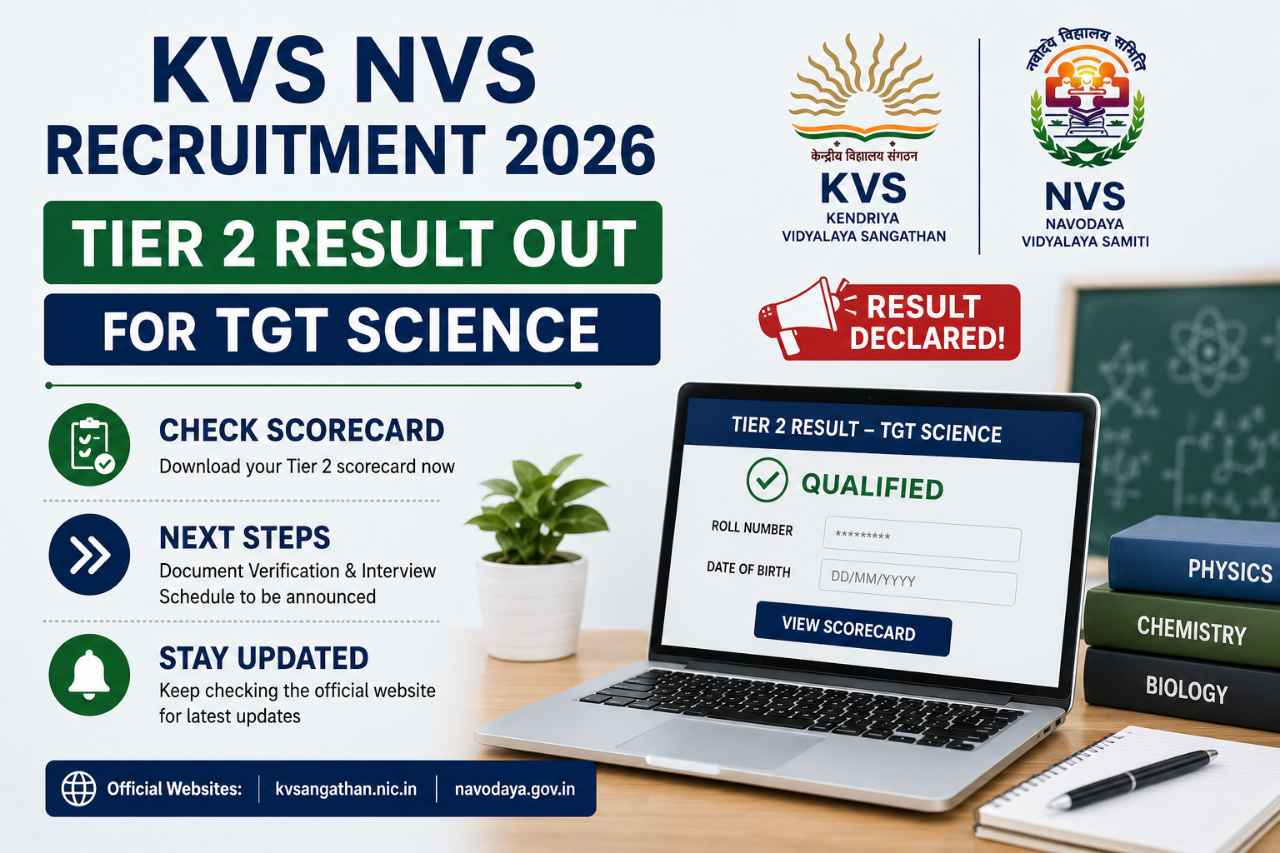
The Central Board of Secondary Education (CBSE) has released the KVS NVS Tier 2 result 2026 for TGT Science, marking an important milestone for thousands of teaching aspirants across India. Candidates who appeared for the Tier 2 examination under the combined Kendriya Vidyalaya Sangathan (KVS) and Navodaya Vidyalaya Samiti (NVS) recruitment drive can now log in to the official portal at examinationservices.nic.in and verify their scorecard, shortlisting status, and next-stage instructions.
For science graduates and B.Ed.-qualified teachers, KVS and NVS posts remain among the most sought-after central government teaching jobs because of job security, transferable postings, structured pay scales under the 7th Central Pay Commission, and the opportunity to teach in well-resourced Kendriya Vidyalayas and Jawahar Navodaya Vidyalayas nationwide. Whether you trained at a research-focused institution like the Indian Institute of Science Bangalore or completed your degree from a regional science college, this result directly affects your path toward a stable teaching career in central schools.
This article explains everything you need to know about the TGT Science Tier 2 result—how to download it, what the selection process looks like, what shortlisted candidates should do next, and how to stay updated as CBSE releases results for other posts in phases.
KVS NVS Recruitment 2026: What Is the Tier 2 Result for TGT Science?
The KVS NVS combined recruitment 2026 is a large-scale central government hiring exercise conducted by CBSE on behalf of Kendriya Vidyalaya Sangathan and Navodaya Vidyalaya Samiti. Posts include Trained Graduate Teachers (TGT), Post Graduate Teachers (PGT), Principals, Vice-Principals, and other categories across multiple subjects and administrative roles.
For TGT Science, the selection process typically involves:
- Tier 1: A computer-based test (CBT) covering general awareness, reasoning, pedagogy, and subject knowledge.
- Tier 2: A subject-focused examination that assesses deeper science content, teaching methodology, and application-based questions aligned with the NCERT/CBSE school curriculum for Classes VI to X.
- Document verification, interview, or skill test (where applicable for the specific post and recruitment rules).
CBSE is declaring Tier 2 results post-wise and in phases. The TGT Science result is among the early declarations; results for other subjects and posts are still being processed. This phased approach is standard in large recruitments where answer sheets, normalization (if any), and scrutiny are completed batch by batch.
Why the TGT Science Result Matters
Science teachers play a critical role in building foundational concepts in physics, chemistry, and biology before students choose specialised streams in Classes XI and XII. KVS and NVS schools follow NCERT textbooks and emphasise conceptual clarity, practical work, and board-exam readiness. A strong TGT Science teacher can influence student performance in board exams, Olympiads, and later competitive paths such as engineering, medical, and pure sciences.
If you studied science at institutions known for rigorous curricula—such as IISER Pune, SRM Institute of Science and Technology Chennai, or Government Science College Sikar—you may already have strong subject depth. The Tier 2 result now converts that preparation into a concrete shortlisting decision.
How to Check KVS NVS Tier 2 Result 2026 for TGT Science
Candidates must use only the official CBSE recruitment portal. Avoid third-party websites that claim to show results without login, as they may host outdated or misleading information.
Official Website and Login Details
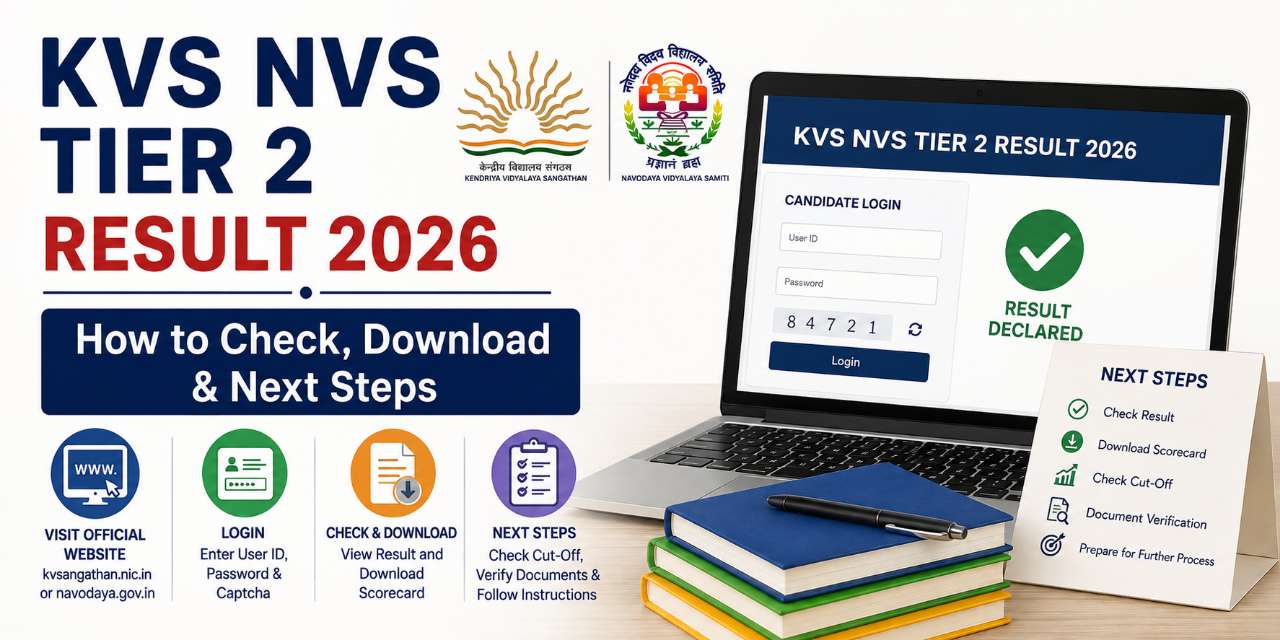
The result is available on the CBSE examinations services portal:
- Website: examinationservices.nic.in
- Section: KVS and NVS Recruitment 2026 candidate login
- Credentials required: Registration number (or application number) and password/date of birth as set during application
Once logged in, select the relevant recruitment cycle and open the TGT Science Tier 2 result or scorecard link. Save a PDF copy and note your marks, category, and shortlisting status carefully.
Information Displayed on the Scorecard
Depending on the post and recruitment rules, your scorecard may show:
- Candidate name and roll number
- Category (General, OBC, SC, ST, EWS, PwBD, etc.)
- Tier 2 marks obtained
- Shortlisting status (qualified / not qualified for next stage)
- Instructions for document verification, interview, or preference submission
For posts that do not require an interview, Tier 2 marks may be published along with the final result stage. Always read the notice PDF attached on the portal for post-specific rules.
Selection Process After Tier 2: Interviews, Skill Tests, and Preferences
Clearing Tier 2 does not always mean immediate appointment. The next steps depend on the recruitment notification and post category.
Interview and Skill Test
Candidates shortlisted for posts requiring an interview or skill test will receive call letters and schedule details through their candidate login on the official portal. Keep checking the dashboard daily after the Tier 2 result, as interview dates, venue details, and document lists are uploaded there first.
Prepare the following for the next stage:
- Original certificates: degree, B.Ed., caste/category certificate (if applicable), experience certificates
- Photo ID and passport-size photographs
- Teaching demonstration readiness (for some interviews)
- Printout of application form and Tier 2 scorecard
KVS/NVS Preference Submission
In combined recruitments, shortlisted candidates are often asked to submit posting preferences between KVS and NVS, or among regions/zones, within a specified deadline. Missing this window can affect allotment even if you qualify on merit. After logging in, look for a “Preference” or “Choice Filling” tab and complete it before the deadline mentioned in the official notice.
Document Verification and Final Merit List
Final selection is based on combined performance across applicable stages—Tier 1, Tier 2, interview/skill test (if any)—along with document verification. CBSE will publish category-wise merit lists and appointment orders through official channels. NVS and KVS may also post updates on kvsangathan.nic.in and navodaya.gov.in respectively.
Eligibility Reminder: Who Can Apply for TGT Science in KVS/NVS?
Understanding eligibility helps you assess whether your candidature remains valid through later stages. While you should always refer to the official notification, typical requirements for TGT Science include:
- Educational qualification: Bachelor’s degree in Science (B.Sc.) with Botany, Zoology, Physics, Chemistry, or equivalent combinations as specified; B.Ed. or equivalent degree from a recognised university
- Minimum marks: Often 50% aggregate in qualifying exams (relaxation for reserved categories as per rules)
- Age limit: As prescribed in the notification, with relaxation for SC/ST/OBC/PwBD and other eligible categories
- Teaching aptitude: Demonstrated through Tier 1 and Tier 2 pedagogy components
Graduates from science-focused universities—such as Cochin University of Science and Technology Kochi, JSS Science and Technology University, or Charotar University of Science and Technology Anand—commonly meet the academic criteria, provided they also hold B.Ed. and satisfy age and category requirements.
Understanding KVS and NVS: Where TGT Science Teachers Work
Both organisations operate under the Ministry of Education, but their school systems serve slightly different purposes.
Kendriya Vidyalaya Sangathan (KVS)
KVS runs Kendriya Vidyalayas primarily for children of transferable central government employees, defence personnel, and other eligible categories, though admission is also open to others subject to seat availability. KVs follow CBSE curriculum, offer Hindi and English medium options in many regions, and maintain a nationwide network of schools near cantonments, railway colonies, and urban centres.
Navodaya Vidyalaya Samiti (NVS)
NVS operates Jawahar Navodaya Vidyalayas (JNVs)—residential schools aimed at nurturing rural talent. JNVs select students through the Jawahar Navodaya Vidyalaya Selection Test (JNVST) at Class VI and provide free quality education, boarding, and facilities. TGT Science teachers in JNVs often handle lab-based teaching in a residential campus environment, which requires adaptability and strong student mentoring skills.
Choosing between KVS and NVS through preference filling is a career decision: urban transferable postings versus residential school settings, each with distinct work culture and community impact.
Phase-Wise Result Declaration: Other Posts Still Pending
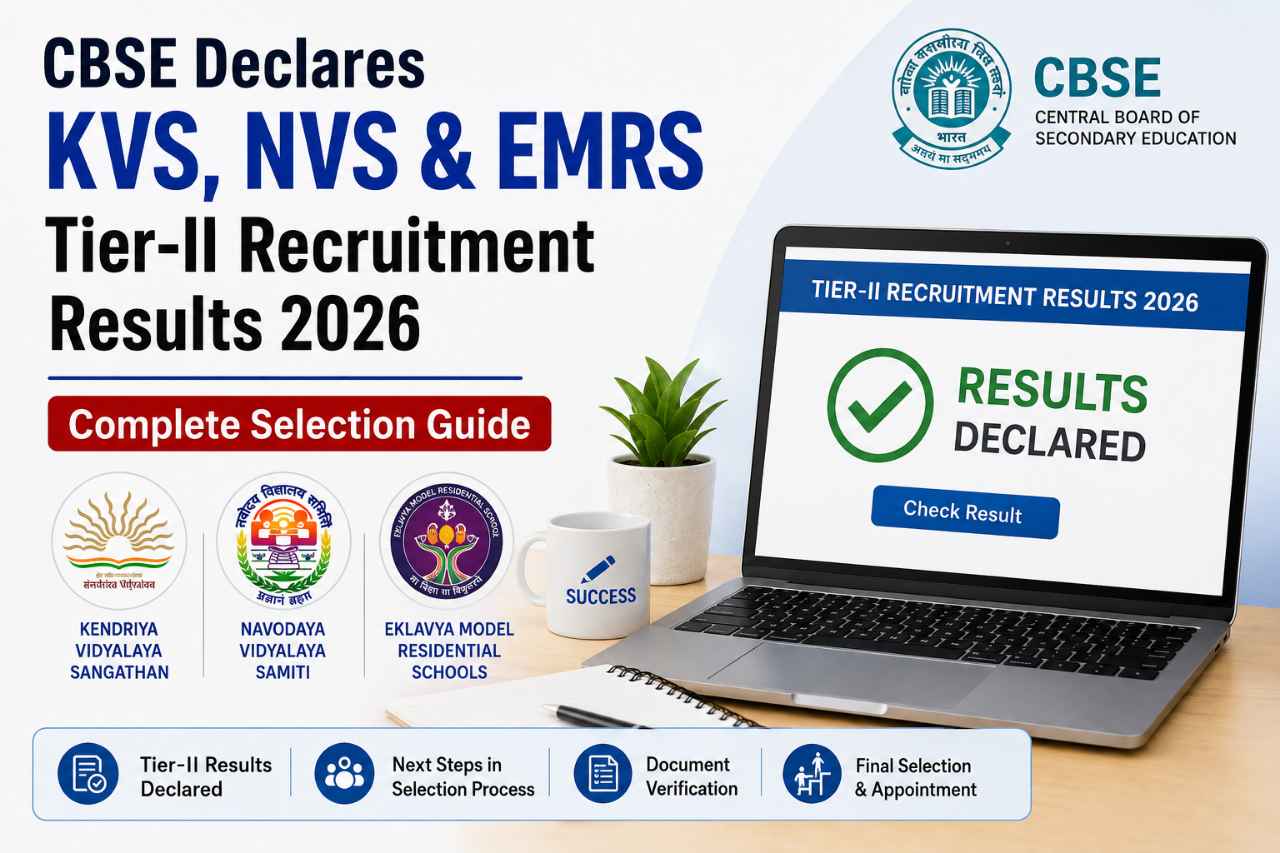
CBSE has clarified that KVS, NVS, and EMRS (Eklavya Model Residential Schools) results for different posts are being released in phases. TGT Science Tier 2 is out; other TGT subjects (such as English, Mathematics, Social Science), PGT posts, and administrative categories will follow as processing completes.
If you appeared for multiple posts or are waiting for another subject result:
- Do not assume the same cutoff or timeline as TGT Science
- Keep your login credentials safe and check the portal every few days
- Follow official PDF notices for answer key objections, result dates, and cutoffs
- Avoid rumours on social media; verify every update on examinationservices.nic.in
TGT Science Exam Pattern and Preparation Insights
Even if your result is already declared, understanding the exam pattern helps candidates awaiting other posts or planning future attempts.
Typical Tier 2 Focus Areas for Science
- Physics: Mechanics, heat, light, electricity, magnetism, modern physics basics
- Chemistry: Atomic structure, chemical bonding, acids-bases, metals-non-metals, organic chemistry fundamentals
- Biology: Cell biology, human physiology, plant physiology, genetics, ecology
- Pedagogy: NCERT-based teaching strategies, inclusive education, assessment techniques, ICT in science teaching
- Application: Diagram-based questions, practical/lab-linked concepts, and curriculum mapping for Classes VI–X
Students who build strong fundamentals during B.Sc.—whether at Indian Association for the Cultivation of Science or Sathyabama Institute of Science and Technology Chennai—should revise NCERT Class IX and X textbooks thoroughly, because KVS/NVS school teaching aligns closely with NCERT content.
Actionable Preparation Tips for Future Cycles
- Solve previous-year KVS/NVS and CTET Science papers to understand question framing.
- Revise NCERT Class VI–X Science with emphasis on diagrams, experiments, and activity-based questions.
- Practice time management: Tier 2 papers are lengthy; attempt familiar sections first.
- Study teaching methodologies—constructivism, remedial teaching, and NEP 2020-linked pedagogical ideas appear frequently.
- Join mock tests on official-style CBT platforms to reduce exam-day anxiety.
Career Path: From Science Graduate to Central School Teacher
A TGT Science appointment in KVS or NVS opens long-term career options beyond classroom teaching. Teachers can progress to senior teacher roles, participate in curriculum workshops, guide student science clubs, and eventually compete for PGT promotions or administrative positions subject to departmental rules.
For science graduates still completing their degrees, planning early helps. Institutions such as Indian Insitute of Space Science and Technology Thiruvananthapuram and IIEST Shibpur produce strong science graduates, but teaching posts additionally require B.Ed. and success in central recruitment exams. Similarly, graduates from Rajasthan College of Arts and Science Sikar or Lord Buddha Institute of Technology and Science Kota should ensure their B.Ed. is from an NCTE-recognised institution to remain eligible.
Women science graduates, including those from specialised institutions like Avinashilingam Institute for Home Science and Higher Education for Women Coimbatore, increasingly compete in central teaching recruitments, and KVS/NVS postings offer family-friendly transfer policies compared with many private-sector jobs.
Comparison Table: Tier 1 vs Tier 2 in KVS NVS Recruitment
| Aspect | Tier 1 | Tier 2 |
|---|---|---|
| Purpose | Screening and broad eligibility test | Subject-depth and post-specific assessment |
| Content focus | General English/Hindi, GK, reasoning, basic pedagogy | Science content, advanced pedagogy, curriculum application |
| Outcome | Qualification for Tier 2 | Shortlisting for interview/DV/final merit |
| Result status (2026) | Declared earlier for qualified candidates | TGT Science result declared; other posts pending |
Common Issues While Checking the Result and How to Fix Them
Many candidates face technical problems on result day. Here is how to handle them:
- Forgotten password: Use the “Forgot Password” link on the login page; reset via registered email or mobile OTP.
- Website slow or down: Try during off-peak hours (late night or early morning), use a stable connection, and avoid multiple rapid refresh attempts.
- Login error: Verify registration number format, check caps lock, and ensure you are on the correct recruitment cycle (KVS/NVS 2026, not an older year).
- Discrepancy in name or category: Contact the helpdesk numbers or email listed in the official notification with supporting documents.
- Result shows “Not shortlisted”: Review marks against expected cutoffs, check whether normalization or category-wise lists apply, and wait for official cutoff PDFs if not yet released.
What Shortlisted Candidates Should Do in the Next 7 Days
- Download and print the Tier 2 scorecard; store digital and physical copies safely.
- Read every instruction PDF on the portal regarding interviews, document verification, or preference submission.
- Submit KVS/NVS preferences before the deadline if the option is active in your login.
- Organise original documents in a folder with attested photocopies.
- Prepare for interview questions on classroom management, lesson planning, NCERT activities, and NEP 2020 themes.
- Track updates on examinationservices.nic.in, kvsangathan.nic.in, and navodaya.gov.in.
- Ignore unverified WhatsApp forwards about cutoffs or fake appointment letters.
Broader Context: Central Teaching Recruitments in 2026
The KVS NVS Tier 2 result arrives amid a busy calendar of national-level education exams and recruitments. Candidates often simultaneously track CTET, UGC NET, state TET exams, and university admissions. For science educators, qualifying central exams like CTET Paper II (Science/Mathematics) strengthens eligibility credentials for KVS, NVS, and state government schools.
India’s push under the National Education Policy (NEP) 2020 emphasises experiential science learning, vocational integration, and multilingual education. Central schools are expected to lead implementation. That makes TGT Science recruitment not just a job announcement but part of a larger effort to strengthen public school science education—from metro KVs to rural Navodaya campuses.
Aspirants exploring science higher education while preparing for teaching exams may also research institutes such as IISER Kolkata, Deenbandhu Chhotu Ram University of Science and Technology, and Hindustan Institute of Technology and Science Kancheepuram for advanced degrees, while keeping B.Ed. and teaching eligibility in view.
Salary, Benefits, and Job Profile for TGT Science Teachers
Selected TGT Science teachers in KVS and NVS are appointed on central government pay scales, typically Level 6 or as notified in the recruitment advertisement, with basic pay plus Dearness Allowance, House Rent Allowance, and Transport Allowance depending on posting location. Additional benefits often include medical facilities, leave travel concession, pension or National Pension System contributions, and children’s education allowances subject to prevailing rules.
The day-to-day job profile includes planning NCERT-aligned lessons, conducting laboratory sessions, preparing students for CBSE board examinations, maintaining records, participating in co-curricular activities, and supporting school events such as Science Day exhibitions and regional science fairs. NVS postings additionally involve residential campus duties and mentoring students beyond regular classroom hours. Understanding this profile helps shortlisted candidates prepare better for interviews where recruiters assess subject knowledge as well as communication, discipline management, and commitment to public education.
Document Checklist for Verification Stage
Keep these documents ready in original and photocopy form to avoid last-minute delays:
- Class X and XII mark sheets and certificates
- Graduation (B.Sc.) degree and mark sheets for all semesters/years
- B.Ed. degree, mark sheets, and NCTE recognition proof of the institution
- Category certificate (SC/ST/OBC/EWS) issued by competent authority
- PwBD certificate and medical certificate if applicable
- Experience certificate from recognised schools, if claimed
- Photo identity proof (Aadhaar, PAN, passport, or driving licence)
- Recent passport-size photographs matching the application
- Printout of online application and Tier 1/Tier 2 scorecards
Candidates who completed their B.Sc. from institutes such as Pratap Institute of Technology and Science Sikar or Mody University of Science and Technology Lakshmangarh should ensure degree certificates clearly mention required subjects such as Physics, Chemistry, and Biology or Botany/Zoology as specified in the notification.
Conclusion
The KVS NVS Tier 2 result 2026 for TGT Science is now live on examinationservices.nic.in, and candidates should check their scorecards immediately using their registration credentials. Shortlisted applicants must watch their login dashboard for interview call letters, document verification schedules, and KVS/NVS preference deadlines. Those not shortlisted should review their marks against official cutoffs when published and prepare strategically for future central teaching recruitments.
As CBSE continues phase-wise result declarations for other KVS, NVS, and EMRS posts, staying informed through official websites remains the safest approach. A central school teaching career rewards patience, consistent exam preparation, and strong command of NCERT science and pedagogy—and for successful TGT Science candidates, that journey has now entered its most decisive stage.