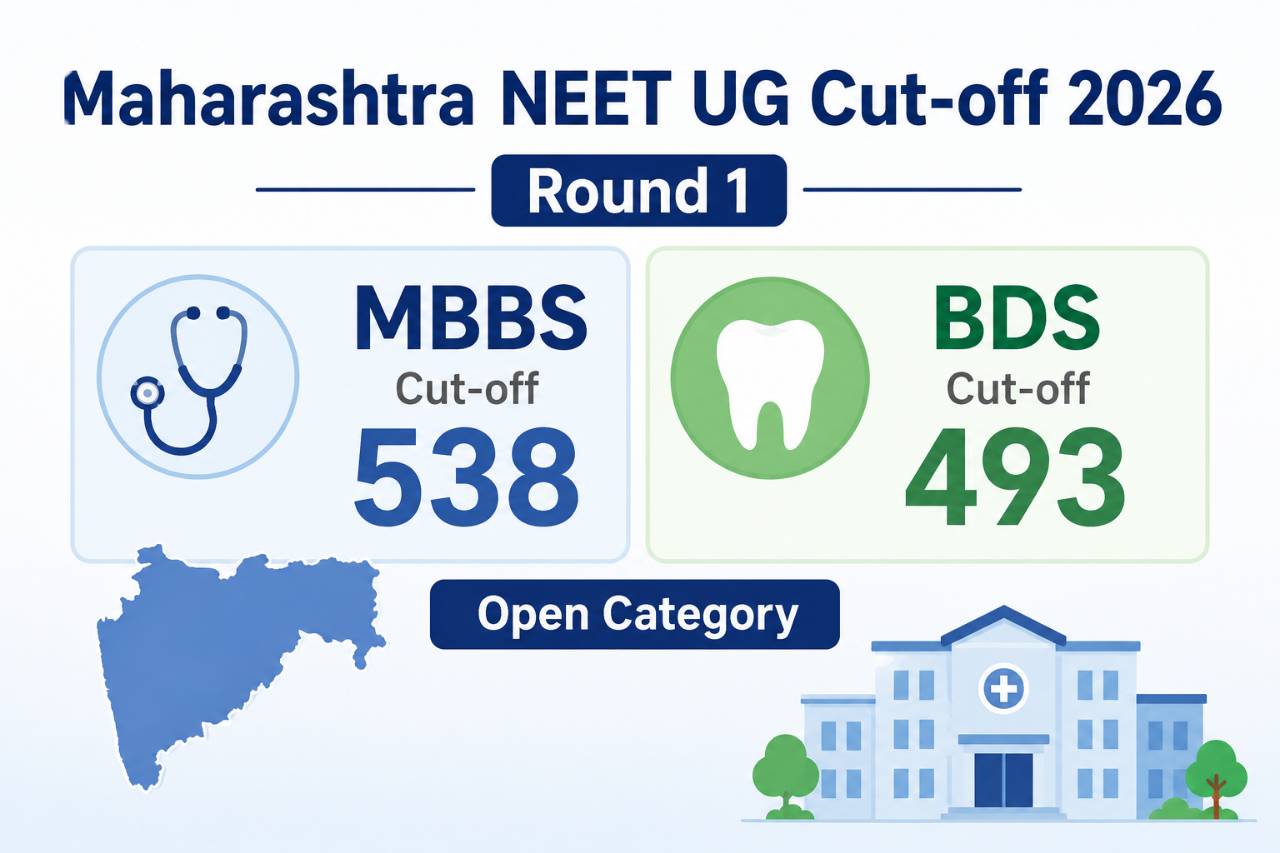

The Maharashtra State Common Entrance Test (CET) Cell has released the NEET UG 2026 Round 1 cut-off for MBBS and BDS admissions under the state quota. For the open (general) category, the highest qualifying score for governemnt MBBS seats is 538 marks, while governemnt BDS seats closed at 493 marks. These figures set the benchmark for thousands of medical aspirants who appeared in NEET UG and registered for Maharashtra state counselling.
Round 1 is often the most competitive phase of CAP (Centralised Admission Process) counselling, as top governemnt medical colleges fill a large share of their seats in this round. Whether you have been allotted a seat, are waiting for the next round, or are planning for 2027, understanding how Maharashtra publishes cut-offs, seat matrix, and reporting rules will help you make clearer admission decisions. This guide breaks down category-wise scores, allotment statistics, reporting deadlines, and practical next steps in simple language.
Maharashtra NEET UG Round 1 Cut-off 2026: Overview
The cut-off marks represent the lowest NEET score at which the last candidate in a given category was allotted a seat in Round 1. They are not pre-decided minimum marks; they emerge from seat availability, number of applicants, college preferences, and reservation rules under Maharashtra domicile policy.
Medical and dental colleges in the state function under the regulatory framework of the Maharashtra University of Health Sciences Nashik, which oversees undergraduate health sciences programmes including MBBS and BDS. The CET Cell conducts online counselling, publishes merit lists, and coordinates seat allotment across government, municipal, and private institutions affiliated with MUHS and other recognised bodies.
Key Highlights at a Glance
- Open category government MBBS cut-off: 538 marks (highest among all categories for govt. MBBS)
- Open category government BDS cut-off: 493 marks
- Government MBBS range: 384 (ST) to 538 (Open)
- Government BDS range: 350 (ST) to 493 (Open)
- Private MBBS highest cut-off: 482 marks (Open and EWS)
- Private BDS highest cut-off: 366 marks (SBC category)
- Total students allotted in Round 1: 10,509
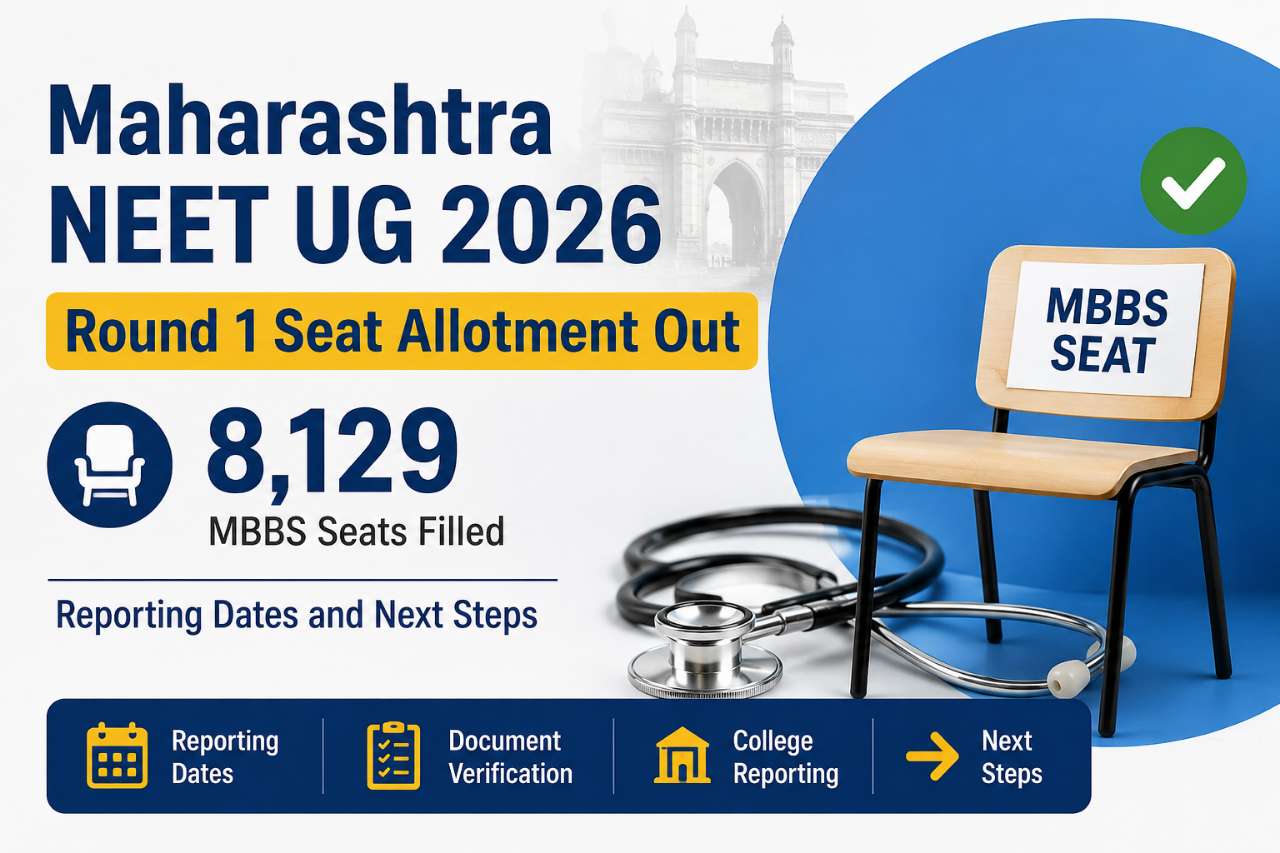
- MBBS seats allotted: 8,065 out of 8,129 available
- BDS seats allotted: 2,444 out of 2,517 available
- Reporting window: 31 August to 4 September 2026, until 5:30 PM
These numbers reflect intense competition for government seats, especially in metro and tier-1 cities. Reserved categories benefit from lower closing marks, but the gap between Open and ST categories on government MBBS seats remains significant—154 marks in Round 1. Candidates from northern Maharashtra regions such as Jalgaon often compete for seats across the entire state matrix, making it important to study both regional and statewide closing trends.
Category-wise Maharashtra NEET UG Round 1 Cut-off 2026
Maharashtra follows its state reservation matrix, which includes categories such as SC, ST, VJA (Vimukta Jati and Nomadic Tribes – A), NT-B, NT-C, NT-D, OBC, SBC, SEBC, EWS, and Open. Cut-offs differ for government and private colleges because fee structures, seat quotas, and applicant demand vary between the two sectors.
Government vs Private: MBBS and BDS Closing Marks
| Category | MBBS (Govt.) | MBBS (Private) | BDS (Govt.) | BDS (Private) |
|---|---|---|---|---|
| SC | 463 | 437 | 425 | 348 |
| ST | 384 | 358 | 350 | 274 |
| VJA | 494 | 477 | 460 | 333 |
| NTB | 477 | 453 | 451 | 344 |
| NTC | 521 | 472 | 471 | 340 |
| NTD | 535 | 479 | 466 | 350 |
| OBC | 533 | 476 | 480 | 350 |
| SBC | 534 | 479 | 484 | 366 |
| SEBC | 529 | 462 | 474 | 331 |
| EWS | 513 | 482 | 471 | 355 |
| OPEN | 538 | 482 | 493 | 352 |
From the table, three patterns stand out for aspirants and parents:
- Government MBBS remains the toughest route. Even ST candidates needed 384 marks for a government MBBS seat in Round 1, which is higher than the private BDS cut-off for several categories.
- Private MBBS is comparatively more accessible for middle-rank scorers. Open and EWS categories closed at 482 marks for private MBBS—56 marks below the government MBBS open cut-off.
- BDS offers a wider entry window, particularly in private colleges where Open category seats closed at 352 marks—141 marks lower than government BDS for the same category.
What Do These Cut-off Marks Actually Mean?
A cut-off of 538 for Open category government MBBS does not mean every candidate with 538 marks received the same college. It means the last allotted candidate in that category for any government MBBS seat in Round 1 scored 538. Candidates with higher marks may have secured premier institutes such as B.J. Medical College Pune, Grant Medical College Mumbai, or Seth GS Medical College Mumbai, depending on their preference list and seat matrix.
Similarly, 493 marks for Open category government BDS indicates the closing score for the last government dental seat allotted in Round 1. Dental programmes under institutions affiliated with health sciences universities across Maharashtra—including colleges in Pune, Nagpur, Aurangabad, and Jalgaon—follow the same CAP process. Students from North Maharashtra who study under universities such as Kavayitri Bahinabai Chaudhari North Maharashtra University Jalgaon still need a valid NEET score and CAP registration to enter MBBS or BDS, as clinical medical degrees require separate NMC-recognised medical and dental colleges.
Understanding MBBS vs BDS Cut-offs in Maharashtra
Both MBBS and BDS require qualification in NEET, but admission dynamics differ because seat numbers, course duration, career pathways, and fee levels are not identical.
MBBS: High Demand, Limited Government Seats
Maharashtra has seen steady expansion in MBBS seat capacity over the past decade, yet demand continues to outpace supply for subsidised government seats. In Round 1 alone, 8,065 of 8,129 MBBS seats were filled—a fill rate of roughly 99.2%. Only 64 MBBS seats reserved for Divyang and orphan categories remained vacant after Round 1.
For students scoring between 480 and 537 in the Open category, the choice often narrows to private MBBS colleges, management or NRI quota seats, or waiting for subsequent counselling rounds in Maharashtra or other states. Planning finances early is essential because private MBBS fees in Maharashtra can run into tens of lakhs per year depending on the institution and quota. Government seats may also carry service bonds requiring rural posting after graduation—a trade-off many students accept for the lower fee burden.
BDS: A Strong Alternative Pathway
BDS cut-offs are noticeably lower than MBBS, making dental surgery a practical option for candidates who want a clinical career but fall short of MBBS closing ranks. With 2,444 of 2,517 BDS seats allotted in Round 1, the fill rate is similarly high at about 97.1%.
Students considering BDS should evaluate college clinical exposure, patient inflow in attached hospitals, internship quality, and future options such as MDS through NEET PG. Dental graduates can also explore public health roles, hospital administration, or academic careers. Allied health and interdisciplinary education hubs in the state—including institutions linked to Tilak Maharashtra Vidyapeeth Pune and Krishna Vishwa Vidyapeeth Karad Maharashtra—offer complementary programmes, though independent clinical dental practice requires a BDS degree from a DCI-recognised dental college.
Maharashtra NEET UG Round 1 Seat Allotment Result 2026
Along with cut-offs, the CET Cell published the Round 1 seat allotment outcome. A total of 10,509 candidates received seats in this phase of Maharashtra NEET UG counselling 2026.
Seat Allotment Breakdown
- MBBS: 8,065 candidates allotted against 8,129 seats (64 seats vacant, primarily Divyang and orphan quota)
- BDS: 2,444 candidates allotted against 2,517 seats (73 seats vacant in Divyang and orphan categories)
The near-complete fill rate in Round 1 suggests that most candidates who received allotments are likely to confirm admission, especially for government seats where fees are lower and competition for upgradation in Round 2 can be unpredictable. Vacant seats in special categories may be reverted or carried forward according to CET Cell rules for subsequent rounds—always verify the official notification before assuming a seat will appear in Round 2.
Important Policy Context for 2026
Maharashtra has introduced domicile-focused changes in recent counselling cycles, including reserving a significant share of seats for state domicile students in private colleges and excluding certain institutions from specific rounds when compliance issues arise. Aspirants must read each round's information brochure carefully, as eligibility for a seat depends not only on NEET score but also on domicile certificate validity, caste or EWS certificate verification, and document upload status on the CET portal.
Health sciences education in Maharashtra is decentralised across regions—from Nashik and Pune to Nagpur and Jalgaon—giving students access to diverse campus environments. While comparing colleges, look beyond cut-off marks alone and consider NMC or DCI recognition status, bond conditions for government seats, hostel availability, and previous years' closing ranks for trend analysis. Open universities such as Yashwantrao Chavan Maharashtra Open University serve a different segment of learners through distance education and are not substitutes for NEET-based MBBS admission, but they illustrate the breadth of higher education options available in the state alongside professional medical degrees.
Reporting to Allotted Colleges: Deadlines and Documents
Receiving a seat allotment is not the final step. Candidates must physically report to their allotted college within the prescribed window to confirm admission.
Reporting Schedule
Candidates allotted seats in Round 1 must report to their respective colleges between 31 August and 4 September 2026, by 5:30 PM. Late reporting without official extension typically results in cancellation of the allotted seat, and the candidate may become ineligible for further rounds depending on whether they chose freeze, float, or withdraw options on the counselling portal.
Documents and Fee Payment
At the time of reporting, candidates should carry:
- NEET UG 2026 admit card and scorecard
- Maharashtra CAP allotment letter (printout from the portal)
- Class 10 and 12 mark sheets and passing certificates
- Domicile or nationality proof as applicable
- Caste, EWS, or disability certificate (if claiming reservation)
- Character and transfer certificates from the last institution attended
- Passport-size photographs and identity proof (Aadhaar or equivalent)
- Admission fee in the form of a demand draft as specified by the college
Original documents are mandatory for verification. Colleges may retain photocopies and return originals after verification, but policies vary—confirm with the admission office of your allotted institute before travelling. Keep multiple sets of photocopies and digital scans as backup.
Freeze, Float, and Withdraw: Strategic Choices After Round 1
After Round 1 allotment, candidates choose one of three options on the Maharashtra CET counselling portal:
- Freeze: Accept the allotted seat and exit further rounds. Best if you are satisfied with the college and course.
- Float: Accept the seat provisionally but remain eligible for upgradation in the next round. You must still report and pay fees; if upgraded, the previous seat is released automatically.
- Withdraw: Reject the allotment and participate in the next round without retaining the current seat. Use only if you are confident of a better outcome and understand the risk of losing the current allotment.
Students who float should report within the deadline even while hoping for upgradation. Failure to report typically cancels the seat regardless of the float selection. Many candidates with government BDS allotments choose float hoping to upgrade to MBBS in Round 2, but upgradation depends on vacant seats and revised merit—not guaranteed by score alone.
What Comes After Round 1: Next Steps in Counselling
Maharashtra NEET UG counselling usually proceeds through multiple CAP rounds, followed by institutional quota and stray vacancy rounds where applicable. Cut-offs in later rounds may rise or fall depending on how many candidates freeze, how many seats return from non-reporting, and whether new seats enter the matrix.
Round 2 and Beyond: What to Expect
Historically, government MBBS cut-offs in subsequent rounds can move marginally if top-rank holders migrate to AIQ or other states, or if vacant reserved seats are dereserved. However, relying on a substantial drop is risky—especially for Open category candidates near the 500-mark band. In 2026 Round 1, even OBC and SBC categories needed 533–534 marks for government MBBS, underscoring how competitive every reserved band has become.
Parallel to state counselling, the Medical Counselling Committee (MCC) conducts AIQ and deemed university rounds. Candidates registered in both systems must follow seat exit rules to avoid double allotment penalties. Always prioritise official MCC and CET Cell timelines over unofficial social media updates.
Actionable Tips for Different Candidate Profiles
If you were allotted your dream college: Report on time, complete fee payment, and choose freeze unless you have a realistic chance at upgradation through float.
If you missed the cut-off by a small margin: Stay registered for Round 2, revise your preference list to include colleges that closed slightly above your score in Round 1, and monitor vacant seat notices.
If your score is below private MBBS cut-offs: Evaluate BDS, AYUSH courses, or reattempt preparation. Many successful doctors improved their ranks after a structured second attempt focused on NCERT, mock tests, and weak-topic drills.
If you are a parent: Verify fee structure, bond terms, and hostel costs before reporting to a private college. Cut-off marks tell only part of the story—the total cost of education matters equally.
How Maharashtra Cut-offs Compare: Reading the Numbers Wisely
Round 1 cut-offs should be read alongside your NEET score, category, and domicile status—not in isolation. A score of 520 in Open category may have secured a government MBBS seat in some previous years but fell short in 2026 Round 1 where the closing mark reached 538. Year-on-year variation depends on paper difficulty, number of applicants, and seat additions.
When researching colleges, cross-reference Round 1 data with institutional reputation, clinical load, and location. Institutions in western Maharashtra—such as those connected to universities in Karad and Pune—attract strong regional demand. Vidarbha and Marathwada regions also host established medical colleges whose cut-offs may differ from Mumbai-Pune benchmarks even within the same category.
Quick Reference: Category Closing Marks for Government MBBS
For featured snippet and quick lookup purposes, here is the government MBBS Round 1 closing marks summary by category in ascending order: ST (384), SC (463), NTB (477), VJA (494), EWS (513), NTC (521), SEBC (529), OBC (533), SBC (534), NTD (535), OPEN (538). Use this list to gauge where your score sits relative to the 2026 Round 1 landscape before locking your counselling strategy.
Before Round 2 opens, download the official cut-off PDF from the CET Cell website and save your allotment status screenshot. Keeping a personal record helps if portal access is slow during peak hours—a common issue on result days when lakhs of candidates check outcomes simultaneously across Maharashtra's medical admission system.
Conclusion
The Maharashtra NEET UG 2026 Round 1 cut-off confirms continued high competition for government MBBS seats, with the open category closing at 538 marks, while government BDS closed at 493 marks. Private sector cut-offs offer additional pathways, particularly for BDS and private MBBS, but require careful financial planning. With 10,509 allotments and a reporting deadline of 4 September 2026, allotted candidates must act quickly to confirm their seats with original documents and demand draft fees.
Whether you secured an allotment or are preparing for the next round, stay anchored to official CET Cell notifications, understand freeze-float-withdraw rules, and use category-wise cut-off tables to set realistic expectations. Medical admission in Maharashtra is a marathon of exams, documentation, and timely decisions—Round 1 is a major milestone, but not the only path to a career in healthcare.