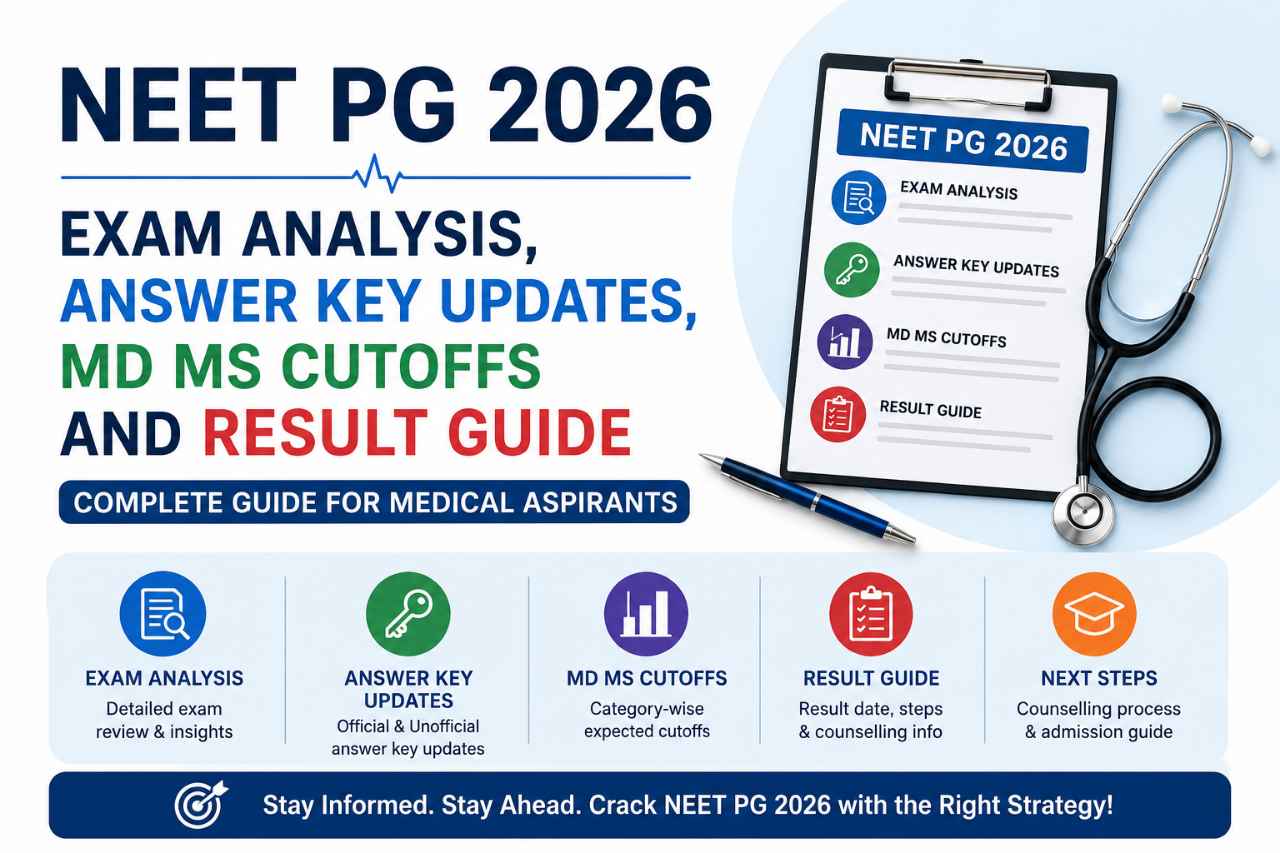

The National Eligibility cum Entrance Test for Postgraduate courses, commonly known as NEET PG, is the gateway to MD, MS, and other postgraduate medical programmes in India. On August 30, 2026, the National Board of Examinations in Medical Sciences (NBEMS) conducted NEET PG 2026 from 9:00 AM to 12:30 PM for 2,73,083 registered candidates at 1,111 examination centres spread across 338 cities. As soon as the exam concluded, aspirants began searching for question paper analysis, unofficial answer keys, expected scores, and MD or MS cutoff trends.
If you appeared for NEET PG 2026 or are planning for future cycles, this article explains everything in simple language from the revised exam pattern and marking scheme to rank prediction, counselling preparation, and seat availability across states. For broader context on medical entrance exams in India, you can also explore our guides on NEET and NEET UG, which cover the undergraduate pathway that leads into postgraduate specialisation.
NEET PG 2026 at a Glance: Key Facts Every Aspirant Should Know
NEET PG is a single-window national-level entrance examination for admission to postgraduate medical courses including MD, MS, PG Diploma (where applicable), and DNB programmes. NBEMS administers the test once a year, and the score determines eligibility for All India Quota (AIQ) counselling as well as state-level PG medical admissions.
Here is a quick snapshot of NEET PG 2026 based on official information and live exam-day reporting:
- Exam date: August 30, 2026 (Sunday)
- Exam timing: 9:00 AM to 12:30 PM (3 hours 30 minutes)
- Registered candidates: 2,73,083
- Exam centres: 1,111 centres in 338 cities
- Total questions: 180 MCQs (reduced from 200 in previous years)
- Maximum marks: 720
- Marking scheme: +4 for each correct answer, −1 for each incorrect answer
- Conducting body: NBEMS (National Board of Examinations in Medical Sciences)
The reduction from 200 to 180 questions is one of the most significant pattern changes in recent NEET PG cycles. Despite fewer questions, the total duration of the exam remains unchanged, giving candidates slightly more time per question on average a detail that can influence attempt strategy and accuracy.
Revised NEET PG 2026 Exam Pattern Explained
Understanding the exam pattern is the first step toward calculating your expected score and comparing it with previous-year cutoffs. NEET PG 2026 follows a computer-based test (CBT) format where all questions are multiple-choice with four options and a single correct answer.
Question Distribution and Sections
NEET PG traditionally covers clinical and pre-clinical subjects drawn from the MBBS curriculum. Questions are organised into sections (commonly labelled Section A through Section E), and tie-breaking rules refer to these sections when two candidates score identical marks. While NBEMS does not always publish a detailed subject-wise breakup on exam day, coaching institutes and subject experts typically release topic-wise analysis within hours of the test based on memory-based recall from candidates.
Common high-weightage areas in NEET PG include:
- Medicine: Internal medicine, cardiology, nephrology, endocrinology, infectious diseases
- Surgery: General surgery, orthopaedics, urology, anaesthesia-related concepts
- Obstetrics and Gynaecology: Antenatal care, labour management, gynaecological disorders
- Paediatrics: Neonatal care, growth milestones, common paediatric infections
- Pathology and Microbiology: Histopathology, immunology, bacteriology, virology
- Pharmacology: Drug mechanisms, adverse effects, clinical pharmacology
- Preventive and Social Medicine (PSM): Epidemiology, national health programmes, biostatistics
- Forensic Medicine, ENT, Ophthalmology, Psychiatry, Radiology, Dermatology, and Anatomy/Physiology/Biochemistry
Why the Question Count Was Reduced to 180
NBEMS reduced the number of questions from 200 to 180 while keeping the exam duration at 3 hours 30 minutes. This change affects how candidates should approach the paper:
- Each question carries more weight relative to the total score (720 marks divided by 180 questions = 4 marks per question).
- Negative marking has a proportionally higher impact one wrong answer can cost you the equivalent of 25% of a correct answer.
- Candidates who previously relied on attempting all 200 questions may need to recalibrate their risk-reward balance for 180 questions.
Experts generally advise attempting questions you are confident about first, marking uncertain ones for review, and avoiding blind guessing because of the −1 penalty per incorrect response.
NEET PG 2026 Marking Scheme and Score Calculation
The NEET PG marking scheme is straightforward but unforgiving for careless guessing. Here is how your raw score is calculated:
- Correct answer: +4 marks
- Incorrect answer: −1 mark
- Unattempted question: 0 marks (no negative marking)
Formula: Raw Score = (Number of correct answers × 4) − (Number of incorrect answers × 1)
Example: If you answered 140 questions correctly and 30 incorrectly, with 10 left unattempted, your score would be (140 × 4) − (30 × 1) = 560 − 30 = 530 marks out of 720.
When using unofficial answer keys released by coaching centres after the exam, remember that memory-based questions may differ slightly from the actual paper. Treat estimated scores as a range rather than a final number until NBEMS publishes official results.
NEET PG 2026 Tie-Breaking Rules: What Happens When Two Candidates Score the Same
With lakhs of candidates competing for limited PG seats, tie-breaking rules are critical. If two or more aspirants obtain identical marks in NEET PG 2026, NBEMS resolves the rank using the following order of priority:
- Fewer incorrect answers overall The candidate with fewer wrong responses ranks higher.
- Fewer incorrect answers in Section A Section-level accuracy becomes the next differentiator.
- Fewer incorrect answers in Sections B, C, D, and E Applied sequentially in that order.
- Higher aggregate marks in MBBS professional examinations Academic performance during MBBS is considered.
- Older candidate Age is the final tie-breaker if all other criteria remain equal.
This multi-layered system rewards accuracy over blind attempts. Candidates who attempted fewer questions but maintained high accuracy may rank above those with the same total score but more incorrect answers a practical reason to avoid random guessing on difficult questions.
NEET PG 2026 Question Paper Analysis and Unofficial Answer Key
NBEMS does not release the complete official NEET PG question paper or answer key to the public immediately after the exam. Instead, coaching institutes, medical educators, and subject experts compile memory-based question papers from feedback shared by test takers who exit exam centres.
What Is Memory-Based Analysis?
After the exam, candidates recall questions they remember sometimes with approximate wording or answer options and share them on social media, Telegram groups, or with coaching faculty. Experts then:
- Compile topic-wise question lists
- Provide suggested answers with explanations
- Rate overall difficulty (easy, moderate, difficult)
- Identify subjects that were heavily tested or surprisingly absent
Memory-based materials are useful for rough score estimation but are not official. Wording may differ, some questions may be missing, and disputed answers are common until multiple sources confirm the same key.
How to Use Unofficial Answer Keys Safely
- Cross-check answers across at least two reputable coaching sources before finalising your response sheet.
- Mark questions where sources disagree and exclude them from score calculation or use an average.
- Do not panic over a single low estimated score official results may differ due to question variations.
- Save screenshots or PDFs of analysis for reference, but do not treat them as legal evidence in any grievance.
Expected NEET PG 2026 Cutoffs for MD and MS Programmes
Cutoffs for MD and MS seats depend on multiple variables: total number of candidates, difficulty level of the paper, seat availability, category (General, OBC, SC, ST, EWS), and quota (All India vs state). NBEMS and the Medical Counselling Committee (MCC) publish category-wise cutoff scores only after results and counselling rounds.
Factors Influencing NEET PG 2026 Cutoffs
- Exam difficulty: A tougher paper typically lowers cutoff scores; an easier paper pushes cutoffs upward.
- Number of applicants vs seats: India currently has approximately 86,360 PG medical seats, with Karnataka reporting the highest number among states according to recent Lok Sabha data shared by the Union Health Minister.
- Seat expansion: The central government has approved a third phase of a scheme to strengthen state and central government medical colleges, aiming to create 5,000 additional PG seats by 2028–29 at a cost ceiling of ₹1.50 crore per seat. Long-term, this may ease competition, though immediate cutoffs depend on seats available in the current academic cycle.
- Policy changes: The National Medical Commission (NMC) has moved to scrap two-year PG medical diploma programmes, redirecting those seats toward MD and MS courses. This structural shift may alter seat matrices and cutoff dynamics over coming years.
Illustrative Cutoff Ranges (Based on Previous-Year Trends)
Exact NEET PG 2026 cutoffs will be announced only after results. However, aspirants often refer to previous years for planning. The table below shows indicative score ranges always verify against official MCC and state counselling bulletins:
| Category | Indicative Score Range (Previous Cycles) | Notes |
|---|---|---|
| General (AIQ) | 550–650+ (varies by year and branch) | Top clinical branches require higher scores |
| OBC | 500–600+ | Category relaxation applies |
| SC | 400–500+ | Check MCC official cutoff PDF |
| ST | 350–450+ | State quotas may differ |
| EWS | 540–630+ | Introduced for economically weaker sections |
Clinical branches such as Radiology, Dermatology, Orthopaedics, and Obstetrics & Gynaecology historically demand higher ranks than non-clinical or pre-paraclinical specialisations. Always match your expected rank with branch-specific closing ranks from the previous counselling round closest to your category and quota.
PG Medical Seats in India: Competition Landscape
NEET PG is intensely competitive because postgraduate specialisation determines career trajectory, earning potential, and super-speciality eligibility. According to recent parliamentary responses, India has 86,360 PG medical seats, with Karnataka leading among states in total PG seat count.
Key points for aspirants mapping their options:
- All India Quota (AIQ): 50% of seats in government medical colleges (except certain institutions) are filled through central counselling.
- State quota: Remaining seats are allotted through respective state counselling authorities; domicile rules apply.
- Deemed universities and private colleges: Separate fee structures and admission processes; NEET PG score remains mandatory.
- DNB seats: Diplomate of National Board programmes offered at accredited hospitals; often considered alongside MD/MS during choice filling.
Medical education hubs such as Delhi, Mumbai, Bengaluru, Hyderabad, Chennai, and Kota attract large numbers of PG aspirants. While Kota is widely known for NEET UG coaching, cities across India now host dedicated NEET PG preparation ecosystems with test series, grand tests, and subject-wise revision modules.
NEET PG 2026 Result Date and What Happens After the Exam
NBEMS typically announces NEET PG results within a few weeks of the examination, though exact dates are confirmed through official notifications on natboard.edu.in and nbe.edu.in. After results, the following timeline generally unfolds:
- Scorecard release: Downloadable from the NBEMS candidate portal using login credentials.
- Cutoff publication: MCC releases qualifying cutoff for AIQ counselling.
- Registration for counselling: MCC NEET PG counselling registration on mcc.nic.in for AIQ; parallel state registrations on respective portals.
- Choice filling and locking: Select preferred colleges and MD/MS branches in order of priority.
- Seat allotment rounds: Round 1, Round 2, mop-up, and stray vacancy rounds as applicable.
- Reporting to allotted college: Document verification, fee payment, and admission confirmation.
Keep your NEET PG 2026 admit card safe until the entire counselling and admission process is complete it is required for identity verification at multiple stages.
Documents to Keep Ready for NEET PG Counselling
Preparing documents in advance prevents last-minute stress during seat allotment:
- NEET PG 2026 scorecard and admit card
- MBBS degree certificate and provisional certificate (if applicable)
- MBBS mark sheets (all professional years)
- Internship completion certificate
- Permanent or provisional registration certificate from State Medical Council
- Category certificate (SC/ST/OBC/EWS/PwBD) if applicable
- Domicile certificate for state quota counselling
- Photo ID proof (Aadhaar, passport, driving licence)
- Passport-size photographs
- Caste validity certificate (if required by state)
Preparation Tips for Future NEET PG Aspirants
Whether you are awaiting NEET PG 2026 results or planning for the next cycle, these evidence-based strategies help improve performance:
- Follow the revised pattern: Practice 180-question mock tests within 3 hours 30 minutes to build exam-day stamina.
- Prioritise high-yield subjects: Medicine, Surgery, OBG, Paediatrics, and PSM collectively account for a large share of questions.
- Use previous-year analysis: Identify recurring topics and image-based question trends.
- Master negative marking discipline: Attempt only when you can eliminate at least two options.
- Revise notes, not new textbooks: In the final month, consolidation beats covering new content.
- Take care of mental health: The pressure surrounding NEET PG is immense; seek support if anxiety affects preparation or wellbeing.
Aspirants preparing from coaching hubs often combine structured test series with self-study. Institutions in cities like Kota have expanded beyond school-level science coaching; however, PG preparation typically requires clinical knowledge built during internship and early residency exposure.
NEET PG vs NEET UG: Understanding the Pathway
Medical education in India follows a clear ladder. NEET UG qualifies candidates for MBBS and BDS undergraduate programmes. After completing MBBS including a compulsory rotating internship graduates become eligible for NEET PG to pursue MD, MS, or equivalent postgraduate degrees.
Both exams are conducted under the broader NEET framework overseen by national bodies, but they differ in syllabus depth, competition level, and career stakes. UG NEET tests foundational science and limited clinical knowledge, while NEET PG evaluates comprehensive MBBS-level clinical reasoning across all major specialties.
NEET PG 2026 Exam-Day Guidelines Recap
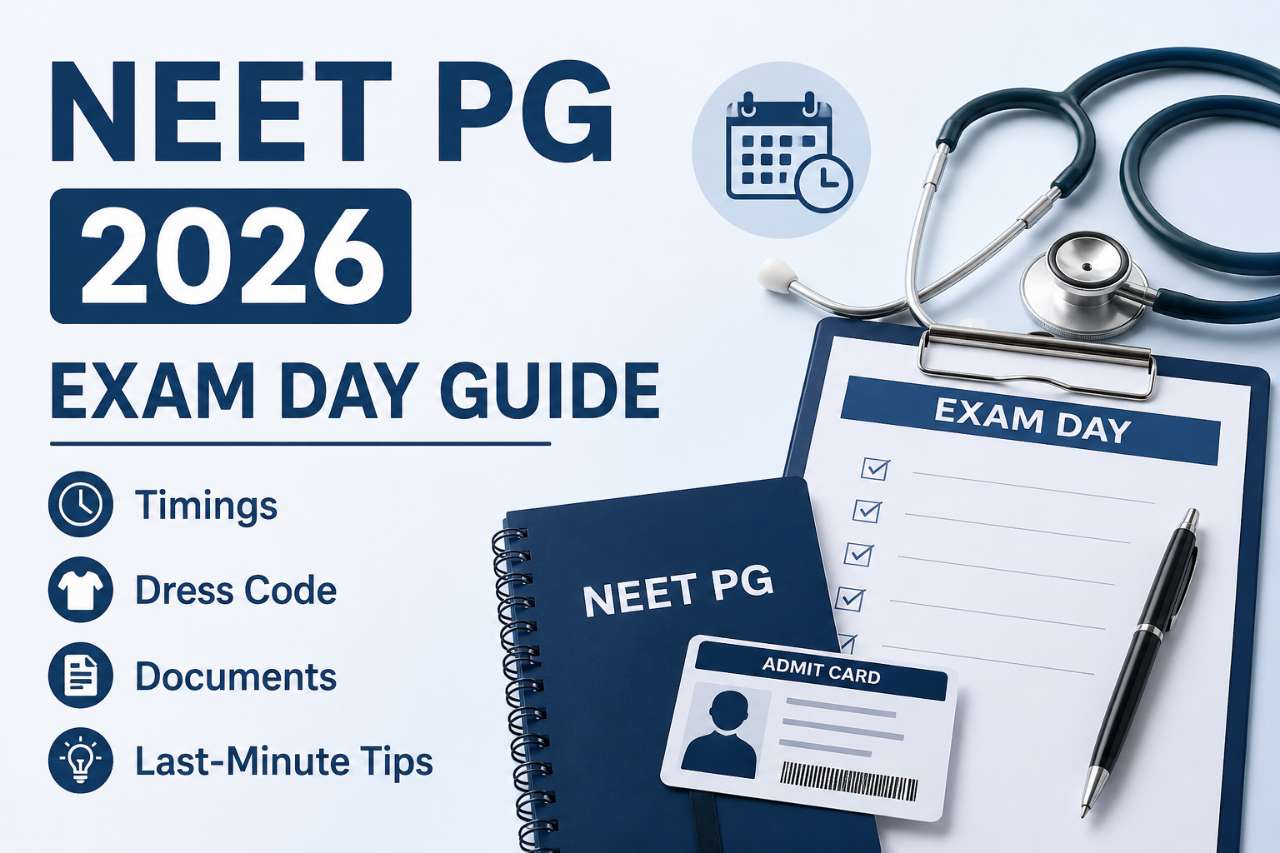
NBEMS enforced strict exam-day protocols to maintain fairness and security across all 338 cities. Candidates who appeared on August 30, 2026 were required to carry a printed NEET PG admit card along with a valid photo identity proof. Reporting times, gate closing rules, and biometric verification procedures were communicated through the official information bulletin available on natboard.edu.in.
Items commonly prohibited inside the exam hall include mobile phones, smart watches, calculators, study material, bags, and electronic devices. Dress code guidelines typically restrict full-sleeve clothing, metallic accessories, and footwear with thick soles to prevent concealment of unfair means. Candidates were advised to reach centres well before the reporting time to accommodate security checks and seat allocation inside the CBT lab.
If you missed the exam due to a genuine emergency or faced a technical issue during the CBT session, document every detail including time stamps, centre name, and staff interactions and check whether NBEMS opens a grievance or re-test window through an official notification. Unofficial social media claims about re-exams should never be trusted without verification on NBEMS portals.
How to Choose MD or MS Specialisation During Counselling
Once NEET PG 2026 results are out, choice filling becomes the most consequential decision of the admission cycle. Rather than chasing branch popularity alone, use a structured approach:
- Assess clinical interest: Choose a subject you can study and practise for decades forced choices often lead to burnout.
- Review seat matrix: Download the latest seat matrix from MCC or state counselling authorities to see realistic options at your expected rank.
- Compare college quality: Patient load, faculty strength, research exposure, and hospital infrastructure matter as much as branch name.
- Plan super-speciality early: If DM or MCh is a long-term goal, pick an MD branch that keeps that pathway open.
- Keep backup choices: Fill the maximum allowed preferences including DNB and less competitive branches to avoid vacant rounds.
Candidates from Rajasthan and nearby states sometimes explore educational institutions across Kota and other academic hubs ranging from dedicated medical coaching ecosystems to established colleges such as Shri Ana Sagar Mahila Shiksha Shastri Mahavidyalaya Kota while weighing college reputation against branch availability. Geography, fees, and clinical exposure should all factor into your final locked choices.
Conclusion
NEET PG 2026 marked another milestone in India's postgraduate medical admissions journey, with over 2.73 lakh candidates appearing for the revised 180-question paper on August 30, 2026. While unofficial answer keys and expert analysis help estimate scores immediately after the exam, official results and MCC cutoffs remain the only reliable basis for counselling decisions.
Focus now on accurate score estimation using multiple memory-based sources, gathering counselling documents, researching MD and MS branch preferences, and tracking official NBEMS and MCC announcements. With approximately 86,360 PG seats nationwide and thousands more in the pipeline by 2028–29 thorough preparation and smart choice filling can still secure a desirable specialisation even in a competitive year.
Stay updated with CollegeDwar for the latest NEET PG news, cutoff analysis, counselling guides, and college-wise admission insights across India.