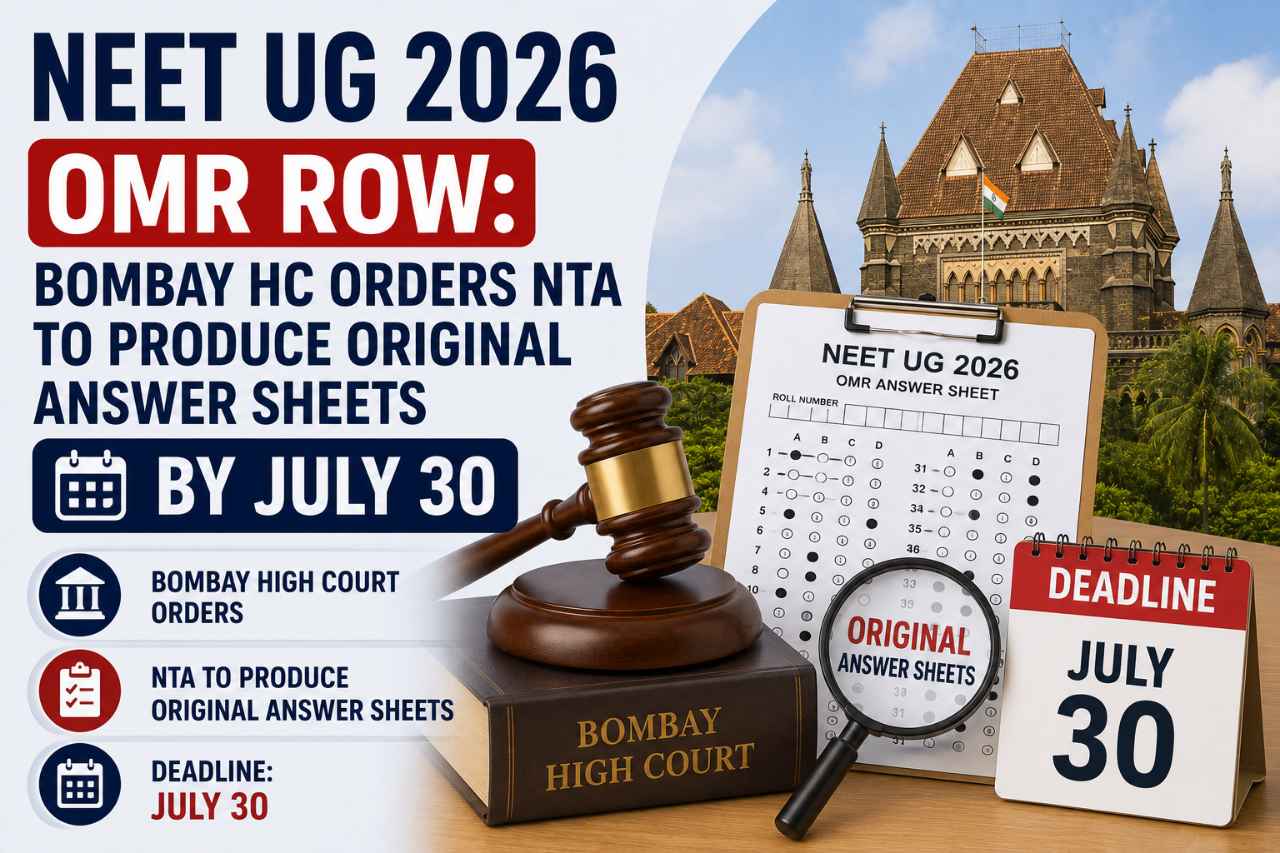

The NEET UG 2026 result row has moved from social media debates to a formal courtroom direction. On July 24, 2026, the Bombay High Court (Aurangabad Bench) ordered the National Testing Agency (NTA) to produce the original OMR answer sheets of three candidates who reported major gaps between their self-calculated marks and the scores shown on the official result. The next urgent hearing is scheduled for July 30, 2026.
For lakhs of medical aspirants who appeared for NEET UG, this order matters beyond three individual cases. It raises questions about result transparency, digital verification, and whether MBBS, BDS, and AYUSH counselling can proceed smoothly while disputes remain unresolved. This guide explains the court order, petitioner claims, NTA's response, and a practical action plan for students and parents.
What Did the Bombay High Court Order in the NEET UG 2026 OMR Case?
The Aurangabad Bench of the Bombay High Court, comprising Justice Nitin Suryawanshi and Justice Abasaheb Shinde, heard three joint petitions filed by NEET UG 2026 candidates. The core prayer was straightforward: the court should direct NTA to place on record the original Optical Mark Recognition (OMR) sheets so that alleged score mismatches could be examined factually.
Optical Mark Recognition technology scans bubbled responses on answer sheets and converts them into machine-readable data. In high-stakes exams like NEET, even a small scanning or mapping error can change ranks dramatically. Because NEET UG determines admission to government and private medical colleges across India, courts treat such disputes with urgency—especially when results are already declared and counselling is about to begin.
Why the Court Marked the Matter as Urgent
NEET UG 2026 results were declared on July 16, 2026. Counselling registration through the Medical Counselling Committee (MCC) and state authorities typically follows within weeks. If a candidate's score is wrong by hundreds of marks, they may miss government medical college cutoffs entirely. The petitioners argued that without access to verified original OMR records, they cannot protect their admission rights.
The court listed the next hearing on July 30, 2026 under the urgent category, signalling that the timeline of admissions may depend on what NTA produces and how the bench evaluates the evidence.
Who Are the Three Petitioners and What Do They Allege?
Three aspirants—Hricha Deshpande, Soham Gavate, and Atharva Jagtap—approached the Bombay High Court together. Each claims a serious discrepancy between marks calculated from their OMR response sheet and the final score published by NTA.
Hricha Deshpande: 619 Calculated vs 280 Awarded
According to her petition, Hricha calculated 619 marks based on her OMR sheet and the official answer key. However, her declared NEET UG 2026 result showed only 280 marks. She further alleged that the result reflected fewer attempted questions in Physics and Chemistry than what her OMR copy displayed. A gap of 339 marks is extraordinary in NEET terms—it can mean the difference between a strong government college seat and not qualifying at all.
Soham Gavate: Re-Exam Candidate With a 427-Mark Gap
Soham's case is linked to the NEET UG 2026 re-examination held on June 21, 2026, which NTA conducted for select candidates. He claims that after matching his responses with the answer key, he should have scored around 522 marks, but NTA awarded him only 95 marks. Re-exam cases draw extra scrutiny because a separate test administration introduces additional logistics—identity verification, centre allocation, and answer-sheet processing.
Atharva Jagtap and the Revised OMR Email Issue
All three petitioners reportedly received revised OMR sheets by email after July 15, 2026. They stated these emailed copies did not match the OMR versions they had earlier accessed on the NTA candidate portal. This "two versions of the same OMR" claim sits at the heart of the controversy: candidates want to know which file reflects their actual bubbled responses at the examination centre.
Key Timeline: NEET UG 2026 Result Row at a Glance
Understanding the sequence of events helps students separate facts from rumours circulating online.
| Event | Date / Detail |
|---|---|
| NEET UG 2026 re-examination | June 21, 2026 |
| Revised OMR sheets emailed to some candidates | After July 15, 2026 |
| NEET UG 2026 result declared | July 16, 2026 |
| NTA public clarification on viral OMR images | July 20, 2026 (via nta.ac.in and official social media) |
| Bombay HC order to produce original OMR sheets | July 24, 2026 |
| Next Bombay HC hearing (urgent) | July 30, 2026 |
| Exam conducting body | National Testing Agency (NTA) |
| Court | Bombay High Court, Aurangabad Bench |
How Has NTA Responded to the Viral OMR Controversy?
On July 20, 2026, NTA issued an official notice through nta.ac.in and its verified social media channels. The agency stated that OMR images circulating widely on social media were digitally altered and described several viral posts as fabricated content.
NTA maintained that the authentic OMR of every candidate remains in its official records. According to the agency, OMR sheets were made available on the candidate portal and sent to registered email addresses during the official OMR response challenge window—before the final result was declared. NTA urged students not to rely on screenshots forwarded on WhatsApp, Instagram, or Telegram groups.
What NTA Wants Candidates to Trust
NTA's position rests on a simple principle: only portal-downloaded and officially emailed OMR copies should be treated as authentic. The agency has asked candidates to raise grievances exclusively through official communication channels rather than through unverified social media campaigns.
However, the petitioners' argument is different—they are not merely sharing viral screenshots. They claim inconsistencies between portal copies, emailed revisions, and final scores. That is why the High Court's direction to produce original physical or master digital OMR records is significant: it moves the dispute from online arguments to documented evidence.
What Is an OMR Sheet in NEET and Why Does It Matter?
An OMR (Optical Mark Recognition) sheet is the bubble sheet on which candidates mark answers during NEET UG. After the exam, NTA scans these sheets and uploads a digital copy for candidate verification. During the challenge window, students can:
- View each question and the response recorded against their roll number
- Compare recorded responses with the provisional answer key
- Submit challenges if they believe a response was wrongly captured
- Download and save a personal copy for future reference
Because NEET UG uses negative marking, a wrongly recorded blank or double-marked bubble can change scores quickly. For example, if ten questions are shown as unattempted when a student actually bubbled them, the lost marks plus negative-mark penalties can create the kind of large gaps alleged in the Bombay HC petitions.
Digital OMR vs Original OMR: What Is the Difference?
Candidates typically interact with a digital reproduction of their OMR on the NTA portal. The court's order refers to original OMR sheets—the primary record NTA holds, which may include scanned images, raw response logs, or physical sheets depending on processing workflow. For forensic comparison, original records help establish whether discrepancies arose during scanning, data entry, result compilation, or later document revision.
Understanding NEET UG 2026 Marking and Rank Implications
Before reacting to social media posts, every candidate should understand how NEET UG scoring works. The exam carries 720 maximum marks across 180 questions—45 each in Physics and Chemistry and 90 in Biology (Botany and Zoology). Each correct answer typically earns +4 marks, each incorrect answer costs 1 mark under negative marking, and unattempted questions score zero.
Rank and percentile depend not only on raw marks but also on the relative performance of all test takers. A correction of even 20–30 marks can shift a candidate across thousands of rank positions. When petitioners allege gaps of 300+ marks, the implied error is not a marginal key dispute—it would require large-scale misrecording of responses or a fundamental mismatch between the evaluated sheet and the candidate's actual paper.
Category-Wise Qualifying Marks and Cutoff Pressure
NEET UG 2026 category-wise qualifying cutoffs determine eligibility for counselling. General category candidates traditionally face the highest threshold, while reserved categories receive relaxed qualifying marks. Government medical college cutoffs, however, are far above the minimum qualifying score. A student who loses hundreds of marks due to an OMR error may fall from a comfortable government seat estimate to below the qualifying line entirely—making timely verification and legal remedy urgent.
Will the NEET UG 2026 OMR Row Delay Counselling?
This is the question most rank holders are asking. NEET UG 2026 counselling for All India Quota seats is conducted by the Medical Counselling Committee (MCC), while state medical counselling authorities manage state quota seats. Normally, counselling proceeds on the basis of the declared result and rank list.
One petitioner has specifically raised concern that counselling should not advance on disputed marks while their case is pending. The July 30, 2026 hearing could clarify whether:
- Counselling continues for all other candidates as scheduled
- NTA must revise specific results if originals contradict published scores
- The court issues broader directions affecting document verification norms
Historically, isolated result corrections in national exams do not always halt entire counselling cycles, but court orders can pause steps for affected roll numbers or require NTA to publish corrigenda. Students should monitor both nta.ac.in and mcc.nic.in rather than assuming either a full freeze or business-as-usual.
Impact on MBBS, BDS, and AYUSH Admissions
NEET UG is the gateway to MBBS, BDS, BAMS, BHMS, BUMS, BSMS, and related undergraduate medical programmes. Even a short counselling delay can cascade into collegereporting deadlines, hostel allotment, and academic session start dates. Medical colleges plan batch sizes and faculty intake based on confirmed admissions; uncertainty at the counselling stage creates administrative pressure across states.
Aspirants targeting top institutions—whether medical colleges or other premier campuses such as IIT Bombay for non-medical programmes—should keep parallel options open until admission is formally confirmed.
Rights of NEET Candidates: Portal Records, Email Copies, and Grievances
Every NEET UG aspirant has the right to inspect the responses recorded against their roll number during the official challenge window. NTA publishes the OMR display and provisional answer key precisely so candidates can detect scanning or mapping errors before results are finalised. Once results are declared, options narrow, but documented discrepancies can still be raised through grievance mechanisms or, in exceptional cases, judicial review—as the three Bombay HC petitioners have done.
Students should understand the difference between an answer-key challenge (disputing whether a question's official key is correct) and an OMR recording challenge (disputing which bubble was scanned for a given question). The current row primarily involves the latter: candidates believe the machine-recorded responses do not match their actual OMR copies.
Why Saving Time-Stamped Records Matters
Digital records can be updated when agencies reprocess data. That is why petitioners flagged revised OMR emails received after July 15, 2026 that differed from earlier portal downloads. Saving time-stamped PDFs during the challenge window creates an evidence trail. If you have not done this yet, download whatever is currently available on the portal immediately and compare it with every email NTA ever sent to your registered address—not just the most recent message.
How Can NEET UG 2026 Candidates Verify Their Own OMR and Scores?
Even if you are not involved in the court case, this episode is a reminder to verify your records now. Waiting until counselling choice filling begins is risky. NTA has repeatedly stated that candidates should treat portal and registered-email copies as the authoritative reference.
Follow these verification practices immediately:
- Log in to the official NEET UG portal at neet.nta.nic.in using your application number and password.
- Download the OMR response sheet currently shown in your dashboard.
- Open the email account registered with NTA and locate the OMR mail sent during the challenge window.
- Compare portal and email copies question-by-question—note any mismatch in recorded responses.
- Download the final answer key and calculate your expected score manually.
- Match your calculated score with the marks on your official scorecard.
- Save PDF copies, screenshots with timestamps, and score calculation spreadsheets.
- If you find a discrepancy, use only official NTA grievance or support channels to report it.
- Do not edit OMR images or share manipulated screenshots—this undermines credible complaints.
- Track court and NTA updates through verified sources until the July 30 hearing outcome.
Red Flags to Watch For in Your NEET Result
- Final marks significantly lower than manual calculation from OMR + answer key
- Subject-wise attempted counts that do not match your recollection or OMR copy
- A revised OMR email that differs from an earlier saved portal version
- Roll number or name errors on the scorecard
- Result visible on portal but rank list anomaly for your category
Legal and Policy Context: Why NEET Result Disputes Keep Returning
NEET UG is India's single-largest gateway exam for medical admissions, conducted nationwide by NTA. Over the past few years, students and parents have grown more vigilant about OMR transparency, centre conduct, and result accuracy—especially after high-profile exam controversies. Courts have increasingly asked testing agencies to produce primary records rather than dismissing student complaints as misinformation alone.
The current Bombay HC order fits that pattern: when alleged discrepancies are large and documented through official portal materials, judicial intervention seeks paper-trail accountability. Separately, policy discussions continue on reforming NEET administration—including proposals for statutory status for NTA and longer testing windows for future cycles.
Students planning long medical careers should also understand that NEET UG is only the first step. Postgraduate specialisation later requires clearing NEET PG, which has its own result and counselling ecosystem. Accuracy at the UG stage protects your eligibility chain for years ahead.
Actionable Advice for Students and Parents Right Now
Uncertainty is stressful, but a calm, evidence-based approach works better than panic sharing online. Here is a practical checklist:
- Verify first: Cross-check OMR, answer key, and scorecard today—not tomorrow.
- Archive evidence: Store original downloads exactly as NTA issued them.
- Avoid viral content: Treat social media OMR posts as unverified unless matched to your portal copy.
- Prepare for counselling: Register on MCC and state portals on time even while watching legal updates—missing registration deadlines can be costlier than waiting for clarifications.
- Plan contingencies: If medical admission becomes uncertain, explore structured alternatives early. Some students consider allied health degrees; others pivot to programmes like a BA in sciences or healthcare management pathways, or even professional courses such as an MBA or MBA Finance after completing a suitable undergraduate degree. A Master of Business Administration (MBA) is not a substitute for medical licensure, but sensible backup planning reduces anxiety.
- Follow official sites only: nta.ac.in, neet.nta.nic.in, mcc.nic.in, and your state counselling authority.
What to Expect After the July 30, 2026 Hearing
The upcoming urgent hearing will likely examine whether NTA has complied with the direction to produce original OMR sheets for the three petitioners. Possible outcomes include:
- Verification completed, no systemic error: Court may dispose of petitions if originals match declared results and emailed copies are explained satisfactorily.
- Confirmed mismatch for petitioners: NTA could be directed to revise marks and issue an updated scorecard or rank.
- Broader procedural directions: The bench may recommend clearer OMR versioning, tighter email audit trails, or interim safeguards for disputed roll numbers during counselling.
Third-party observers—including college admission desks and counselling help centres—should refrain from predicting outcomes. The legally relevant documents are those NTA places before the court.
Conclusion
The NEET UG 2026 OMR row has entered a decisive phase with the Bombay High Court directing NTA to produce original answer sheets for three candidates who reported massive score gaps. NTA maintains that viral OMR images are digitally altered and that authentic records were already shared through official channels. The truth for these petitioners will likely hinge on what the original records show at the July 30, 2026 hearing.
For the wider student community, the lesson is clear: download, verify, and preserve your NEET documents now. Whether you are aiming for MBBS counselling or mapping a longer journey that may eventually include NEET PG, your admission security begins with accurate UG records. Stay updated through official portals, avoid manipulated social media content, and complete counselling registration steps on time while monitoring court and NTA announcements closely.