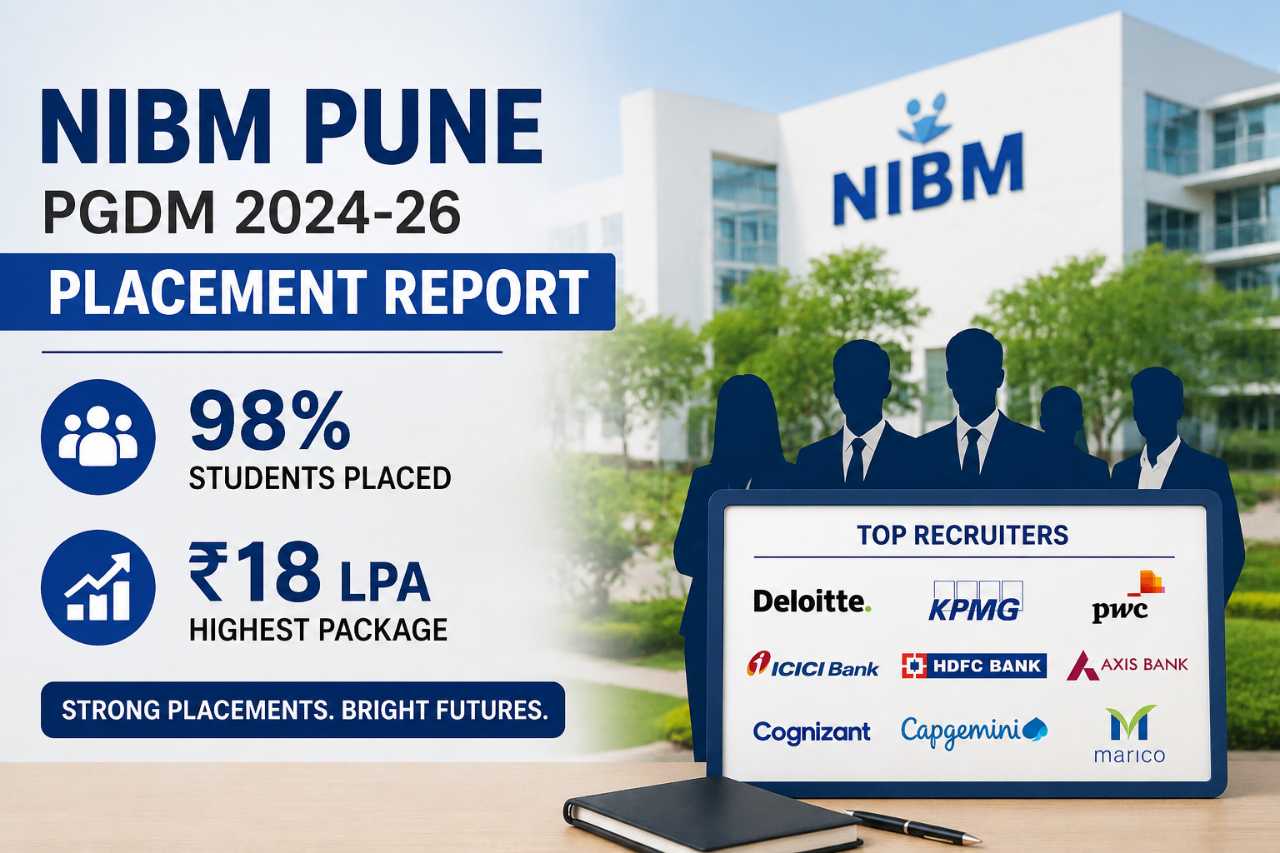

The National institute of Bank Management (NIBM), Pune has officially released the placement report for its PGDM 2024-26 batch, confirming another strong hiring season for one of India's most specialised banking and financial services B-schools. According to the report published on the institute's PGDM portal, 128 students were placed, translating to a 98 percent placement rate, with the highest package at ₹18 LPA and the average package at ₹13.5 LPA.
For MBA and PGDM aspirants targeting roles in banking, NBFCs, fintech, and financial services, NIBM's latest numbers offer a clear snapshot of recruiter confidence, sector demand, and return on investment. This guide breaks down every headline figure, compares the 2024-26 batch with earlier cohorts, explains how to read the official report, and outlines a practical action plan if you are planning to apply for the next admission cycle.
What Is NIBM Pune and Why Does Its Placement Report Matter?
NIBM is an autonomous institution established by the Reserve Bank of India (RBI). Unlike general management programmes that cover marketing, HR, and operations in equal measure, NIBM's flagship Post Graduate Diploma in Management (PGDM) is built exclusively for the Banking and Financial Services (B&FS) domain. That specialisation shapes everything—from the curriculum and faculty profile to the recruiter list and salary outcomes.
Pune has long been one of western India's strongest education hubs. Alongside NIBM, the city hosts reputed institutions such as Symbiosis International Deemed University Pune, Savitribai Phule Pune University, and specialised schools like the Gokhale Institute of Politics and Economics Pune. Among this diverse ecosystem, NIBM occupies a unique niche: it is not a broad MBA factory but a sector-focused institute where nearly every graduating student is groomed for roles in banks, asset management, insurance, and allied financial sectors.
When NIBM publishes a batch-wise placement report, it carries weight for three reasons. First, the institute's RBI lineage gives it credibility with public and private sector recruiters. Second, placement outcomes are closely watched because the PGDM fee and opportunity cost are significant for working professionals and fresh graduates alike. Third, year-on-year comparisons help aspirants judge whether packages are improving, stable, or adjusting to market cycles—information that generic college brochures rarely provide in detail.
NIBM PGDM 2024-26 Placement Highlights at a Glance
The 2024-26 batch continued NIBM's track record of near-total campus hiring. Placements were driven primarily by leading banks and financial services organisations, reflecting sustained demand for trained managers who understand credit, risk, treasury, retail banking, and digital finance.
The key statistics from the official report are summarised below:
| Parameter | Figure |
|---|---|
| Total students placed | 128 |
| Placement rate | 98 percent |
| Highest package offered | ₹18 LPA |
| Average package offered | ₹13.5 LPA |
What a 98 Percent Placement Rate Actually Means
A 98 percent placement rate indicates that almost the entire eligible batch received job offers through the institute's placement process. In practical terms, only a small fraction of students—typically those opting out for entrepreneurship, higher studies, or personal reasons—did not participate in or complete the placement cycle. For aspirants comparing B-schools, rates above 95 percent generally signal robust corporate relations and structured career services.
However, smart applicants look beyond the headline percentage. Ask whether the report counts all enrolled students or only placement-eligible candidates, whether pre-placement offers (PPOs) are included, and whether the remaining two percent reflects voluntary opt-outs or unresolved placements. NIBM's consistent 98 to 100 percent rates across recent batches suggest the figure reflects genuine hiring momentum rather than statistical adjustment.
Understanding the ₹13.5 LPA Average and ₹18 LPA Highest Package
The average package of ₹13.5 LPA represents the mean compensation across placed students, usually including fixed salary components as reported by recruiters. For a programme focused on banking and financial services, this is a competitive entry-level figure—particularly when many roles offer additional variable pay, performance bonuses, and rapid promotion tracks in commercial banking.
The highest package of ₹18 LPA came from a top recruiter on campus. It is important to remember that the highest offer is typically an outlier driven by a specific role, location, or employer tier. It demonstrates the ceiling of what the batch achieved but should not be treated as the expected salary for every graduate. Use the average—and, when available in the full PDF, the median—as your realistic planning benchmark.
Year-on-Year Comparison: How the 2024-26 Batch Stacks Up
Placement data gains meaning only when viewed over time. NIBM has maintained near-total placement rates across recent graduating cohorts, though absolute package figures have shifted with broader banking-sector hiring trends, macroeconomic conditions, and recruiter mix.
| Batch | Placement Rate | Highest Package | Average Package |
|---|---|---|---|
| 2024-26 | 98 percent | ₹18 LPA | ₹13.5 LPA |
| 2022-24 | 100 percent | ₹26.51 LPA | ₹14.23 LPA |
| 2021-23 | 100 percent | ₹23.5 LPA | ₹15.22 LPA |
Reading the Trend Without Overreacting
At first glance, the 2024-26 batch shows lower highest and average packages compared with the 2022-24 and 2021-23 cohorts. Several factors may explain this pattern, and responsible analysis avoids jumping to conclusions from headline numbers alone:
- Market cycles: Banking and NBFC hiring intensity varies with interest-rate environments, credit growth, and regulatory changes. A softer cycle can compress fresher compensation even when placement volumes stay high.
- Recruiter composition: If a batch receives more offers from public-sector banks—which often have structured but moderate pay scales—the average may dip even as job security improves.
- Role mix: Retail banking, credit analyst, and operations roles pay differently from investment banking or specialised treasury positions. A shift in role profile affects averages.
- Reporting methodology: Institutes may differ in whether they report fixed CTC, total CTC, or cost-to-company including variable components. Always verify definitions in the official PDF.
What remains consistently positive is the placement rate staying at or above 98 percent. For sector-focused aspirants, employability appears stable even when absolute pay bands fluctuate—a useful insight when weighing NIBM against broader MBA programmes in Pune such as those offered at Bharati Vidyapeeth Pune or Sri Balaji University Pune, where recruiter pools and sector focus differ significantly.
Who Recruits from NIBM Pune? Sector and Employer Profile
Although the summary report highlights overall numbers, NIBM's full placement document typically lists recruiter names, role titles, and sector-wise splits. Historically, the institute's hiring landscape includes:
- Private sector banks seeking branch managers, credit officers, and relationship managers
- Public sector banks recruiting for probationary and specialist officer tracks
- Non-banking financial companies (NBFCs) hiring for retail lending, collections, and product roles
- Asset management and insurance firms filling analyst and sales-management positions
- Fintech and financial technology units looking for candidates who combine domain knowledge with digital fluency
This employer mix aligns tightly with the PGDM curriculum. Students typically study monetary economics, financial markets, risk management, regulatory frameworks, and banking operations—subjects that have direct workplace application. That alignment is a major reason NIBM punches above its weight in B&FS hiring compared with generalist MBA programmes.
How NIBM Compares with Other Pune Management Options
Pune offers multiple pathways into management education. Symbiosis International Deemed University Pune runs a wide portfolio of MBA and specialised programmes with diverse recruiter bases. NICMAR University Pune focuses on construction and project management—a completely different career track. Indian Institute of Information Technology Pune serves technology aspirants rather than banking professionals.
NIBM is the right choice when your career goal is narrowly and clearly defined: you want to work in banking or financial services and prefer an institute whose brand equity is built within that sector. It is the wrong choice if you want a general MBA that keeps doors open across consulting, FMCG, and e-commerce with equal ease. Clarity on this distinction prevents expensive mismatches during admission season.
About the NIBM PGDM Programme: Eligibility, Focus, and Outcomes
The NIBM PGDM is a two-year full-time programme designed for graduates who want deep exposure to banking, financial markets, and regulatory policy. The institute's RBI connection influences guest lectures, research orientation, and industry networking in ways that general B-schools cannot replicate.
Typical Admission Requirements
While exact criteria may vary by admission cycle, NIBM generally evaluates candidates on the following:
- A recognised bachelor's degree with minimum aggregate marks as specified in the admission notification
- Valid scores in national management entrance tests such as CAT, XAT, or CMAT
- Performance in group discussion and personal interview stages
- Relevant work experience (often preferred, though fresh graduates are also admitted depending on batch composition)
Aspirants should monitor the official NIBM PGDM portal for the 2026-28 admission notification, updated fee structure, and application deadlines. Early preparation for entrance exams and interviews significantly improves admission chances at specialised institutes where intake is limited and competition is concentrated among serious sector applicants.
Return on Investment Perspective
When evaluating any PGDM, calculate ROI using three inputs: total programme cost (fees plus living expenses in Pune), foregone salary if you quit work to study, and expected post-MBA compensation. With a ₹13.5 LPA average for the 2024-26 batch, many graduates can reasonably expect to recover tuition within a few years—faster if employer roles include performance-linked pay.
Compare this with your alternative options. A general MBA from a tier-2 institution with a ₹6–8 LPA average may cost similarly but deliver weaker sector placement. Conversely, if you receive admission to a top generalist MBA with consulting and finance roles above ₹20 LPA averages, the broader network may suit candidates whose goals extend beyond banking. The best choice depends on your career anchor, not universal rankings.
How to Access the Official NIBM PGDM 2024-26 Placement Report
Always rely on primary sources when making admission decisions worth several lakhs of rupees. The complete placement report—including recruiter-wise details, role profiles, and sector splits—is hosted on the official NIBM PGDM website at pgdm.nibmindia.org/placement.
Follow these steps to download and review the document:
- Visit the official NIBM PGDM website at pgdm.nibmindia.org/placement.
- Locate the Placement Report 2024-26 link on the placements page.
- Click the link to open the report PDF in your browser.
- Download or save the file for offline reference and note-taking.
- Review recruiter names, role descriptions, and any sector-wise or function-wise breakdowns included in the full document.
The summary statistics cited in news coverage—98 percent placement, ₹18 LPA highest, ₹13.5 LPA average—are verified against this official release. Aspirants should still read the PDF end to end because media summaries rarely reproduce every recruiter and role detail.
Actionable Tips for PGDM Aspirants Considering NIBM Pune
If you are targeting the next admission cycle, treat the 2024-26 placement report as one data point in a structured research process. Here is a practical checklist:
Before You Apply
- Download the full placement PDF and list the top 15 recruiters. Ask whether these employers match your target organisations.
- Compare three-year placement trends rather than reacting to a single batch's highest package.
- Calculate personal ROI using the average package, not the highest offer.
- Prepare entrance exams early. Competitive scores in CAT, XAT, or CMAT strengthen your profile for specialised institutes with selective intake.
- Speak with alumni on LinkedIn about role reality, work-life balance, and growth paths in banking versus NBFCs.
During the Programme
- Build internship and project experience aligned with your target sub-sector—retail banking, credit risk, treasury, or fintech.
- Develop Excel, financial modelling, and regulatory knowledge alongside soft skills for client-facing roles.
- Participate actively in campus recruitment preparation sessions; specialised institutes often run domain-specific mock interviews.
Alternative Pathways in Pune and Beyond
If banking is not your sole interest, explore broader management programmes at institutions such as Dr DY Patil Vidyapeeth Pune or DES Pune University. For economics and policy-oriented careers, the Gokhale Institute of Politics and Economics Pune offers a different academic pathway. Pune's strength lies in this variety—aspirants benefit from mapping programmes to outcomes rather than chasing brand names alone.
Key Metrics Every Aspirant Should Verify in a Placement Report
Headline numbers tell part of the story. Before shortlisting NIBM—or any B-school in Pune—train yourself to read placement documents critically. Experienced counsellors and alumni reviewers typically examine the following dimensions:
- Batch size and participation rate: A 98 percent rate from a batch of 128 placed students carries more weight when you know the total enrolled strength and how many students were placement-eligible versus those who opted out.
- Median versus mean salary: Averages can be skewed by a handful of high outliers. If the official PDF publishes median compensation, use it alongside the ₹13.5 LPA average for realistic salary planning.
- Fixed versus variable pay split: Banking roles often include performance-linked components. Understand what portion of reported CTC is guaranteed fixed salary versus variable or performance-based incentives.
- Recruiter repeat rate: When the same banks and NBFCs return year after year—as NIBM's history suggests—it signals sustained trust in graduate quality rather than one-off hiring spikes.
- Role function mapping: Check whether offers are concentrated in front-office sales, credit analysis, operations, or compliance. Your preferred function should align with the bulk of placements, not just the highest-paid niche roles.
Developing this analytical habit protects you from marketing-heavy brochures and helps you compare NIBM fairly against other options in the city, including programmes at Defence Institute of Advanced Technology Girinagar Pune for technology-led careers or Deccan College Postgraduate Research Institute Pune for research-oriented postgraduate pathways that serve entirely different professional goals.
Life in Pune as a PGDM Student: Practical Considerations
Choosing NIBM is not only an academic decision—it is also a lifestyle and financial planning choice. Pune offers relatively moderate living costs compared with Mumbai or Bengaluru, which can improve your overall return on investment during the two-year programme. Most students budget for accommodation in areas accessible to the institute, local transport, meals, study materials, and entrance-exam or certification fees if pursuing additional credentials alongside the PGDM.
The city's educational density works in your favour. You can attend cross-institute seminars at Savitribai Phule Pune University, network at business events linked to Symbiosis International Deemed University Pune, and access a growing fintech and banking corporate presence in the wider Maharashtra industrial corridor. For banking aspirants specifically, Pune's proximity to Mumbai—the country's financial capital—also creates internship and networking opportunities during academic breaks.
What to Watch for in Coming Weeks
NIBM may publish supplementary details as recruiter-wise break-ups are finalised. Additionally, aspirants should track:
- The NIBM PGDM 2026-28 admission notification on pgdm.nibmindia.org
- Updated fee structure and scholarship information for the upcoming academic year
- Entrance exam registration deadlines for CAT 2026, XAT 2027, and CMAT cycles
- Any revised placement statistics if late recruiters confirm offers after the initial report
Staying updated through official portals—not unverified social media posts—protects you from outdated or inflated claims during admission season.
Conclusion: Should You Consider NIBM Pune Based on the 2024-26 Report?
The NIBM PGDM 2024-26 placement report reinforces the institute's reputation as a dependable launchpad for banking and financial services careers. With 128 students placed at a 98 percent rate, an average package of ₹13.5 LPA, and a highest offer of ₹18 LPA, the batch demonstrates that sector-focused training continues to translate into strong employability even in a evolving compensation environment.
For the right candidate—someone committed to B&FS roles and willing to invest in a specialised curriculum—NIBM remains a compelling option within Pune's rich higher-education landscape. The wise approach is to verify every claim through the official PDF, compare multi-year trends, and align programme choice with a clear career anchor. Admission decisions made on evidence rather than hype tend to age best, and NIBM's transparent placement reporting gives aspirants the raw material to decide with confidence.