
Punjab NEET counselling 2026 has entered a decisive phase after Baba Farid University of Health Sciences (BFUHS) Faridkot published Round 1 seat allotment results and, in a separate notice, debarred 25 candidates from the 85% state quota for MBBS and BDS admissions 2026-27. The action follows verification that these applicants had simultaneously registered for counselling in other states—a direct breach of Punjab's admission rules. For thousands of other qualified students who cleared NEET UG, the focus now shifts to document verification, fee payment, and college reporting before the September 5, 2026 deadline. This guide explains why the debarment happened, who is affected, how Punjab quota counselling works, and what every medical aspirant in the state should do next.
What Happened: BFUHS Debars 25 Candidates from Punjab Quota
On August 31, 2026, BFUHS Faridkot—the state counselling authority for undergraduate medical and dental seats in Punjab—released an official list naming 25 NEET-qualified candidates barred from admission against the 85% Punjab state quota for academic session 2026-27. The university stated that these students had applied for state-quota seats in other states while participating in Punjab NEET UG counselling, which violates the conditions candidates accept at registration.
Punjab reserves 85% of MBBS and BDS seats in its government and private medical/dental colleges for domicile-based state quota candidates. The remaining 15% falls under the All India Quota (AIQ), which is handled separately by the Medical Counselling Committee (MCC). When a Punjab-domiciled student registers for another state's 85% quota, they effectively compete in two state merit pools for domicile-reserved seats—a practice admission authorities treat as unfair and prohibited.
Why Dual State Quota Registration Is Not Allowed
State quota seats exist to give resident students priority access to medical education within their home state. Each state builds its merit list from NEET scores of candidates who declare domicile and meet local eligibility norms. If the same candidate registers for Punjab's 85% quota and, say, Chandigarh's or karnataka's 85% quota, they occupy merit-list positions in both pools. That can block genuine domicile holders and distort seat allocation.
BFUHS checks cross-state registrations during document scrutiny and allotment verification. Once a parallel application in another state's domicile quota is confirmed, the candidate may lose Punjab quota eligibility entirely for that admission cycle—exactly what happened to the 25 students on the published list.
Punjab NEET Counselling 2026: Round 1 Highlights
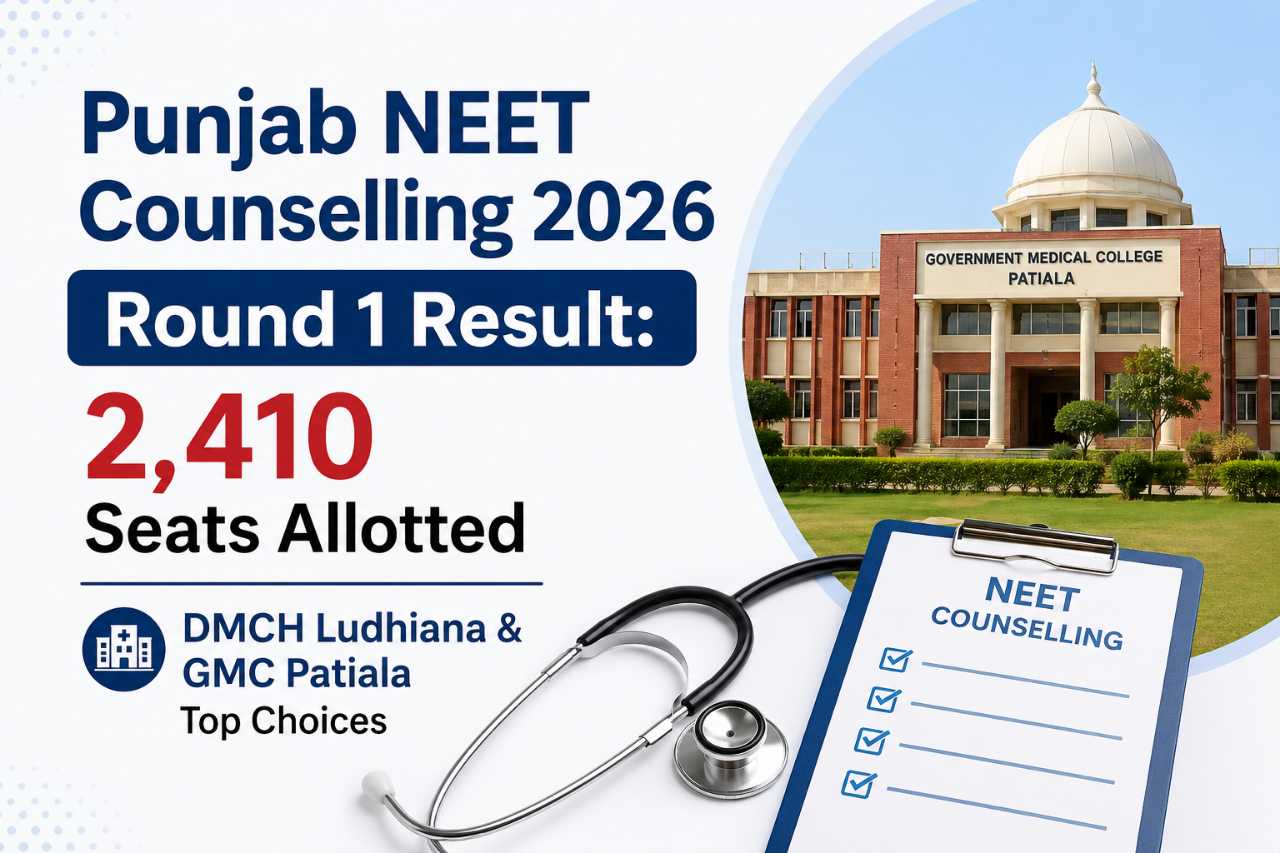
Punjab NEET UG counselling 2026 Round 1 seat allotment results are available on the official portal at bfuhs.ggsmch.org. Candidates can log in to download allotment letters in PDF format. According to official updates reported on August 31, 2026, more than 2,000 MBBS seats were allotted in Round 1—a substantial share of Punjab's total undergraduate medical intake for the year.
Students allotted seats must report to their respective colleges by September 5, 2026, carrying original documents and paying the prescribed admission fee to confirm their seat. Failure to report within the window typically leads to seat cancellation and possible penalties in subsequent rounds, depending on BFUHS rules for the current year.
Top Medical Colleges Chosen in Round 1
As in previous years, premier government institutions remained the most preferred choices among high-ranking NEET candidates in Punjab:
- Dayanand Medical College (DMC), Ludhiana — among the state's oldest and most sought-after MBBS destinations
- Government Medical College (GMC), Patiala — another top government pick for serious rank holders
Students targeting these colleges typically need strong NEET ranks within Punjab's state merit list. Ludhiana, as Punjab's largest city and an education hub, also hosts institutions like Punjab Agricultural University Ludhiana, though medical admissions at DMC follow BFUHS counselling, not PAU's admission stream.
Complete List of Debarred Candidates (2026-27)
The following table summarises the 25 candidates debarred from Punjab's 85% state quota, along with the other state counselling they reportedly applied for. NEET roll numbers are as published by BFUHS.
| Candidate Name | NEET Roll Number | Also Applied For (State Quota) |
|---|---|---|
| Divam Gupta | 3805106075 | Chandigarh |
| Avneet Kaur | 3803108015 | Chandigarh |
| Harpreet Kaur | 3814106180 | Chandigarh |
| Love Preet Saini | 3814101144 | Chandigarh |
| Palak Rani | 3802105192 | Chandigarh |
| Rayna Nag | 2303102488 | Chandigarh |
| Ridhima | 1601104042 | Chandigarh |
| Swadhya Shree | 3803104270 | Chandigarh |
| Vitasta Bhat | 3804101305 | Himachal Pradesh |
| Babhneet Kaur | 2410102339 | Himachal Pradesh |
| Nikhil | 2404101085 | Himachal Pradesh |
| Saumya Dubey | 2001603666 | Assam |
| Sushaan Jhamp | 2712403204 | Karnataka |
| Arshdeep Kaur | 3115301482 | Maharashtra |
| Navya | 2707102129 | Karnataka |
| Priya | 4410205184 | Uttarakhand |
| Tasis Fatima | 1501105318 | Karnataka |
| Athma Diya T | 2410103289 | Tamil Nadu |
| Pardeep Kaur | 4201306097 | Telangana |
| Navtej Singh Parmar | 2712305421 | Karnataka |
| Rythm Raina | 3814103003 | Jammu & Kashmir |
| Akkireddy Krishna Sai | 3814101309 | Andhra Pradesh |
| Aahana Vethshiba Masih | 3003104552 | Madhya Pradesh and Chhattisgarh |
| Mahima Shukla | 2712205175 | Karnataka |
| Roshani | 30011062 | Madhya Pradesh |
Notably, nine candidates had applied for Chandigarh's state quota—the highest single cluster—followed by several applicants for karnataka, Himachal Pradesh, and other states. One candidate appears to have registered in two additional states (Madhya Pradesh and Chhattisgarh), underscoring how strictly BFUHS is auditing cross-state participation.
Understanding Punjab's 85% State Quota vs 15% AIQ
Medical admissions in India operate on a dual-quota framework after NEET. For Punjab colleges:
- 85% State Quota: Managed by BFUHS for candidates with valid Punjab domicile (or qualifying category/reservation as per state rules). Registration, choice filling, seat allotment, and reporting all happen through bfuhs.ggsmch.org.
- 15% All India Quota: Managed by MCC at mcc.nic.in. AIQ is open to candidates from any state; participating here does not conflict with Punjab state quota rules.
The debarment applies only to violations involving other states' domicile quota seats, not to AIQ counselling. A Punjab student can legitimately participate in MCC AIQ and Punjab state counselling in parallel, subject to seat acceptance rules—but cannot hold or pursue 85% quota seats in two different states.
How BFUHS Verifies Cross-State Applications
State counselling bodies share registration data and conduct backend checks against NEET application details, domicile certificates, and counselling login records from partner states. Discrepancies trigger scrutiny notices. Candidates may also be flagged when they accept a seat in one state's quota while remaining active in another state's merit list. The published debarment list suggests BFUHS completed such verification before or during Round 1 allotment finalisation.
MBBS and BDS Admissions in Punjab: Seat Matrix and Process
Punjab offers MBBS seats across government medical colleges, private medical colleges, and government/private dental colleges for BDS. BFUHS coordinates the entire process—from online registration and security deposit to choice filling, mock rounds (if announced), seat allotment, and reporting.
Key stages in Punjab NEET UG counselling 2026 include:
- Registration and fee payment on the BFUHS portal
- Document upload and verification (domicile, category certificate, NEET scorecard, etc.)
- Choice filling and locking for preferred colleges and courses
- Seat allotment based on NEET rank, category, and choices
- Reporting to allotted college with originals and admission fee
- Subsequent rounds (Round 2, mop-up, stray vacancy) for vacant seats
With over 2,000 MBBS seats allotted in Round 1 alone, competition remains intense—especially for government seats where fees are far lower than private colleges. BDS seats follow a parallel counselling track with separate cut-offs.
Reservation Categories and Eligibility in Punjab NEET Counselling
Punjab NEET UG counselling follows category-wise reservation within the 85% state quota. Seats are distributed across Scheduled Caste (SC), Scheduled Tribe (ST), Other Backward Classes (OBC), Economically Weaker Section (EWS), and Persons with Benchmark Disabilities (PwBD) categories as per Punjab government norms and National Medical Commission guidelines. Each category maintains a separate merit list derived from NEET scores, and cut-offs vary significantly between government and private institutions.
Candidates claiming reservation must upload valid category certificates issued by competent Punjab authorities during registration. BFUHS verifies these certificates during document scrutiny—a stage where many applications face delays or rejection due to expired certificates, incorrect formatting, or mismatch with NEET application data. The debarred candidates list focuses on cross-state quota violations, but category document errors remain another common reason for admission complications in every counselling cycle.
Domicile Requirements for Punjab State Quota
To access the 85% Punjab quota, candidates generally need a valid Punjab domicile certificate confirming residency. The domicile norm ensures that state-funded and state-regulated medical seats benefit students who belong to Punjab. Students who studied in Punjab schools but hold domicile of another state cannot claim Punjab quota seats—they must apply through their home state's counselling authority instead.
Chandigarh, though geographically surrounded by Punjab, operates its own UT counselling system. Nine debarred candidates had applied for Chandigarh's quota—highlighting a frequent confusion among Punjab-region students who assume interchangeability between Punjab and Chandigarh domicile rules. These are separate jurisdictions with independent merit lists and eligibility criteria.
BDS Admissions Parallel Track: What Dental Aspirants Should Know
While MBBS dominates headlines—with over 2,000 seats allotted in Round 1—BDS (Bachelor of Dental Surgery) admissions run through the same BFUHS portal with separate seat matrices and cut-offs. Dental colleges in Punjab include government and private institutions offering five-year BDS programmes. Candidates interested in dentistry should fill BDS choices separately during choice filling, as MBBS and BDS allotments operate on independent preference lists.
BDS cut-offs are typically lower than MBBS for equivalent college categories, making dentistry a viable pathway for NEET qualifiers who miss medical cut-offs by a margin. However, the same debarment rules apply: dual registration in another state's 85% quota while holding active Punjab counselling registration leads to disqualification for both MBBS and BDS state quota seats.
Private vs Government Medical Colleges in Punjab: Fee and Choice Strategy
Punjab's medical landscape includes prestigious government colleges like DMC Ludhiana and GMC Patiala, where annual tuition fees remain relatively affordable compared to private institutions. Private medical colleges in Punjab charge substantially higher fees, and total programme costs—including hostel, clinical training, and miscellaneous charges—can run into tens of lakhs across the five-and-a-half-year MBBS duration.
During choice filling, candidates should rank colleges realistically based on their NEET rank within Punjab's state merit list. Over-optimistic choice lists may result in no allotment in early rounds, while overly conservative lists may leave higher-value seats unclaimed. Mock allotment rounds, when announced by BFUHS, help candidates gauge likely outcomes before locking final preferences.
Management and NRI Quota Seats
Some private medical colleges offer management quota or NRI quota seats with separate fee structures and eligibility conditions. These seats follow BFUHS notifications but may have different registration timelines and document requirements. Candidates exploring these pathways should read the official prospectus carefully—management quota participation does not exempt anyone from general counselling integrity rules, including the prohibition on dual state quota registration.
What Happens After Round 1: Round 2 and Mop-Up Expectations
After Round 1 reporting closes on September 5, 2026, BFUHS will calculate vacant seats from candidates who did not report, withdrew, or upgraded. Round 2 registration and choice filling dates will be announced on bfuhs.ggsmch.org. Candidates who received no allotment or wish to upgrade can participate in subsequent rounds, subject to seat availability and BFUHS upgrade policies.
Simultaneously, MCC will conduct All India Quota Round 2 registration starting September 3, 2026. Punjab students participating in both tracks must understand that accepting a seat in one system may require formal resignation from a seat held in the other within specified deadlines. Missing resignation windows can result in seat forfeiture and counselling penalties.
Guidance for Parents and First-Generation Medical Aspirants
Medical admission counselling in India is complex, and first-generation college-goers often rely on coaching centres or peer networks for guidance. While coaching institutes provide rank prediction and college lists, official rules and penalty notices come exclusively from BFUHS and MCC portals. Parents should verify any advice against the published information bulletin before their child registers for multiple state counsellings.
The debarment of 25 candidates serves as a cautionary example for families who treat counselling registration as a low-risk formality. Each registration involves accepting terms and conditions that carry legal weight. Reading the declaration checkbox, saving PDF confirmations, and maintaining a single-state quota strategy unless professionally advised otherwise can prevent costly mistakes.
For students exploring alternatives if medical admission does not work out, Punjab offers strong programmes in engineering, agriculture, law, and vocational education through universities such as Lamrin Tech Skills University Punjab and The Maharaja Bhupinder Singh Punjab Sports University. However, for committed medical aspirants, understanding counselling rules is as important as NEET preparation itself.
How to Stay Updated: Official Sources vs Social Media Rumours
During counselling season, social media groups circulate unverified seat lists, fake cut-off predictions, and misleading deadline extensions. BFUHS publishes all authoritative updates—including merit lists, allotment results, debarred candidate lists, and reporting schedules—on bfuhs.ggsmch.org. Candidates should bookmark this portal, enable SMS and email alerts registered during counselling login, and cross-check any third-party claim against the official site.
Reputable education news platforms report counselling developments with reference to official notifications. When reading news about debarments, seat allotments, or deadline changes, always trace the information back to a BFUHS PDF or portal announcement before taking action.
What Debarred Candidates Can and Cannot Do
Students on the BFUHS debarment list lose eligibility for Punjab's 85% state quota seats for 2026-27. Practical implications include:
- They cannot confirm or join any seat allotted under Punjab state quota in the current cycle
- They may still explore MCC All India Quota counselling if they had registered separately and meet AIQ eligibility—AIQ is not affected by this specific Punjab penalty
- They might pursue admission in the other state where they registered, provided that state's rules do not similarly penalise dual registration
- Management quota or NRI seats in private colleges, if applicable, follow separate BFUHS notifications and may have different conditions—candidates should read the latest prospectus carefully
Legal recourse (writ petitions, representation to BFUHS) is sometimes attempted by affected families, but courts generally defer to published admission policies when rules were clearly stated at registration. Prevention remains far easier than reversal.
Actionable Tips for Punjab NEET Aspirants Still in Counselling
If you have received a Round 1 allotment and are not on the debarred list, treat the September 5, 2026 reporting deadline as non-negotiable. Missing it can forfeit your seat and harm your chances in later rounds.
Document Checklist for College Reporting
- NEET UG 2026 admit card and scorecard
- Punjab NEET counselling registration printout and seat allotment letter
- Class 10 certificate for date of birth proof
- Class 12 mark sheet and passing certificate
- Punjab domicile certificate (for state quota seats)
- Category certificate (SC/ST/OBC/EWS/PwBD) if applicable
- Character certificate and migration certificate (if required by college)
- Passport-size photographs and photo ID
- Demand draft or payment proof for admission fee as specified by the college
Common Mistakes That Lead to Disqualification
- Registering for two or more states' 85% domicile quota simultaneously
- Submitting incorrect or forged domicile documents
- Failing to lock choices before the deadline
- Not reporting after seat allotment without a valid exit procedure (resignation/withdrawal as per rules)
- Ignoring BFUHS notices and email/SMS updates on the registered mobile number
Students preparing for future cycles should note that NEET remains the single gateway for undergraduate medical programmes nationwide. After completing MBBS, specialisation requires clearing NEET PG—a separate examination and counselling track managed by NBEMS and respective state authorities.
Punjab Higher Education Context Beyond Medical Admissions
While BFUHS dominates health-sciences admissions, Punjab hosts a diverse university ecosystem. Aspirants exploring non-medical pathways may consider institutions such as Central University of Punjab, Bathinda, I K Gujral Punjab Technical University, Jalandhar, Maharaja Ranjit Singh Punjab Technical University, Bathinda, and Punjab Engineering College, Chandigarh. Law aspirants often look at Rajiv Gandhi National University of Law, Punjab, while open-distance learners may explore Jagat Guru Nanak Dev Punjab State Open University.
Medical admissions, however, remain uniquely regulated: one national entrance exam, strict quota rules, and zero tolerance for merit-list manipulation. The BFUHS debarment sends a clear signal to future batches.
Timeline: Key Dates for Punjab NEET Counselling 2026
- Round 1 seat allotment result: Published on bfuhs.ggsmch.org (August 2026)
- Round 1 college reporting last date: September 5, 2026
- MCC NEET UG Round 2 registration: Begins September 3, 2026 (for AIQ candidates nationwide)
- Subsequent Punjab state rounds: Dates to be announced by BFUHS after vacancy calculation
Candidates participating in both AIQ and state counselling must track two portals and reconcile seat acceptance rules. Accepting an AIQ seat may require resigning from a state seat, and vice versa, within stipulated time frames.
E-E-A-T Perspective: Why This News Matters for Students and Parents
From an experience and trust standpoint, Punjab's medical admission ecosystem is highly structured but unforgiving of procedural errors. BFUHS Faridkot, as the state's designated health sciences university, publishes transparent merit lists, allotment PDFs, and penalty notices on its official website. Families should rely only on bfuhs.ggsmch.org and verified news outlets—not unverified WhatsApp forwards—for counselling updates.
The debarment of 25 candidates is significant not because of the number alone, but because it reinforces that domicile quota integrity is actively monitored across state lines. For every student who avoided this pitfall, the lesson is simple: read the registration declaration carefully, choose one state quota path unless you qualify for exceptions, and keep AIQ participation separate and compliant.
Conclusion
Punjab NEET counselling 2026 Round 1 has delivered more than 2,000 MBBS allotments while simultaneously enforcing admission discipline through the debarment of 25 candidates who applied for other states' 85% quota seats. BFUHS Faridkot's action protects Punjab domicile students and upholds fair seat allocation. If you hold a Round 1 allotment, prioritise college reporting by September 5, 2026 with complete documentation. If you are planning for future NEET cycles, commit to one state quota strategy, monitor official portals daily, and treat counselling as a legal contract—not a trial-and-error exercise. Staying informed through authoritative sources and platforms like CollegeDwar helps you navigate India's complex medical admission landscape with confidence.