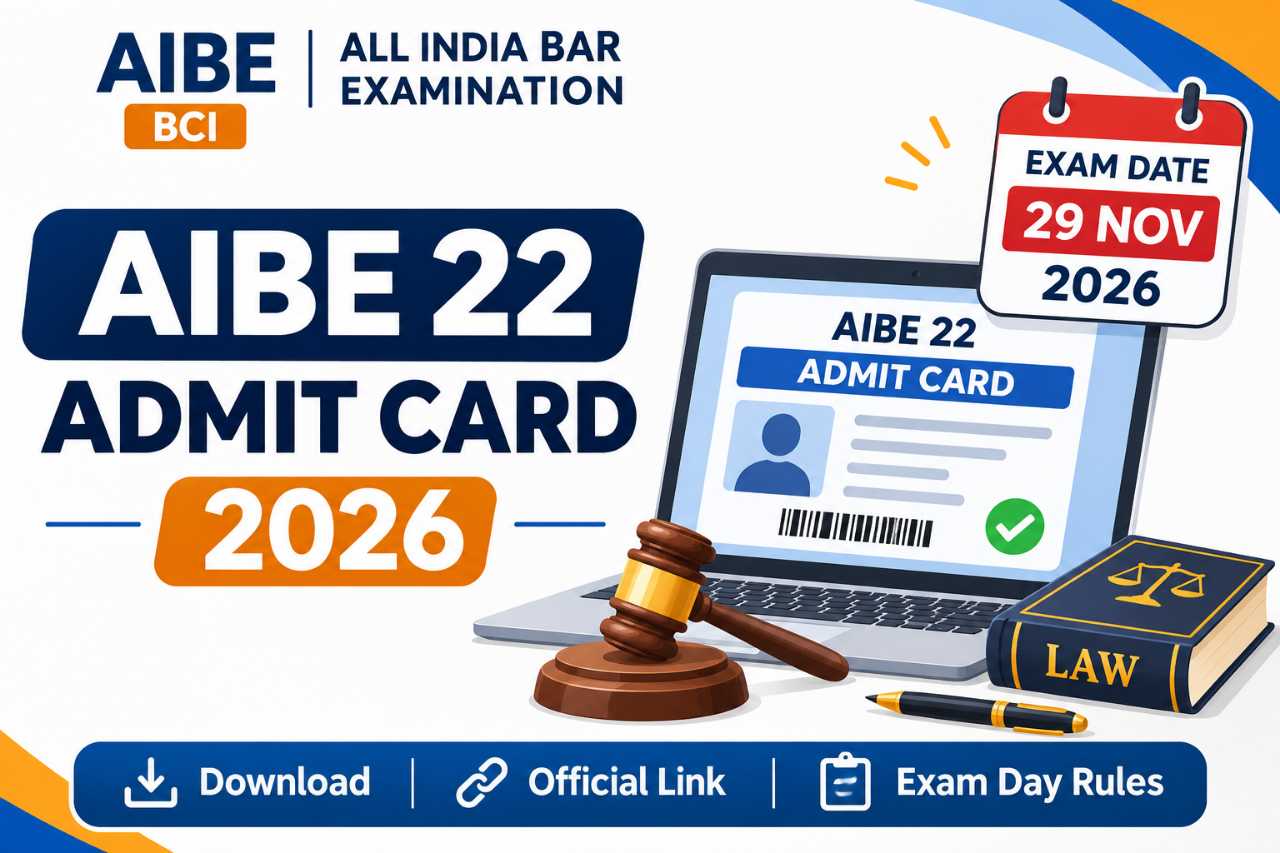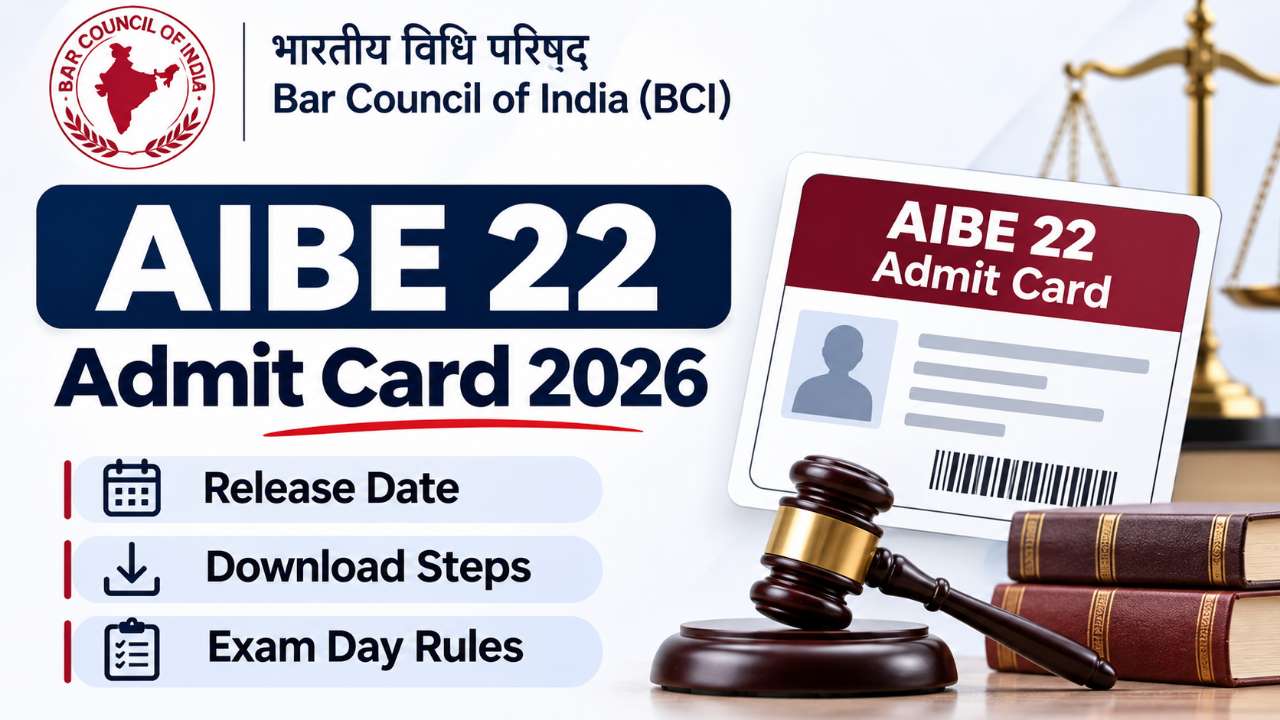
The All India Bar Examination (AIBE) is the gateway to practising law in India. For lakhs of law graduates who have cleared their LLB but not yet received the Certificate of Practice (CoP), AIBE 22 is the next major milestone. The Bar Council of India (BCI) has scheduled AIBE 22 for 29 November 2026, and admit cards for eligible candidates were released from 15 November 2026 onward. Unlike competitive law entrances such as CLAT, AIBE is an open-book qualifying exam: your goal is to meet the category-wise pass mark, not to beat other candidates on a rank list.
Working through an AIBE 22 question paper strategy daily sample MCQs, subject-wise revision, and a curated list of landmark judgments helps you spot repeated themes and manage time on exam day. Whether you studied at a national law university, a state law college in Rajasthan, or through a three-year LLB after graduation, the syllabus and question style are the same nationwide. This CollegeDwar guide breaks down pattern, marks, high-yield topics, case laws that recur across editions, cut-offs, and practical steps so you can revise with confidence.
What Is AIBE 22 and Who Should Take It?
AIBE is a post-enrolment examination. After you enroll with a State Bar Council, BCI rules generally require you to pass AIBE before you can practise as an advocate in courts. AIBE 22 is the twenty-second edition of this assessment.
Eligibility in Brief
Candidates must hold a recognised LLB degree and be enrolled with their state bar council, subject to BCI notifications. For the three-year LLB pathway, registration is typically allowed when you are in the final (sixth) semester and have cleared backlogs from earlier semesters not while you are still in the fifth semester. Five-year integrated law students follow the rules applicable to their batch year. Always verify the latest BCI circular on the official AIBE portal before applying.
If you are still completing your degree, explore foundational law programmes and institutions that align with your career plans from National Law University Delhi to regional colleges such as Government Law College Kota or Dr Bhimrao Ambedkar Law University Jaipur.
AIBE 22 Exam Date, Mode, and Key Facts
- Conducting body: Bar Council of India (BCI)
- Exam date: 29 November 2026
- Admit card: Available from 15 November 2026 (download from the official registration portal)
- Format: Multiple-choice questions (MCQs), open-book
- Medium: English and Hindi (confirm options on your admit card)
- Outcome: Certificate of Practice on qualifying
Because books and bare acts are permitted, AIBE rewards accuracy and speed in locating provisions, not rote memorisation alone. Past papers show that many questions are direct tests of sections, articles, and leading case ratios exactly the kind of drills you get from structured daily practice.
AIBE 22 Exam Pattern and Marking
While BCI may tweak instructions slightly each year, AIBE has consistently used 100 MCQs for 100 marks with no negative marking in recent editions. Each correct answer typically carries one mark. Since there is no penalty for wrong attempts, you should attempt every question after eliminating obvious distractors.
Open-book conditions mean you may carry permitted study material (check the official list usually bare acts, textbooks, and notes; electronic devices are banned). On exam day, tabbing your books with subject labels and sticky notes for frequently used sections saves precious minutes.
AIBE 22 Syllabus and Subject-Wise Marks
The AIBE syllabus spans substantive and procedural laws, ethics, and allied subjects. The table below reflects the official subject-wise weightage publicised for recent AIBE editions, including AIBE 22 orientation materials.
| Subject / Area | Marks |
|---|---|
| Constitutional Law | 10 |
| Cr.P.C. and Bharatiya Nagarik Suraksha Sanhita (BNSS) | 10 |
| C.P.C. | 10 |
| I.P.C. and Bharatiya Nyay Sanhita (BNS) | 8 |
| Evidence Act and Bharatiya Sakshya Adhiniyam (BSA) | 8 |
| Family Law | 8 |
| Law of Contract, Specific Relief, Property, Negotiable Instruments | 8 |
| Law of Tort (incl. MV Act & Consumer Protection) | 5 |
| Professional Ethics & BCI misconduct cases | 4 |
| Labour & Industrial Laws | 4 |
| ADR including Arbitration Act | 4 |
| Law related to Taxation | 4 |
| Public Interest Litigation | 4 |
| Administrative Law | 3 |
| Company Law | 2 |
| Environmental Law | 2 |
| Cyber Law | 2 |
| Land Acquisition Act | 2 |
| Intellectual Property Laws | 2 |
High-weightage clusters Constitution, CrPC/BNSS, and CPC together account for 30 marks. A realistic study plan should allocate roughly 30–35% of revision time to these three areas, then rotate through IPC/BNS, Evidence/BSA, Family Law, and Contract Law. Graduates from National Law University Jodhpur, Chanakya National Law University Patna, or Modi Law College Kota use the same syllabus; depth of prior coursework may vary, but AIBE checks breadth across all bars.
Why Practise AIBE 22 Question Papers and Daily MCQs?
Previous-year and sample AIBE question papers reveal repeated topics, familiar phrasing of MCQs, and how BCI blends old statutes with new codes (BNS, BNSS, BSA). Daily practice even 10 quality MCQs builds muscle memory for:
- Matching case names to legal principles
- Identifying correct section numbers under CrPC, CPC, IPC/BNS, and Evidence/BSA
- Constitutional amendments and Article-linked concepts
- Professional ethics scenarios drawn from BCI rules
Live and rolling “question of the day” formats, as seen in exam-season coverage, mirror this approach: short bursts of practice keep working lawyers and fresh graduates engaged without burning out before 29 November.
Topic-Wise Preparation: CPC, CrPC, and Constitution
Code of Civil Procedure (CPC) – 10 Marks
Focus on jurisdiction, res judicata, injunctions, execution, appeals, and summary procedures. PYQs often ask about orders versus decrees, inherent powers under Section 151, and place of suing. Make a one-page “CPC flowchart” for suits, appeals, and revision.
Cr.P.C. / BNSS – 10 Marks
High-return CrPC/BNSS topics include:
- Arrest (Sections 41–60 and parallel BNSS provisions)
- Bail (Sections 437–439)
- Cognizable vs non-cognizable offences
- Police powers, FIR, and investigation timelines
Link landmark cases such as D.K. Basu v. State of West Bengal (custodial violence guidelines) and Lalita Kumari v. Government of Uttar Pradesh (mandatory FIR in cognizable cases) to the relevant sections in your notes.
Constitution of India – 10 Marks
Prepare fundamental rights, directive principles, emergency provisions, constitutional amendments, and judicial review. Repeated judgments include:
- Maneka Gandhi v. Union of India – expanded reading of Article 21
- Kesavananda Bharati v. State of Kerala – basic structure doctrine
- Minerva Mills v. Union of India – harmony between Parts III and IV
- Indra Sawhney v. Union of India – creamy layer and reservation cap
- K.S. Puttaswamy v. Union of India – privacy as a fundamental right
Repeated Case Laws Across AIBE Editions
Case-law MCQs are a signature of AIBE. Group judgments by theme so you can revise quickly.
Contract Law
- Carlill v. Carbolic Smoke Ball Co. – advertisement as unilateral offer
- Hyde v. Wrench – counter-offer rejects original offer
- Lalman Shukla v. Gauri Dutt – acceptance with knowledge of offer
- Currie v. Misa – definition of consideration
- Chappell v. Nestlé – consideration need not be economically adequate
- Dunlop v. Selfridge – privity of contract
- Ranganayakamma v. Alwar Setti – coercion vitiates consent
Environmental Law and PIL
- M.C. Mehta v. Union of India (series) – pollution and strict liability
- Vellore Citizens' Welfare Forum v. Union of India – sustainable development
- Olga Tellis v. Bombay Municipal Corporation – livelihood under Article 21
- Bandhua Mukti Morcha v. Union of India – bonded labour and PIL
Technology, Speech, and Criminal Process
- Shreya Singhal v. Union of India – struck down Section 66A, IT Act
- Navtej Singh Johar v. Union of India – decriminalisation under IPC
Create flashcards: Case name → one-line ratio → subject. Review them in commute-sized sessions alongside bare acts.
Family Law, Tort, Evidence, and Ethics
Family Law (8 marks) spans Hindu and Muslim personal law basics marriage, divorce, maintenance, succession, and guardianship. AIBE often tests definitional and section-based questions rather than long factual matrices. Separate notes for Hindu Marriage Act, Special Marriage Act, and Muslim law fundamentals.
Evidence Act / BSA (8 marks) emphasises relevancy, admissions, confessions, dying declarations, and electronic evidence. Post-reform questions may reference BSA parallels study comparison charts if your coaching centre provides them.
Professional Ethics (4 marks) requires reading BCI rules on misconduct, advocate–client relations, and contempt-aware conduct. Scenario MCQs (“An advocate does X what is the appropriate conduct?”) are common.
Students at Excellent Law College Kota, Government Law College Sikar, or NLUs like Gujarat National Law University Gandhinagar should still unify revision through PYQs, because AIBE does not distinguish between institution tiers.
Most Repeated Themes in the Last Three AIBE Cycles
Analysis of recent papers suggests these themes reappear often:
- Fundamental rights, writs, and judicial review
- Bail, arrest, and FIR jurisprudence
- CPC concepts res judicata, injunctions, execution
- Contract offer, acceptance, consideration, and vitiating factors
- Consumer Protection and Motor Vehicles compensation under tort papers
- Recent constitutional amendments and women’s reservation legislation
- Landmark Supreme Court judgments on equality and reservation (M. Nagaraj, Indra Sawhney)
Build a “repetition ledger”: each time you miss a PYQ, log the subject and revisit it after seven days. Spaced repetition suits working professionals preparing while interning or practising under a senior.
AIBE 22 Qualifying Marks and Cut-Off
AIBE is qualifying, not competitive. Typical cut-offs (confirm on the official notification for AIBE 22) are:
- General and OBC: 45% (45 marks out of 100)
- SC and ST: 40% (40 marks out of 100)
There is no rank-based “closing score” like PG law entrances. Once you clear the threshold, you may apply for the Certificate of Practice through your state bar council’s process. Retakes are available in subsequent AIBE editions if you do not qualify on the first attempt.
Exam-Day Guidelines for AIBE 22
- Carry admit card and valid photo ID exactly as specified.
- Reach the centre at least 60 minutes early for frisking and seating.
- Follow the published dress code and avoid prohibited items (phones, smartwatches, unauthorised electronics).
- Impersonation or unfair means is a punishable offence report irregularities to invigilators immediately.
- Leave the hall only when permitted after submission.
Pack books the night before: Constitution (with amendments), CrPC/BNSS, CPC, IPC/BNS, Evidence/BSA, Contract Act, Personal law compendium, and a slim ethics handbook. Use coloured tabs for faster lookup under exam stress.
How AIBE Fits Your Law Career in India
Clearing AIBE validates your readiness for independent practice. Many graduates aim for litigation, government legal service, corporate legal teams, or judiciary prep afterward. Understanding the broader law stream ecosystem including NLUs such as National Law School of India University Bangalore, Hidayatullah National Law University Raipur, and Dr Ram Manohar Lohiya National Law University Lucknow helps you plan LLM or specialist diplomas after your CoP.
Government lawyer roles, for instance, require strong procedural knowledge the same CPC and CrPC pillars that dominate AIBE papers. Treat AIBE revision as foundation-building for courtroom and advisory work, not a one-day hurdle.
Thirty-Day Revision Planner (Actionable Overview)
- Days 1–10: Constitution, CPC, and CrPC/BNSS with one PYQ set daily.
- Days 11–18: IPC/BNS, Evidence/BSA, Contract, and Family Law.
- Days 19–24: Tort, ethics, ADR, labour, taxation, and smaller 2-mark subjects.
- Days 25–28: Full-length timed mocks using previous AIBE papers; review every wrong answer.
- Days 29–30: Light revision of case-law cards and section tabs; organise carry bag for open books.
Adjust the calendar if you started late: prioritise the 30-mark procedural–constitutional block before low-weightage subjects.
Navigating New Criminal and Evidence Codes (BNS, BNSS, BSA)
Indian criminal and evidence law is in transition. The Bharatiya Nyay Sanhita (BNS), Bharatiya Nagarik Suraksha Sanhita (BNSS), and Bharatiya Sakshya Adhiniyam (BSA) replace major portions of the IPC, CrPC, and Evidence Act for offences and procedures governed by the new framework. AIBE papers increasingly pair classic section numbers with parallel provisions in the new codes.
A practical approach is to prepare side-by-side comparison sheets for arrest, bail, FIR registration, cognizable offences, and admissibility of electronic evidence. When a daily practice question references an IPC section, locate the mapped BNS provision the same day. Graduates revising at National Law Institute University Bhopal or Rajiv Gandhi National University of Law Punjab often have code-reform notes from seminars condense them into AIBE-length facts, not academic essays.
In open-book conditions, examiners expect you to locate the correct statutory hook quickly. Tab separate inserts in your bare-act bundle labelled “BNS,” “BNSS,” and “BSA” so you do not flip blindly during the 100-question paper.
IPC/BNS and Allied Substantive Law (8 Marks)
Substantive criminal questions on AIBE usually test definitions of offences, stages of crime, joint liability, abetment, and general exceptions. Under tort and consumer law (five marks combined in the tort cluster), expect principles of negligence, strict liability foundations from the Rylands v. Fletcher line of authority, and statutory remedies under consumer forums.
Company law, cyber law, intellectual property, land acquisition, and environmental law together contribute about ten marks. Do not ignore them entirely: two-mark subjects are ideal for quick wins when you revise section captions and leading judgments. For cyber-related MCQs, link Shreya Singhal with the IT Act framework and know basic definitions of digital evidence under evolving rules.
Taxation, Labour, ADR, and Administrative Law
Four-mark buckets taxation, labour, ADR, and PIL reward concise notes. For taxation, focus on constitutional entries, basics of income-tax authority, and famous Supreme Court rulings on legislative competence rather than numerical problem-solving. Labour law questions may touch on industrial disputes, strikes, and standing orders. ADR sections typically reference the Arbitration and Conciliation Act’s core concepts: arbitration agreement, interim relief, and enforcement of awards.
Administrative law (three marks) often examines principles of natural justice, delegated legislation, and judicial review of administrative action. Tie these to Part III jurisprudence you already study for constitutional law. PIL questions connect ethics, Article 21, and landmark social-action cases such as Bandhua Mukti Morcha.
Registration, Enrolment, and Official Updates
Before attempting any question paper, confirm your enrolment status with your State Bar Council. Registration for AIBE happens through the official BCI portal; fees, city choices, and category certificates must match your enrolment record. After the exam, keep your admit card and scorecard safely you will need them for CoP applications.
Exam-season live updates including fresh sample MCQs, repeated case-law compilations, and analysis posts are useful only when cross-checked against bare acts. Treat unofficial answer keys as provisional until BCI releases official keys or results. Candidates affiliated with universities such as Tamil Nadu National Law University, Dharmashastra National Law University, or Indian Law Institute Bhagwandas Road New Delhi may access library bare-act sets; if you are far from campus, a single consolidated carry bag of tabbed acts still works nationally.
Conclusion
AIBE 22 on 29 November 2026 is an open-book qualifying test that rewards systematic revision, smart book preparation, and familiarity with repeated case laws and section-based MCQs. Use daily sample questions, previous-year papers, and subject-wise notes aligned to the official syllabus weightage. Aim above the 45% or 40% category thresholds, respect exam-centre discipline, and treat each practice question as training for real advocacy not mere exam trivia. For institution choices and pathways after your LLB, continue exploring trusted profiles on CollegeDwar and stay tuned to BCI announcements for any last-minute updates to instructions or materials allowed in the hall.