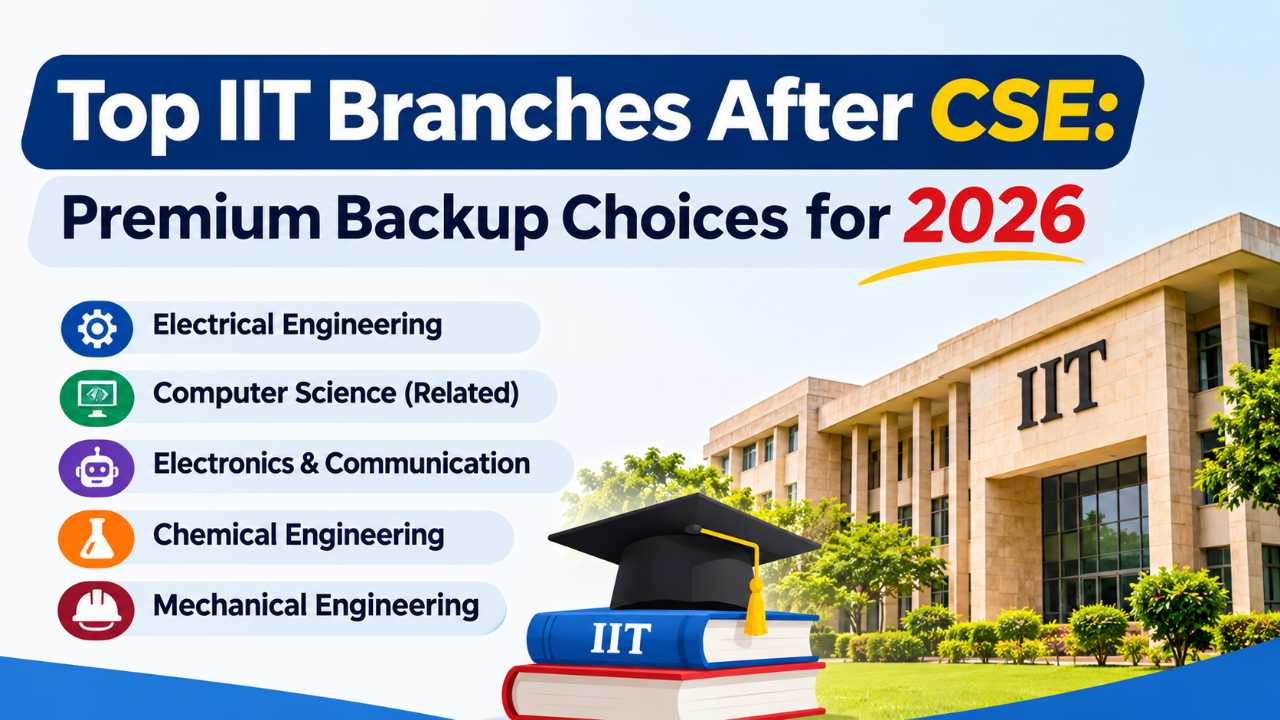
If you narrowly miss Computer Science and Engineering (CSE) in JoSAA counselling, the decision you make next can shape your entire career. For JEE Advanced qualifiers in 2026, several IIT branches now sit just below CSE in opening ranks and many of them offer salaries, research depth, and industry relevance that rival traditional “backup” options like core mechanical or civil engineering. This guide explains which programs are climbing the premium ladder, how JoSAA opening ranks reflect real student demand, and how to pick a branch that matches your strengths rather than regret.
Why Premium IIT Branches Matter After CSE
CSE at older IITs still dominates wish lists, but seat limits and cut-throat ranks mean thousands of top performers must look elsewhere within the same institute or at another IIT with a stronger non-CSE program. “Premium” here does not mean obscure specializations; it means branches whose Round 1 opening ranks stay close to CSE, whose curricula overlap with software and data careers, and whose placement cells report competitive packages.
Demand has shifted because industries hire for skills machine learning, VLSI, quantitative finance, power electronics not for a single degree label. A student who wanted B.Tech CSE but lands Mathematics and Computing or Electrical Engineering at a top IIT often reaches similar recruiter shortlists after internships and electives. Understanding this landscape helps you avoid panic choices during JoSAA and plan a four-year path with clear goals.
How JoSAA Opening Ranks Define “Next Best” After CSE
JoSAA publishes category-wise opening and closing ranks for every academic program. For the General (Open) category, Round 1 opening rank is a practical proxy for perceived prestige and placement buzz within that IIT. Lower opening rank after CSE usually means fiercer competition and stronger peer groups in that branch.
Remember that ranks differ by IIT, category, and quota. Electrical Engineering at IIT Bombay may open around three-digit CRL ranks, while the same branch at a newer IIT opens much later. Always compare program to program at the institute you can realistically get, not only national folklore.
Factors That Push Closing Ranks Up or Down
- Seat intake: Fewer seats tighten closing ranks even when popularity is moderate.
- New programs: AI, Data Science, and M&C often start with small batches and premium cutoffs.
- Placement narratives: One viral highest-package story can spike demand the next year.
- Dual degrees and B.S. programs: Separate listings can confuse first-time counselling candidates.
- City and campus culture: Hyderabad, Delhi, and Chennai campuses attract distinct recruiter mixes.
Top Premium IIT Branches After CSE (2026 Outlook)
Based on recent JoSAA trends and industry alignment, these families of programs repeatedly appear immediately after CSE in student preference not always in the same order every year, but consistently in the “first backup” zone for high rankers.
1. Artificial Intelligence and Data Analytics / Data Science
Programs blending AI, statistics, and computing are among the hottest backups nationwide. At IIT Madras Chennai, Artificial Intelligence and Data Analytics has recorded opening ranks very close to CSE often the first non-CSE program to fill in several recent rounds. Similar offerings exist at IIT Hyderabad, IIT Guwahati, IIT Roorkee, and IIT Kharagpur under names like Data Science and Artificial Intelligence or standalone Artificial Intelligence.
What you study: Machine learning, deep learning pipelines, data engineering, optimization, and often product-oriented capstones.
Career paths: Data scientist, ML engineer, NLP specialist, analytics roles in finance and e-commerce. Fresh graduate bands in India often span roughly ₹5–15 LPA, with top IIT offers far higher.
Actionable tip: If you missed CSE but love coding and probability, treat this as a near-equivalent slot prioritize institutes with mature AI research centres and industry labs.
2. Mathematics and Computing (M&C)
M&C sits at the intersection of pure mathematics, algorithms, and computing. IIT Delhi has seen M&C opening ranks competitive with top core branches; IIT Bombay, IIT Kanpur, IIT Kharagpur, and IIT Guwahati run variants with slightly different titles (e.g., Mathematics and Scientific Computing).
Why it is premium: Graduates routinely enter software development, quantitative research, and high-frequency trading trainee roles. Recruiters from global tech and finance firms actively hunt M&C profiles because of strong analytical training.
Actionable tip: Excel in JEE Mathematics and enjoy proof-heavy courses; weak algebra comfort can make the first two semesters stressful despite great outcomes later.
3. Electrical Engineering (EE)
EE remains the classic “smart backup” at legacy IITs. Opening ranks at IIT Bombay and IIT Madras keep EE in the premium tier. The branch feeds power, embedded systems, VLSI, telecom, and increasingly software roles after students pick CS electives.
Placements: Semiconductor firms (Intel, Qualcomm, Texas Instruments), core electrical (Siemens, NTPC), and product companies hiring for firmware and systems. Average UG packages at leading IITs often exceed ₹20 LPA in strong years.
Actionable tip: If you want hardware plus optionality for tech jobs, EE beats chasing a distant CSE at a much lower-ranked college.
4. Engineering Physics (EP)
Engineering Physics appeals to students eyeing research, semiconductors, optics, and emerging quantum technologies. At IIT Bombay, EP opening ranks have stayed aggressively low (highly competitive), reflecting small batches and strong faculty.
Outcomes: Research associates, optical and test engineers, roles in national labs (ISRO, DRDO ecosystem), and quant or automation tracks after postgraduate study or self-driven coding projects.
Actionable tip: Choose EP if you may pursue MS/PhD abroad; it is less ideal if you want only a nine-to-five product job with minimal physics depth.
5. Electronics and Electrical Communication Engineering (ECEC / EEE variants)
At IIT Kharagpur, ECE-style programs often rank just after the most selective computing-related seats. Curriculum overlaps with chip design, signal processing, and communication networks sectors boosted by India’s semiconductor push.
6. Industrial Engineering and Operations Research (IEOR)
IEOR at IIT Bombay attracts analytically strong students interested in optimization, supply chain, and consulting. It is premium within that institute though less universal across all IITs.
7. Mechanical Engineering at Top IITs
Mechanical is not always the next rank after CSE nationally, but at IIT Bombay it still draws strong ranks and packages because of brand, robotics labs, and cross-disciplinary hiring. Modern mech curricula include computational mechanics and design automation skills transferable to tech roles.
Illustrative JoSAA Opening Rank Patterns (Round 1, Open Category)
The following patterns mirror publicly discussed counselling data; always confirm on the official JoSAA portal for your admission year.
| IIT (Example) | Academic Program | Observed premium-tier pattern |
|---|---|---|
| IIT Madras | Artificial Intelligence and Data Analytics | Among the earliest non-CSE programs to close |
| IIT Bombay | Electrical Engineering | CRL opening ranks often in low hundreds |
| IIT Bombay | Engineering Physics | Very competitive; small batch size |
| IIT Delhi | Mathematics and Computing | Top computing-adjacent demand at campus |
| IIT Hyderabad | Artificial Intelligence | Strong AI hiring narrative |
| IIT Kanpur | Mathematics and Scientific Computing | Premium among science–computing blends |
| IIT Kharagpur | ECE / AI / M&C cluster | Multiple high-demand codes in sequence |
| IIT Guwahati | Mathematics and Computing | Popular backup for rank band near top few hundreds |
| IIT Roorkee | Data Science and Artificial Intelligence | Rising interest in analytics careers |
Placement Reality: Packages, Roles, and Myths
Premium branch status is not a guarantee of ₹1 crore offers. Highest packages are outliers; look at median and average CTC, sector-wise splits, and higher-study rates.
- AI/DS and M&C: Heavy tech and finance recruitment; skill portfolios matter as much as branch name.
- EE and ECE: Core plus VLSI hiring cycles; global chip demand can lift roles in strong years.
- EP and Aerospace: More research and PSU orientation unless you proactively build software projects.
Students comparing an IIT premium backup with a private university CSE seat should weigh peer network, internship access, and alumni density not brochure highest salary alone. Resources on B.Tech CSE pathways help contrast curriculum outcomes across institutes.
Academic Preparation: JEE Advanced and Branch Fit
JEE Advanced rewards depth in Physics, Chemistry, and Mathematics. Branch choice should align with subjects you enjoyed mastering:
- Love algorithms and contests? M&C, AI/DS, or EE with CS minors.
- Enjoy labs and circuits? EE, ECE, Instrumentation.
- Curious about materials and devices? EP, Materials Science where offered.
- Interested in systems and design? Mechanical, Aerospace, or Engineering Design at IIT Madras.
Diploma holders exploring entry routes can review B.Tech Lateral CSE options separately; IIT admissions remain primarily JEE Advanced–based for standard B.Tech.
Counselling Strategy When CSE Is Out of Reach
During JoSAA, list choices in strict order of preference. A common mistake is padding the top with unreachable CSE codes at every IIT, then dropping to weak programs at the bottom. Instead, interleave realistic premium backups at your best IIT before downgrading campus tier.
- Lock your achievable IIT tier using mock rank vs previous cutoffs.
- Within that tier, order AI/DS, M&C, EE, then other premiums.
- Use floating wisely in later rounds only if seat loss risk is acceptable.
- Track dual-degree and new program codes they are easy to miss in PDF lists.
Future Skills and Why These Branches Age Well
India’s policy push in semiconductors, renewable grids, AI safety, and space commerce favours EE, EP, ECE, and interdisciplinary computing programs. Employers increasingly hire for project portfolios open-source contributions, Kaggle rankings, research publications regardless of whether the degree title says “CSE.”
Students in Delhi-NCR ecosystems sometimes cross-apply skills from adjacent fields (design, policy, management) but for core engineering careers, staying inside a top IIT premium branch usually beats relocating only for a CSE label on paper.
E-E-A-T Note for Families and Counsellors
This article is intended for educational planning, not as official cut-off advice. Always cross-check ranks on JoSAA, institute BVOC/program pages, and JEE Advanced brochures. Cutoffs move every year with paper difficulty and seat changes.
JEE Main, JEE Advanced, and JoSAA: The Admission Chain
Every premium IIT branch whether labelled AI, M&C, or EE is filled through the same national pipeline. Candidates first appear in JEE Main to qualify for JEE Advanced. Only after clearing Advanced cutoffs and meeting category requirements can you register for JoSAA, where you rank hundreds of institute–branch combinations in one locked list.
This matters because branch hype shows up only at the JoSAA stage. Your Advanced rank is a single number, but counselling turns it into a specific seat. Families often research CSE cutoffs for months yet skim AI or M&C listings days before choice filling. For 2026, treat non-CSE premium programs with the same diligence: download the seat matrix, highlight every computing-adjacent code, and compare Round 1 opening ranks across at least three IITs you can realistically join.
Who Should Still Chase CSE in Later Rounds?
Floating and spot rounds sometimes release stray CSE seats when candidates withdraw for foreign offers or civil services. The strategy works only if you accept the risk of losing a premium backup. If your current allotment is M&C at IIT Delhi or EE at IIT Bombay, dropping it blindly for a distant chance at CSE at a newer IIT may weaken your long-term network. Counsellors often advise keeping a premium seat unless the round offers CSE at an equal or higher institute tier.
Branch-by-Branch Skill Map for 2026 Careers
Aligning branch fundamentals with where you want to work in 2030 reduces mid-degree regret. The map below links academic focus to hiring lanes not guarantees, but patterns recruiters repeat year after year.
Computing-Adjacent Programs (AI/DS, M&C, Statistics)
These degrees foreground algorithms, probability, and programming projects from semester one. Students who missed B.Tech CSE but thrive in Math Olympiad culture or Codeforces-style practice usually adapt quickly. Recruiters for ML engineer, backend developer, and quantitative analyst roles interview these branches with technical tests similar to CSE.
Build early: competitive programming, databases, one full-stack or ML capstone before third-year internships.
Electrical and Electronics Ecosystem
Semiconductor fabs, EV powertrains, and 5G infrastructure keep EE and ECE graduates in demand. India’s chip incentives mean more traineeships in VLSI and embedded design. EE students should not assume they are “locked out” of Big Tech many hires come through firmware, systems, and hardware–software co-design teams.
Build early: Verilog or VHDL exposure, microcontroller projects, signal processing labs on your résumé.
Engineering Physics and Deep Science Paths
EP graduates often shine in national missions, advanced degree programs abroad, and niche R&D units. Starting salaries may look modest compared with hot software offers, but long horizons in photonics, quantum computing, or materials can outperform if you pursue postgraduate study.
Build early: research internships, strong GATE or GRE physics preparation if academia is on the table.
Mechanical, Aerospace, and Design-Oriented Branches
Premium mechanical or aerospace seats at leading IITs still attract automotive, aviation, and robotics employers. Computational mechanics and CAD automation blur the line with software careers when students add Python and simulation skills.
Gender, Category, and Quota Effects on Premium Branches
Opening ranks quoted in articles usually refer to the General (Open) CRL list. OBC-NCL, EWS, SC, ST, and PwD quotas have separate matrices with different closing ranks. A premium branch “just after CSE” for Open category may still feel distant under another quota or easier if seat reservations expanded. Always filter JoSAA data for your exact category and PwD status.
Female participation in STEM quotas and institute culture can also influence branch feel. Programs like EE and M&C see growing diversity; peer support and hostel policies vary by campus. Visit institute open days or student forums when possible before finalizing choice order.
New IITs vs Legacy IITs: Premium Is Relative
A “premium” label at IIT Madras does not automatically transfer to every new IIT. When comparing options, ask: (1) Is the program established with alumni in industry? (2) Are electives flexible toward CS minors? (3) Do companies visit specifically for that branch or only for the IIT brand generically?
Sometimes the smarter play is EE or M&C at a legacy IIT rather than CSE at a distant third-tier engineering college. Other times a new IIT’s dedicated AI department with modern labs beats an overcrowded legacy section with limited elective slots. Rank the institute–program pair, not slogans.
Financial Planning and ROI Realism
IIT UG fees remain subsidized relative to many private colleges, but living costs differ by city. Mumbai, Delhi, and Chennai have distinct expense profiles. Premium branches do not shorten the four-year timeline budget for coaching for GATE, GRE, or CAT if higher study is likely.
Education loans and family savings plans should assume median packages, not social-media peak offers. A ₹22–25 LPA average at a top EE batch is excellent; planning life around a single ₹1 crore+ outlier creates risky expectations.
Conclusion
Missing CSE at your dream IIT is disappointing, but it is not a dead end. Artificial Intelligence and Data Analytics, Mathematics and Computing, Electrical Engineering, Engineering Physics, and select ECE or IEOR programs now form the new premium layer immediately after CSE in student choice and recruiter interest. Use JoSAA opening ranks as a signal, match branch physics and math load to your aptitude, and build skills that transcend degree names. The right premium branch at IIT Bombay, IIT Delhi, or IIT Madras can still place you in the same rooms as CSE graduates if you use the four years deliberately.