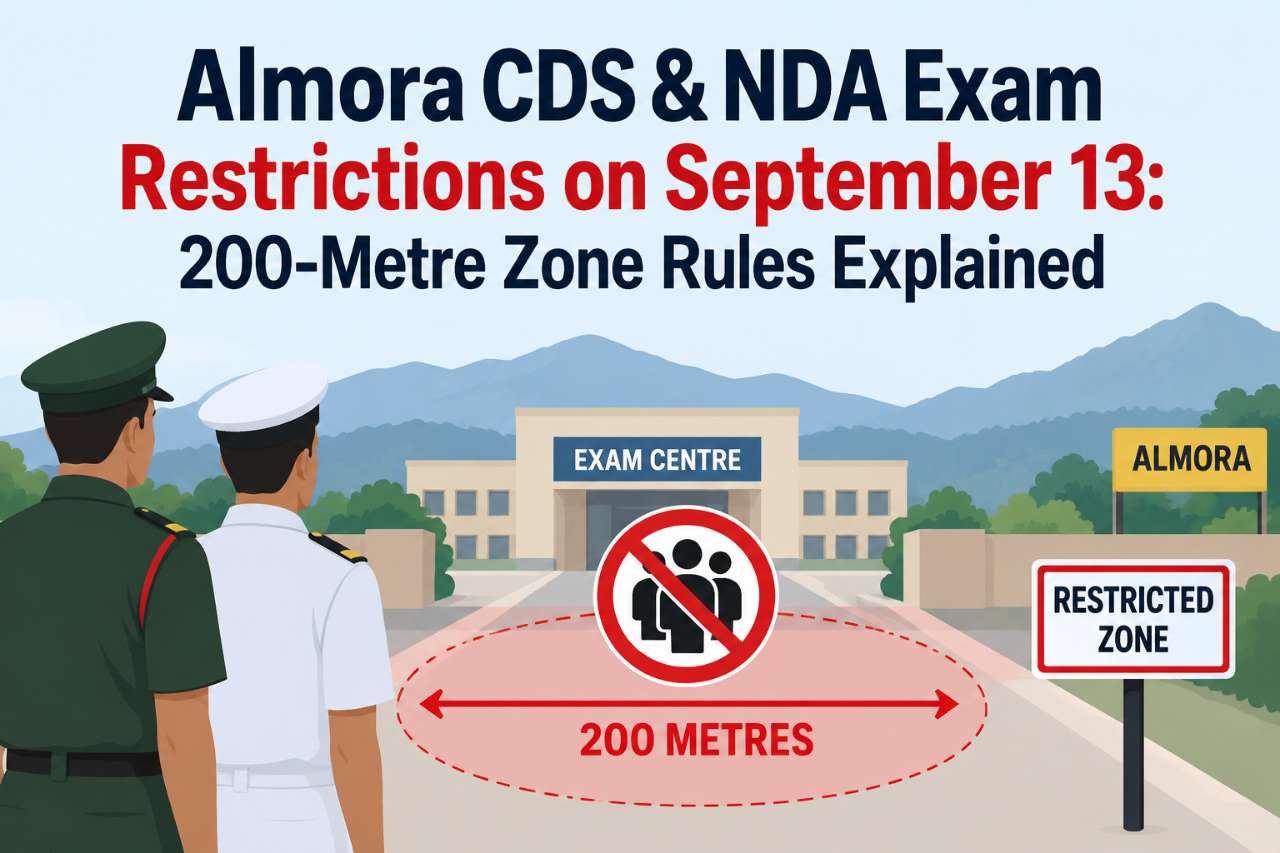
On September 13, 2026, Almora district in Uttarakhand will host candidates appearing for the Combined Defence Services (CDS) and National Defence Academy (NDA) examinations conducted by the Union Public Service Commission (UPSC). To ensure a calm, secure, and fair testing environment, the district administration has issued a formal order under Section 163 of the Bharatiya Nagarik Suraksha Sanhita (BNSS), imposing strict restrictions within a 200-metre radius of every designated exam centre.
These measures are not unique to Almora alone similar local orders are commonly issued across India during high-stakes competitive exams but the specifics matter for every candidate, parent, and resident near the centres. Whether you are travelling from Haldwani, Ranikhet, Pithoragarh, or a nearby village, understanding the 200-metre zone rules, prohibited items, gathering limits, and legal penalties can help you avoid last-minute confusion and unnecessary stress on exam day.
This guide explains the Almora CDS and NDA exam restrictions in plain language, with practical checklists, timelines, and tips aligned with UPSC norms and local law. If you are appearing at an Almora centre or supporting someone who is read through before you leave home on September 13.
Why Almora Has Imposed Exam-Day Restrictions
Competitive defence entrance exams like CDS and NDA attract thousands of aspirants who have prepared for months or years. Exam centres become high-pressure zones where even small disturbances crowding at the gate, loud announcements, or unauthorised gatherings can affect concentration and logistics for hundreds of candidates at once.
The Sub-Divisional Magistrate (SDM), Almora, Sanjay Kumar, issued the restriction order to:
- Prevent overcrowding and unauthorised entry near exam halls
- Reduce the risk of disorder, protests, or disruptive activity
- Keep entry and exit routes clear for candidates and staff
- Minimise noise so examinees can focus during a long, demanding test
- Enable police and exam personnel to manage security efficiently
The order remains in force from 9:00 am to 6:00 pm on September 13, 2026 the full window during which examinations are scheduled and candidates may be reporting, seated, or leaving centres.
Legal Basis: Section 163 BNSS
Section 163 of the BNSS empowers magistrates to issue directions in urgent situations where immediate prevention of unlawful activity is necessary. In the context of public examinations, such orders are routinely used to create a controlled perimeter around centres. Violations can attract action under Section 223 of the Bharatiya Nyaya Sanhita (BNS), which deals with disobedience to orders duly promulgated by public servants.
Candidates should treat these restrictions as legally binding not optional guidelines. Cooperation helps everyone finish the day smoothly.
The 200-Metre Restricted Zone: What It Means
The core rule is straightforward: persons not connected with the examination shall not enter within 200 metres of any CDS or NDA exam centre in Almora during the restricted hours. The 200-metre limit is measured around each centre's boundary and applies to roads, lanes, and open spaces falling inside that radius.
Who Is Allowed Inside the 200-Metre Area
The entry ban does not apply to:
- Registered candidates appearing for CDS or NDA on September 13
- Examination staff assigned to centre duty (invigilators, observers, support personnel)
- Police and security personnel on official duty at or near the centre
Everyone else including parents, friends, coaching mentors, photographers, and curious onlookers must stay outside the 200-metre zone unless explicitly permitted by authorities. If you are dropping off a candidate, plan to stop at a safe point beyond the restricted boundary and avoid lingering near the gate.
Who Must Stay Outside
Parents and companions often underestimate how strictly perimeter rules are enforced on exam day. Almora's order makes it clear that non-exempt persons inside the zone may be asked to leave immediately and could face legal consequences if they refuse.
Practical tip for families: Agree on a meeting point outside the 200-metre area such as a known shop, bus stand, or parking spot so the candidate can exit without searching through a crowd.
Weapons and Prohibited Items Near Exam Centres
Within the 200-metre restricted zone, the order prohibits carrying weapons. This includes:
- Firearms and ammunition (where applicable under general law)
- Sharp weapons such as knives, blades, or similar objects
- Sticks, batons, lathis, and comparable items that could be used to cause harm or incite disorder
Additionally, people may not collect or store bricks, stones, rubble, or other throwable materials near examination centres. Such restrictions aim to prevent improvised disturbances and keep pathways clear for emergency access if needed.
UPSC Admit Card Rules vs Local Orders
UPSC already publishes a detailed list of permitted and barred items for CDS and NDA electronic devices, study material, bags, and personal belongings are regulated separately through centre frisking and admit-card instructions. Almora's local order adds a geographic layer: even legally owned items that could qualify as weapons must not be carried inside the 200-metre zone on exam day.
Leave unnecessary items at home. Carry only what UPSC allows: admit card, valid photo ID, and approved stationery as per the latest notification.
| Category | Generally Allowed (verify on admit card) | Not Allowed in 200m Zone / at Centre |
|---|---|---|
| Documents | Admit card, photo ID | |
| Stationery | Black ballpoint pen (as notified) | Extra unauthorised devices |
| Personal items | As per UPSC centre rules | Weapons, sharp tools, sticks |
| Stored materials | Bricks, stones, rubble piles | |
| Groups | Individual candidate entry | Groups of 5+ with disruptive intent |
Gathering Restrictions: Groups of Five or More
The order states that groups of five or more persons shall not assemble if the purpose of the gathering is to affect the examination process. This rule targets organised disruption protests, aggressive campaigning, or coordinated blocking of access routes not casual family pairs standing far outside the zone.
Still, candidates should avoid forming large huddles at the gate before or after entry. Examination staff may interpret crowding as a security concern. Enter in an orderly queue, follow instructions, and move away from the entrance once your session ends.
Advice for Parents and Companions
Waiting anxiously at the centre gate is common but counterproductive under these rules. Drop candidates early, ensure they have documents and directions, and wait at an agreed location outside the restricted radius. A calm send-off matters more than last-minute pep talks in a congested lane.
Students exploring multiple career paths defence, design, engineering, or liberal arts often sit several entrance exams in the same season. If you are also preparing for exams such as the NIFT Entrance Exam or MET, use Almora's exam-day discipline as a template: reach early, travel light, and respect local orders at every centre.
Loudspeakers, Speeches, and Noise Control
Inside the 200-metre zone, the use of loudspeakers without permission is prohibited. Delivering speeches without approval is also not allowed during the examination period.
Shopkeepers, residents, and visitors near centres should keep noise levels low. Loud music, amplified announcements, honking in narrow lanes, and shouting can distract candidates during timed sections where every minute counts.
Creating a Candidate-Friendly Environment
Community cooperation on exam day reflects well on Almora as an education-conscious district. Simple actions muting televisions near a centre, avoiding honking campaigns, postponing construction noise where possible support aspirants who may be attempting CDS or NDA for the first time.
CDS and NDA at a Glance: Why This Day Matters
Understanding the exams helps candidates appreciate why security is tightened.
Combined Defence Services (CDS)
CDS is a UPSC examination for graduates seeking commission into the Indian Military Academy (IMA), Indian Naval Academy (INA), Air Force Academy (AFA), and Officers' Training Academy (OTA). Subjects typically include English, General Knowledge, and Elementary Mathematics for IMA, INA, and AFA papers; OTA candidates appear for English and GK. Thousands of graduates nationwide compete for a limited number of vacancies each cycle.
National Defence Academy (NDA) Examination
NDA targets younger aspirants who have completed or are appearing in Class 12. Successful candidates may join the tri-service training pipeline at NDA Khadakwasla after clearing the written exam, Services Selection Board (SSB) interview, and medical standards. The written paper covers Mathematics and General Ability Test (GAT).
Science-focused students from institutions such as the Jawaharlal Nehru Centre for Advanced Scientific Research, Bangalore or the Regional Centre for Biotechnology sometimes combine rigorous academic training with defence aspirations. Strong fundamentals in mathematics and physics remain assets in both NDA and CDS papers.
Candidate Checklist for September 13 in Almora
Use this consolidated checklist before leaving home:
- Verify centre address on your UPSC admit card and locate it on a map.
- Plan travel accounting for local diversions near the 200-metre zone.
- Reach early at least 30–45 minutes before reporting time.
- Carry admit card and photo ID exactly as specified by UPSC.
- Avoid weapons, sharp objects, sticks, and prohibited UPSC items.
- Do not wait in large groups at or near the entrance.
- Follow instructions from police, magistrate's staff, and centre invigilators.
- Keep mobile phones as per UPSC rules (usually not permitted inside the hall).
- Agree on a post-exam meeting point outside the restricted area.
- Stay calm a clear mind helps more than frantic last-minute revision at the gate.
Women candidates and students from leading institutions whether Lady Shri Ram College for Women, Delhi, Indraprastha College for Women, Delhi, Indraprastha College for Women (North Campus), or Indira Gandhi Delhi Technical University for Women should note that CDS offers pathways to Officers' Training Academy for women candidates as per current UPSC notifications. Always confirm eligibility criteria in the official notification for your exam year.
Coaching Hubs, College Towns, and Exam-Day Discipline
Many CDS and NDA aspirants prepare in coaching clusters before returning to home districts for the exam. Cities like Kota are known for competitive-exam culture; institutions such as the International Academy for Certification and Training, Kota serve students pursuing professional certifications alongside degree goals. Wherever you prepare, exam-day behaviour at the centre should be the same: punctual, document-ready, and compliant with local law.
Students who later choose civilian higher education at places like ICFAI Foundation for Higher Education, Hyderabad, Avinashilingam Institute for Home Science and Higher Education for Women, Coimbatore, or Centre for Design Excellence, Jaipur still benefit from the discipline defence exams demand: time management, accuracy under pressure, and adherence to rules.
Legal Consequences of Violating the Order
Anyone who disobeys the Section 163 restrictions may face legal action under Section 223 of the Bharatiya Nyaya Sanhita. Penalties for such offences can include fines and imprisonment depending on severity and court discretion. Police personnel deployed at centres are authorised to enforce the order and remove violators from the restricted zone.
Do not argue at the gate over perimeter rules resolve disputes through proper channels after the exam if needed. Your priority on September 13 is safe entry, fair conduct inside the hall, and timely completion of your paper.
Geography and Logistics: Reaching Almora Exam Centres
Almora sits in the Kumaon region of Uttarakhand, with winding hill roads and limited parking near many public buildings. Candidates travelling from nearby towns should:
- Check weather and road conditions the night before
- Prefer reaching Almora a day earlier if travel is long or uncertain
- Identify parking or drop-off points outside likely restricted stretches
- Carry drinking water and light snacks for after the exam, not for the exam hall
- Keep emergency contact numbers saved, but use devices only where permitted
Regional colleges such as Shekhawati College for Education, Losal (Sikar), SRD Modi College for Women, Kota, and Bharathidasan Government College for Women, Chennai produce graduates who appear for UPSC examinations nationwide. Local restrictions in Almora apply equally to all home district or outstation.
Hour-by-Hour Timeline for September 13 in Almora
Knowing when restrictions apply helps candidates and residents plan the day without surprises. The Section 163 order is active from 9:00 am to 6:00 pm, but your personal schedule should begin much earlier.
Before 9:00 am
Although the formal 200-metre restriction begins at 9 am, exam centres often see early arrivals. Candidates may queue outside the zone before reporting time, but avoid blocking roads or forming large groups. Parents should complete drop-offs quickly and leave the immediate vicinity so traffic keeps moving on Almora's narrow hill roads.
9:00 am to 6:00 pm Restricted Period
During this window, all rules are fully enforced: unauthorised entry within 200 metres, weapons, stored projectiles, disruptive gatherings of five or more, and unapproved loudspeakers or speeches. UPSC sessions for CDS and NDA typically run within this timeframe, including entry verification, seating, the written test, and orderly exit. Police and centre staff have clear authority to manage the perimeter.
After 6:00 pm
Once the order expires, normal movement resumes around centres. Still, candidates and families should exit calmly and avoid lingering unnecessarily. If you need to discuss performance or plan next steps SSB preparation for NDA shortlisters, or OTA/IMA pathways for CDS qualifiers do so away from the centre gates so remaining staff can close the venue.
Common Mistakes Candidates Should Avoid
Even well-prepared aspirants lose valuable time to preventable errors on exam day. In Almora specifically, watch out for:
- Arriving with companions who expect to wait inside the 200-metre zone send them to an agreed spot outside instead.
- Carrying items that look harmless but qualify as restricted, such as pocket tools, long umbrellas with sharp tips, or sports equipment in the vehicle near the gate.
- Clustering in groups of five or more near the entrance to discuss answers or share notes immediately before entry.
- Ignoring UPSC frisking rules while focusing only on the magistrate's order both sets of rules apply simultaneously.
- Reaching late because hill-road traffic or last-minute centre confusion was not planned for.
- Using phones where prohibited, which can lead to disqualification regardless of local perimeter rules.
Defence exams reward discipline long before you wear a uniform. Treat compliance with Almora's order as part of your examination temperament.
What Residents and Shopkeepers Near Centres Should Know
Exam-day restrictions are not only for candidates. Residents living within 200 metres of a centre, nearby shopkeepers, and visitors passing through the area share responsibility for maintaining order.
Keep commercial noise low avoid promotional loudspeakers, open-door music at high volume, and unnecessary honking. Do not store construction debris, stones, or bricks outside shops facing the centre during the restricted hours. If you see unauthorised gatherings forming, inform local police rather than engaging directly.
These small civic actions protect Almora's reputation as a fair host for national examinations and support youth from across Uttarakhand and India who travel here to attempt CDS and NDA.
UPSC Official Instructions: What to Cross-Check
Local magistrate orders supplement but never replace UPSC's own guidelines. Before September 13, revisit the official UPSC examination notice and your admit card for:
- Exact reporting and gate-closing time for your session
- Permitted and barred items inside the examination hall
- Valid identity proof formats (Aadhaar, PAN, passport, etc., as notified)
- COVID or health-related instructions if applicable for your cycle
- Any centre-specific directions printed on the admit card
When in doubt, trust the admit card and UPSC notification over social-media rumours. Misinformation spreads quickly during competitive exam seasons, especially in WhatsApp groups mixing updates from unrelated cities or exams.
After the Exam: Next Steps for CDS and NDA Aspirants
Once you leave the centre and meet your companions outside the restricted zone, shift focus to post-exam planning. UPSC publishes answer keys and results on scheduled dates through its official website. NDA candidates who clear the written stage prepare for the Services Selection Board interview; CDS qualifiers follow medical standards and document verification as notified for IMA, INA, AFA, or OTA entries.
Whether you ultimately join the armed forces or pursue higher study at universities and colleges across India, the habits that got you safely through Almora's restricted exam zone punctuality, document readiness, and respect for rules will serve you in every competitive milestone ahead.
Beyond Defence: Keeping Options Open
CDS and NDA represent prestigious careers, but sensible aspirants keep parallel plans. Research universities and institutes such as the international institute for Population Sciences, Mumbai, Indian Association for the Cultivation of Science, Noorul Islam Centre for Higher Education, Kanyakumari, Sree Chitra Tirunal Institute for Medical Sciences and Technology, Thiruvananthapuram, Lokbharti University for Rural Innovation, and Sri Sathya Sai University for Human Excellence offer strong programmes across sciences, social research, medicine, and humanities. A single exam day does not define your entire career trajectory.
Conclusion
Almora's CDS and NDA exam restrictions for September 13, 2026, centre on a 200-metre security zone active from 9 am to 6 pm, issued under Section 163 BNSS by SDM Sanjay Kumar. Unauthorised persons must stay outside the perimeter; weapons, stored projectiles, disruptive gatherings of five or more, and unapproved loudspeakers or speeches are prohibited. Registered candidates, exam staff, and on-duty security personnel may enter the zone.
Success on exam day starts with preparation not just of syllabus topics but of logistics and conduct. Carry valid documents, arrive early, respect UPSC and local rules, and support a quiet, orderly environment for every aspirant. Violations may invite action under Section 223 BNS. Treat September 13 as a professional milestone: focused inside the hall, compliant outside it, and confident that you did everything within your control.