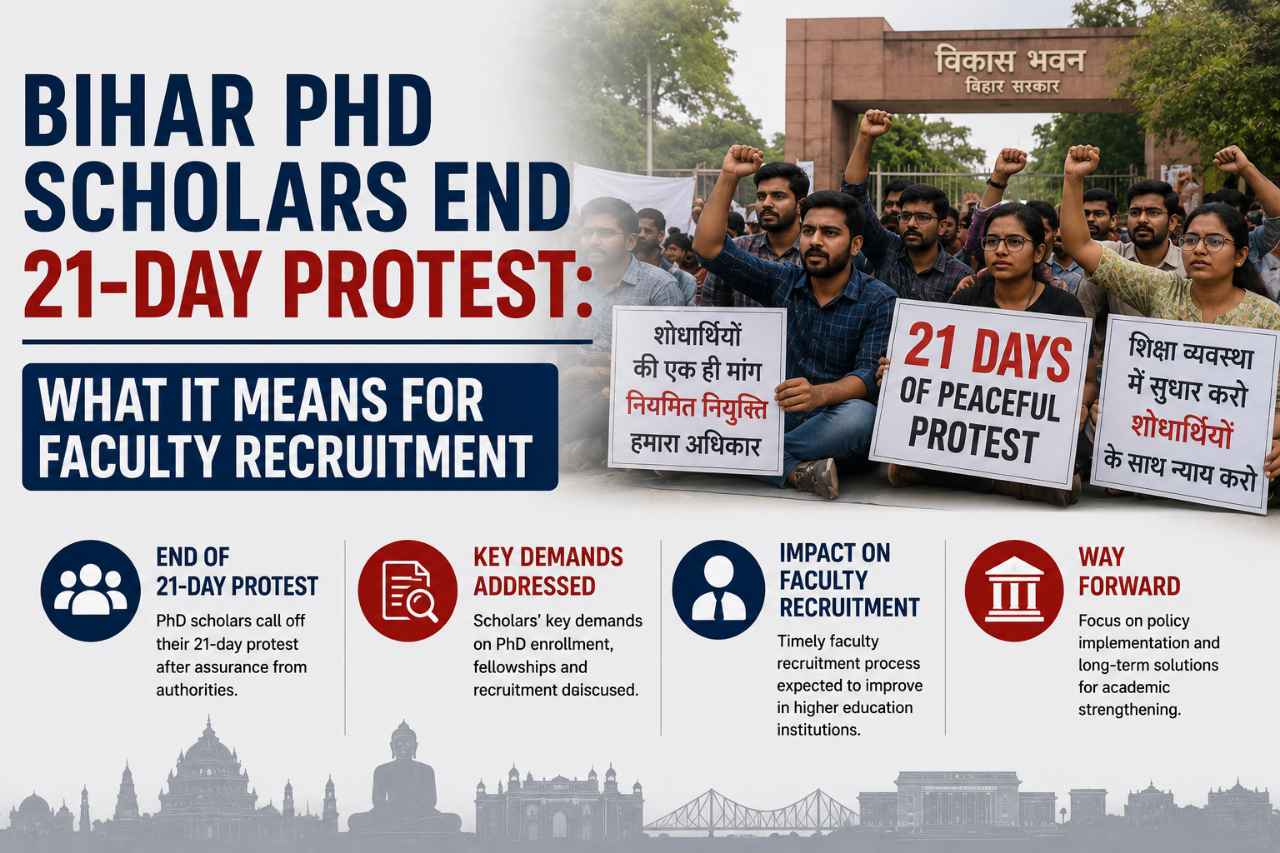

On August 25, 2026, PhD scholars and guest faculty members in Bihar ended a 21-day protest that began on August 4 after a two-hour meeting with Governor Syed Ata Hasnain at Lok Bhawan in Patna. The All PhD Holders and Research Association agreed to withdraw their agitation, including a sustained hunger strike by Kumud Patel, following assurances that their concerns about assistant professor recruitment, age limits, Academic Performance Indicator (API) scoring, and guest faculty conditions would be reviewed through a high-level committee.
For thousands of research scholars, NET-qualified teachers, and contractual faculty across Bihar's public universities, this development is more than a headline—it signals a possible reset in how faculty hiring and guest appointments may be governed in the state. If you are planning a PhD, preparing for university teaching roles, or comparing institutions such as Central University of South Bihar with state universities, understanding this protest and its outcome helps you read recruitment notices with clarity and set realistic career timelines.
This article explains what the protest was about, what the Governor's office has committed to, how UGC norms relate to Bihar's hiring rules, and what students and faculty should watch for in the months ahead—all in simple language aligned with India's higher education landscape.
What Triggered the 21-Day Protest in Bihar?
The protest united two overlapping groups: PhD holders seeking fair access to permanent assistant professor posts, and guest or contractual assistant professors demanding dignity, pay parity, and clearer renewal rules. Both groups argued that recent policy moves—especially the Statutes for Appointment of Assistant Professors, 2026—would shrink opportunities for experienced researchers and weaken research weightage in selection.
Timeline at a Glance
- August 4, 2026: Protest begins across Bihar universities.
- August 4–24, 2026: Demonstrations, dharnas, and academic work disruptions at multiple campuses.
- Throughout the protest: Kumud Patel continues a hunger strike as a symbolic pressure tactic.
- August 25, 2026: A six-member delegation meets Governor Syed Ata Hasnain; protest is called off.
Universities affected include major state institutions where faculty vacancies have remained unfilled for years. Scholars at places like Babasaheb Bhimrao Ambedkar Bihar University, Muzaffarpur, Bihar Engineering University, and specialised varsities such as Bihar Agricultural University, Sabour, have repeatedly flagged delayed permanent recruitment and over-reliance on guest faculty to run undergraduate and postgraduate programmes.
Key Demands Raised by PhD Scholars and Guest Faculty
The association placed several structured demands before the state. While the exact wording of each memorandum may vary by campus, the core issues discussed with the Governor's secretariat can be grouped into five broad areas.
1. Implementation of UGC Regulation 2018, Table 3A
Protesters asked Bihar to align assistant professor appointments with UGC Regulation 2018, Table 3A, which outlines minimum qualifications and API-based assessment criteria for university teachers. Table 3A covers how teaching, research, and academic contributions are scored during recruitment and promotion. Scholars contended that deviating from this framework would undervalue doctoral research and published work.
For aspirants, Table 3A matters because it defines what counts—publications, conferences, research projects, and postgraduate teaching—and how much each component should weigh. When state statutes diverge from UGC norms, candidates may find their PhD and journal papers carrying less merit than school-level marks, which many researchers consider unfair.
2. Maximum Age Limit Raised to 55 Years
Another central demand was restoring the maximum age limit for assistant professor applicants to 55 years. Faculty hiring in several states allows experienced NET/PhD holders to apply until their mid-fifties, recognising that many scholars complete doctorates after years of teaching or field work. Protesters opposed abrupt cuts in the upper age ceiling, arguing they would exclude qualified mid-career researchers who had waited years for advertised vacancies.
3. Regularisation of Assistant Professor Appointments
Bihar's universities have long carried large backlogs of sanctioned but unfilled faculty posts. The association demanded regular, transparent permanent recruitment rather than extended dependence on temporary or guest appointments. Regularisation, in this context, means filling sanctioned posts through open advertisement, written tests where applicable, and merit-based selection—not keeping qualified teachers in limbo on short contracts.
4. Domicile Policy for State University Faculty
Protesters also sought a domicile or state-residency policy in faculty recruitment. Supporters say local preference can strengthen regional language teaching, community engagement, and retention of talent within Bihar. Critics caution that overly strict domicile rules may reduce diversity and conflict with constitutional equal-opportunity principles. The Governor's statement indicates this demand will be examined, not immediately implemented.
5. Better Conditions for Guest Assistant Professors
Guest faculty—often PhD or NET-qualified teachers hired semester-wise—formed the second pillar of the movement. Their demands included minimum pay scale and dearness allowance on par with contractual assistant professors, a uniform renewal process across universities, verification of qualifications and research papers, and permission to serve until 65 years of age if eligible.
At institutions like Bihar University of Health Sciences, Bihar Animal Sciences University, and Bihar Sports University, guest teachers often carry full teaching loads while lacking job security, leave benefits, or a clear promotion path. The protest highlighted how student learning suffers when instructors cannot plan beyond a single academic session.
Protest Demands vs Governor's Review Agenda
The table below summarises how major protest points map to items the Governor's committee is expected to study. Use it as a quick reference when reading future government orders or university circulars.
- UGC Table 3A alignment: Protest demand—full implementation; committee scope—harmonise statutes with national norms and API framework.
- Age limit: Protest demand—restore 55-year cap; committee scope—consider 55 years and phased reduction instead of sudden cuts.
- Merit list formula: Protest demand—written test plus API; committee scope—objective examination combined with API scores.
- PhD weightage: Protest demand—minimum 30%; committee scope—raise doctoral weightage and define publication criteria clearly.
- Guest faculty pay: Protest demand—minimum scale plus DA; committee scope—parity with contractual assistant professors.
- Annual recruitment: Protest demand—fill vacancies every year; committee scope—ensure regular assistant professor hiring cycles.
What Did the Governor Assure After the Meeting?
According to an official statement from the Governor's secretariat, the delegation assured the Governor they would end the hunger strike and broader protest because their demands were under active consideration. Three immediate outcomes were announced.
- Statutes in abeyance: The Statutes for Appointment of Assistant Professors, 2026 will remain suspended until amendments are made after reviewing the association's major demands.
- Committee formation: Within 15 days, the Governor—after consulting Chief Minister Samrat Choudhary—will constitute a committee of prominent Bihar educationists and experienced administrators.
- Structured review: The committee will examine recruitment age limits, examination format, API weightage, guest faculty pay, and annual vacancy filling.
This is not yet a policy change; it is a commitment to structured dialogue. Candidates should continue to monitor official university websites and the Bihar government's higher education notifications rather than assuming old age limits or API rules are automatically restored.
Understanding API Scores and the Merit List Debate
The Academic Performance Indicator (API) system scores a candidate's teaching, research, and co-curricular contributions. Under UGC frameworks, API helps compare applicants who may have similar NET/SET qualifications but different publication records.
What Protesters Want Changed in API Calculation
The Governor's note stated the committee will consider several API-related reforms:
- Excluding matriculation and intermediate marks from faculty merit calculations, so school-level grades do not outweigh postgraduate research.
- Retaining NET/JRF weightage at existing levels, preserving value for National Eligibility Test and Junior Research Fellowship qualifiers.
- Increasing PhD weightage to not less than 30%, ensuring doctoral depth is central to selection.
- Including research publications and experience with clear, transparent definitions to prevent misuse or arbitrary scoring.
The association also pushed for an objective written examination, with written-test marks combined with API scores to prepare the final merit list. Objective tests can reduce allegations of bias in interview-only selections, but they require standardised syllabi, bilingual question papers where needed, and accessible exam centres—especially for candidates from north Bihar districts who may travel to Patna for tests.
Why This Matters for PhD Aspirants
If you are enrolling in a PhD in Engineering or humanities programmes at state universities, your publication strategy should align with likely API weightage. Prioritise peer-reviewed journals, conference papers with ISBN/ISSN proceedings, and documented postgraduate teaching hours. Keep scanned copies of acceptance letters, DOI links, and API proformas ready—selection committees often ask for evidence at short notice.
Age Limit Policy: The 55-Year Demand Explained
Age limits in faculty recruitment balance two goals: giving young scholars entry into academia and allowing experienced researchers a fair chance when vacancies open late. Bihar's proposed statutes reportedly lowered the maximum age sharply, which protesters said would disqualify many PhD holders who completed their degrees in their forties after years as guest faculty.
The Governor's statement mentions the committee will consider restoring the cap to 55 years and also examine a gradual reduction rather than an immediate cut. A phased approach— for example, lowering the limit by one year every recruitment cycle—gives mid-career applicants time to apply under known rules instead of facing sudden exclusion.
Actionable tip: If you are above 40 and hold a PhD, track vacancy advertisements monthly on university sites. Age eligibility is assessed on the cutoff date mentioned in the notification, not the date you downloaded the form.
Guest Faculty in Bihar Universities: Issues and Proposed Fixes
Guest assistant professors keep academic programmes running where permanent posts are vacant. In Bihar, their numbers grew as recruitment stalled, creating a parallel workforce without tenure-track benefits.
Common Challenges Guest Faculty Face
- Semester-to-semester contracts with delayed renewal decisions.
- Pay below the minimum of the assistant professor pay band plus dearness allowance.
- No clarity on whether years of guest service count toward future permanent appointments.
- Unequal verification standards for qualifications and research papers across universities.
The proposed committee review includes uniform renewal rules, qualification verification, and allowing eligible guest faculty to work until age 65. For students, stable faculty lines mean consistent syllabi, regular office hours, and stronger mentorship—especially in professional courses linked to health and technical fields.
Bihar's University Landscape and Faculty Recruitment
Bihar has expanded its higher education map beyond traditional multi-faculty universities. Today, aspirants choose among general universities, central institutions, agricultural and veterinary sciences varsities, engineering and health sciences universities, and specialised centres.
Institutions such as Central University of South Bihar (CUSB) follow central recruitment norms, while state universities operate under statutes approved by the Governor as chancellor. That dual structure explains why a state-level protest can simultaneously affect Muzaffarpur, Sabour, Patna, and newer campuses.
Medical and health-related faculty hiring also intersects with institutions like AIIMS Patna, which follows AIIMS recruitment rules, distinct from state university statutes. If you aim for clinical academia, distinguish between state medical university posts, AIIMS faculty cadres, and guest lectureships in affiliated colleges.
Humanities and language scholars may additionally explore niche centres such as Atal Bihari Vajpayee Hindi Vishwavidyalaya or regional universities like Binod Bihari Mahto Koyalanchal University, each with separate vacancy cycles. Technical and management researchers should note that central institutes outside Bihar—such as ABVV-IIITM Gwalior—follow different recruitment calendars, useful for comparison when evaluating whether to wait for Bihar vacancies or apply nationally.
Impact on Students, PhD Candidates, and Job Seekers
For Undergraduate and Postgraduate Students
Protests and hiring freezes can delay exam schedules, practical classes, and project supervision. When permanent professors are absent and guest faculty turnover is high, students face repeated syllabus adjustments. The call-off offers hope for smoother academic sessions if recruitment resumes—but students should maintain backup plans for internship and exam timelines.
For PhD Scholars Nearing Completion
If API weightage rises for PhD and publications, current doctoral students benefit by publishing early and documenting conference presentations. Consider co-authoring with your supervisor, targeting Scopus or UGC-CARE listed journals where your discipline requires it, and maintaining an ORCID profile. Explore programme details through resources on doctoral programmes to compare duration, coursework requirements, and placement history.
For NET/SET Qualified Job Seekers
Until amended statutes are notified, prepare for both possibilities: a written test plus API, or interview-heavy selection. Build a merit folder containing NET/SET certificate, PhD award letter, API proforma, publication reprints, experience certificates from guest service, and caste or disability certificates if applicable under Bihar reservation rules.
What Happens Next? Committee, Amendments, and Recruitment Calendar
The next 15 days are critical. The Governor's committee is expected to study representations from the All PhD Holders and Research Association, vice-chancellors, the Bihar State Universities Service Commission (if applicable to advertised posts), and legal advisers on UGC alignment.
Possible outcomes include:
- Revised statutes reinstating a 55-year age limit or phased reduction schedule.
- A hybrid merit formula combining written examination marks with API scores.
- Standard operating procedures for guest faculty pay, renewal, and age extension to 65.
- A directive to universities to advertise vacant assistant professor posts annually.
Until gazette notifications appear, treat the 2026 statutes as paused—not cancelled. Human resource departments may withhold new advertisement drafts, so expect short-term delays followed by a potential burst of vacancies if political will aligns with the committee's recommendations.
How Bihar Compares: Faculty Hiring Trends Across India
Bihar is not alone in wrestling with API, age limits, and contractual faculty angst. States such as Uttar Pradesh, West Bengal, and Maharashtra have seen similar protests over guest faculty permanence and UGC harmonisation. National institutions—including central universities and AIIMS campuses from AIIMS New Delhi to newer AIIMS units—typically advertise faculty posts with all-India eligibility and structured interview panels.
The Bihar case is distinctive because the Governor acts as chancellor for state universities, giving Raj Bhawan direct influence over statute amendments. That constitutional role makes Monday's meeting politically and administratively significant in ways that a vice-chancellor-level negotiation might not be.
Actionable Tips for Aspiring Assistant Professors in Bihar
- Clear NET/SET early: Even if PhD weightage rises, eligibility norms still require NET (or equivalent) for most university posts under UGC regulations, subject to exemptions for PhD holders as notified.
- Publish consistently: Target one to two quality papers per year during PhD rather than rushing volume in your final semester.
- Document teaching hours: Guest or ad hoc teaching counts only if universities issue formal certificates—request them each semester.
- Track multiple portals: Follow individual university sites, the Bihar education department, and employment news aggregators.
- Prepare for written tests: Revise your postgraduate subject, research methodology, and general teaching aptitude topics.
- Join academic networks: Faculty associations often share unofficial vacancy alerts and statute drafts before wide media coverage.
Conclusion
The withdrawal of the 21-day protest by Bihar's PhD scholars and guest faculty marks a pause in confrontation, not the final word on policy. Governor Syed Ata Hasnain's assurance to form an expert committee within 15 days, keep the 2026 assistant professor statutes in abeyance, and study demands on age limits, API scoring, written examinations, domicile rules, and guest faculty pay has opened a negotiated path forward. For students and job seekers, the episode underscores how faculty recruitment rules directly shape classroom quality, research opportunities, and career stability.
Stay informed through official notifications, build your academic record with API in mind, and use trusted college directories to compare where you study or apply. Bihar's higher education system is large enough to absorb thousands of new professors if vacancies are filled transparently—the August 2026 agreement is a step toward that possibility, provided follow-through matches the promises made at Lok Bhawan.